Category Archives: Personal

Facing into Bereavement, Part II

This entry is part 34 of 39 in the series Fiona

I know that it can be very hard at Christmas time for people who have suffered bereavement. At this highly traditional, cosy family time which is always known for its joy and ‘good cheer’ (has anyone ever explained what that actually means? 😉 ), the absence of our loved ones is always more poignant.

It’s similar for me, as the 25th of each and every month is always harder for me because my wonderful wife Fiona died on a 25th; the 25th October. That’s why I do a ‘Fiona post’ every 25th or thereabouts.

But as I wrote a few months back, although for me, my faith helps me through it, I do appreciate that not everyone has that faith. And that’s why I wrote that article, to try to help others, without such a faith, to cope.

But what I want to write about today touches not so much on matters of faith, but rather on those of heartlessness and what amounts to spiritual terrorism, especially when directed towards those who do not share a ‘faith’.

Whatever your beliefs, you will have heard religious people – usually Christians, and to a lesser extent Muslims (these are the only two faith groups, apparently, that believe in it) banging on about Hell. About a terrible place where bad people go when they die, to be tormented for ever. Or, indeed, you might even have heard someone say that everyone goes there, apart, of course, from the people who adhere to the ideas of the group making that claim.

So, I’m going to be talking a little bit about God today, but only in the context of trying to help you past any of these fears you might have, either for you or for your departed loved ones (or both!). If God doesn’t exist, then you don’t need to fear any afterlife of eternal torment in Hell. If God does exist, I would say you also don’t need to fear such an afterlife either, because, I believe, God is good and loving. Bear with me as I explain.

To my dismay, I have even heard of religious preachers at funerals perpetrating their despicable claims about Hell, at grieving relatives, destroying them in the process. Well, I am here to tell you today that, no matter what your beliefs in God, afterlife, whatever, Hell, as depicted by these nasty Religious people, does not exist.

Think back to those preachers I mentioned, who destroy grieving relatives at a funeral by claiming that the person they are mourning has gone to Hell. I can’t even imagine how someone like that can claim to be a follower of Jesus, the one about whom the Bible says that he will not crush those who are grieving; instead, he will gently lift them up. How do I know I am right, and these preachers are wrong? Well, you can tell by the effects – Christians would call it the ‘fruit’ – of what they say. If their words bring grief, destruction and sadness, they are not speaking the words of God. If, on the other hand, their words bring comfort, reassurance, even joy, then this is from God and is therefore true.

There are those who seem to really want to believe everything bad about God that they can. If there’s two Bible verses that contradict each other (and despite the contrary claims of certain religious people, the Bible does indeed contradict itself, regularly, blatantly, and often [1]) then why do they always go with the verse that means the most grief for the greatest number of people? I really don’t know the answer to that. But what I do know is that we need to remember Jesus. If you are afraid that God might not forgive you (for whatever), look at what Jesus did. He forgave people who were actually in the process of driving huge iron spikes through his wrists and his feet. If you are afraid that God is a grumpy old radge just waiting for someone to throw thunderbolts at, then tell me, did you ever hear any stories of Jesus doing anything like that? (Hint: Luke 9:54 where Jesus actually refuses to do just that) If you are afraid of Hell, be aware that Jesus did not speak once about such a place. Jesus actually shows God as a nice guy.

No, Hell is what happens here on earth when people are horrible to each other. Hell is the tragedy of lives wasted; lives lost to alcoholism or other addiction, or to religious fundamentalism, or whatever: anything where people are prevented from living to their full potential. Hell is nasty religious preachers telling people at funerals that, even as they speak, their loved one is burning in some terrible fire and being prodded by devils with pitchforks. That’s hell.

And Jesus came to set us free from that; both from its effects here in this world, and from the fear of its happening in the next. The afterlife – including for your loved ones, dear heart reading this – will be glorious, joyful; full of amazing colours and light and scenery and full also of the presence and love of God. Tell you what, since it’s Christmas Day today, let’s remember what the angels said to the shepherds:

Glory to God in the highest, and on earth peace to men, on whom His favour rests! (Luke 2:14)

It doesn’t mention only certain ‘chosen’ people; it says that there is peace to men (meaning all mankind) on whom His favour rests. This means that actually God likes humans. He’s not mad with us; no, He loves us and in fact likes us! This is a million miles away from the story told by those who would call everyone miserable sinners. Jesus never once did that. He just loved people, and demonstrated practically the claim of the angels; that God’s favour rests on humanity. God likes us!

And so, please be assured. Your loved one is not in a Hell of any kind. They have gone on to be with the One Who loves them – present tense – both in this life and in the next.

Don’t listen to anyone who would have the gall to tell you otherwise!

Be encouraged, dear heart.


[1] For example, the adjacent Bible verses Proverbs 26:4, and Proverbs 26:5. They go like this:

v.4: Do not answer a fool according to his folly, or you yourself will be just like him

v.5: Answer a fool according to his folly, or he will be wise in his own eyes.

So, which is it? Do you answer the fool, or don’t you? That’s a contradiction, plain as day. Oh sure, people will try to explain it away, and as a Bible college graduate, I do understand what it means. But it contradicts, and there’s no getting away from it.

Weddings

This entry is part 33 of 39 in the series Fiona

Twenty-five months ago today, my precious wife Fiona died of pancreatic cancer. She’d been fighting it for three years.

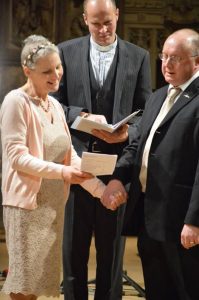
And in the midst of the horror, we chose hope over despair, joy over grief, and love over despondency. Four years ago, on 5th December, 2014, about eight months after her diagnosis, Fiona and I renewed our wedding vows together in our Church in Torquay.

Hope for healing (didn’t happen, at least not this side of the veil), hope for the ability to live life one day at a time and appreciate everything that each new day brings. Renewing our vows so that, no matter how long we had left together, we would publicly declare our commitment to each other and our intention to live out our time together in freedom, joy and love. Because of our faith in Jesus, Who died and then came back from the dead, we believed (and I still do) that death is not the end. That kind of belief gives a person the power to live free of fear, and to live in the freedom of the moment. Not that fear and horror are not part of the ‘cancer journey’ – they are! – but that  the fear is not one of losing someone forever to ‘death the great divider’, but that our lives go on through the veil of death and on into a glorious afterlife with Jesus. And that definitely affects the way that we live our lives, including the ability to live in the light of that blazing truth.

Fiona and I were married in January, 1984, at Guiseley Baptist Church in Guiseley, West Yorkshire. In the same way that we first promised to ‘have and to hold, in sickness and health’, that promise became actual and real in the face of the ultimate sickness of terminal cancer.

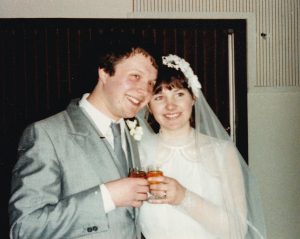
I’ve scanned in some of the photos that were taken at our wedding. The header picture is one of gorgeous Fiona, here reproduced in colour:

Wasn’t she stunning? Like I’ve said elsewhere in this series, Fiona was easily the most beautiful girl I had ever set eyes on, and, for me at least, it was love at first sight. 😀

Happy days, eh? 🙂 I was twenty-one (nearly twenty-two) on our wedding day, and Fiona was nineteen (nearly twenty). I count myself the most blessed man to have had such a gorgeous, amazing, wise and clever lady as my wife, and we always agreed how glad we were that we had met when we were young so that we could spend our entire lives together. And what amazing lives we led. The sheer amount of adventure we packed into our nearly 33 years of marriage was incredible, despite me (at least while in Leeds) being in a low-paid job and raising a young family on a shoestring. We were so happy together.

Of course, the last part of the story was traumatic. Cancer has a way of changing one’s outlook and priorities, but that doesn’t have to be a change for the worst. The illness meant that although we had wanted eventually to grow old together, we knew this wasn’t going to happen, and that’s quite disappointing when you realise it. And yet, over the time of the illness, we were so close: we learned so much about life and death; God and others; illness; compassion; dedication and commitment. Truly, that time enriched us as people, and we certainly didn’t let it go to waste.

For some time, we had wanted to renew our vows, so what better time to declare our love for, and commitment to, each other, than in the face of a terrible terminal illness? On that 5th December 2014, then, we stood in front of our family and our Church family, and many of our relatives and old friends who had come hundreds of miles to be with us on our special day.

In the face of that evil illness, we lit a bright light of hope and joy. We had decided that we were not going to let the illness defeat us as people, nor to let it cloud what remaining time we had together. And it’s interesting, but we actually enjoyed our second wedding far more than we did our first. Which, I think, speaks volumes.

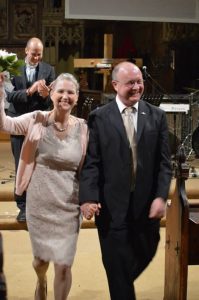
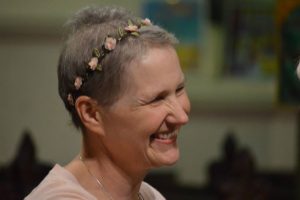
Here are some photos from our second wedding:

Look at her wonderful smile, and that despite the ravages of the chemotherapy and the cancer. Because we had such a great life together, I often find it hard to point to a specific event and say ‘that really made her day’ – there were so many such events! – but in this case I think I can safely indicate that this was one of those occasions. She was just so happy! As you can see on this next shot, with Fiona dancing down the aisle because she was so full of joy 😀

I’m so glad we did that renewal of vows wedding. And at the time of the publication of this article, it’s almost exactly four years since our second wedding, and I still look back on it as one of the happiest days of my life, mainly because my lovely Fiona was so happy.

And doesn’t that smile say it all? It compares very well with the one she’s wearing at our first wedding, in the top picture above!

This next point is quite personal. Just lately, I have had the experience of seeing elderly people living in a care home. And while the care home in question really is an excellent one, still it is less than ideal; there is little privacy, there is of necessity a regimented approach to mealtimes, the patients have no freedom, but to be honest what else can they do? If someone is incapable of looking after themselves, then someone has to look after them, whether that’s family, or, if unavaliable/unable/unwilling, the local care system. But it’s horrible to see, even though the staff are lovely and the care home is excellent. I find it incredibly traumatic to see it. And here’s my point: although obviously I miss Fiona greatly, it would have broken my heart to see her in a situation like that, should we in our old age have become unable to look after each other any longer. Or being separated from each other; some elderly couples are (for whatever reason) not together in the same care home. We would have found that unbearable; completely and heartbreakingly unbearable. It hurts to even think about it, but I know of course that I will be spared seeing her in that situation, and for that I’m grateful. And she too has been spared the pain of either being in that situation herself, or seeing me go through it. I mean, sure, the trauma of losing her, and that of coping with her having a terminal illness, was immense  for both of us. And in some ways I have already been through the heartbreak. But this is one heartache I will not have to face into. Fiona had the chance to live her last years in dignity and in freedom, and only for her last two weeks or so was she in a hospice – and even that was supposed to be temporary.** Maybe that sounds like I’m glad she died young – it’s not that; all I am doing is being grateful for ‘small mercies’, and finding another silver lining in the dark cloud of her loss. But I’m glad that I was spared that care home trauma, and of course I’m glad that she too has been spared it either way.

Anyway, with our second wedding, we effectively thumbed our noses at death and disaster. We declared by our actions that tragedy wasn’t going to have the last word over our happiness, and that was indeed how it worked out. Our last two years together were spent in joy and fulness, living the Kingdom life that Jesus gives, and being shining examples of joy in the face of adversity.

Fiona, my love, I love you and I miss you. Thank you so much for our second wedding, for what you said to me there, and for affirming once again that deep, deep love we shared.

It meant everything to me, and it still does.

I’ll see you soon, and then we’ll never be separated again.


*During our first wedding, it  was throwing a blizzard outside and this is why all our photos were done indoors.

**As she was going in to the hospice (for a closely-monitored pain control regime), Fiona did jokingly ask, “When people go into a hospice, do they ever come out again?” “Oh, yes!” said the nurses…but in her case, they were wrong! Even at times like that, Fiona thought it funny. Our sense of humour together was funny and flippant; I’m still like that (have been so since about 1980) and I would have it no other way 😀

In fact, I almost did even more dark humour and called this piece Two Weddings and a Funeral. For this purpose, I took a photo of Fiona’s gravestone, which I reproduce below to complete the ‘joke’. The Scripture quote is Psalm 116:7, Return to your rest, O my soul, for the Lord has been good to you, a verse the Spirit gave me a couple of years ago.

Our family name has been redacted because I want my site to stay semi-anonymous. With disabled people in my family, and given the propensity of certain Christians to take exception to heretics like me, the last thing I want is for a mob of rampaging Pharisees to turn up on my doorstep brandishing King James Bibles 😉


I must also say that credit for the photos of the second wedding go to my friend Ella. Well done, chick 🙂

The Sound Boys’ Yo-Yo

Most of my readers will know that I used to be a worship leader in a Charismatic-style church; we’d have ‘open worship’ with, as well as the singing, things like tongues, prophecy and other spiritual gifts. There’d be singing ‘in the Spirit’ too, and it was all most uplifting.

My particular setup was that I had an electronic keyboard/piano: a Roland JV-30, which at the time, and despite having only five octaves (thus limiting my pitch range capability), was pretty much state of the art.

The JV-30 does not have its own internal loudspeakers; it requires external amplification. In this case, and since we were using a public hall for our meetings, the keyboard’s output was piped over to a sound desk at the back, manned by a couple of teenage non-musician lads that we nicknamed (unsurprisingly) the ‘Sound Boys’.

We also had other musicians: three vocalists – myself, Fiona and Cathy; Steve, our bass player; and sometimes an acoustic guitarist. I won’t give any names for the guitarists because there were quite a few of them and we never really knew who we were going to get from one week to the next. And in addition to the keyboard, each of these ‘inputs’ – the microphones for the vocalists, Steve’s bass guitar, and my keyboard, plus any guitarist(s) we had (playing into an electronic pickup clipped to the guitar’s sound hole), also went into the sound desk, each input with its own dedicated channel, to be dominated controlled by the Sound Boys.

The relationship between the musicians and the Sound Boys was somewhat complex, and often pretty fraught*. I usually felt that the Sound Boys had the volume of the piano turned way too far down; this was long before we had any ‘foldback’ (a loudspeaker set up facing the instrumentalist so that they can hear what they are playing) so not only could I not really hear myself playing, but I also had to trust the Sound Boys that the congregation was able to hear what we were playing. They assured us that they could, but I was never fully convinced!

Sometimes they even used to mute my output channel completely, such as during the sermon, or if there were some prayers going on; or if for whatever reason they ‘thought’ (and that’s being generous) that the piano was not needed at that time. It was almost as if they didn’t trust me to handle my instrument correctly, and to not do a huge bloody great big ‘dead body in the bath’ chord in the middle of the notices.

And so it seemed that, despite our best efforts, all that we did as a band was subject to the power-crazed whims of the Sound Boys and their all-powerful sound desk. Whenever you lead public singing, you need to have quite a bit of, well, let’s call it ‘authority’, but I don’t mean it in a domineering kind of way; more a practical way. When you are leading 300-400 people in singing, you need to be heard, so that they can follow your lead. For example, sometimes the congregation’s timing goes a little off so you need to lead them back into time again. To do this, you’d boost your volume to emphasise the timing and allow people to hear what you are doing and to re-synchronise. Or maybe they have drifted off pitch (out of tune), but this is actually quite rare. The problem comes when you can’t lead the music properly because your sound volume is turned wayoooh-doooowwwwn and you don’t have the oomph; thanks a bunch, Sound Boys.

And so, I had to develop a little trick to let me lead properly and thwart the best efforts of the Sound Boys. I called it the ‘Sound Boys’ Yo-Yo’.

Here’s what you do.

Set the keyboard’s volume control to about 30-35%, and do all your sound checks from there. Begin the worship with the same volume setting; the Sound Boys will have set you at a moderate volume for the opening song, and hopefully they will boost you once the congregation join in and the general volume in the hall increases. So far, so good.

But let’s say that after a couple of verses, you realise that the congregation’s timing is drifting (possibly because of the low lead instrument volume – who’d ‘a thunk it?!), so it’s time to ‘assert your authority’ as lead musician and bring it all back together again for them. Your piano isn’t yet loud enough to re-establish the rhythm, so you’re going to need more volume; trouble is that the Sound Boys don’t realise this is what you need to do, and if you gently nudge your volume up, they will correspondingly gently nudge your channel volume down in response, and to show you who’s boss of course. So there’s no net effect on the volume and things get worse for the song being sung.

So, you don’t do it that gentle way. What you do is to whack your volume control slider up into afterburner – say about 90-100% setting…

Afterburners on a Typhoon fighter

…and this allows you to use that increased volume to stabilise the song’s rhythm or whatever it is that’s drifted. Before long, of course, the Sound Boys will have rumbled what you’re up to, and will have reacted to your gross misbehaviour by drastically racking your channel volume fader right back down again. By that time, though, they’re way too late and they’ve proper missed their boat; you have brought things back into line again, in musical terms, like you wanted to do. And that was easy. Just doing my job.

However, at this point, of course, the Sound Boys have solidly put you in your place; your channel volume is a long way down and your keyboard volume is maxed out, although nobody can tell because the net effect on your piano volume as heard by the congregation is unaffected, and no-one’s any the wiser apart from yourself and the Sound Boys, of course. So now you need somehow to recover that reserve power so that you can use it again, possibly soon. And this is the clever bit, and the part that gives the Yo-Yo its name.

While playing, and in a reverse of the actions that the Sound Boys would perform if you boosted your volume gradually, you reduce your keyboard volume equally gradually, say by about 10% per minute. Maybe you could do this after each verse of the song you are playing, especially if you’re varying your song’s dynamics, which disguises what you are doing very nicely. One hopes that the Sound Boys will notice that your volume is getting a bit low, so they will (ideally!) advance your channel volume bit by bit until they can hear you better.

You continue doing this until your keyboard volume slider is back at around 30-35% and then you can use your afterburner again as required. You have now restored your ‘volume reserve’ and it’s available for use once more. Lather, rinse and repeat.

And that’s the the Sound Boys’ Yo-Yo, so called because you move your volume slider up and down like a yo-yo.

Granted, if you are an instrumentalist in a similar position and you’re thinking about using this trick, remember that  your Sound Boys might have read this too, and therefore they will be wise to what you’re up to, but there’s nothing they can really do about it if they want the congregation to hear the piano at all.

Or maybe you’re extremely lucky and have Sound Boys that actually listen to you and provide the service you need. In which case, I envy you.

But it’s still a useful trick to have in your repertoire!


*Sound Boys, if you should read this, don’t worry, I forgave you a long time ago, and this is just humour, ok? 😉


‘Sully’

I’ve just finished watching the movie ‘Sully’, starring Tom Hanks as Capt. Chesley ‘Sully’ Sullenberger, the airline pilot who landed his crippled Airbus 320 passenger jet on the Hudson River, New York, on 15th January 2009. (Can’t believe that’s nearly ten years ago!)

After a double engine failure due to multiple birdstrikes, Sully and his First Officer, Jeff Skiles, glided the jet down for a forced water landing, on to the Hudson River, in one piece and, despite several injuries being sustained, there were no fatalities. Of the 150 passengers and five crew aboard, all survived. Fittingly, it was known as the ‘Miracle on the Hudson’.

Well. What a superb movie.  It tells the story of the flight; what happened, the decisions of the crew, the investigation by the US NTSB (National Transportation Safety Board) and also a little about the people involved. While the NTSB investigation is not shown in a good light – the members of the investigation panel are more hostile than they were in real life – this only helped, I thought, to highlight just what an amazing job Sully and his team did.

It was technically (i.e. from an aviation point of view) perfect. So often, in movies like this one where aeroplanes are simulated using Computer Generated Imagery (CGI), the computer-generated aeroplanes fly nothing like the real thing. For a Pilot, it’s usually very painful to watch. But this was perfect. Also the other technical details were accurate too.

Captain Chesley ‘Sully’ Sullenberger

As my regular readers know, I fly aeroplanes for fun, and I often practice emergency situations, including simulated engine failures. I know how to cope with an engine failure, and I have over twenty years of flying experience to call on. I sincerely hope that, should the same sort of emergency situation happen to me as happened to Sully that day, that I too would manage to pull it off and land safely*. Mind you, not with 155 people on board…

Sully had been flying for twice as long as I have. I love the modest quotation from him that sums up the experience and training aspect of his amazing feat. He said, “One way of looking at this might be that for 42 years, I’ve been making small, regular deposits in this bank of experience, education and training. And on January 15, the balance was sufficient so that I could make a very large withdrawal.”

I personally think that the movie will also increase passenger confidence. Many people have a fear of flying, and seeing the professionalism of the aircrew on this movie is bound to help. Mind you, the sight of a flock of Canada geese knocking an airliner out of the sky is a bit worrying… Also, they go to great pains to explain that a forced landing is not a ‘crash’, as the media love to call it. It’s not even a ‘ditching’; it’s a forced water landing. One implies lack of choice. The other implies being in complete control. I’ll leave you to guess  which is which.

And there was so much to learn from a Pilot’s perspective. ‘Fly the aeroplane’ is the first rule of flying. Nothing else matters more than that. And the discipline; the calm, measured approach to handling the emergency checklist; the effect and benefit of experience and training; the ‘permission’, almost, that the movie gives to make split-second decisions based on that experience and training; the interaction between, and best use of, the crew of the aircraft; the liaison with ground controllers; the ability to ignore distractions. All excellent stuff, and yet accessible by the general, non-aviating public.

So, if you can see this film on Netflix or Amazon Prime, or whether you need to rent/buy a DVD or borrow one from a friend, definitely watch this movie. I heartily recommend it.

“Just doing my job”, said Sullenberger afterwards.

What a hero.


*A forced landing is one where due to loss or lack of engine power – still under full control, but like it or not, the aeroplane is coming down – and you just have to make sure it gets down in one piece. Look at it this way: well before I went on to flying powered aircraft, my flying career actually began on gliders. These are aeroplanes just like the ones I fly nowadays – but they have no engine. In a glider, then, you have a permanent ‘engine failure’.  When flying gliders, therefore, Every. Single. Landing. is a forced landing. Since I have about 70-80 flights in gliders under my belt, that means that I personally have performed 70-80 real forced landings. They are perfectly safe when you know what you’re doing!

What a Day That Will Be!

This entry is part 32 of 39 in the series Fiona

This is the most moving painting I have seen in a long time.

It’s called ‘First Day In Heaven’, by Egyptian artist Kerolos Safwat.

It moves me to tears just looking at it. Something snapped inside of me as I pondered this painting; something deep happened within my spirit.

That’s because this painting reminds me of a vivid picture that God gave me two years ago today: 25th October, 2016, the day my precious wife Fiona began her first day in Heaven. On that day, I saw a vision of her that I can’t describe, it was so simple, and yet so awesome and personal and such that I can’t communicate it, but suffice it to say that it was very similar to this one. And this is why I am using this painting in today’s blog post, marking the second anniversary of Fiona’s passing into that incredible place.

I mean, can you imagine what it must be like to be the lady in that picture? Look at that expression on her face!

It’s saying:

“Yes! It’s all true! Jesus, I love you so much! Thank You, thank You, thank You!”

“Wow, I feel so young again!”

“I’m out of pain! I’m whole! I’m alive!”

“I was so scared of dying…and this is just amazing!”

“I’m home!”

“YESSS!”

This lady can now see – with her own eyes – that everything is ok; everything is fine – in fact, it’s better than fine; better than she’d ever hoped for, better than she could ever imagine (1Cor 2:9-10). No matter what her sufferings in this life, she now has a completely new, whole, functioning, beautiful, heavenly body – and yet she’s still completely herself; more so, in fact, than she’s ever been . She is fully aware that the place she has entered is the most beautiful place she has ever seen: like Earth, like the world she was used to, but the colours are so much more vibrant, the air is sweet and clear, the temperature is just right, there are huge mountains, pastures, lakes and forests the like of which she has never even contemplated in her best imaginings. And, best of all, the Person she loves the most is right there!

The joy that she feels is indescribable. She never knew such joy was possible.  Alongside that joy, the greatest earthly ecstasy was just a dim, flickering glow. To see Jesus face to face, and know that she is now completely safe from danger, pain, horror, suffering, weeping (except maybe tears of joy) – it’s the ultimate healing.

She’s been looking forward to being reunited with her loved ones, and with countless other people from all ages and all civilisations throughout history; friends whom she hasn’t yet met. And now that’s going to happen. And she will be reunited with her beloved pets. Like Jesus, she has the ability to do just about anything she wants to do. She can pass through walls, she can enjoy food and drink, she can feel the warmth of His Presence all the time as a constant glow. She can see the full glory of God, and yet she’s so aware that there is all of eternity stretching out before her so that she can learn more and more of Him and His ways. To gain a full appreciation of an infinite Creator will require an infinite amount of time, and she’s got all the time she needs. Time will never again be a constraint on her life or on her activities.

Then there’s Divine justice. The Judgement, which holds so much fear for so many people, but not for our friend here. Divine judgement; Divine justice, is restorative, not adversarial nor punitive. All wrongs will be made right. Everything that was ever done to her that was unjust, undeserved, painful, heart-wrenching, agonising – all this will be made right and her hurts healed forever, to trouble her never again. God will wipe away every tear from her eyes (Rev 21:4). Everything will be made to be as it should be. All wrongs that she ever did to anyone else will be – has already been! – completely forgiven and forgotten (Is 43:25, Heb 8:12). She will have no more enemies, ever again. All her cares and worries are now in the past, and will stay there forever. No more arguments, no more conflicts, no more fighting, no more anguish, no more pain.

Imagine it. Eternity opens up before you, in its full glory and potential, rich in unlimited possibilities. Wow, wow, wow!

This is the promise that is for everyone. Life in God’s Presence, for ever and ever. Sure, there’s lots of people on the Internet (including myself) who remind us that ‘Jesus’s teaching was for this life, not for any kind of afterlife’. And yes that’s true too, because we don’t want to be ‘so heavenly-minded that we are no earthly use’! But the promise of the afterlife with Jesus is key to the Gospel. It takes away all fear (1Jn 4:18) and Jesus gives us His Spirit to guarantee what is to come (2Cor 1:22, Eph 1:14). Isn’t that awesome? It means that the joy that this lady feels in that painting, is the joy that you and I will also feel.

It seems too good to be true, doesn’t it? And if it was something on this earth, something someone was trying to sell us, then yes – it would be too good to be true. But you see the thing is, the Gospel – that God loves us, He’s not mad at us, and He wants us to spend time with Him – is almost too good to be true, except that God is the One who can make good on His promises – to the point that if it isn’t too good to be true, then it’s not the Gospel!

I think that’s a simply mind-blowing concept!

What  a day that will be
When my Jesus I shall see!
And I look upon His face
The One Who saved my by His Grace
And He takes me by the hand
And leads me to the Promised Land
What a day, glorious day, that will be!

And I heard a loud voice from the throne saying, “Look! God’s dwelling place is now among the people, and he will dwell with them. They will be his people, and God himself will be with them and be their God. He will wipe every tear from their eyes. There will be no more death’ or mourning or crying or pain, for the old order of things has passed away.”
He who was seated on the throne said, “I am making everything new!” Then he said, “Write this down, for these words are trustworthy and true.” (Revelation 21:3-5)

Please note that Mr. Safwat’s painting has been pirated, copied, even printed and sold by unscrupulous people who had nothing to do with its creation. People have modified it and altered the image to reflect their own agendas. If you want to support the original artist by buying his work, you can visit his Facebook page here. [Edit: Apparently the photo is not called ‘First Day In Heaven’, but actually it’s ‘I found the one I love and I held him and wouldn’t let go’, according to Kerolos’s Facebook page].

Granted, it does strongly appear that Mr. Safwat’s painting was itself inspired by a photo by photographer Paige Stewart; a shot of the celebration of two Canadian Rugby players, apparently.


Reference here

But still the painting, however it was inspired and whatever it should be called, still moves me to tears because, for me, it captures just what we will feel when we, too, spend our first day in Heaven. The joy of even the greatest Rugby score pales into nothing when compared with that; indeed, all this earth’s joys are but a pale reflection – and yet perfect models – of the joy we will receive when we get there. Kerolos Safwat has taken this photo and recreated it into one of the most moving paintings I have ever seen. That takes real talent!

And What He Says, Do…

This entry is part 31 of 39 in the series Fiona

It’s twenty-three months today since I lost the love of my life, my dear Fiona. Nearly two years.

In that time I have learned so much, I have grieved so much, I have lived so much. I have learned a wisdom and a compassion I never thought possible. I have walked closely with Jesus like I never have done before. I have attained a depth and breadth of understanding that previously I could only dream of.

Truly, I have taken that terrible loss, and with my best friend Jesus walking by my side, we have brought new life from the darkness. New ideas, new concepts, new understandings, new meaning for life and faith.

Of course, I would give anything to have my Fiona still by my side. And the last couple of months, particularly, have been extremely hard for some reason; I seem to have felt her loss more keenly than I have before, at least since the first few months. I dream about her most nights, and that’s good, because I get chance to talk to her about how I am feeling.

But the growth continues; the strengthening of my spirit, the confidence, the complete lack of any kind of fear, the total absence of any compulsion to please men rather than God. It’s almost as if my recent growth has placed me in a position where I feel that I am beyond mere worldly cares and considerations. Sure, I have my responsibilities to my family and to my employers. But the freedom I experience in my life is immense.

I find myself above and beyond the considerations of mere worldly politics and other double-meaning, double-dealing shenanigans.

Here’s an example of this wisdom in action. A friend of mine, the other day; a man who is far on in the faith and has an incredible spiritual maturity, was accused of ‘taking sides’ on a certain matter of dispute because he can see both sides, just like Jesus can. Here’s how he expressed it:

“I’m afraid my “middle of the road” stance is gonna get blasted by BOTH sides. You have to either believe everything that a potential victim says and demonize the alleged offender, making him unfit to serve our country in any capacity, or try and minimize what could be a serious crime and call their accusations “fake news”. And I’m not good with EITHER of those positions. I want to know the truth, but I don’t know if the truth can be ascertained in these circumstances. I want justice for [the person in question], but don’t know if justice means destroying a man’s career and possibly life over what COULD have been a stupid macho mistake or terrible misunderstanding. Can I trust a man to handle the law that has potentially hurt someone? Yes, under the right circumstances. But I’m not even clear on what those would be, but I want it to revolve around the truth, admission of any guilt, apologies, forgiveness and restitution. I really just want compassion and justice for all”

I wrote this to him:

“[My friend], I don’t see you as being ‘middle of the road’ at all. I see you as being above the road; being able to see what is going on – but not only not taking sides, but just being Jesus. Remember the theophany in Joshua 5? [Josh 5:13b-14 (KJV)] ‘Are you on our side, or the enemy?’ “No” was the answer. Not ‘Neither’, although that’s not far off, but ‘No’. ‘Neither’ involves the choice of taking neither side. ‘No’ indicates that the question is not germane. There is a detachment from sinking to the level of the human conflict and its ‘choosing sides’, or even choosing the middle road, and seeing it from God’s point of view instead. Any and every Christian has the right to sit in that position of ‘No’; it’s far above a simple refusal to take sides, it’s part of being who you are in Christ. There is neither requirement nor compulsion to declare or assume sides; you are not answerable to anyone because you are a spiritual man. And you don’t have to explain yourself to anyone either.”

His reply:

“Wow, thanks Anthony. I don’t know that that’s EXACTLY what I’m doing, but it sure is something I would aspire to. I am trying to see everyone’s point of view, to put myself in their shoes and think about what they would need and want. And, yeah, that’s why I can’t just pick a side. Argue for one side, and I’ll just end up telling you why the other side can’t be ignored or belittled. When it comes to perpetrators (or even alleged perpetrators) that becomes VERY difficult in this country [USA – Ed], even among the Christian population. Everyone seems to call out for their pound of flesh. I’m trying to see from the point of view of that flesh”

I finished off the exchange with this:

“And that was exactly what was in my mind when I wrote the comment. But as a man of peace, you naturally, well, maybe not always see both ‘sides’, but you at least are aware that both ‘sides’ exist and having that ability to put yourself in both sides’ shoes and try to see things from their point of view is about as Christlike as it gets. Unfortunately, those who cannot understand this see it as picking sides, merely because you express the fact that both sides have a point of view – but without making a value judgement on those points of view. So, you haven’t picked sides, but because you express attempted understanding of both sides, this makes you apparently complicit with both. But you and I both know that this is not the case at all, and this is why the spiritual man cannot be judged by anyone – because we see things from the spiritual point of view, not the worldly. Not that we are superior or anything, but we simply have a perspective that not everyone has”

This is the kind of wisdom that we learn from being close to Jesus and listening closely to His heart. And to bring this back to Fiona, I believe that Jesus has taken the wisdom that she implanted in me, as part of our relationship, and He’s developed it in deeper ways because I have lost her. I can think of several very deep reasons why this is the case, which I will not share here as they are too personal. This really is an example of ”the Secret of the Lord is with those who fear Him“.

But be encouraged. You do not have to go through a bereavement process in order to take on a wisdom like this. Simply walk with Jesus, and what He says, do (John 2:5). Ignore what other humans say when it contradicts what Jesus says, even if they quote Bible verses at you that apparently also contradict what He says. Anyone can find Bible verses to support their point of view. But, as I said, Do whatever He tells you (Jn 2:5) and your wisdom will grow simply because you are walking with the Personification of wisdom – Jesus. And in the process, you will also find, almost as an added bonus, the strength and also the wisdom to cope with the hard times that life will inevitably throw at you. Life in its fulness (Jn 10:10) includes the ability to cope with the hard circumstances of life, simply because of Jesus, Who walks with you through those times.

This is faith. This is freedom. This is Jesus.

He will never let you down!


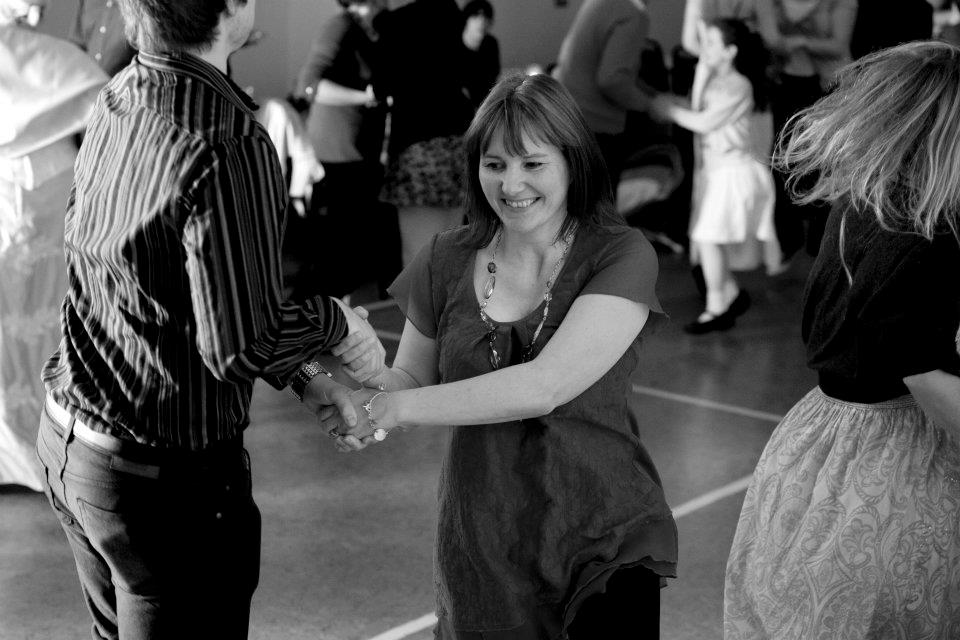
Header picture shows my beautiful Fiona dancing with her nephew, at the ceilidh at her brother’s wedding in November 2011.

Facing into Bereavement

This entry is part 30 of 39 in the series Fiona

In the raw grief, terrible devastation and utter despair of the total loss of someone so central to your life, what can you possibly do? What is the next step?

Do we ever really ‘cope’ with the loss of someone we love? I mean, sure, ‘life goes on’; we still have to get on with life and survive; others also seem to cope in their own fashion. But each of us is different. Each of us wonders: when the time comes, how will I ever manage?

Well, in this series, I have attempted to share, usually in a deeply personal way, the ways in which I have coped with the loss of my dear wife, Fiona, to cancer in October 2016. The insights I have published in this series will doubtless have been helpful to others who are going through a similar thing.

I realise, though, that much of what I have written is based on my Christian faith, because much of the way in which I have coped has also been based on that faith. And I realise that not everyone shares that faith. Maybe you don’t believe in God at all; maybe you would like to believe in God but you don’t like what Religion does to society; maybe you think that a belief in God is kidding ourselves and there is really no good news in Religion at all.

And that’s all fair enough. We all believe in different things. And so, I have written this piece for the benefit of people who maybe don’t believe those faith things like I do. But we all feel pain, whether we have faith or not. And there are still practical, down-to-earth things you can do in order to help you in your grieving process; things I have learned or had to do for my own grief journey. So, in this piece, I will go through a number of such ideas which you may, or may not, find helpful. There’s a lot in this article, and it might look overwhelming, so feel free to read it over as many sittings as you need. And please feel free to take on board those things you like; and to leave behind those you don’t.

Recognise that grief is normal, and yet it is also unique

Everyone feels grief. But everyone feels it in a different way. Do not be either worried or surprised if you find yourself behaving differently from other bereaved people you have met; there is no ‘right’ or ‘wrong’ to your grieving process or the ways in which you express your grief. There is no ‘you should feel this way’ or ‘you should not feel like that’.  Anything you feel is ‘normal’ to you, even though you may not have felt it before. Accept that this is your own personal grief journey. That’s not to say it cannot be shared, as we shall see later, but it is unique to yourself.

Recognise that grief is a journey

Time is indeed, as common folklore suggests, a great healer. In two months’ time, in a year’s time, you will not feel the same feelings and emotions about your loss that you do now. Believe it or not, these raw, uncharted and uncontrollable feelings that you feel now – they will pass. Give yourself the time and space to explore, and, if you like, express those feelings, and also, importantly, give yourself permission to have them.

Recognise that grief is healthy

It may not feel like it right now, but the process of grief is a healthy, natural process. Despite how modern society likes to view tears and emotion, grief is just as healthy as a bowl of muesli or salad. It is part of your body’s (and your mind’s) way of coping with a big life change, and for this reason grief can actually be welcomed. Even though you do not welcome the event that has caused the grief (the death of your loved one), the grief itself is the path to healing and recovery.

Get help

Death is an unavoidable part of the life journey. Because of this, there are, unsurprisingly, many ways of receiving external help which are already in place. Do not hesitate to avail yourself of the help that is available; it definitely makes the process smoother and easier. I’m listing these early on, because these are usually the most pressing things to get sorted out.

Practicalities – after your loss, the first couple of weeks or so will understandably be taken up with various ‘official’ duties such as registering the death, arranging the funeral and things like that. Registration of the death is free; certified copies of the death certificate are £4.00 each in the UK at the time of registration; £7.00 each at any later time. I recommend that you get several copies of the death certificate. It seems that everyone wants to see it at once; and not only that, but everyone wants to see a proper certified copy. A photocopy is never good enough, it seems. The other thing is that you will also receive a document which you take to the Funeral Directors; this document enables you to arrange the burial or cremation with them.

The UK has a very good ‘Tell us Once’ system where, when you register the death, you take along things like your loved one’s Driving Licence, National Insurance Number Card, Passport and similar documents, and the registrar’s staff will notify the relevant Government authorities and departments  of your change of circumstances on your behalf, so that it saves you a lot of painful rehashing of the same information to various people. This is definitely extremely helpful at such a time of intense emotional stress, and in my opinion this is one of the best ideas that Government has ever come up with. For more information on the ‘official’ side of things, in the UK at any rate, visit this link; other countries will no doubt have similar systems in place.

Funeral – One of the first things you will need to do will be to contact a Funeral Director – better if they are local – in order to begin to arrange the funeral. There will be various official things that you have to arrange with regard to this, and the Funeral Directors will have experience of this and will help you through the process. For instance, they will be able to advise on the arrangements which are needed if there is going to be a cremation; this is slightly different from a burial. They will also be able to help you find someone to advise on things like probate (if required) and the execution of the Will; many Funeral Directors offer a legal service to help with that sort of thing, and there will be a charge for this service. Although I am absolutely sure that every Funeral Director will give an excellent service – many of them see it as their life’s ‘calling’ – I would not hesitate to recommend the Co-Operative Funeral Service, which has branches all across the UK. They were recommended to me by a member of Fiona’s extended family, and they were absolutely superb.

There is also the possibility that your loved one may have had a Funeral Plan set up in order to pay for their funeral. If this is the case, they will probably have told you or another member of your family about it, so it’s worth checking that.

Funerals can be quite expensive; however, in the UK, many people are entitled to receive help with this cost, even if they are not on benefits. See the section on ‘Financial’ below.

Visiting – If you can at all face it, if it is at all possible, I would advise considering visiting your loved one’s body before the burial or cremation. I never regretted spending a last couple of hours with Fiona, even though I knew she wasn’t really ‘there’ any more. The opportunity to be able to say some final things to her was priceless beyond compare. Offer the opportunity to your family too; they might need it. And once her ashes arrived at my house, on their way to being finally buried, I gave other members of my family the chance to just sit with the box for a while and say goodbye.
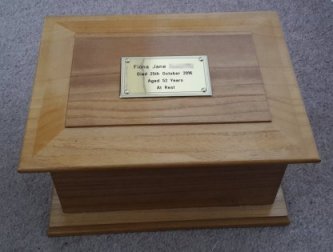
This too was helpful for them. For me, both these events were instrumental in helping me to let go of her and I am so glad I did it. But naturally you might not want to do this; you might want to remember them as they were when they were living. This too is fine. You can always visit the graveside later to say anything you need to say.

Financial – You will need to contact your financial institutions, like your Bank, mortgage lender, savings institutions and so on in order to get names changed; also contact your Life Insurance company if your loved one was insured.

The UK Government provides financial help after the death of a loved one, to many people in the UK, whether or not they are on benefits. If you live in the UK, it is well worth you applying for this help – which I appreciate you may not have known about – because if you are entitled to it, then it is your right and your privilege to claim it. Don’t feel bad about it; this is what you pay your taxes for! At the time of writing, there is a one-off ‘Bereavement Support Payment’ available, to the tune of £2,000, which would go a long way towards helping with the funeral costs. When you apply for this benefit, you should also be automatically considered for all other bereavement benefits, all with the same application. More details here. [Edit: At the time of this edit, 18th October 2019, I note that the ‘Bereavement Support Payment’ benefit has increased to a lump sum of either £3,500 or £2,500 (which should cover the cost of the funeral) and up to 18 monthly payments of at least £100 per month. This is really good news.]

Medical – In the UK, there is plenty of medical, voluntary and professional help available for those going through bereavement. One of the main ways of accessing this help is through your doctor. Your doctor will be able to offer suggestions for first steps such as bereavement counselling; medication if necessary; and maybe they might also be able to discuss with you the illness that your loved one died of, if that was what happened. Sometimes, it’s good to discuss with your doctor things such as the events leading up to your loss, the way in which (what we call) end-of-life care works, how the body prepares itself for death by shutting down various systems (it’s actually really amazing) and reassurance that your loved one did not suffer. Your doctor will also be able to provide contact details for various counselling organisations, if that’s a route you decide you want to take. Certainly, talking with people experienced in helping bereaved people is really helpful – I myself received an excellent bereavement counselling service from the people at the local hospice where Fiona died. This approach may not be suitable for everyone, of course, but your doctor is still the person best-placed to advise you on this.

You could also consider asking your doctor to sign you off from work for a time; the practicality of this will of course depend on your workplace’s sickness absence policy and philosophy. And you might not feel like doing that now, but after a few months or so you might change your mind. Like I said, grief is different for everyone and there is no set pattern. For me, I was reasonably fine for about eight months, and then I found I had to take some time off work. You should find that your doctor is only too willing to help in this way.

Practical Help – Feel free to ask others – maybe family or friends – if they can help with things like shopping, cleaning and ironing, walking the dog, looking after the kids for a couple of hours, whatever you need. Most people will be only too pleased to help, because they will know they are doing something really practical to help you in your time of need, and this will also help them in their grieving process too. But equally if you do not feel up to receiving offered help, you should also feel free to refuse graciously. Maybe something like ‘I don’t need anything at the moment, but can I call you if I do?’ would be good.

Protect against Identity Theft – I know this is a horrible thing to hear about, but it’s also worth realising that, for various reasons, identity thieves love to steal the identities of deceased people, causing additional stress and grief at an already difficult time. In the UK, the ‘Tell Us Once’ service I mentioned above goes a long way towards preventing identity theft for the deceased. However, not all countries have that service, so it might be worth doing a similar ‘shutdown’ of your loved one’s official matters as soon as you can. I am indebted to Matt, a reader of this article, for giving me the link to an excellent website that should get you started with this. It’s an American website, but the principles are the same and the credit reference agencies the writer mentions also have offices in other countries including the UK. Here is the link. The site is well worth a look.

Forgive Yourself

You might feel as if you have let your loved one down; maybe you might feel as if it’s your fault they died. Maybe you had an argument with your loved one just before they set off on the journey from which they did not return. Maybe you feel as if you contributed somehow to their loss in some way. Or perhaps there were unresolved issues in your relationship that still niggle at you. Well, everyone is different, of course, but personally I feel that there is no point in letting these things bother you anymore. You might feel there’s nothing you can do because all these things are in the past and it can’t be changed, and in itself that is true of course. But there is something you can do: although you can’t change the facts, you can change the power they have over you right now. The practical offshoot of all this is that you need to forgive yourself. Self-forgiveness means looking at the thing you think you did wrong, acknowledge it (whether it’s true or not) and then let it go. Decide that it’s in the past, and there’s no point at all in beating yourself up about it any longer. What’s done is done; you can’t change the fact, and to put it bluntly, the only person that any unforgiveness will hurt is you. So, determine right now to put that fault, be it perceived or real, behind you, leave it behind you and move on. Do this for every accusation that you feel yourself making towards yourself. This stuff, this self-forgiveness, is healthy and it works wonders for promoting healthy grieving. This is because the key to healthy grieving is to have it as guilt-free as possible. So, give yourself a break and just let it go. Forgive yourself, let the guilt go, and feel the weight just lift off you.

Forgive Others

Again, you may be aware of things that others have said to you, or to your loved one, that cannot be unsaid; that cannot be mended. Ok, these things happen. But if you hold unforgiveness in your mind, the only person it harms is you. If you are mad at someone, and they are mad at you too, they are not going to care one jot that you are mad at them. In fact they may even cherish the idea because they know you are feeling bad about them. Well, it has no constructive benefit to you at all and it certainly won’t change their behaviour or attitude towards you; all it’s going to do is to eat you up from the inside. And, at this terrible time in your life, you can do without that sort of hassle on top of the grief. The decision to forgive lies in your hands. And that decision is something you have complete control over, and it’s also something they have no control over. I’m not saying that you all need to be friends again; indeed, you don’t need to tell them that you have forgiven them because it may well be greeted with scorn anyway. You can’t control their thoughts or behaviour, neither should you try. But you do have control over your own, and that is your trump card. So, forgive, and in that way you take away their power to hold anything over you. I’m not saying you shouldn’t learn from others’ behaviour – if you ‘forgive and forget’, as the old saying goes, then you’ll never learn anything – but you owe it to yourself to release yourself from the burden of having to feel bad about those people.

Forgive your Loved One

More importantly, though, please forgive the person you have lost for any way in which you feel aggrieved by something they did, said or were. Again, you do not have the power to change the past; it really is set in stone. But, again, the power you do have is that of forgiveness. So yes, you can’t change the past, but you can change the effect it has on you. So, once again, forgive. You have absolutely nothing to lose, and everything to gain, by so doing.


Remember that in all three cases above, forgiveness is not a feeling, it is a decision. You decide that you are not going to let those things have any control over you any more. And when the thoughts and feelings keep popping up, push them aside as completed, dealt with, and sorted, and just get on with what you are doing. Tell those thoughts to get knotted!

It’s OK to feel relieved

While on the subject of guilt and forgiveness, you might need to hear this too.

If you lost your loved one through, for example, a long illness, once they have died, you might be surprised to feel considerable relief now they have gone. And that in itself can make you feel guilty. How is it possible for me to be relieved that my loved one has died? Well, it’s perfectly valid. You are relieved that your loved one is no longer suffering and no longer in pain. You are relieved that the waiting and uncertainty – for you, your loved one and for your family and friends – is now over. You are also relieved that your own huge struggle, at least with the impending loss of someone you hold most dear – is over. Granted, there will be things that you still need to sort out, as we have already seen, but these things will soon be done and you will know that that part of your ordeal is over. And it’s perfectly ok to feel a sense of relief about that.

Talking with Others

You will get a lot of people who will express their sorrow and sympathy for you and for your loss. Remember that they have no idea what you are going through – even if they too have suffered a bereavement; remember everyone’s grief journey is different – and they may say some insensitive things. The vast majority of the time, these people are only trying to help, and part of the problem is that they don’t really know what to say. What can anyone say at a time like this? Death is an awkward subject and it’s not something many people think about in terms of how they would cope with it. And so their sympathetic words might seem a little hollow – but they really are doing their best to express their concern for you. They are probably feeling awkward and like I said, they – actually quite literally! – don’t know what to say. I used to reply to such things with ‘It’s ok’, but not for long! I had to take my dog to the vets a couple of days after I lost Fiona, and the vet said ‘Sorry to hear about your wife’. I replied with a simple, ‘Oh, it’s ok’, and his reply was, ‘Well, no it’s not ok’ and he was right. It’s not ok. And so I decided that from then on I would simply say ‘thank you’, because that was far more accurate! Or maybe you could have a set phrase – ‘I’m coping’, or similar. It’s not lying. That you are still alive and just getting on with stuff shows that you actually are coping after a fashion!

Don’t hold it against others who might say insensitive things. They are grieving too, possibly for the first time on this sort of scale. Maintain an attitude of forgiveness – let the ‘offence’ go. Coping with others is not my strong suit, though, because I have Asperger’s Syndrome, and so I can’t really advise beyond this. Maybe your counsellor or doctor can help with that.

Being There for Others

Although your grief is huge, there may well come a time – and, indeed because you might have friends and family relying on you, that time might be here already – when you feel you can help others cope with their grief by talking with them about your respective grief journeys. Not only is it true that a burden shared is a burden halved, but getting these feelings out into the open, and realising that you are all going through a common process, can be a huge step towards your healing.

Look after yourself

As soon as you feel able, try to restore your normal eating patterns. And, certainly, remember to keep yourself hydrated. Continue to exercise and get fresh air, continue your hobbies and continue your social life as far as possible – I realise it will be more difficult now if it’s your spouse or significant other you have lost.

There may – or may not! – be a strong temptation to give up doing the things you used to do together. If possible, don’t give those things up. Ok, if it was something like ballroom dancing, you’re going to find it hard without your dancing partner. But many of your activities can likely still be engaged in as often as you feel like it. So, if you can, don’t forego continuing the things you used to do together. If you can do it, this is a healthy way to remember and indeed celebrate the good times you had together – see this article for more on this idea.

And give yourself a break, in the sense of ‘go easy on yourself’. You do not have to do everything at once. You do not have to feel pressure from anyone to do anything. Your grief journey is your own, and you do not have to explain yourself to anyone.

Memories

Something profound I learned a few months ago is that memories are just as lasting whether the person you made those memories with is alive or not. Here’s how I put it in a previous article:

“And so, the happy memories I hold precious as examples of how good life was, and indeed still is. In essence, whether Fiona is here or not, those memories would only ever be all I have left of those times, because what is past is indeed only ever memories”.

And so, remember the good times and rejoice in the fact that they happened. Nothing can ever take that away from you. And forgive the bad times; holding a grudge will only interfere with your healthy grieving process.

Remember that everything that your loved one contributed to your life, your character, is still yours. All the attitudes that you learned, all the memories you have, the way in which your character has changed for the better because of the time you spent together – all of that is yours and can never be lost.

Let go

Finally, I should let you know that it is perfectly normal eventually for you to let go of your loved one, for this life at least. This doesn’t mean that you didn’t want them, nor that you don’t wish with all your heart that they had not died. It simply means that life goes on. You are going to have to learn to live a very different life from now on because your loved one isn’t here any more, and, although you will think about that person every day for the rest of your life, it’s perfectly ok for you to let go of your loved one. You keep the memories and attitudes and things, but there’s no avoiding it that the person is gone. Letting go is a gradual process, and it is a natural one, and above all it is nothing to feel guilty about. Indeed, it is part of the healing process.

Conclusion

I apologise that this article is so long, but there was so much that I wanted to say, and different people will have different things that they receive from reading this piece. Remember: take in what you want and find helpful; discard what you do not.

I hope this has been helpful for you.


Useful links

Finally, here are some links to services I have either mentioned or hinted at in the text of my article. These are primarily for my UK readers, but other countries will have similar services. Remember: Google is your friend!

Cruse Bereavement Care – somewhere to turn when someone dies

NHS advice page on coping with bereavement

The UK Government’s page on how to claim Bereavement Support Payment and other bereavement-related benefits. Applying for Bereavement Support Payment means that you will automatically be considered for any other bereavement benefits you may be entitled to.

The Samaritans – the renowned, free-of-charge counselling service

Communing in the Deep Silence

For thousands of years, spiritual people have known the value of communing with God in the Silence. In this piece, I would like to give you some ideas about how to do this; how to commune with God in the ‘deep silence’.

Jesus said this in Matthew 6:6 (NASB):

Now, I fully realise that this was said in the context of not being all ‘showing-off’ in our faith, as if for the approval of others, but instead to keep our prayer and communion with God between Him and ourselves. But I believe there are also a couple of deeper truths in this passage that are useful in our present context. You see, I believe that, while on the surface, Jesus talks about your ‘inner room’ as if it’s a room in your house where you won’t be disturbed, He also talks about praying to your Father ‘…who is in secret’. I think that that right there is the key – it’s a private place, a Secret Place if you will. A Secret Place within your spirit (your ‘inner room’ being just that: a room ‘inside you’), that only you and God know. In the King James Version, the words the translators use are ‘…enter into thy closet’ (Mt 6:6 (KJV)). I like that. It’s as if it’s a tiny room where there is space only for two – you and God – and no-one else. It’s a place where only you and God are; where indeed no-one else will even fit in (in both senses of the term); where nobody else can get to but you and Him, no matter what is going on around you. This is the deepest place of communion with God; the place where it’s just you and Him*. Is it any wonder, then, that Jesus says that your Father ‘…will reward you’; what greater reward can there be but the Presence of God Himself?

Some people have written on the subjects of the ‘Discipline of Silence’ and the ‘Discipline of Solitude’. I won’t go into detail on these; you can easily Google the terms yourself and get a wide range of differing ideas and viewpoints on them. My post is kind-of related to those Disciplines, in that (that is, if you are into Spiritual Disciplines; I personally am not) these Disciplines may be able to help you on the road to practising accessing your ‘Secret Place’. Different paths for different people; it will work for some, not for others. Only you will know which way is best for you. But it is not the same thing as either the Discipline of Silence or that of Solitude. It’s not just being quiet before God, nor about silencing our thoughts, nor is it about being away from others, although as I said these disciplines all have their own value and can help you to access your Secret Place.

I will let you know how I personally do it. I find that I can easily find the inner Silence when there is literal silence – the absence of sound or noise – around me. If you like, the silence around me is a ‘picture’ of, or a ‘parable’ about, the Silence within. And once I am in the habit of finding that Silence in those circumstances, I find I can ‘touch base’ with the Silence in even the shortest silences. Moving on from this, I find I can also discover what I call the ‘underlying silence’ under all the noise of the day and/or the circumstances. I realise that this may be because of me having Asperger’s Syndrome, in which I find that my senses are constantly overloaded by visual, auditory and other sensory stimuli, and because of this I have had to learn to ‘tune’ out’, to some extent, as much extraneous ‘noise’ as possible in order to even be able to think straight. Even as I am writing this, someone has the television on in the background and I am having to tune that out too, because one of my Aspergic ‘gifts’ is the ability to concentrate on, or listen to, something in the background, at the same time as concentrating on my main task. It can become quite distracting, to be honest.

But anyway, let me try to explain it by describing the background levels that I perceive, in order to help you try to get a handle on the idea of the ‘underlying silence’; the ‘Deep Silence’, using an everyday example.

When I arrive home from work, and switch off the car engine, I open the door and just listen to the silence. I am most fortunate in living on a quiet road in a quiet part of town, and when I open my car door after switching off, the silence is quite profound. That’s easy; but even then, I am in the habit of ‘listening’ to the silence, and consciously having the feeling of ‘touching my feet down’ on it.

Then I unlock my front door, go in, and close the door behind me. There will be sounds, maybe the TV will be on, maybe someone might be listening to music or my daughter playing the piano. Or maybe, if my son is up to stay for a couple of days, he might be cooking or talking. But because I have already ‘heard’ the silence, I know that, beneath the noises, quiet or loud though they may be, the silence is still there and my feet are still planted on it – because I have made myself aware of it.

Or if I am at an airshow or even out flying myself. Sure, there is activity, noise, concentration and there are things to be done. But I am aware that underneath everything is the silence. Even if the noise has not been taken away, filtered out, or whatever, still I am aware that it is there – the underlying silence that is the background for all the layers of sound and distraction that we or our surroundings cover it with.

Or if I am at work and everyone wants everything done more urgently than everything else, again, I am aware of the deep underlying silence that lies behind everything, after everything else has been filtered out. It’s still there, even if I can’t actually hear it. And I therefore find that I can touch or access that silence even if everything around is havoc, as it so often is.

Do you see the progression here? I start by listening to ‘actual’, real silence: the absence of sounds. While doing that, I become more aware of the deep, inner Silence where God dwells. Then, as things become more distracting, I maintain an awareness of that underlying silence, that makes me aware of the inner Silence. It is still there, even despite the noise. Because I have experienced it when it’s ‘easier’, I can then also learn how to do this in other circumstances because I already know it’s there. And, with practice, I can be aware of the inner Silence in this manner irrespective of what goes on around me. I don’t mean I am constantly thinking about God, silence or things like that. What I mean is that, having experienced the Silence, I am aware that it is there, ‘on tap’, whenever I want to access it because it really is. It would have been there even had I not known how to access it, although it wouldn’t have been of much use to me. But because I am aware of it, I can tap into it any time I like.

This is the place where we can touch right down onto the bedrock of our faith; to plant our feet firmly on the solidity that is God, and from there all else just falls into place. Once our feet are placed on Him, the shocks and strains of life don’t have anywhere near the devastating effects that they would normally have, because we are grounded in Him.

Silence, Peace and Rest

In some ways, this inner Silence is also linked to the ‘peace that transcends understanding’ (Phil 4:7) and the ‘Sabbath rest of God’ (Heb 4:9-10) because it forms one of three spiritual ‘legs’, as it were, of Silence, Peace and Rest.

Silence, in that in the silence sits the waiting, welcoming Presence of God.

Peace, in that the supernatural Peace that transcends not only our understanding but also our circumstances gives us a real confidence that God has everything in hand, no matter how bad it might seem – and that death is no longer the end.

Rest, in that we have a Sabbath rest from our works in the same way that God rested from His labours – in that He simply let things be as they are, and we too also no longer need to work to ‘obtain’ or ‘earn’ our favour in God’s eyes, but that He accepts us, likes us and loves us just as we are.

Because of these three factors, we are welcome in that Secret Place. We can come directly into the Presence of God with neither hindrance nor fear (1Jn 4:18). Silence is just the way in which I have become aware of it; for you, it may be different – or it may not. That’s up to you to find out. But be assured, that inner, underlying Silence is indeed present; you do have a ‘Secret Place’ which you can access by climbing your secret staircase into that place where God waits for you, and is in fact there all the time.

I’m not saying you have to have a ‘Quiet Time’. Indeed, the Secret Place is not the same thing as the Quiet Time, although you can of course access the Secret Place during your Quiet Time, if you happen to practise that Spiritual Discipline (and I talk more about this in this article). But you can just as easily access the Secret Place in the hectic hassle of everyday life. In fact, it’s deeper than the ‘Quiet Time’ because, although in the Quiet Time you do indeed ‘charge your spiritual batteries’ and commune with God, there is a definite demarcation between the Quiet Time and the outside world. You step out of your Quiet Time and go into the world. With the inner Silence, however, you essentially carry your Quiet Time, if you like, around with you wherever you are and whenever it is. Your communing with God depends not on a set time and place, but more on an ongoing habit or mindset. Some have called it ‘Practising the Presence of God’, and this does sound like another way of looking at it, although I have not studied the idea in any great depth because so much of it appears to involve formulas and stuff like that. For me, the practice of the Inner Silence is far more personal, far more intimate than anything reached by a set of formulas or rituals. But it might work for you, of course; just because things like that don’t work for me doesn’t by any means infer that it won’t work for anyone.

If you live somewhere where it’s never quiet, can I recommend maybe finding the silence when you wake up at 3am in order to go to the toilet. Savour the silence when you get back into bed. Be conscious of it – the silence that lies underneath everything else. If you can’t do that at that time in the morning, maybe try out in the mountains or the moors, or on a secluded beach at dusk – or preferably at dawn; most people still seem to think it’s clever to stay up late, so the morning is usually quieter. Some of the most silent places are places like up in the Yorkshire Dales, or I can also specifically recommend Wasdale Head in the Lake District. In practice, though, you will find that you don’t usually need to go too far from civilisation to find somewhere silent.

This is the majestic peak of Great Gable, 2949ft, as seen from Wasdale Head in the Lake District, one of the most remote places in England. Photo taken April 2011.

Or maybe you might prefer the silence of the forest. Granted, in a forest, the wind in the trees virtually never stops making a sound of some sort, but it can still be good because the sounds of nature are easier to filter out as they make less demands on you, and can even in some cases be part of the silence. The silence itself is buried far less by the sounds of nature than it is by the sounds of civilisation.

However you find your inner Silence, the next step is to generate the habit of consciously resting on the Silence whenever you can. Pause and wait before you open your car door after switching off the engine. As you lay your head on your pillow last thing at night, be conscious of the inner silence just before you wander off into your dreamland. When you wake in the morning, before your ‘To Do’ list comes crowding in, savour that deep inner silence. Look for times during the day when there is a pause in your routine. Maybe you’re waiting at traffic lights in your car. Maybe you’re in the lunch queue at school. Any time when your mind can be diverted from what you’re doing is a good time. An example of what would not be a good time to be diverted is maybe when you are landing an aeroplane or negotiating a complex series of lane changes on a busy motorway junction. God doesn’t mind that you’re concentrating on what you’re doing! But in the same way as you might, sometimes even subconsciously, reach across the car and touch the hand of a loved one, or catch their eye across a crowded room and give them a wink, or a meaningful look of support or something; that’s what the Secret Place sometimes looks like. You find that  almost unconsciously – because it is habitual and comes naturally – you find yourself reaching in to the Inner Silence and communing there with your Heavenly Father – Who, as Jesus said, ‘rewards’ you – with His Presence.

In fact, this can also be seen as a definite form of prayer, because you are communing with God; being intimate with Him. Even if only for a couple of seconds, you are acknowledging His presence and going into that place where it’s just you and Him. And, to me, that few seconds is far more precious than many hours of just talking out loud to a God Whom you are not sure is listening…

So, although that might all sound a bit mystical and strange, please let me encourage you to find, in your own way, your own Inner Silence – or whatever it looks like to you. It’s well worth the effort. I’d also be interested in any comments that my readers make about their own experiences in this field.

May God bless you as you seek Him in this way.


I have written a piece touching on this subject before; you might want to read this previous article in order to ‘flesh out’ these ideas presented here with some more examples and thoughts, along with a couple of songs you might find helpful.


*I also believe that this is what Don Francisco means in his song, ‘Come Away‘, where he sings of the ‘…place where the thief has no key’.

A Personal Message to Someone I Met

Hi there

I don’t know your name, but it was lovely to have that interesting and gentle conversation with you yesterday, despite our having only just met, at Sainsbury’s in Bridgwater in Somerset. Hearing a lady whistling a Vineyard song from the 1980s was so unusual, I just had to come over and say something!

Our conversation began over that worship song – ‘Change My Heart O God’, from the Vineyard in about 1986. In reply to your question, I declared that Yes, God has indeed changed my heart in dramatic ways, but not in ways that many Christians can cope with. Remember, it’s not up to me how God changes me; it’s just my task to follow where He leads, and that’s going to be different for each of us.

Having received the tendered business card for my blog, and the accompanying explanation, I appreciate that meeting a Spirit-filled Christian who doesn’t believe in Hell must have come as a bit of a shock to you. Maybe that was something a little outside your experience, and I apologise for shocking you with that little nugget. I must say I did warn you, though, that I was an heretic!

I may have got this wrong – I am Autistic, so I don’t always pick up properly on what people are saying…but it seemed that your assumption was that I don’t believe in the Bible either. Well, I really do believe in it – subject to an intelligent reading, taking into account things like literary and historical context, type of literature and similar factors, and all this reading with the Person of Jesus in mind and the Holy Spirit doing His usual narrative in my spirit.

I don’t know if you’re aware of this, but some people have different interpretations to Scripture passages than do others. In this case, the Parable of the Rich Man and Lazarus was, I think, the passage you were referring to. I always have to remind myself that when Jesus was speaking in parables, He was deliberately being slightly obfuscatory, where some thinking in his listeners would be necessary in order to glean the nuggets of wisdom contained within. Parables are all about hidden meanings. But one of the key things about parables is that they are stories with a meaning, and the very last thing that they are meant for is to be taken literally. If you read the context of that Parable, it’s all about the Jews not bearing fruit despite repeated exhortations from God. And there are as many different interpretations of most Scriptures, not just the Parables, as there are people reading them. Except for the Jehovah’s Witnesses; they are all told what to believe and no dissension is allowed. We don’t want to be like that. But this is the reason why there are so many – tens of thousands, in fact – Christian denominations!

Please let me reiterate that I have the highest respect for the Bible, as long as it is used correctly. I am a Bible college graduate who knows the Bible inside out; I have several sections memorised by heart; and I quote from it regularly in my writings, usually using passages that I have found already to be true in my life. I’m sorry I couldn’t explain things to you properly, but as I said, I am Autistic, and my main medium for communication is in writing, like here in my blog. I find it very hard to communicate face-to-face, because of a number of factors. The main thing is that I can’t understand body language, and so, for me, interfacing with others is often like speaking only half a language. Also, because of the way my thought processes work, I can’t formulate proper trains of speech on the spur of the moment; I need time to consider replies properly, and so my face-to-face interactions come across as a series of disjointed arguments which only make sense in my own thought patterns. These patterns make perfect sense to me, but they won’t make sense to someone we would call a Neurotypical (NT); a non-derogatory term meaning someone whose brain is wired ‘normally’, whereas the brain of someone with Asperger’s Syndrome (my particular Autistic Spectrum Condition) is wired differently from those of NT people.

I can – and I have done it many times – stand up in front of hundreds of people and lead them in worship, or preach a sermon. It comes easily to me, but that’s because in that situation I don’t need to do any interpersonal interactions. But put me one-on-one, and I am usually at a complete loss.

So, yes, it was lovely to meet you and yes, we are greatly enjoying our holiday here in Somerset. I think next time I meet a fellow believer, though, I will let them see what fruit I have in my life before mentioning a contentious issue. He is indeed the Potter, and I am the clay. Who am I to contest the work He’s doing in my life? Isaiah 29:16 says this:

You turn things upside down,
as if the potter were thought to be like the clay!
Shall what is formed say to the one who formed it,
“You did not make me”?
Can the pot say to the potter,
“You know nothing”?

– Is 29:16

I wouldn’t dream of changing the things He’s done in my life, nor unlearning the things He’s taught me. For me, once I have tasted, there is no untasting. Once I have seen, there is no unseeing. Once I have been given something from God, I cannot and will not reject it, because His calling and gifts are irrevocable (Rom 11.29). I have to do what I see the Father doing (Jn 5:19); how else could I honour God’s calling on my life?

To better understand where I was coming from, all I can suggest is that you read some of my blog posts – there are over 500 of them to pick from – with an open mind and see how I came into the freedom I have, and what that freedom looks like. Maybe you too might be able to catch a glimpse of the wide-open spaces of God’s Grace and move out even further into the broad, sunlit uplands of freedom in the Spirit, guided by the Master’s Hand. Remember that, as a Christian of 38 years’ standing, I will not have reached the conclusions and positions I have reached without a great deal of study, thought and prayer.

And don’t worry, I wouldn’t dream of dissing your faith or your beliefs. I’m not saying you don’t already know Him; you do. I’m not saying you don’t already have freedom; you do. But there is so much more to learn, and so much deeper depths of God, and so much wider freedom than you may know. I have heard people talking about ‘pressing in’ to God; well, that’s what it looks like. As C. S. Lewis once wrote, ‘Further up and further in!’, and this is a never-ending process.

I hope this hasn’t come across as condescending; that would never be my intention. As you are probably aware, Autism means that sometimes people lack the social graces necessary to keep others comfortable. If that’s the case here, I am sorry. It also means that, when you first meet someone, you really don’t know what sort of filters and barriers that person is trying to overcome in order to try to communicate. One thing’s for sure, though. Next time, it will not be the case that I virtually introduce myself as someone who does not believe in Hell. That’s always going to get a conversation off on the wrong foot!

Keep on singing the songs, dear sister. And always bear in mind that someone might come into hearing range and start harmonising with your music, and your worship… 😉

Peace and Grace to you.

– Anthony


Yes, the header picture is actually of the Bridgwater branch of Sainsbury’s. Well, I am quite pedantic; no other picture would do 😉

Assurance

This entry is part 28 of 39 in the series Fiona

This is a very personal account that describes something of what I observed in Fiona, my beautiful late wife, during the time leading up to her loss.

When I lost Fiona to cancer, twenty months ago today, I knew that she had no qualms about dying; about going to be with her Jesus.

This is because she had assurance.

She had complete confidence in Jesus – was ‘assured’, if you like – that He would come through for her and would deliver her into her promised rest. She had no doubts whatsoever about what awaited her on the other side of the veil of death.

And I too rejoice in my salvation. I belong to God; I know it more certainly than I know anything else, and no-one and nothing can take that salvation away from me*.

Jesus’s message was simple: God loves you. Just as you are. He loves you and He cares for you. Jesus amply demonstrated this in His life, His teachings, His miracles, His death and His Resurrection. And His Grace. The unearned, undeserved favour of God. On that basis alone, nothing we can do, or not do, is either a qualification or disqualification for being ‘allowed’ into God’s Presence. Salvation is freely given, and it is complete and perfect, rooted in the historical death and Resurrection of Jesus the Christ. This is so simple; why do we complicate it? And yet, maybe it’s just part of human nature, but we do so complicate it indeed!

But not everyone believes like that. Not everyone has that assurance. As I’ve said before, so many people in the Christian faith, particularly those of a legalistic leaning, are actually not sure what would happen if they died tonight. They are not sure because they think that somehow their behaviour might disqualify them at the last second.

My faith isn’t like that. Being fully convinced that we are forever safe in Christ is what’s known as assurance, and knowing for a fact that Jesus has you forever in His arms is simply nothing short of revolutionary. Once we believe that, and know it in our hearts, then every single insecurity we might have concerning our ‘eternal destiny’ just melts away in the burning light of His love. But, because of the ideas expressed below, sadly, many believers who actually have this assured inheritance simply do not know it.

And so I am going to look at our assurance today, from the perspective of one who has seen someone die in perfect assurance of where she was going.

You see, part of the problem, for some people, is that idea that we need to ‘confess’ (i.e. own up to) every. single. ‘sin’. in order to be ‘forgiven’. If we die with just one ‘unconfessed ‘sin’, they claim, then we are toast. I could present many, many Scripturally-based  arguments to refute this idea, but instead let me testify to what my Fiona was like in the last weeks of her earthly life.

Fiona had a complete assurance of where she was going. She had an unshakeable certainty that, once she passed through the veil of death, she was not only going to be with Jesus, but she was going to her reward, her inheritance, to an amazing life full of beauty, light, joy, fun, and the Presence of God. Not long before she passed away, Fiona shared with me that she had received a vision of what Jesus had waiting for her there with Him. Fiona’s visions were always very vivid and real, like an IMAX experience, only better. Personally, I know what it’s like to receive a revelation from God, but Fiona’s ‘style’, if you like, was much more vivid. And this vision was such a comfort, indeed an encouragement, to her. She already knew what she was going to; she knew she was dying, she knew she wasn’t going to make it with that cancer eating away at her, and yet in that dark tunnel of what could have been despair, instead she was filled with the light, glory and hope of Jesus. She was actually looking forward to going to her inheritance. The phrase, ‘Well done, good and faithful servant’ applied to her for certain, and I am absolutely sure that she heard those words from Jesus the moment she arrived there.

And you just can’t argue with that. When you have seen the shining holiness of one of God’s Saints about to pass through the veil, you just know it. You know where they are going, and so do they. And that is such a tremendous boost to one’s own faith.

Precious in the sight of the LORD is the death of His Saints – Ps 116:15

Non-existent is any lack of assurance; the tired and worn-out ideas that one last-second slip-up could condemn one’s soul to torment for all eternity**. The worry of one ‘unconfessed sin’. When seen in the light of the death of a saint like Fiona, those arguments become just shadows. The harsh, unbending and assurance-breaking doctrines of the religious legalists and gatekeepers are seen as simply two-dimensional, flat concepts when compared with the real, solid and altogether complete certainty of where we go after death. How can I put this more emphatically?

It’s funny, but Christians sing the hymn, ‘Blessed Assurance, Jesus is mine’, and yet some of them do not really recognise that assurance. If you are one of those people today, please let me encourage you to raise your head from the mire of – yes, let’s call it what it is: self-righteousness – and of ‘doing things’ in order to try and please God, and instead to rest complete in the salvation that Jesus has bought for you. This is real, it is complete, and it is already accomplished. And I have seen it. All the arguments, theology and doctrine of men melt into nothing in the face of the death of a saint like Fiona; when you have seen this happen, nothing can ever be the same again, and the dry, dusty and indeed crumbly doctrines of we mere humans become as naught in the face of the utter assurance of salvation seen in a dying saint.

I’ve always believed in ‘once saved, always saved‘. I have never believed that anything I can do could either lose or indeed ‘boost’ my inheritance. I am utterly sure of my station in Christ and my status as one of God’s children, because these things have been revealed to me personally by my Heavenly Father. I have dates and times for these events, they were that real. And you can argue with me all you like about doctrines and whatnot, but the thing is that I have seen it. And I have seen the final assurance, first-hand, of someone who is about to pass into the direct Presence of her Lord. There is no fear; there is no sense of ‘what if?’; there is no sense of ‘resignation’. There is only an eager assurance, a peace, indeed an anticipation, of what is to come. There is sadness, yes; we will miss her, and she knew that we would miss her, and she also knew that we would have to carry on without the guidance and wisdom that she brought into our lives in such full measure. And I miss that wisdom every day. But there is also a quiet and yet exuberant joy, that ‘soon and very soon, we are going to see the King!’ And it’s awesome to behold.

Jesus’s Resurrection was, and is, the guarantee for us that there is life after death. Jesus’s presence in our lives, by the tangible presence of His Spirit, is the guarantee, the downpayment if you like, of that assurance. That death is not the end is the single most important truth that we can get hold of in this life, after the fact that it’s God’s love that provides that truth for us. Once you see that; once you grasp that, your life will never be the same again. In fact I would even say that, unless you really believe that you know ‘…where you would go if you died tonight’, then you have absolutely no right to try to sell people the salvation that Jesus offers as if it is indeed a complete, cast-iron assurance, when the reality is that you yourself don’t really believe it is as secure as you claim. Because that sort of gospel, that so many peddle these days, is really no gospel – not good news – at all***.

So, for the question, “Is it ‘once saved, always saved’? “, I actually rather think we are looking in the wrong direction. That’s looking backwards, at things we have done; it is a backwards perspective because we are always focused on looking back to see if we have done something that’s somehow going to drop us out of God’s favour, and that we need to ‘confess’ it and get it out of the way. But it’s not like that at all. If you walk in the Spirit, then you will not gratify the desires of the ‘sinful nature’. You just get on with it, free from the encumbrance of worrying about ‘sin’ all the time. Our salvation enables us to walk forwards in life with Jesus. When Jesus said that “whoever sets his hand to the plough, and then looks back, is not worthy to be My disciple” (Lk 9:62), He meant that by looking back all the time, you just can’t see where you’re going. You need to look forward and just walk with Jesus. The only way to keep that plough straight is to look forward, not backwards. Landing an aeroplane is similar; you look forward to the far end of the runway, not down at the runway below you, otherwise you can’t judge the landing properly. Thank you Lord for your wisdom.

And so let’s round this out by saying that, when it comes to the crunch, and death is just around the corner, it is possible – indeed it is your right, as a Child of God – to face that event with love, confidence, hope and indeed a joyful anticipation. Because precious indeed in the sight of the Lord is the death of His Saints – and you are one of them. There is no fear in Love, because perfect Love casts out all fear (1Jn4:18). And there is no fear in death, because Jesus has gone there before us – and He has come out the other side for our assurance.

Be assured.

Be at peace.

God’s love for you is greater than you can possibly imagine.

And there is no need for fear.


Grace and peace to you.


*I’m not going to define ‘salvation’ right now; I do have a set of developing ideas on the subject but I wouldn’t do them justice if I write about them just yet, because the ideas are not fully formed. In this context, suffice it to say that I believe that Fiona’s firm conviction that she was going to be with Jesus is what I am talking about here.


**Not that I believe in that anyway.


***[Edit] Can I please just clarify what I mean here, in that the main context of that line in the original essay was that some sell the ‘where would you go if you died tonight’ as simply a hook to get people into a life of legalism. The main point being that they themselves are not ‘sure’ in that they think that Jesus might still disown them at the ‘last day’, whatever that is. I wasn’t meaning so much about those who aren’t sure about the Resurrection; more about those who think they have to keep every. single. rule. or else they’re toast! These are the people who should not be sharing that news as if it’s good news, because they are not selling something that they believe is bullet-proof. Hope that makes sense.