It’s the time of year again where we play the ‘White Christmas Game’.
I’m reblogging this article from November 2015 because it describes the game so you can join in if you want to!
Click the graphic below to go to the article. Enjoy!


It’s the time of year again where we play the ‘White Christmas Game’.
I’m reblogging this article from November 2015 because it describes the game so you can join in if you want to!
Click the graphic below to go to the article. Enjoy!


Grief and mourning are part of losing someone dear to us – in my case, my dear wife, Fiona, who passed away a month ago today. But I have found that life goes on; I still have to manage my home, earn a living, look after my family. I still need to keep myself happy, to do the things I do, like flying, playing my (solitaire, billy-no-mates) boardgames, writing my blog, fellowshipping with my church, spending time with my family.

And sometimes there’s this really irrational thought there – How can you do (that thing that you enjoy) now that Fiona is gone; you used to love doing that together and you can’t enjoy it without her, because it will remind you of her.
Now, I understand that this may be a defensive mechanism to prevent us from being reminded of the pain of loss. But I also know that Fiona would have wanted me to continue with that pastime that we used to share, whatever it was.
In the unspeakably amazing book, The Lord of the Rings, Tolkien writes of the hobbit Merry Brandybuck, who was looking forward to discussing ‘herb-lore’ (in this case, tobacco) with his master, King Théoden of Rohan, once the war was over. But Théoden was killed in battle, and Merry couldn’t face smoking his pipe and being reminded of Théoden…
” “Good!” said Merry. “Then I would like supper first, and after that a pipe.” At that his face clouded. “No, not a pipe. I don’t think I’ll smoke again.”
“Why not?” said Pippin.
“Well,” answered Merry slowly. “He is dead. It has brought it all back to me. He said he was sorry he had never had a chance of talking herb-lore with me. Almost the last thing he ever said. I shan’t ever be able to smoke again without thinking of him, and that day, Pippin, when he rode up to Isengard and was so polite.”
“Smoke, then, and think of him!” said Aragorn. “For he was a gentle heart and a great king and kept his oaths; and he rose out of the shadows to a last fair morning. Though your service to him was brief, it should be a memory glad and honourable to the end of your days.”
“Merry smiled. “Well then,” he said, “if Strider will provide what is needed, I will smoke and think. I had some of Saruman’s best in my pack, but what became of it in the battle, I am sure I don’t know.”
“Master Meriadoc,” said Aragorn, “if you think that I have passed through the mountains and the realm of Gondor with fire and sword to bring herbs to a careless soldier who throws away his gear, you are mistaken…”
“Was there ever any one like [Aragorn]?” [Pippin] said. “Except Gandalf, of course. I think they must be related. My dear ass, your pack is lying by your bed, and you had it on your back when I met you. He saw it all the time, of course!” ”
J.R.R. Tolkien: The Lord of the Rings – The Return of the King
If you have suffered a similar loss, and you find that life has lost its lustre because of that loss, then may I encourage you to ‘Smoke, then, and think of him’, in whatever way means something to to you.
For me, it’s like this:
I love going out for country, moor and fell-walks; Fiona used to love our walks together and with the dog. ‘Walk, then, and think of her’.
I’ve just heard my daughter singing in the shower. Fiona had a phenomenal singing voice and so has my daughter. ‘Sing, then, and think of her’.
I love sitting and reading; we used to do a lot of that together, particularly on a quiet morning. ‘Sit, then, and think of her’.
I fly too – of course! – and although Fiona didn’t really have the same, shall we say, ‘passion’ for it that I do, she still encouraged me in it. “You were born to fly”, were her exact words to me once upon a time. So, I will ‘Fly, then, and think of her’.
We loved worshipping together, whether in housegroup, in church, to recorded tracks in the kitchen, or just standing around my piano while Fiona sang or played the flute. ‘Worship, then, and think of her’.
For she was a gentle heart and a great woman and she kept the faith.
Just to paraphrase Aragorn…

Here’s a great little piece by a friend of mine, who prefers to remain anonymous. It might be useful to read this in conjunction with two of my other articles, ‘Why be a Christian?’ and ‘Life after Death: A Contentious Post on Decision Points‘.
“Personal Response”
We must take care not to confuse what is true in Jesus for all humanity with each individual’s personal response to that truth.
We do not “decide for Christ” in the sense that our personal decision causes our salvation. Rather, we accept what is ours already in Christ, placing our trust in the one who has already trusted for us in our place.
When we personally believe the gospel, which is to accept what is already ours by grace, we begin to participate in God’s love for us. We begin to live out the new creation that God, prior to our ever believing, made us to be in Christ.
There is the general, or objective, truth about all humanity in Jesus, and also the personal, or subjective, experience of this truth.
Objectively, all people, past, present and future, are justified already; all are sanctified; all are reconciled in Jesus in and through what he has done as their representative and substitute. In Jesus, objectively, the old self has already passed away; in him, objectively, we are already the new humanity, represented as such by him before and with God.
However, although all people are already objectively redeemed by Jesus Christ, not all have yet personally and subjectively awakened to and accepted what God has done for them. They do not yet know who they truly are in union with Jesus.
What is objectively true for everyone must be subjectively and personally received and experienced through repentance and faith. Repentance and faith do not cause a person’s salvation, but salvation cannot be experienced and enjoyed without them. Repentance and faith are themselves gifts of God.
In the Scriptures, we find some verses that speak to the general/objective nature of salvation, while others speak to the personal/subjective nature of salvation. Both are real and true—but the personal is true only because the general is a pre-existing reality.
These two categories are found throughout Scripture—both sometimes occurring in one passage, as happens in 2 Corinthians 5:18-21. Paul starts in verses 18-19 with the objective/universal nature of salvation: “All this is from God, who reconciled [past tense] us to himself through Christ and gave us the ministry of reconciliation: that God was reconciling the world to himself in Christ, not counting men’s sins against them. And he has committed to us the message of reconciliation.”
Here is a general truth that applies objectively to all—all are already reconciled to God through what Jesus has done in union with all humanity.
Having established the general truth in 2 Corinthians 5:18-21, Paul goes on in verses 20-21 to address the subjective/personal: “We are therefore Christ’s ambassadors, as though God were making his appeal through us. We implore you on Christ’s behalf: Be reconciled to God. God made him who had no sin to be sin for us.”
How can all be “reconciled” already and yet the invitation go out to “be reconciled”—suggesting a reconciliation yet to occur? The answer is that both are true—these are two aspects of one truth. All are already reconciled in Christ—this is the universal and objective truth—but not all yet embrace and therefore experience their reconciliation with God.
To be reconciled and yet not know and experience it is to continue to live as though one is not reconciled. Having one’s eyes opened by the Spirit to this reconciliation, choosing to embrace it, and then experiencing it does not cause the reconciliation to occur, but it does make it personally realized.
Thus, the evangelistic invitation from Christ’s ambassadors (verse 20) is to “be reconciled.” But this appeal is not to do something that would cause God to reconcile us; rather it is an appeal to receive the reconciliation that exists already with God in Christ. As we welcome the truth of the gospel, we can’t help but worship our Lord and Savior!

While someone else’s sexuality is none of anyone else’s business, there are of course many Christians who would disagree, particularly with regard to people of what you might call ‘alternative’ sexualities, such as Lesbian, gay, bisexual, transgender and queer/questioning (LGBTQ) people.
Most of my readers will know by now that I am an open affirmer of committed LGBTQ relationships. I have many gay friends, both online and in ‘real life’. As a Christian, I find it morally indefensible that Christians should be in any way bigoted towards people of alternative sexualities. I share here, then, a great article by John Shore of ‘Unfundamentalist Christians’, explaining both his and my position really clearly, and Scripturally too. Click the image below to go to the article.
Enjoy!


There’s actually a new Revival going on in the Church in this time.
This new Revival does not look at all like we expected it would look like, when we prayed for it decades ago.
But with God, things rarely are what we expect.
In Jesus’s day, the people of Israel expected a conquering King-Messiah; this was the ‘revival’ they were looking for. An all-powerful, conquering King who would use military might and Kingly authority to evict the hated Roman occupation forces and re-establish theocratic law in their society, and in so doing, driving out the essentially Pagan gods that the Romans worshipped. This was why they did the thing with the palm branches and cries of ‘Hosanna!’ on what we now call ‘Palm Sunday’, and is also why they rejected Him in that final week of His life on earth and eventually cries of ‘Crucify!’. Their Messiah was not what they expected, and He was not what they wanted, and so they rejected Him.
Some still expect this kind of Messiah today. We expected the idea of a conquering King that would slay (or at least bring to repentance) all His ‘enemies’ in one go – either as part of that expected Revival or, preferably, when He comes again. We always expected a returning Jesus who would really give His enemies ‘what for’, as we say in Yorkshire.
It was also what they expected when Jesus read from the scroll of Isaiah in His home town of Nazareth in Luke chapter 4 (I expand on this passage in this blog entry). When we prayed for revival, we expected God to bring thousands into His Kingdom in repentance and change governments, ‘usher in’ (I hate that phrase!) a ‘new age’ of righteousness in our nations, society and governments.
But, in Nazareth, Jesus ‘rolled up the scroll’ (Lk 4:20). He figuratively shut the book with a decisive ‘snap’; He didn’t read the bit they wanted to hear, the bit about vengeance and judgement. Their ‘revival’ didn’t happen as they thought it would.
And a similar thing is going on with the modern revival. Jesus seems to have ‘rolled up the scroll’ on the parts that people are expecting. The things that many modern Christians are looking for in the revival they are praying for are the things they expect – many souls crying out to God for mercy and forgiveness, consciousness of sin, and yes healings, deliverances and salvation – just like happened in revivals in the nineteenth and twentieth centuries – and these things aren’t happening. But still people are coming to a fresh realisation about the love of God for them.
You see, this time, what’s actually happening is different. This time, the revival is about revisiting the nature of God’s loving character; His forebearance, tolerance and, above all, His grace – His undeserved, extravagant and properly-over-the-top favour. people are realising what God is like and how much He loves them, irrespective of how ‘unworthy’ they thought they were (and sadly this feeling has largely been fostered by some in the Church).
In Jesus’s day, His ‘Revival’ was fixed entirely in an accurate vision of Father God’s character and His love. And Jesus does not change. Jesus Christ is the same yesterday and today and forever (Heb 13:8). He’s not coming back as a mighty Conqueror, bent on destroying all those who refuse to submit to His Will. He’s still coming back, yes, but just like He did before, in living and enacting the key to His character: “Father, forgive them” (Lk 23:34). And so this modern revival also shows God’s character and love to those who have the eyes to see it.
Now, with our modern ‘expected’ Revival, in a way, similarly to overthrowing the Romans (who were the percieved problem for the Jews a the time), people are asking for the Spirit to come, but to bring us back to the rules (i.e. to perceived purity) and make us slaves to law/religion again. I’ve written on this before and, for those with eyes to see, it’s pretty obvious what is happening. It’s interesting that the Revival that many Fundamentalist Christians have been praying for for decades (and I know; I was one of them!) is going on right now under their noses, but most of them fail to see it. It’s a revival of peace, tolerance, a lack of bigotry and exclusivism; a revival of love, goodness, joy and all the other fruits of the Spirit. And yet they still see it as ‘liberal’ theology; as work of the devil. And this is so tragic because they are missing what God is doing, just like some of the religious people in Jesus’s day.
Maybe that’s why Jesus told his disciples to go only to the lost sheep of Israel (Mt 10:5-6). Maybe it’s because the Jews of that day were the most lost, most bigoted and thought that they were the only ones who were ‘saved’ because they were God’s holy people. It sounds like some of the more militant of the ‘fundamentalist’ groups today – an insistence that theirs is the ‘Only True Way’ when actually it is Jesus – inclusive, broadly-encompassing, all-welcoming Jesus – who is Himself the ‘Way’ (Jn 14:6), and not some narrow doctrinal position.
Note that when I talk about the Church in most of my writings, I am not referring to your ordinary, everyday churchgoer who loves and serves Jesus. The people who simply love others as Christ asked us to do. No, I am referring to the militant Pharisee brigades, the ones who think that their, and only their interpretation of Scripture is the correct one, to the exclusion and indeed presumed ‘damnation’ (sending to Hell) of all who disagree on even the most minute little point of doctrine. The people who turn unbelievers away because they ‘shut the door of the Kingdom in people’s faces’ (Mt 23:13)
But this modern Revival is one in which the doors of the Kingdom will be opened once more. Opened to those who have doubts, opened to those who don’t want to believe in all the silly trappings of Religion, opened to those who traditionally have been made to feel unwelcome in churches: Gay/Lesbian/transexual etc. people, atheists, those who want to ask awkward questions. Jesus welcomes all these people and everyone else too. It doesn’t matter if you don’t feel ‘worthy’; God loves you just as you are. He doesn’t want you to be different, to change, to change your points of view on anything – except that the only thing involved in what Jesus called ‘repentance’ is that you need to change your mind about Jesus. And God can help you do that, too. This doesn’t need any strength on your part.
If you are someone who feels like they would like/love to be a part of what Jesus is doing in this day, but you’ve never really taken that step of trusting Him, then can I invite you to do that? The Bible says in many places that all that is required is to ‘believe in the Lord Jesus’. You don’t have to buy into all the silly ideas and doctrines, like the earth being only 4,000 years old, or that evolution is false, or that the earth is flat or whatever. You don’t need to believe that the entire Bible is written by God or that it is infallible or contains no errors or anything. All you have to do is believe in Jesus; the other things you can accept or reject as you want. Maybe say something like, ‘Jesus, I believe in You. I know I have my doubts and my fears, but I know that You understand those and you also understand me as well. Help me to believe in You. Please walk alongside me and please make Yourself real to me’. There’s no formula; no ‘right’ or ‘wrong’ way to do this. Simply express your desire for Him to be your Friend and to walk with Him. And He will honour that. Then just walk free in your life in Him.
This is the new Revival. Knowing that God is entirely FOR us, and not even slightly against us (Romans 8:31). It’s a Revival of finding out about God’s true character of Love, Grace, mercy, forgiveness and His complete, utter, unshakeable favour.
Let me put it another way. Jesus is saying to everyone in this day:

Here’s another great article by Paul Ellis, of escapetoreality.org, that’s well worth reading since it tells you how you can be sure you’re ‘saved’. No more being scared of street preachers! You can pass them by – and even talk to them! – without being afraid you’ll get a devastating earful (although they may well want to check your theology because they just can’t help themselves!), but the point is you’ll know!
Click the logo below to go to the article:

There’s an odd, fairly obscure little Scripture, found only in Matthew 27:50-53, that describes how at the moment Jesus died, an earthquake broke open the tombs of ‘many’ holy people who were, at the same time, raised from the dead. After Jesus’s own Resurrection a couple of days later, these people were seen by many people in Jerusalem. Here’s the Scripture:
“When Jesus had cried out again in a loud voice, He yielded up His spirit. At that moment the veil of the temple was torn in two from top to bottom. The earth quaked and the rocks were split. The tombs broke open, and the bodies of many saints who had fallen asleep were raised. After Jesus’ resurrection, when they had come out of the tombs, they entered the holy city and appeared to many people.” – Mt 27:50-53
I’ve always understood this as happening because of the sheer power and Life that pulsed out from the Cross* as Jesus died. Somehow, however the ‘mechanism’ works, sin and death had been defeated and history had been changed. Nothing would ever be the same again. Life had been released into God’s Creation in such a way that had not happened since He first said ‘Let there be Light!’. And all this was because of the death of the most righteous Man Who ever lived. It’s no wonder, then, that all those people were raised by that power. And, when a Godly person dies, in a similar way that same power is released, bringing life to those who will receive it.
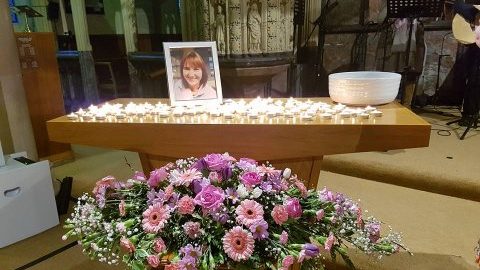
Most of my regular readers will know that my incredible wife, Fiona, passed away a couple of weeks ago. And in a similar way to that Life that poured out from Jesus’s death, I believe that I have seen this Life radiating out from from Fiona’s loss too. She was, without exception, the most Godly person I have ever known.
Within a day of her passing, just like when Jesus died, so much good fruit was released. There were fruits of joy, laughter, reconciliation. Fruit of healing. People felt a light-heartedness, despite the heartbreak of her loss, that could only be explained by remembering her as she was through her life and her final illness. Always radiant, full of joy and laughter, always looking for the joke, that was my Fiona.
And then at Fiona’s memorial service in our Church, every single one of the people who got up to speak about her said about how full of fun and joy she was. As I’ve said, she was always looking for an excuse to laugh about something. Mark, our Vicar, commented on this and said that she was so full of fun, joy and laughter – yes, because that was the way she was made, the way she was ‘wired’ – but that she was also so full of that joy because she was also so full of God. And she was indeed 🙂

At the memorial service, many people – who were not all necessarily people of faith – were uplifted by the stunning testimonies of her influence on people’s lives. People I know who are not necessarily people of faith have been touched by the obvious light of this amazing lady’s life, character, friendships, life and death, and also by the shining faith and love manifested in lesser measure by those left behind. In this way, Fiona’s loss has radiated out new Life into people’s lives and hearts, in life-changing power. People who knew Fiona in life were, knowingly or unknowingly, being continually touched by the Love of Christ that was her driving force and the core of her being. At her memorial, even people who hardly knew her were moved deeply and felt something that they’d never felt before: the immense love of Christ that came from her life and ministry. The Presence of God filled that place and some people hadn’t felt that before. That’s much of the reason why it was so moving, because the testimonies to Fiona’s faithfulness and qualities were backed up by the actual Presence of God. Some might put this down to emotion or similar, and I agree that there was a lot of that about. Of course there was. But there was something more: the real Presence of Jesus right there in that place. If you were there and you felt that, and you were wondering what it was, hopefully that explains it for you. And that is partially why it felt as if Fiona was there with us, because Jesus’s Presence was so much of what you felt when she was nearby. I don’t think that anyone who was there went out of that place unchanged, in a good way.
So then, in Fiona, the life of Christ was made literally tangible because, as I have said previously, she was Jesus to others. And even in her death, that Christ-Life was still pulsing out in all its radiance and bringing Resurrection Life to those in that place, whether they realised it or not. It’s no wonder that people were finding the service so incredibly moving!
*By ‘The Cross’, I refer (as does St. Paul in his writings) to, not specifically the actual wooden scaffold on which Jesus was crucified, but to the history-changing events that happened when Jesus died and subsequently rose from the dead. The self-sacrificial death that Jesus died is the single most powerful event in all of history, and that’s what I refer to when I talk about ‘The Cross’.
In the light of this article, here is another piece about coping with the grief of losing someone dear.
Here is a link to a free eBook by my friend David Matthew: Christian teacher and writer. The book is called ‘A Poke in the Faith’ and the subject matter is exactly relevant for readers of this blog who can identify with my enquiries into the ‘boundaries of faith’. In the book, he describes how evangelical Christians are calling into question certain tenets of their faith (like I do in my blog), and explains how and why it is safe to do this.
I’ve just finished the first chapter and I am captivated. This book deserves to be read – and spread – far and wide. The page I am linking to gives you links to a PDF version, and versions also for Kindle, Kobo and other e-readers.
Click the cover image below to go to the download page:


“…and I was being chased by at least three Focke-Wulf 190s…”
“What, in a Tempest? Couldn’t you just outrun them?”
“Well, no, it wasn’t like that you see…..carry on, you’re doing fine….”
What an honour, having veteran flying instructor, senior flight examiner and war veteran Rufus Heald have me fly him for my pre-solo check ride. This is the final check by a senior instructor, to see if he agrees with your Instructor that you are ready to take an aeroplane up by yourself for the first time – the First Solo. And what a real gentleman Rufus was, taking my mind off my nerves by regaling me with war stories – albeit stories about being chased by German fighters!
But I have to be honest and say that in some ways I kind of felt like I couldn’t wait to get him out of the aeroplane so I could go flying by myself for the first time ever. Rufus, if you read this, please accept my apologies, although I am absolutely sure you understand!
‘Any questions?’
‘Just the one, Rufus: if some clot decides to prang a Dash-8 [an airliner] right on the runway intersection, what do I do?’
‘No problem. Just follow the A38 eastwards all the way to Exeter, and land there’
‘Oh, ok, thanks.’ A sobering thought, that; if that happened, then my first solo would turn into my first solo cross-country flight, but fortunately that doesn’t happen. Good job too; I haven’t started my navigation training yet.
‘Right then, off you go and good luck!’
So, once Rufus had hopped out, it’s interesting to see how quickly the flying discipline comes in. Settle down, now; you’ve got to get this next bit right first time, there’s no second chances. Crumbs, this is scary, do I have to do this? Yes, you do; you’ll never be a Pilot unless you do this.
Right then, time to get cracking. Power checks: check clear behind, set 1,200rpm, check both magnetos on, brakes on and oil temperature and pressure (T’s and P’s) in the green, set 2,000rpm and check brakes holding. Select carburettor heat HOT and rpm drop within limits at less than 175rpm, also no rough running and select carb heat COLD and check the rpm recovers to 2,000, Mag drop right – 100rpm; mag drop left – 100rpm. Max drop 125rpm so within limits; difference between drops less than 50rpm (in fact they were the same) so that’s ok. Mags both on again, suction gauge showing 3″-5″ vacuum, ammeter charging, T’s and P’s in the green, Idle check – close throttle, 700rpm, that’ll do, reset 1,200rpm.
Now pre-takeoff vital actions: Trimmer set for takeoff, throttle friction nut set, mixture rich, magnetos both on and master switches both battery and alternator on, pitot heat off, primer IS locked, fuel on and sufficient, flaps up, Instruments: Direction Indicator, artificial horizon, altimeter has the QFE set [pressure setting to indicate height above aerodrome level], T’s and P’s again, landing light goes ON and transponder indicating 7000 and set to Mode C, doors and windows secure, straps tight, carb heat recheck then select COLD, controls full and free movement. Call: ‘Golf Tango Oscar, ready for departure’. I know my Instructor, Tim, is watching from the Tower right next to the Air Traffic Controller, in case anything goes wrong and I need any help. Not that he can give direct help; I think that when flying an aeroplane by yourself, you are more alone, and beyond direct help, than you can ever be in any situation on earth. Another sobering thought.
“Golf Tango-Oscar, backtrack line up Runway 31”
“Backtrack line up 31, Golf Tango-Oscar”
Right, this is it, then. Brakes off, and off we trundle from the holding point onto the active runway, rolling along to the far end of the runway and then turn the Cessna on a sixpence to line up. The familiar sight fills my view: the runway stretching off into the distance, promising imminent adventure, exhilaration, concentration and the ultimate in achievement – that of flying an aeroplane in complete defiance of the gravity that has held our ancestors earthbound for so many thousands of years. But this time I’m on my own; there’s nobody sitting in the right-hand seat and I know that the next five minutes or so are the real beginning of my flying career – if I get it right. But surely Tim and Rufus wouldn’t have let me go if they didn’t think I was up to the task?
Without any delay, the Controller’s voice comes in over the R/T: “Golf Tango-Oscar, clear takeoff runway 31, right hand circuit, surface wind three-three-zero, five knots”. Good, that’s the wind more or less straight down the runway, then; no significant crosswind component. “Clear takeoff 31 right hand, Golf Tango-Oscar”. So, hold the aeroplane on the toe-brakes, power to 2,000rpm and check T’s and P’s in the green, then brakes off heels on the floor [so toes away from the brakes] and full power applied smoothly. Everything happens very quickly but this is what I have been trained for. Check full power: 2,500rpm, T’s and P’s in the green, airspeed building, keeping straight using the feet on the rudder pedals and looking for 65 knots and rotate and….”AIRBORNE! Wooohooo!” the shriek of pure delight erupts spontaneously. I’m flying an aeroplane all by myself for the first time ever and the only way I’m going to live through this is if I get everything right. That’s honestly what I thought, you know! Right, concentrate now, five hundred feet, after-takeoff checks: Fuel is on and sufficient, Engine T’s and P’s green, radio tuned to Plymouth and we’ve got our clearances, Altimeter has the QFE in, landing light stays on because we’re staying in the circuit. Crumbs this aeroplane is performing so much better; we’re at circuit height, 800ft, already and only just turned crosswind. Must be because we’re so much lighter with only one person on board. ONLY ONE PERSON on board and I’m flying an aeroplane on my own oh my goodness this is crazy right settle down and remember your training. Set 2,000rpm for 80kt at 800 ft. And you’re going to land in a couple of minutes so you need to do something about that. Right then, turn downwind, level now with the end of the runway and report “Golf Tango-Oscar downwind to land” Just the one circuit for the first solo. “Golf Tango-Oscar, report final”. “Report final, Golf Tango-Oscar”.
Right that’s him told, now let’s do the downwind checks. Brakes are OFF (check them), undercarriage is fixed down, (and now miming the actions) mixture is rich, fuel on and sufficient, flaps up, instruments QFE in the altimeter – and we’re a little high; must be the excess power – T’s and P’s are good, landing light is on still, carb heat check – no rough running – and then selected COLD, hatches and harnesses secure; yours? Oh, there’s nobody in the right hand seat, now isn’t that weird? Aeroplane feels empty…. ok downwind checks complete, runway in my four-o clock position, time to turn base.
So, a neat 90-degree right turn and now I’m on base, the last part of the circuit before my final approach. Immediate actions: carb heat HOT, power back to 1,700rpm and hold the height as the speed decays; we are already within Vfe [maximum flap extension speed] so flaps to 20 degrees and watch the nose come down. Establish 70kt and 500fpm descent and re-trim the aeroplane. Everything’s looking good except that I’m still too high; now at 900ft instead of 800ft. I know exactly why; it’s because I didn’t have the weight of the instructor aboard (how ’bout that!) and so the aeroplane had excess power at 2,000rpm so she was climbing slightly. Anyway, never mind why, what are you going to do about it? Nothing for it but to select full flap; save that until you’ve turned final so you’re not trying to do too much at the same time. Don’t let the aeroplane get ahead of you; you need to stay ahead of the aeroplane all the time. Crumbs the workload is so high in the circuit; no wonder they use it as a First Solo test. If you can do circuits, you can do anything. Looking for 70kt on the airspeed indicator for the final turn; plenty of speed, nice and safe. Slow turns on final are what kills people.
So, lined up on final approach and the call, “Golf Tango-Oscar, finals to land”
“Golf Tango-Oscar clear to land runway 31, surface wind three-three-zero, five knots”
“Clear land, Golf Tango-Oscar”, so now it’s all up to me. Let’s have those flaps now: the full 30 degrees of flap come on and pull the power all the way back and she comes down not quite like a piano, but at least like a dive-bomber anyway. Adjusting the rate of descent with power and the airspeed with the nose attitude, this is precision flying at its best. It has to be if you’re going to arrive properly in the right place. Setting 65kt all the way down final, trim it up, nice and easy, coming down nicely. 300ft: pre-landing final check – Cleared to land, runway is clear, happy with the approach (although still a little above the glideslope, still, I’m doing all I can about that), carb heat goes COLD so the engine can deliver full power in a potential go-around situation. Crumbs I love this stuff. Over the hedge now, looking for 60kt but still a little high, we’re safe as it’s a nice long runway. Flare now, nose up and arrest the descent, aeroplane now just a few feet off the runway and hold her off as the airspeed decays, she sinks and Bump she lands but the airspeed is a little too high and so she comes unstuck again because she still wants to fly and I don’t blame her, but re-establish the hold-off and add just a trickle of power to slow the rate of descent so she doesn’t come down like a safe and Bump she’s down again but this time she stays down. “Golf Tango-Oscar: six out of ten for the first one; seven for the second one”. Cheeky so-and-so; I’d like to see him try and do what I’ve just done. Still, Tim most likely put him up to it anyway; sounds like a Tim comment. “Congratulations, well done!” That’s more like it. I’ve just fulfilled the dream of my entire lifetime and as you can imagine I’m feeling pretty good about it. I am now a Pilot; granted I haven’t got my licence just yet – that is still more than nine months away – but it means that I have just joined that very few select people who have flown an aeroplane by themselves. I am now a member of the ‘Fraternity of Pilots’, and nothing will ever be the same again. The feeling is indescribable and I can tell you that it took approximately ten days for the delighted grin to disappear from my face.
To commemorate my first solo, Tim gave me a certificate to mark this milestone event. And because I flew my first solo on the ‘unlucky’ day of Friday the Thirteenth of September, 1996, and I am so completely and totally unsuperstitious, I asked Tim to annotate my certificate accordingly. Here it is:

As you can tell, that flight is etched indelibly on my memory. They say that you never forget your first solo; twenty years down the line and I can attest to that as a fact.
I know this article is a bit techy, but I wanted to put across as realistically as possible what goes through a Pilot’s mind as he is flying, and also to try to share some of the feelings of concentration, discipline, training, exhilaration and panic that the first solo entails. I hope you have enjoyed it.
Here is a video of a young student pilot doing her first solo. Listen out for her comments, like ‘Holy shit, I’m flying an aeroplane on my own!’ Having read my article, perhaps you can appreciate that a little more easily! This is a great little video which gives an intimate insight into flying a light aircraft solo for the first time. Enjoy!
Header image shows me and my son David departing Bodmin Airfield on 2nd May 2009 in my favourite Cessna 152, Golf Tango-Oscar, the aeroplane I flew my first solo in.
There’s an interesting backstory here. I had to get my Pilot’s licence signed by a senior examiner, and we didn’t have one of those at Plymouth Flying School at the time. So I’m thinking, like, Ok, David, let’s go flying at Plymouth and then drive from there to Bodmin to get my licence signed by Phil the Chief Examiner. Hey, hang on a minute, I’ve got an aeroplane! Why not just fly to Bodmin and take my licence with me? So that’s what we did. First time I’d done a landaway since my solo cross-country qualifier in 1997, and the first time I’d ever done a landaway at Bodmin [apart from some touch-and-goes in ’97 when we had to go to Bodmin because weekend circuits were banned at Plymouth. I was converting onto the PA-28 Warrior and needed some landing practice in one]. It was the warm welcome we got at Bodmin, combined with a great first impression of the airfield and its surroundings, that decided David to do his flying training at Bodmin with Cornwall Flying Club, and then for me to move to Bodmin as my home airfield when Plymouth Airport closed.
The photo shows me performing a classic textbook soft-field take-off: full power, ten degrees of flap, stick right back to get the nose wheel off the ground early and craning my neck to see forward over the cowling. Aircraft gaining speed, looking to lift into ground-effect at about 50kt or so and ‘fly’ about three feet above the runway allowing the airspeed to build to 65kt at which point we rotate into the climb attitude for the climb-away. It all went really well, too….

(This photo is clickable to get the full-size picture)
.