Monthly Archives: January 2026

Prayer and Parking Spots

I don’t need to add anything to this great little essay by my friend Heather. There’s so much meaning and so much to think about in here that I think it’s better if I just leave it alone and let you chew it over for yourself![1]

Over to Heather:

I’ve been thinking lately about how people criticize people who pray for a good parking spot. And I think that the criticism CAN be justified, if people are just always praying about selfish, petty things and don’t care about anyone else. And I get how it can seem to an observer to be really messed up to think that “God gave you a parking spot but God didn’t heal that kid from cancer.”

But I think more often the people who are bothered by people who share they were grateful God gave them a good parking spot are misunderstanding the inclination and heart of people who weave prayer into mundane things of life.

So let me turn this around and share my perspective on silly little prayers like praying for a parking spot.

First, it might not always be proper to pray for a parking lot close to the store, sometimes it might be more fitting to pray for a parking spot near a neighbor you need to meet or that gets you the right amount of exercise for the afternoon. But sometimes we really need one close to the store too, so YMMV.

But I think learning to pray about random little things in an ongoing way is actually a way to align yourself in obedience to the Lord. And a mode of consecration.

It’s consecration to learn to involve God in everything, and to refuse to leave Him on the sidelines until cancer shows up or until Sunday morning. It’s consecration to cultivate our mind towards recognizing God in potential randomness, and it’s obedience to recognize the scriptural injunction that believers are called to learn to live a life where conversation and communion with God is meant to encompass everything in life.

And it’s daring to learn to act like God cares about hearing you, and loves you enough to entertain your mundane life details; but it’s an expression of faith in a God who would send His very own Son for each and every one of us to act like your every day life concerns are worth His ear.

So in fact, asking for a parking spot can be a declaration of faith in the death and resurrection of the Lord.

But most of all, it’s an expression that is meant to be humbling. That when we share our personal joy that God showed up to us in something seemingly ridiculous, mundane, and even selfish, and others don’t understand, we are choosing to testify anyway. We are naming where we have seen Him glorified in moments that would otherwise pass as meaningless and forgettable. And we are willing to do that even when others try to collapse that glory back into coincidence, or render it insignificant altogether.

But as believers we are joined spiritually to the Lord. And to proceed through life without involving Him would be to deny that connection. So when we pray for a parking spot, we are ready to look foolish to ourself, to any invisible spirit listening, and to anyone else in the car, that we won’t even do something as simple as park without involving the One we love and who loves us.

Our joy when suddenly the parking spot is there is not because we can’t bear to walk a few more feet to the store, but our joy is seeing God peek His head out into the random background noise of small details.

And when the parking spot doesn’t show up? At least His name was remembered on our lips for one more moment than it would have been had we just depended on our own selves to park.

That, in and of itself, is worth it.

– Heather

Footnotes

Footnotes
1 Except maybe to add a little background: some Christians like to share the little things that they believe that God has done in their lives, like finding them a parking spot, and others feel this sort of sharing – or indeed, this sort of praying – is frivolous, trivial and unimportant. And maybe it’s because they themselves can never seem to find a parking spot … 😉

Josie

This is Josie, our Miracle Chicken.

In October last year, Josie was free-ranging in our large garden when she was attacked and left for dead by a fox. I know it was a fox because I saw it myself and chased it off, then went to look for Josie.

I found her under the bushes in the garden in a state of shock and surrounded by a pile of feathers; she had at least three deep-penetration wounds: two bite marks in her back and a big one under her back end. We immediately treated her for shock, and arranged to get her in urgently to be seen by the brilliant Ollie at Dart Vale Vets here in Devon.

Ollie agreed to try to save her, although he gave her a less than 50% chance of survival. He cleaned her up, sewed up the wounds as best he could (on the biggest wound, there wasn’t enough skin to be able to close the wound fully) and gave her some antibiotics and pain relief.

We kept her in the house for three weeks – she’d always wanted to come in to the house and now she had to be indoors! – and gave her her treatments. Chickens don’t like to be given oral antibiotics so that was a struggle every day! But she survived.

She survived.

Now, she has a secure walk-in run and cage out in the garden; sadly we can’t take the risk of letting her out freely any more because the fox still visits; we see it regularly on our overnight security camera footage, so we know it can still get in.

And now she also has two new sisters, both rescued from industrial egg farming just like she herself was rescued four years ago.

In this picture, Josie is perched on one of the ladder perches in her cage, about to begin devouring a tray of bird seed, a treat that she and both her sisters love.

She really is a Miracle Chicken, and we are so glad that we saved her life that day. Poor little sweetheart can’t go out free-ranging any more, sure, but she’s still lovin’ life and you really can’t tell that anything ever happened to her.

Dear little Josie. We are so proud of her! ❤️

Ideas…

This entry is part 19 of 19 in the series The Problems of Evangelicalism

As part of my series on the Problems of Evangelicalism, here’s a slightly different approach to the subject.

This post is comprised of an eclectic collection of ideas about common Evangelical misconceptions, and some responses to such misconceptions which show up the misconceptions[1] in their own right. They are a bit like the Proverbs in the Bible; seemingly random and unrelated sayings and concepts which nevertheless have a common, underlying theme.

Many if not most of them are my ideas; nevertheless, maybe think of it like one of my ‘Quotes’ pieces; indeed, some of the ideas are taken from such articles.

Enjoy!


For so many, the thing that ruined Jesus for them wasn’t the lure of sin, but the lovelessness of Christians.
– Chris Kratzer

I have to jokingly say that [a preacher from a church I used to attend] would be a preacher I would invite to speak if I thought the congregation was getting too happy. He’d soon put the kibosh on that.
– Me

I hate when they talk about ‘hyper-grace’, when they want to teach about grace but don’t like the idea of it being freely given without asking anything in return. The idea of grace is too much for the religious mind; it cannot comprehend grace, because grace is free, and religion is work. There’s no such thing as hyper-grace; there’s only grace. Grace is by essence hyper. It’s like the “color” white. White is white. There’s no hyper-white, there’s just white. If you add anything to white, it becomes something else, it becomes a shade of an other color. Grace is grace; if you add anything else it’s not grace anymore.
– Yorick Videlson

Plus they are likely trying to twist [a Bible verse’s] meaning to their own ends. How many churches’ signs have we seen where they are called ‘Grace [whatever] Church’ but of course it’s a bait-and-switch for a den of legalism.
– Me

Religious people are good at using terms they don’t understand. Actually, using terms at all to describe and define the spiritual comes from a religious mind. A free spirit doesn’t have words to share the divine experience, because it’s precisely that: an experience. You can only let people see the fruits and the effects; you know, like the wind.
– Yorick Videlson

I define Religion [as opposed to faith – Ed] as being the concept of humans trying to please, appease or otherwise placate ‘the gods’ (including the God of the Bible) so that said humans will not be subject to those gods’ wrath, whatever form that wrath may take – volcanoes, famine, flood, going to Hell, or even just plain and simple ‘bad luck’. Usually, Religion involves performance of some kind: doing rituals, magic spells, sacrifices, obeying rules either written or tacitly inferred. Religious people are people who feel that this ‘doing stuff’ is necessary in order for them to be able to approach God/the gods. Personally, I think that’s just a modern form of superstition.
– Me

“If you find that your heart has grown bigger than your doctrine, know that it is the doctrine that needs to go, not the heart that needs to be restricted.”
– Jeff Turner

If God desires us to love Him in any serious way, He would be stupid to threaten us with Hell. Or any other punishment. Once punishment is introduced, any action comes from fear, not love.
– Susie

If wrath would be a property of God it would be the 10th fruit of the Spirit. It is not.
– Anon

The Bible worshippers think God stopped speaking after the last word in the book of Revelation. Then they limit God to just be a sign poster pointing you back at the Bible.
– Kehinde

“Christianity is like a swimming-pool. All the noise comes from the shallow end.”
– Quote from a US theologian.

[Speaking of a photo of a legalism preacher who doesn’t look all that happy] No wonder he’s looking so fed up. He’s missed that the Kingdom of God is not about following rules, but about righteousness, peace and joy. One is a set of behaviours. The other is a state of being. I know where I’d rather live
– Me

The thief comes to steal, kill and destroy. It’s the religious mindset destroying and tainting everything it touches, and thus steals joy. People who are in that mindset have my pity, but not my sympathy. The gates of hell are locked from the inside, said CS Lewis, and they are in there by their own choice. The hell of religion, that is. All it takes is the decision to call BS on the whole thing, and they can escape.
– Me

Can we get it wrong if we follow the Spirit? Of course. And you don’t have to look very hard to see a few thousand years of people getting it wrong by following the Book, either.
– Keith Giles

Unfortunately, sometimes the grey religious NPC types twist the ‘unmerited’ idea [that is, the idea of Grace being the unmerited favour of God] into ‘unworthy’ and ‘undeserved’. This is wrong. All it means is that Grace is unearned – you don’t have to *do* anything in order to obtain it or to keep it. You haven’t received it through any merit, but just as a gift. But they like to mask that by saying that it is something we are actually not worthy of receiving. More Pharisees shutting the door of heaven in others’ faces.
– Me

You will not heal by going back to what broke you.
– Anon

The reason that Evangelical attack dogs attack mystical experiences is that they themselves lack such experience. [The people who do that kind of attacking of others] have likely never knowingly known the Presence of God. In the same way as miserable people love to drag others down to their level, so too these Evangelical attack dogs try to deny all valid mystical experiences, so that they think they’ll feel better about their own lack of such experiences. But a) it doesn’t make them feel any better; and b) nothing they can say or do can ever erase the reality experienced by those they attack. The caveat is that not all Evangelicals are like that, fortunately.
– Me

…non-Christians are asking the L.G.B.T.Q. question before they even enter the door as a litmus test as to whether they will even come in the first place. We can argue about whether that’s fair or not, but we can’t argue about whether that’s reality. They simply will only come to a church that is welcoming of L.G.B.T.Q. people, and not what they call “pretend” welcoming into what they call “second-class citizenship.”
– Bill White

What [Evangelicals] do is yes, they claim the Bible leads them to Jesus, just as Jesus says (John 5:39), but their job is to lead them back from Jesus to the Bible, it seems!
– Me

A god who saves you from himself is a god in whose presence you will never truly feel safe.  – Jeff Turner

I didn’t want to bring people to my old church precisely because I didn’t want them to hear about the loving God I personally know, in such terrible terms [as one who would send people to burn forever in hell]. I see that now. I wasn’t sure back then why I was so reluctant, but this is why.
– Me

I’ve also noticed that when you start to enthuse about your freedom while talking with a Legalist – whether they know they are one or not! – the first thing they will do is to try to explain to you why you should not be free. It’s usually couched in Bible verses, and [possibly] from a good heart, but still that’s what they are doing. “He gave His word for freedom; you use it to enslave“. And they will claim that they are under Grace but their lives will not show this. I sometimes wonder if this is simple insecurity; they feel threatened to see someone operating out of freedom instead of Law.
– Me

I think [legalists] need the ‘security’ afforded by having clear rules by which to live… Even if they consistently fail to live by them (and consequently live stunted lives of fear and self-loathing). It’s pretty sad really, especially when all the ‘evidence’ needed to live a life of freedom is readily available.
– Phil Hendry

[It’s] so sad; [legalists] are still clinging to the side of their swimming pool, shouting unheeded and unnecessary warnings to those who are out in the deep waters of faith and living life to the full.
– Me

When some people talk about the gospel, you’d think that John 3:16 said: “God so hated the world that he killed his only Son.” Sometimes people say: “That picture is important—wrath and sin and hell and all the rest of it, and it’s because God loves us.” But simply adding the word “love” onto the end of that story can actually be even worse. It is like what abusers do when they say, “I love you so much”—it’s hideous.
– N.T. (‘Tom’) Wright

To Pharisees[2] condemning the ministry of inclusion[3]: “You are just the jealous older brother (from the Prodigal story). You have worked hard to earn the Father’s favour, only to be told that you had His favour all along. And now you want to deny it to the Prodigals out there. Well, shame on you”.
– Me

For me, I know how much the unclean have besmirched the name of my faith. But I refuse to let them steal my birthright: I am a Christian; I was a Christian before they stole the name and I will still claim that title for the rest of my life. I am a Prince of the Kingdom of Heaven; a child of God and He is my Father. I was crucified with Christ and have been raised up with Him to heavenly places. These things have been revealed to me over and above what a mere book says, and I know them as part of my make-up, as you say. It’s part of who I am, too, and, like you, no-one can take that away. Even (and especially) the Thief and his children.
– Me

Footnotes

Footnotes
1 If I was playing a game of Radio 4’s ‘Just A Minute’, I’d already have been buzzed for repeated use of a word. Sorry about that. But it was supposed to be used to emphasise a point….
2 That is, self-righteous people in today’s Christianity, not the ancient sect of first-century Judaism – although they are of the same spirit!
3 That is, the inclusion of everyone into Jesus, not just those who agree with certain doctrines, are of a certain sexuality, or have said the ‘right’ prayer

Casting Down the Imaginations – Reblog

This entry is part 18 of 19 in the series The Problems of Evangelicalism

Some years ago now, I published an essay describing how I felt that God is being misrepresented by the Church because of various doctrines that make Him seem somehow ‘less attractive’ to people outside the Church[1]. Doctrines that give people a really good set of reasons why they would never ‘darken the doors’ of a church building – and I really don’t blame them.

Not much has changed since that essay was written. Church attitudes change at a less-than-glacial pace; I think it’s true that, in religious circles, ideas, attitudes and doctrines remain more set-in-stone more than in any other part of society. That said, when I say that  not much has changed, it’s probably more accurate to say that this is really true only in the most hardened churches, where the inmates are partly deaf to the Voice of the Spirit. Encouragingly, in some places, people are coming to realise more and more that past attidues should be left behind and more ‘modified’ attitudes adopted in the light of things that God has said to them. I suppose that this is what church growth actually looks like in practice; as the individuals in a given congregation have their attitudes slowly and gently modified by the Spirit, so then the congregation as a whole gradually reflects those attitudes in increasing measure. And if I can change, despite having once been one of those apparently hardened people, then I guess anyone can[2]. It’s also quite instructive to me in that, in the past, I have usually majored on what individual spiritual growth looks like, and not really said much about what it looks like at a congregational level. I’m still learning!

At any rate, the essay is still applicable today, and even more so in that I now have a series going – my series ‘The Problems of Evangelicalism ‘ – for which it is particularly relevant. And so here’s the essay, unchanged from its first publication, except for my usual tidying-up of asterisked footnotes into properly-indexed ones.

Here is the essay:


“Casting down imaginations, and every high thing that exalteth itself against the knowledge of God, and bringing into captivity every thought to the obedience of Christ” 2Cor10:5 (KJV)

I’ve recently identified the driving force behind my contentious blog posts, my forum postings (usually contesting posts by religious hard-liners) and my attitudes in general towards things spiritual.

It’s simply this: I feel passionately that the God that I love has been grossly misrepresented by certain current Church doctrines and attitudes. It is apparent to me that the Gospel of a God Who loves everyone, and saves people entirely by Grace, has been watered-down by several seriously-flawed, man-made ideas.

Jesus said, “But in vain they do worship me, teaching for doctrines the commandments of men” (Mat 15:9 (KJV)) – in other words, things from men’s imaginations being taught as if they are truths worth stating as part of your belief structure (which is basically what a doctrine is).

Now, St. Paul wrote of ‘the weapons of our warfare’ being mighty in God for the destruction of [spiritual] strongholds (2Cor10:4). And the current spiritual strongholds that are in place are that God is seen as a horrible, evil, vicious, judgemental dictator; partly because of how certain people portray Him, and partly because of doctrines that have been held as true – in my opinion, erroneously – by the Church.

And it’s time to tear down these strongholds – these ‘imaginations’ – and that’s why I post as I do. These horrible man-made ideas, that malign the name of God and besmirch His Character, are indeed the ‘imaginations’ that need to be torn down, and the reason they need that is because, as the verse above says, they exalt themselves against the knowledge of God.

Let’s look at the verse again:

“Casting down imaginations, and every high thing that exalteth itself against the knowledge of God, and bringing into captivity every thought to the obedience of Christ” 2Cor10:5 (KJV)

‘Exalting’ means ‘lifting up’, so what we are saying here is that these ‘imaginations’ – doctrines made up by men – are lifted up against the knowledge of God; they give Him a bad name, if you like, and skew humanity’s perception of Him. They portray Him in ways that are simply untrue.

And so I am completely fed up with my wonderful God being portrayed as horrible, by these ‘imaginations’, and by people who really should know better.

Let me be more specific, and use a few examples.

The Doctrine of Hell

Of course, the first up is the doctrine of Hell, as espoused by most people in the current Evangelical branch of the Church. This doctrine states that if a person does not believe in Jesus in this life, then when they die they go to Hell where they will be tortured forever.

This awful doctrine speaks of a cold, heartless god who, quite arbitrarily, sends people who have never heard the gospel, to this Hell place.

To quote from Rob Bell,

“Millions have been taught that if they don’t believe, if they don’t accept in the right way, that is, the way the person telling them the Gospel does, and they were hit by a car and died later that same day, God would have no choice but to punish them forever in conscious torment in hell. God would, in essence, become a fundamentally different being to them in that moment of death, a different being to them forever. A loving heavenly Father who will go to extraordinary lengths to have a relationship with them would, in the blink of an eye, become a cruel, mean, vicious tormenter who would ensure that they had no escape from an endless future of agony. Does God become somebody totally different the moment you die?

“That kind of God is simply devastating. Psychologically crushing. We can’t bear it. No one can. And that is the secret deep in the heart of many people, especially Christians: they don’t love God. They can’t, because the God they’ve been presented with and taught about can’t be loved. That God is terrifying and traumatizing and unbearable.

“And so there are conferences about how churches can be more “relevant” and “missional” and “welcoming,” and there are vast resources, many, many books and films, for those who want to “reach out” and “connect” and “build relationships” with people who aren’t part of the church. And that can be helpful. But at the heart of it, we have to ask: Just what kind of God is behind all this?

“Because if something is wrong with your God, if your God is loving one second and cruel the next, if your God will punish people for all of eternity for sins committed in a few short years, no amount of clever marketing or compelling language or good music or great coffee will be able to disguise that one, true, glaring, untenable, unacceptable, awful reality.”

Rob Bell, Love Wins: A Book About Heaven, Hell, and the Fate of Every Person Who Ever Lived

Everything that exists was created by God. If Hell exists, then it too must have been created by Him. But I find it hard, nay, impossible, to believe that God has indeed created Hell. It’s quite simple to tell, really: we’ve just said that by Him all things were created (Col 1:16); and without Him nothing was created that has been created (John 1:3) and, put simply, God cannot have created Hell because in Him there is no darkness. And he’d have to be a pretty dark person to have created Hell, but of course He’s not. And therefore Hell does not exist, or at least not the Hell that is portrayed in modern Christian doctrine.
this-is-the-message-in-him-there-is-no-darkness

(1Jn1:5)
You see, that Hell doctrine has to have increasingly complex arguments put in place to defend it, where really it (the doctrine) should not exist at all and it is simpler and far more realistic to simply discard the whole doctrine.

I too was brought up in the faith believing in the doctrine of Hell, and would you believe that I almost rejoiced in thinking that those who did not agree with me were destined to burn there. How sick was I? And yet I do think that some people believe this but without really thinking it through. They are just parroting what they have been told. There are so many other arguments I could make on this subject, but this is not the place for them. Click here for my blog’s resource page on Hell, which also includes my own personal opinions, for what they’re worth.

And, in fact, there are encouraging signs that individuals like me in the Church are ‘privately’ coming around to the point of view that God does not, and never has, condemned people to eternal suffering based on their theology. Here’s an interesting article on that subject.

‘Angry God’

The next travesty and slur on the Character of  God is the Doctrine of ‘Angry God’. Now it’s not named as such in any doctrinal handbook, but it’s inferred by most Christian doctrine that god’s holiness is so pure that he can’t bear to look upon sin, and his ‘wrath’ is so great that he has to ‘punish’ people for sin. He’s a god of destruction, one that kills women and children and commands his servants to hamstring all their enemy’s donkeys. Over to Jeff Turner for a good summary of the way that God is seen by most people – and what Jesus does to banish that notion:

“The sad truth is that we have all inherited a portrait of God that looks far more like Mt. Olympus than Mt. Zion, and it’s an inheritance that most are too terrified to discard. In our Western traditions God is often presented as being cold, austere, distant and judgmental. We imagine Him surrounded by dark clouds, with a scowl sprawled across his angry mug.

angry-god-wtf

He’s very eager to be pleased, but, unfortunately, extremely difficult to please. He is a hermit that is notoriously difficult to coax out of hiding and even harder to keep around because the slightest scent of sin can send him bolting for the hills in a rage. In fact, one of our imagined deity’s greatest weaknesses is His sin allergy. Wherever there are humans behaving badly, you can be sure he’ll be absent. Where there are broken people doing broken things with their broken lives, God will not be present, for in our mythology human sin works like Kryptonite against him, forcing Him to retreat and separate Himself from us.

“He is mostly sad andAngryGod1 mad, and rarely, perhaps when his enemies bite the dust, glad. He is heartbroken over our lack of devotion and disinterest in prayer, but is himself quite disinterested in the everyday events of our lives. He is a demented Santa Claus of sorts, who tightly clenches the naughty list – which we’ve all landed on, by the way – and dreams of filling our spiritual stockings with the burning coals of judgment. When he looks at [a nation], he doesn’t see individual people who desperately need love and mercy, but a widespread, faceless blob of darkness, deserving judgment. He’s sickened by our lack of fervency, repulsed by our spotty church attendance records, and gets all up in arms when our summer vacation extends over a Sunday morning. To put it simply, He’s angry.

“The God that a large percentage of us imagine and pay homage to is disgruntled, disappointed, and disapproving. While some may be fortunate enough to have imagined Him in His true state, my experience has been that 9 out of 10 people, myself included, do not see Him rightly. We’ve been subjected to hours of teachings that have subtly sown into our minds the idea that He is primarily a legal deity concerned with rights and wrongs, and this subconscious programming is absolutely killing us. I would even venture to say that it is the leading cause of anxiety, fear, discontentment, and depression among Christians. In all of this fear, turmoil, and mythology, however, Jesus Christ, the Word made flesh, still stands in our midst, combatting these false ideologies, and seeking to shine the light of Grace upon the face of His Daddy.”

– (From Saints in the Arms of a Happy God: Recovering the Image of God and Man, by Jeff Turner, and quoted in better context in my previous article ‘The Ultimate ‘Bad Witness’‘)

And as beautifully written by someone I know on Facebook,

“Many people live their lives in depression and anxiety from the theology through which they find their existential meaning, fearful of the future, confused about God and thus about themselves, walking around believing they are rotten to the core, and that God is disgusted with them and would wrathfully destroy them except that he sees them through the appeasing violence done to Jesus. This is a prison for the mind and heart. It is not the Abba that Jesus revealed, nor is it the revelation of the sons and daughters of God, nor is it the life abundantly Jesus came to give, nor is it the power of the kingdom of heaven that dwells within us.

“Now my goal is to help Christians deconstruct this false, baseless idea of existence, and the structures of reasoning that have imprisoned their mind, and give them permission to break free of fear and believe and trust in an extravagantly good Father, who is revealed in the Son, [Whose] love is an endless ocean that you cannot escape as long as you exist, because your existence is energized by nothing less than infinite love. There is no other reason for you to exist except for love” [emphasis mine]

Yes, be assured that Father God is good – as represented by Jesus. Anything else is a complete misconception. Want to know what Father God is like? He’s just like Jesus: “He who has seen Me has seen the Father” (John 14:9) and “The Son is the radiance of God’s glory and the exact representation of his being” – (Heb 1:3).  And in Him there is no darkness – none whatsoever! Let’s read that Scripture (1Jn1:5) again:

this-is-the-message-in-him-there-is-no-darkness

‘God Hates Gays’

I’ve written about this many times before, but the principle of persecution of, well, not just gay/lesbian/transgender (LGBTQ) people, but other ‘minorities’ too, is just the tip of the iceberg. The Old Testament is full of lists of people who, supposedly, God will not permit in the ‘assembly’, that is, people who are not allowed to worship him. This list includes all those who are not of the tribes of Israel, and even within those tribes, there are many minorities – lepers, those who have been ’emasculated by cutting or crushing’, those with various skin conditions, women on their menstrual cycles – the list goes on. And it’s no different in today’s church – people are ostracised for all kinds of offences, the main ones of course being those that can be ‘supported’ by mistranslated and/or out-of-context Scripture verses (which basically anyone who knows their Bible can do; it’s easy to find a Scripture somewhere that will seem to support your point of view!). Oh, and those who do not toe the party line! Basically, anyone who is different, anyone who does not ‘fit in’; that person is ripe for ostracism. While this is not always a doctrine as such (although the gay persecution stuff is; there are at least six Scriptures that are misinterpreted so that gay people can be ‘scripturally’ discriminated against), it is still a major black mark against my Loving Father in the eyes of the world. What the world sees is that Christians – and therefore God – hate gays. The Church does not properly represent God on this matter! “I desire mercy, not sacrifice” – (Hosea 6:6) – God would rather people were good to each other instead of being religious! More of my musings on how the Church treats LGBTQ people can be found here, here, here, and here. But the point is that these practices are a major stumbling-block as perceived by someone considering coming to faith. And it’s a stronghold; an ‘imagination’. I understand that people are afraid of ‘differences’, but surely in the Church Family, there must be a better way than the dysfunctional practice of ostracism. Whatever happened to ‘live and let live’?

The ‘Bad Witness’

Then there’s the question of the people who profess Christianity but who come across as all harsh, judgemental[3], vindictive and unbending. Like those I describe in my article – ‘Bad Witness’. These people see the Holy Spirit as a Convictor[4]) (actually only one step from an Accuser) rather than a Comforter, and Jesus as yet another Lawgiver rather than Him being the end of the Law (Rom 10:4 (KJV)). These people can be found in their droves on religious forums. They portray Father as an angry Dictator, as we have already seen. So, all three Persons of the Godhead are maligned at the same time! And I therefore go on the forums to present the alternative view: that actually God likes the people He has created (including the harsh people!). Sometimes these people claim that I am not a Christian, and one forumite in particular was rather dischuffed that I didn’t support him at all, despite me claiming to be a believer and from that he concluded my salvation state was nil. But of course I’m not going to support him in his transmitting opinions that I feel to be toxic to others. How can I support someone I don’t agree with? But if he was ill, in need, hungry or in need of encouragement, I’d be right there beside him (except I think he lives in America so he’s too far away!)

In some ways, these people are living examples of what a person would have to become like if they are to mirror their heavenly father as they actually see him, if they believe that he’s like that too. If their god is harsh and judgemental, then they are going to portray him as harsh and judgemental. So in a way, they are just representing god in the best way they can; the problem is that, in the eyes of the world, they represent the real, loving, living God, and what the world see is, of course, awful! In a very real way, this ‘Bad Witness’ is actually an extension of the ‘Angry God’ doctrine above; what we are seeing here is merely the manifestation of that image of god to the world for them to see, and for them to be disillusioned with. Who would want to come to Church when they think it will be populated by people such as these? Naturally, these nasty types are just in the minority – most churches, including mine, are full of the sweetest, Christlike people – but can you really blame outsiders for tarring us all with the same brush?

So, that’s just four of these entrenched ideas and concepts – Imaginations – in the Church that are so destructive; there are more but these will do for now.

You see, if we really examine our doctrines on these ideas, they all, without exception, portray our loving Father God in a very bad, harsh and horrible light. Light that is as much darkness as it is light, in fact. I would even go as far as saying that this represents a Pagan, yin/yang, Karma-style (what goes round, comes round) god than a living, loving Creator.

Just because everyone believes in a particular doctrine, does not mean that that doctrine is correct. Acceptance of the majority opinion does not make a doctrine true; it is simply more likely that nobody has questioned it! Ironically, here’s a Rick Warren saying which states exactly that (the irony being that Rick is, as far as I know, one of the people who believes in Hell, and is probably against same-sex marriage 😉 )

rick_warren_carrot_lie truth

I believe that a new revival is slowly and carefully making its way through the Church in this day. A revival where people are waking up to seeing just how fantastic God is, how loving, kind and inclusive. Jesus’s message was not just for the people of Israel in the First Century; it was for all men everywhere and in every time (John 17:20). In this time, we in the Church need to include everyone in the message of Good News which is that God loves us and sent Jesus to show us that, in all that He did and suffered, He will stop at nothing to show us this amazing Truth.

Please be assured: this isn’t supposed to be a rant in any way. I’m just explaining where I’m coming from in my writings. You know, God is so much ‘nicer’ than how many believers – even sincere ones – portray Him, or at least, who believe these untrue things about Him because they haven’t really thought them through in any great depth, and/or they have simply believed what they’ve been told without questioning it. Maybe they don’t realise how destructive these ideas are, but let me assure you that the world outside the Church sees the problems caused by these doctrines really clearly. And it’s also counter-intuitive; most people outside the Church, believe it or not, actually think that God is Good. It’s just some of the Christians who claim to represent Him that they have the problem with!

So, these are just some of the ‘Imaginations’ that need to be cast down. If you can see yourself in any of these descriptions, please ask Jesus what He thinks. And let Him change you, in His own good time! And, if you are someone who already knows that God isn’t like these imaginations, please feel free to let everyone know. Although, I appreciate that you probably already do!

Bless you!



Footnotes

Footnotes
1 It’s really strange for me to think, today, that when I wrote that essay just over nine years ago, my beloved wife Fiona was still alive; indeed, she had only a month left to live. And that’s a really strange feeling.
2 It’s interesting in that, even though I was wide-open to the Voice of the Spirit, still my heart was hardened to change. I suppose that God had His plans all arranged for His changing of my attitudes, and so the timing of it all was done in His good time, and not mine. That’s part of what happens when Jesus is Lord of a person’s life.
3 The concept of ‘speaking the truth in love’ (a ripped out of context verse from Eph 4:15) is abused regularly as an excuse for telling complete strangers where they are ‘sinning’, supposedly in the hope of correcting their behaviour ‘so that they won’t go to Hell’. This concept does not stand up to scrutiny on many levels: they are spoken to complete strangers so how can there be any love involved; who are we to tell others about their ‘sin’; it’s legalistic when really the governing factor should be Grace; it’s the Spirit Who convicts the world of sin (as we have seen above, in Jn 16:8-9); according to the accusing parties, those people are ‘going to Hell’ anyway, it’ll take much more than just being told that they’re doing something wrong to ‘save’ them!; as everyone knows, this ‘method’ of ‘evangelism’ simply does not work; and, finally, everyone else can see that it’s just people being judgemental and using the Scripture as an excuse. But it’s a repulsive practice, literally, in that it repels people from the beautiful Person of Jesus Who does not judge.
4 The Spirit does convict the world of sin, but in the sense of “He will convict the world in regard to sin … because they do not believe in Me” (Jn 16:8-9). Jesus is talking here about unbelievers, not believers. Those in Christ are no longer under condemnation nor accusation of any kind! (Rom 8:1-2

The Chosen

Every so often – actually, no; it’s really quite rare, but let’s say occasionally – a really superb and thought-provoking TV or movie series comes along that really makes its watchers think about just Who Jesus was, and what He taught. The better programmes also examine the effect that Jesus had on those who met Him; those whom He healed, and why His enemies hated Him so much.

A great example of this was the series Messiah, which was first aired a few years ago. While not explicitly about Jesus, it was still brilliant and was highly instructive in so many ways. A multifaceted feast of fascinating stories, if you will[1].

Well, only last week, I discovered quite by accident[2] a superb, well I might say ‘new’ series, but actually it had its humble beginnings in 2017 and became more popular in 2020, during the Covid-19 pandemic.

It’s called The Chosen and it stars Jonathan Roumie as Jesus. And it’s absolutely brilliant.

Rather than do a 633 Squadron on you, where you have to wait until the end for the best bit[3], I will let you know, here and now, how you can get hold of this superb content for yourself and for anyone else you think might be blessed by it.

The first and main place to look is on the main website. The link is here, and the episodes can be streamed directly from that site free of charge. There’s really little else I need to do to help you on this, except maybe to let you know that there is a phone app too (search for it on your phone’s app store under The Chosen; the correct app has an icon showing a turquoise fish and two grey fishes) in which you can stream all the episodes, there’s a physical DVD set you can buy (I got mine on eBay) and there’s also a gift shop for both the UK and the USA.

And the entire series; the episodes themselves – they are all free of charge. Yowser.

So then, to whet your appetite for this brilliant project, here is my review, such as it is.


One of the things I noticed quite early on when reading about Jesus in the Bible, and reading other stories in the Bible too, is that they are not really written like ‘proper’ stories[4] Mainly, the texts are written as wisdom, stories, histories, personal letters and prophecy – which in terms of Hebrew prophecy, it’s written as poetry. The thing that is missing in most of not all of the Bible texts – and that makes them very different from ‘stories’ as we know them today – is that of description. There are no passages that say anything like, ‘Jesus came out of His tent and stretched with a huge smile on His face’, or ‘The group sat on the shores of Lake Galilee; the tops of distant mountains were glowing in the late evening light’. There’s very little descriptive text at all, some few exceptions being things like where someone ‘went away rejoicing’ (Acts 8:39); or the rich young ruler who ‘went away sad’ (Matt 19:22). Or even for Jesus, where you’re given a tiny glimpse into His heart when He was ‘full of joy in the Holy Spirit’ (Luke 10:21). 

In some ways, that’s understandable, because most of the Biblical texts are not written to be read and ‘enjoyed’ in such a way as the reader is actually placed mentally into the situations depicted, as they are in modern novels. How many times have you read a really good book and, when you ‘come up’ from being ‘in’ the book, you might have experienced a momentary disorientation as you come back in the ‘real world’? Well there’s none of that in the Bible. It’s not a compendium that is intended for ‘escapism'[5] Even Jesus Himself is not properly-described; not really, anyway[6]. Although He was described as wearing brilliantly-shining garments during the Transfiguration (Matt 17:1-8, Mark 9:2-13, Luke 9:28-36), even then, this was only in the company of His best friends, and only on the one recorded occasion at any rate – and you can guarantee that He ‘masked’ the glowing stuff before they came down off the mountain! Certainly, if Jesus really had routinely worn brilliantly white shining garments as a matter of course, He definitely wouldn’t have gone around those sporting high-vis threads in public. Nor would He have got away with having a ‘sharp, double-edged sword coming out of His mouth’ (Rev 1:16); the Romans would have arrested Him immediately for sure 🤣. So, we don’t even know what Jesus actually looked like; not from the Bible, anyway. But the real lack of it is that, although Christianity says that Jesus was both God and Human, in some ways the human side of His character is not really all that well-portrayed in the Bible. It never says that He laughs, apart from (you would imagine, anyway) that bit where He was ‘full of joy in the Holy Spirit’. He never hugs anyone; He eats and drinks but the ‘partying’ side of His character, which was so frowned-upon by the Religious elite of His day, can only be inferred from their reaction to it, for example in Luke 7:13, where Jesus’s reply to them is, “The Son of Man has come eating and drinking; and you say, “Behold, a gluttonous man, and a drunkard, a friend of tax-gatherers and sinners!”  He wouldn’t have had to say that to them unless they were complaining about His behaviour, either openly or secretly in their hearts[7].

For this reason, depictions in audio and visual media, such as plays, movies, screenplays, podcasts and radio programs are really useful because they can bring the stories to life like mere reading – of a categorically non-descriptive text like the Bible – can never do. These media are of course a feature of modern society; they didn’t have things like that in the past, at least not before the invention of moving pictures and then cinema.

And so, when a really good Jesus series comes out, it’s time to – once again – see how different scriptwriters and such interpret His life, His teachings and His actions. 

The Chosen is such a series. I do not make this comparison lightly – for this next thing changed my life – but a quarter of a century ago, the New Zealand filmmaker Peter Jackson created the stunning, authentic and beyond-epic movie rendition of J. R. R. Tolkien’s ‘The Lord of the Rings‘. Never before, in my experience, had anyone created such a masterpiece in terms of bringing to life a book that I love so much. Granted, for a Tolkien nerd like me, I was just a little bit nonplussed by some of the plot differences, but the visualisations of the places, characters and story that I knew and loved so well were depicted so much better than I ever imagined anyone could ever do, and yet they were exactly as I imagined them – over the fifty years since I first read the books. Words can’t describe.

In the same way, The Chosen depicts the places, the characters, the miracles, the background – in short, everything in the Gospels – in just the way I’d imagined it all, and then some. There are at present five or six seasons[8], each consisting of eight episodes. In The ChosenJesus indeed parties with people; He joins in celebrations like at the wedding in Cana (John 2:1-11); He doesn’t just sit in a corner looking miserable and disapproving, like the Religious would like to think He would have done. No, He’d have joined in. He’d have laughed, danced, drunk wine, hugged people, and even smiled. And He does so – a lot! – in The Chosen. This series is absolutely brilliant. I was going to say that I can’t describe it, but I feel I owe it to you, my dear reader, to attempt to do so!

One of the most striking things is the age of Jesus’s disciples. Jesus looks to be in His early-to-mid 30s or so, and, similarly, His disciples look to be in their late twenties or early thirties. If you do a Google Images search on Jesus’s disciples, you’ll get loads of pictures of hoary old men with long grey beards and turbans. But they wouldn’t have been like that at all. They’d have been young lads, and they are depicted as such in The Chosen. The series also ‘reads between the lines’ a little, in that there’s lots of dialogue between the characters that reflects the wonder of what they are witnessing. Like where Simon Peter says to Mary of Magdala, “Can you believe we are here to see this?”. The freshness and wonder of what Jesus was doing is really brilliantly expressed.

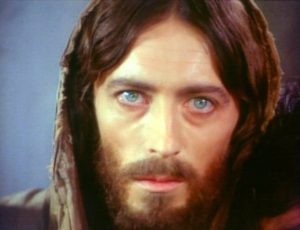
The characters are not fair-skinned, blue-eyed people, as portrayed in much Western artwork and movies depicting Bible stories. Think of the blue-eyed and very white British actor Robert Powell, who played Jesus in the 1978 movie, Jesus of Nazareth, and you’ll understand what I mean:

Robert Powell as Jesus

No, the Israeli characters are played by darker-skinned actors, and they also speak with a rather ersatz[9] ‘Middle Eastern’ accent. Except for the Roman characters, who speak with either an English or mildly American accent. Also really well done is the cosmopolitan nature of first-century Israel. Being at the ‘crossroads’ of many trade routes and central to the land-bridge between Africa, Europe and Asia, ancient Israel was a hotbed of differing cultures, peoples and races. This is why the story of the people who witnessed the coming of the Holy Spirit at Pentecost tells this:

“Now there were dwelling in Jerusalem God-fearing Jews from every nation under heaven. And when this sound [The disciples speaking ‘in tongues’] rang out, a crowd came together in bewilderment, because each one heard them speaking his own language. Astounded and amazed, they asked, ‘Are not all these who are speaking Galileans? How is it then that each of us hears them in his own native language? Parthians, Medes, and Elamites; residents of Mesopotamia, Judea and Cappadocia, Pontus and Asia, Phrygia and Pamphylia, Egypt and the parts of Libya near Cyrene; visitors from Rome, both Jews and converts to Judaism; Cretans and Arabs—we hear them declaring the wonders of God in our own tongues!’ Astounded and perplexed, they asked one another, ‘What does this mean?’ “

(Acts 2:5-12)

And  The Chosen reflects this eclectic mix of peoples really very well; the story-immersion resulting from the authenticity really is remarkable.

There’s lots of really great characterisations, such as the earnest and honest seeking of Nicodemus (brilliantly played by veteran actor Erick Avari), the impulsive, fiery and indeed ‘laddish’ Simon Peter, played by the Israeli actor Shahar Isaac, and Paras Patel‘s superb rendition of the fussy, pernickety, and quite probably Autistic, Matthew the tax collector.

Many nice touches are included too. Simon’s wife[10] ‘Eden’ is a lovely, down-to-earth and honest lady who absolutely adores him, and their on-screen chemistry is a delight to see. The excellent portrayal of decent, sincere-but-misguided yet conscientious and honest Pharisees like Shmuel, as opposed to the High Priest, Caiaphas, who seems to be in it (in the episodes I have seen so far, anyway) just for the prestige and power. Then there’s the Roman Praetor, Quintus, who is ambitious, scheming and cunning, but who has the redeeming quality of recognising Matthew’s ability to think unconventionally (which is why I think he’s supposed to be Autistic)[11] – even if that recognition is only to be used to further his own ambitions[12]. Compare Quintus with the gritty, practical and down-to-Earth Roman Centurion Gaius who nevertheless recognises Jesus for Who He is. He’s the guy whose servant is ‘remotely’ healed by Jesus as per Matthew 8:5-13 and Luke 7:1-10. And Elizabeth Tabish‘s Mary of Magdala is simply superb.

There are also some great theological lessons in there too, which are presented in excellent ‘backstory’ scenes – in that they are not of themselves in the Bible, but are placed in the episodes to flesh out the story. A great example is this little excerpt where the Pharisee Nicodemus is tutoring his student Shmuel on God not being a static idea:

I could go on. But it’s far better for me to simply shut up and let you go and look at this, yes, phenomenon, for yourself. There are many clips from The Chosen on YouTube. And I would say that, without exception, every single one has, in its comments section, many testimonies of how The Chosen has brought to life the Gospel stories like nothing that people have ever seen. Granted, there’s a lot of clickbait out there too. But the overwhelming message of those testimonies is that God has touched people’s lives through this series like few recent things have. Jesus has become more real to people who just want more of Him in their lives. People’s faith; people’s personal walk with Jesus, has been transformed by this series.

Of course, there’s also been naysayers who complain that it is not exactly faithful to the Scriptures. People whose hearts are hardened to the amazing thing that this content really is. These people, like the legalists in Matthew 12:22-32, miss out on what Jesus is doing because they are so convinced that they are more right than He is. They miss the things that God is doing because they have their heads so far into their own preconceptions, and what they think the Messianic prophecies will look like when they actually happen. They therefore have neither the eyes to see, nor the ears to hear. Well, it’s their loss, and I have no sympathy for them – except that their precinceptions have likely come partly from others’ influence. God will hopefully give those people too the ears to hear, someday.

But, for myself, even though I already know Jesus personally, and have experienced Him in ways that maybe others haven’t, this series has strengthened even my faith. It’s lit up the Gospels like nothing else. It’s also taught me things about my own thinking that I won’t mention here – the Secret of the Lord and all that.

But I am absolutely sure that, if you watch these series, your faith will be strengthened too.

Peace and Grace to you!


Header Picture depicts actor Jonathan Roumie as Jesus of Nazareth


Footnotes

Footnotes
1 And please accept apologies for the partial and fully unintentional alliteration!
2 At least, by accident from a human perspective; I am absolutely sure that this was one of those God-appointments. I feel as if I was totally set up… 😉
3 Yes, the 633 Squadron syndrome is my cynical term for making people wait until the end for the best bit. It comes from the epic 1964 movie, 633 Squadron, in which the film builds up, through a series of stories, subplots and other adventures, to the climactic battle at the end. The ‘original’ Star Wars  movie – later called Star Wars Episode IV – A New Hope – was also structured like this, and was in fact inspired by 633 Squadron, as openly acknowledged by George Lucas, the creator of the Star Wars universe. Both films are excellent, of course, and I only use the term fondly!

The reason the term is cynical is because I see it as a very common tactic used by sports organisers, where they have a lot of build-up before the event itself; by rock concert organisers where they have supporting acts before the main act (which is of course actually good for the supporting act) and especially at churches. This might be for a communion service, where they make you wait until the end before you get your bread and wine. Or, especially, at a baptismal service where you have to sit through all the other stuff and people talking at you before you get to the fun bit at the end. It also happens on clickbait websites where they make you click through pages and pages of preamble before letting you read the news article or whatever that you really came for – if indeed you do actually get to it at all. I very quickly escape from those sites once I realise what’s happening. In short, it’s where they make you sit and wait – rather like being in a school detention – rather than getting around to the bit that everyone has really come to see. And that’s why I have put this as a footnote, so that it gives you the option of not reading it should you so wish!

4 Specifically in the context of this essay, the Gospels, which are really the parts we’re concerned with here as The Chosen is a rendition of the Gospels. The Gospels are written more as a collection of anecdotes and are written as history; Jesus said this, Jesus did that. They are presented more as factual than entertainment.
5 Which probably lends more credence to its authenticity, in fact, because there’s no mechanism in there for suspension of disbelief or immersive description, which in a fiction or propaganda document would be plentiful. There’d be lots of narrative content such as adverbs and adjectives – descriptive words – to draw the reader in. But there’s none of that; not really.
6 Except, notably, at the beginning of the book of Revelation (Rev 1:13-16). The description there, of course, is in an apocalyptic vision and as such the writer is trying to describe the indescribable, and all that while in the apocalyptic mode – which means that it is written in a sort of code. Much of Revelation was – and is – never intended to be taken literally, and it would be a mistake to do so.
7 Knowing the terminally self-righteous mindset, though, they would doubtless have been openly criticising His ‘sinfulness’ because that’s what self-righteous people did back then, and still do nowadays too.
8 I think Season 6, the final season, is currently being filmed at the time of my writing this
9 Although, for some of the actors, they actually are of Middle Eastern origin, and their accents are therefore likely genuine!
10 As far as we know, from church tradition, Simon Peter was the only one of Jesus’s disciples who was married. We know that he was married, or at least possibly widowed, from the Gospel story told in all three of the Synoptic Gospels, in Mt 8:14-15, Mk 1:29-31 and Lk 4:38-39. In addition, 1Cor 9:5 mentions that other Apostles were also married, but it doesn’t say which ones. The reference in 1Cor9:5 refers to ‘Cephas’; this is Simon Peter.
11 [Edit]: Turns out I was right. The chartacter of Matthew, as portrayed in The Chosen, is indeed supposed to he Autistic. Here’s what The Chosen’s Director, Dallas Jenkins, writes about him:

“Dallas Jenkins, the creator and director of the show that has captivated millions, decided to depict the Biblical character of Matthew as a person on the autism spectrum.

“When we were first choosing Matthew to be a featured character, we noticed, ‘Okay, he is a numbers guy because he’s a tax man. He’s a facts guy because the first chapter of his book is a genealogy divided into three sections of 14 names apiece, so he’s very precise,” Jenkins explains to WW.

Jenkins continues, “He chose a profession that made him an outcast. I’m very familiar with the autism community. It’s in my family. I’ve done a lot of volunteer work there, so looking at that I go, ‘Boy, these are traits of Asperger’s or someone the autism spectrum. Wouldn’t that be interesting, very human and relatable to have a character who is like that? Is it factual? I don’t know. It’s plausible, and I think one of the top things that we’ve seen people relate to most with the show is the character of Matthew.”

And Matthew is played to perfection by non-Autistic actor Paras Patel; this role really showcases the guy’s acting ability and has in fact led him into becoming an advocate for the Autism community.

Quotation is from this article on Woman’s World.com

12 I love that quality in Quintus; how he recognises the special ability – call it a ‘superpower’ if you like – that Matthew has of being able to think like that. I too have that superpower and my boss in my last job knew about it, and invited me to participate in certain work meetings specifically because he knew I would bring a unique perspective to things because of that superpower. What a guy.

Attack of the Love Buts

This entry is part 17 of 19 in the series The Problems of Evangelicalism

I’ve written quite a lot on the kind of people – I call them the ‘grey people’ – who try to make the Good News into Bad News; people who deny the fantastic, complete and brilliant salvation[1] that Jesus brought. You tell them why you are full of joy, and they promptly tell you why you shouldn’t be full of joy[2]. We’ve all met these people! And, to me at least, these people – and their negative attitudes – are very much a part of the Problems of Evangelicalism, and thus the article is part of my eponymous series[3].

Well, some six years ago now, the brilliant Keith Giles wrote an article closely related to that subject, and I share it here in its entirety with his kind and indeed enthusiastic permission. Although the article is six years old, it is still fully relevant and timely, as I’m sure you will agree!


Attack of the Love Buts

Try this experiment.

Step 1: Post “God is Love” on Facebook or Twitter.

Step 2: Wait 10 minutes.

Step 3: Read dozens of posts from Christians who are eager to remind you that God is love, BUT God is also a God of wrath.

This is my life. Almost every single week. I get responses from Christians – always Christians – who cannot allow a post like “God is love and all who live in love live in God, and God in them” rest on its own without adding the asterisk about God’s wrath.

Just last week I posted: “For those who say we focus on Love too much, please remember: God IS Love”.

The first comment was from a friend of mine, Leyna Nguyen, who is not a Christian. Her response was: “There are people who say this?!”

And around 5 comments below hers, the wave of wrath started to crash. 115 comments later, the post led us to statements like this one: “God loves and never stops but He also hates. Hate is not the opposite of love and God has shown He does both continuously.”

[sigh]

My friend Glenn Warner calls these people “Love Buts”, because when you remind them that God is love, they must respond by saying, “Yes, God is love, BUT…”

Why is this? Why are some Christians so insistent upon contradicting all the numerous verses in the New Testament that practically gush with the extravagant love of God?

I mean, this is just a small sample of the verses I’m thinking of when it comes to the love of God:

“For God so LOVED the world…” [John 3:16]

“The LOVE of God is higher, wider, longer and deeper than anyone can imagine”[Eph. 3:14-21]

“Nothing will ever separate us from the LOVE of God” [Rom. 8:31-39]
“The only thing that counts is faith expressing itself through LOVE” [Gal. 5:6]

“LOVE is patient. LOVE is kind. LOVE keeps no record of wrongs.” [1 Cor. 13]

“God is LOVE.” [1 John 4:7-21]

Etc.

Do you know what you will never read following any of these pontifications on the amazing, unending, extravagant love of God?

You will never once read anything about the wrath of God to “balance” out this teaching.

You also never once read any statements about how you and I are unworthy of God’s love, or how we can’t earn or deserve God’s love.

Never. Not even once.

Instead, what we read is page after page, verse after verse of the fantastic, endless, transformative LOVE of God that is poured out on us night and day like a never-ending waterfall.

So, like it or not, we are loved.

What I don’t understand is why some Christians are so eager to shut down this love train. Why do they seem so afraid of a God whose character is love? Why are they threatened by a God who IS love?

Worse: Why are some Christians MORE afraid of a God of love than they are of a God of Wrath?

That’s what I legitimately do not comprehend.

Perhaps this is “Big Brother” syndrome? Like when the Prodigal Son returns home and the Father forgives him so completely and quickly and throws the party for him, it’s the older brother who can’t handle it. He hates the idea of this extravagant love being shared with his brother the “sinner” who deserves to sleep outside with the servants.

Maybe that’s the reason why some Christians today want to pencil into the margins of their Bibles a long list of wrathful God examples to balance out the overly-loving verses about a God who reconciles, forgives, embraces, restores, and loves His children no matter what they do.

What’s strange to me is that their New Testament scriptures don’t reflect their bias towards wrath, so they literally have to reach all the way back to the Old Testament – before Jesus came to us with the Gospel [and grace and truth] –  to find the pictures of a God they like better. Then they cut and paste that angry God’s face over the face of Jesus so they can sleep better at night; rest assured that they are loved and those other “sinners” are going to get what’s coming to them in the end.

But, I can’t buy that. I have to take the New Testament and the “Good News” of Jesus for what it is – Good News!

We are LOVED by a God who IS Love! We were created by this God of Love – in God’s image – so this means we are LOVED! Created by Love, in the image of LOVE, to BE Loved.

This is who we are.

Love is who God is.

Love is what God does.

Loved is who we will always be.

There is no “Love But…” verse in the New Testament. There is only love. Endless, boundless, unending, unrelenting, exceptional, amazing, fantastic, glorious love that we can only experience to believe and receive.

Hopefully one day those who call themselves followers of Jesus will relax and get comfortable with the idea of a God who really is love, inside and out. No “ifs”, “ands” or “buts” allowed.

Until then, I’ll just keep posting about the God who loves us more than life itself.

Won’t you join me?

 – Keith Giles, shared with his kind permission

Link to original article is here.

Footnotes

Footnotes
1 Salvation here referring to it in its broadest and most complete sense of the complete restoration of relationship with God; the wholeness, peace, healing and freedom that Jesus brought. Not the ‘being saved from Hell’ stuff, because I don’t believe in that theology, but even if Hell exists, then He’s saved us from that too.
2 Jesus spoke of these people in Matthew 7:6, where He suggested that people “Do not give dogs what is sacred; do not throw your pearls to pigs. If you do, they may trample them under their feet, and turn and tear you to pieces”. And that is exactly what they do. I will let you ponder the meaning and ramifications of such actions performed even by fellow believers!
3 As usual, the idea of ‘the church is, at the same time, both the best, and the worst, witness for Christ’ is true more in the second case (the worst witness) than the first case. These people are a proper pain; funsuckers, emotional vampires and definitely not people you would want to have ‘encourage’ you. They feature quite heavily in the Biblical book of Job 😉