
All posts by Tony

Van’s RV-9A

This entry is part 23 of 24 in the series Beautiful Destroyers
…and my Bembridge, Isle of Wight, Flying Adventure.

Last time I posted an article in this series was in 2020, in the midst of the Covid pandemic. The article was about G-VIZZ, the Sportavia/Fournier RS-180 Sportsman aircraft that I and a number of friends owned as a syndicate.

Sadly, we no longer own that aircraft. Since she was the only British-registered example of the aircraft, of which indeed a total of only eighteen! airframes were ever built, she was really expensive to maintain for various reasons, not least of which was the cost of spare parts, her age, and all this as well as our being a captive market to the very few specialist engineers in the country who were actually certified to service her.

And so, we sold her[1]. But, from the figurative ashes of our syndicate arose an even more beautiful flying experience.

Because we decided to build our own aircraft.

Allow me to introduce Alpha-Mike[2], a Van’s RV-9A[3]; a ‘kitplane’ aircraft of a class known as a ‘homebuilt’. The idea is that you get a series of boxes (very much like a giant Airfix kit), and a little tube of glue, and you build yourself an aeroplane in your garage 😉 Of course, it’s not quite like that, but essentially it’s that any halfway-competent engineer, including people who have learned basic car servicing and repairs and whatnot, anyone like that can build an aeroplane for themselves. They are less expensive to buy than an already-assembled plane[4], and you can customise the aircraft to your heart’s content as you build it.

Once it’s built, you then get in a qualified engineer from the UK’s ‘Light Aircraft Association‘ (the LAA), who checks your work for you. And then he gets in the aircraft, complete with his nerves of steel[5], and takes it for its first test flight. Wow, that takes some guts!

On an ongoing basis, then, we now do all our own servicing and repairs, and we have Alpha-Mike’s ‘Permit to Fly’ reissued (after an engineer inspection) once per year. Think of the Permit to Fly as being like an MoT test, if you will; it amounts to the same thing.

The aircraft is owned by Nigel, one of the former G-VIZZ syndicate members. Members of the group (we can’t really think of it as a syndicate because we don’t jointly own the aircraft) can fly her whenever they please. We even have a proper booking system. And this is the cheapest powered flying I have ever had, by far, so I can afford to fly more often[6].

And what flying! I’m going to get on with the main article now, and showcase this lovely aeroplane which is so much better in every way than any other aeroplane I have ever flown[7]. I’ve previously written about the Piper Warrior, the Cessna 152, and the RS-180; all aircraft I have flown on a regular basis. But the RV-9A is in a different league entirely.

(All the images in this essay are zoomable by simply clicking on them)

The RV-9A, like all of the aeroplanes I have flown – well, the powered ones, at least[8] – is a single-engined monoplane light aircraft, powered by an Avco-Lycoming engine. In Alpha-Mike’s case, the engine delivers 160hp of power to an aircraft with a maximum all-up weight of 970kg, as compared to the RS-180’s 180hp for 1100kg, or the Piper Warrior’s 1055kg powered by a 160hp engine, so there’s a fair difference in power-to-weight ratio.

Added to that, the clean airframe design, small forward profile (as you can see in the above photo) and optimised wing profile and even a ceramic coating, means that Alpha-Mike is a bit of a ‘hot ship’. She does 140kt[9] in the cruise – that’s about 160mph – and has an excellent fuel efficiency.

This is also, to a large extent, because she has a variable-pitch (VP) propeller. Unlike all the other aeroplanes I have flown, where the propeller blades have a fixed pitch (the angle they are set at on the propeller spinner), a VP prop can vary its pitch so that it makes it more efficient, taking a bigger or smaller ‘bite’ of the air with each revolution according to how it is set. This works in a very similar way to the gears on a car, so that it doesn’t have to stay in first gear all the time, but instead it can be set to lower RPM (and therefore using less fuel) if required. In fact, Alpha-Mike has a flight endurance of something like 4.5 hours on full tanks, assuming correct leaning of the mixture[10] and judicious use of the VP prop. So, not only is she fast but she’s efficient too[11].

So, we built her ourselves, then. Here’s a picture of her in her original hangar, where we did most of the work.

As you can see, we found the upper wing surfaces to be a very handy place to put all the tools and other bits of the stuff we were working on 😉 and she is pretty much complete in this photo, which was taken the day before her maiden flight. Once we’d shifted all that clobber off the wings, and reinstalled the left seat, we took her over to the fuel pumps to fill her up.

We had already done test runs on the engine, we’d calibrated various items like the ‘magnetometer’, which basically does the same thing as a compass, and so we got the brave engineer out to have a look.

Once he’d signed her off, he took her for her first test flight. Here it is, in all its glory:

Immerse yourself in the aviation vibe for this clip: the air-to-ground communications (we had an airband radio monitoring the Tower frequency), and the raw emotion in the voices of the observers. There was a whole group of us there; most of the people who had had a hand in her construction (about eight of us) were present for this maiden flight. You can hear someone near the end of the clip saying ‘Congratulations, Nigel’, and quite right too.

So, we had a brand-new Van’s RV-9A to play with!

Here is a photo of her instrument panel as it was just after construction was complete:

Originally, she had a single Garmin G3X EFIS (Electronic Flight Information System) – that big screen in the middle – and just a few of the traditional ‘clock’-style instruments on the panel: (left to right) airspeed indicator, altimeter, attitude indicator (aka the ‘artificial horizon’). The G3X handles just about everything, including the primary flight information such as airspeed, altitude, rate of climb and all the usual things, plus it has a built-in moving map display that runs on a GPS system, so that you’re never lost. The traditional gauges are there in case the G3X fails, which just never happens. Even in the event of an electrical failure, the G3X has an internal battery that will keep it going for several hours after mains failure.

Later, we refitted the instrument panel with a new layout, with no dials at all – a completely ‘glass cockpit’ – and also added in an autopilot system. Here’s the new panel; the autopilot box is the one at top centre, just under the ‘SmartGlide’ button[12]. Despite the G3X allegedly never failing, we also have two additional independent self-powered electronic displays: the Garmin G5 (the little box to the left of the main display); and the Garmin 720 on the right, the one that looks like a Kindle Fire or iPad. Between them, these three displays give triple redundancy on flight information display systems, even in the event of a total electrical power failure.

Here is the panel in flight, with the moving map display on the main panel (the purple lines indicate the route programmed in for the autopilot) and the PFD – Primary Flight Display, which displays all the important information such as airspeed, altitude, heading and so on. The sunlight today, up here at 4,000ft, is pretty harsh and also at such an angle as to highlight all the dust on the panel. Sorry about that!

What’s she like to fly? Well, in short, she’s gorgeous. Powerful, fast and enthusiastic. Once you open the throttle on the runway this little aeroplane is positively eager to enter her natural element. Before you know it, only seconds from a standing start she’s at 65kt; the ‘rotate speed’ or Vr, and she’s leaping into the air and accelerating as she climbs. Quite astonishing really, far in excess of anything I’ve ever flown before. Whereas with the RS-180 G-VIZZ, we’d routinely use ten degrees of flap for takeoff, and retracting them in the climb-out, we initially used that procedure with Alpha-Mike but we found out that even though we had flaps deployed, with all the extra drag they give, still she rapidly accelerated in the climb to speeds in excess of the maximum flap extension speed, thereby risking breaking something! And so we now don’t use flap at all on takeoff, even on short fields. She’s just too sprightly to need it!

Control harmonisation – that’s another way of expressing the ‘feel’ of the aeroplane – is excellent, with rudder, elevator and ailerons all beautifully balanced and without any of them being more ‘dominant’ than the others. For example, in the Piper Warrior II, another aeroplane I love, the slab tailplane does give a different feel because it has such a large ‘pitch authority’; it doesn’t need much effort to make the nose go up or down. The ailerons on the Warrior, however, are not as decisive as that, so that althought the Warrior is still a great aeroplane to fly, it doesn’t have the same balanced ‘feel’ that the RV-9A has.

View from the cockpit is simply stunning. While the occupants are not sitting as high up as they would be in the RS-180, and the windowsills are not as low as they are in that aeroplane (actually no aeroplane I know has the same view as the RS-180!) even so the view is excellent because of the bubble canopy. There’s only the one frame breaking the otherwise uninterrupted view. Lovely!

Landing can be a little tricky because the nose undercarriage leg isn’t very strong. This means that even though there are many elements such as crosswind, windshear, sink rate, airspeed and all the other multiple factors that the Pilot has to consider in order to make for a good landing, the thing that must remain high on the list of priorities for the RV-9A Pilot is that the brunt of the landing must be taken by the main undercarriage; the bits under the wings. The nosewheel leg, in fact, is not even considered to be ‘landing gear’ as such; it’s more a ‘taxying gear’, only to be used when the aircraft’s speed has decayed enough after landing to allow the nosewheel to be lowered safely[13]. This involves using a lot of back-pressure on the control column after touchdown, to keep the weight off the nosewheel until it’s safe enough to lower it to the runway. And even then, when I land this aeroplane, I only lower the nose when I can’t stop it lowering itself, when there is insufficient airflow over the tail to keep the nose up any longer; the elevator has lost its ‘pitch authority’, if you like. Even then, I keep on a good back-pressure on the stick because it still helps keep the weight off the nose as the propeller wash[14] still gives a little bit of elevator authority even at taxying speeds. But as long as this is kept in mind, flying and landing this aeroplane is a breeze, and indeed a real delight.

Bembridge, Isle of Wight Flying Adventure

Probably the best way to describe this aircraft is to let you see her in action, so here is a photo diary of an epic flying adventure I had in April this year.

As a bit of background, let me explain that my son David is also a Pilot, and he flies from Kemble Airfield in Gloucestershire. He asked me if I would like to do a landaway meet-up on the Isle of Wight; specifically, at Bembridge Airport right on the eastern tip of the Isle. He intended to rent a club-owned Piper PA-28 Warrior II to be his chariot for the day, and so we arranged to meet at Bembridge Airport at about 1045 local time.

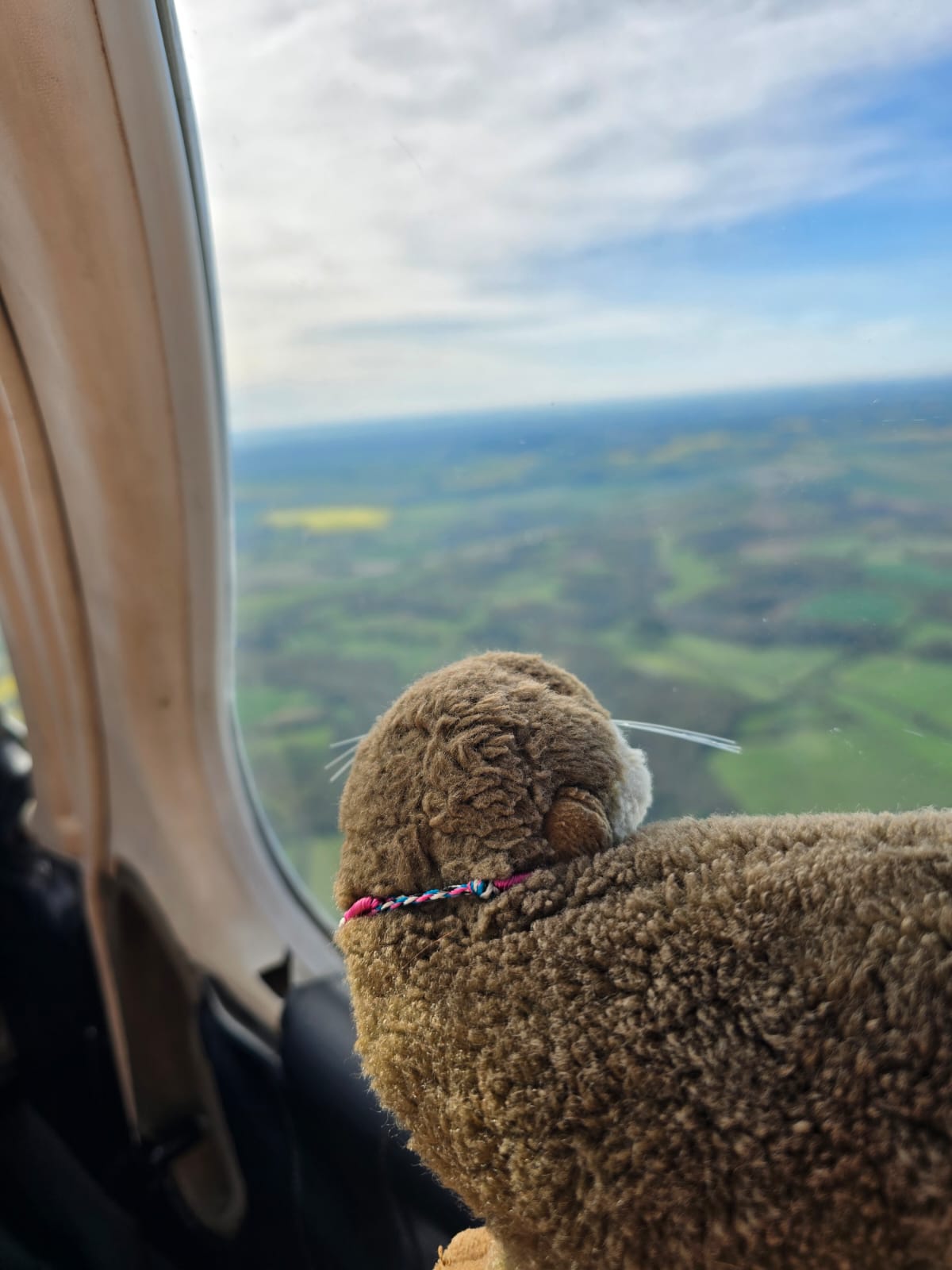
This trip was something I’d always wanted to do, ever since I had visited the Island back in 2015, back when Fiona was still alive, and with my daughter Ellie and some caravanning friends too. We had stayed on a campsite right next to the airfield, and so Bembridge has been on my landaway wish-list ever since then![15] So it was arranged that David, his wife Stace, and myself, plus Oscar – David’s toy otter mascot who loves to fly with him and goes on every flight with him – would indeed meet up at Bembridge and spend the day together on the Island.

So, I booked the aeroplane and checked the weather forecast for the upcoming weekend – this was on the Monday before the Saturday on which we flew out. Looks good on the long range forecast but of course that can all go to trash on the day. Did the PPR request – that’s ‘Prior Permission Required’ – basically an online form you fill in to let them know to expect you. It’s important so that they can account for your aircraft as part of the day’s traffic pattern, but also for safety reasons; if you don’t arrive something like when you say you will, they will have emergency search and rescue procedures that they will implement so that they can come and try to find where you’ve pranged the kite[16]. Planned my navigation route – headings, heights, speeds, landmarks, turning points. Danger areas like military ranges. Checked the NOTAMs – the Notices for Airmen; telling you about important things en route that may affect the way in which you conduct the flight. Things like high obstructions (cranes and stuff) near airfields, temporary airspace restrictions, temporary danger areas maybe because of high-energy military flying exercises (meaning fast-jets doing practice dogfights), temporary airspace restrictions for things like airshows or displays by the Red Arrows, or maybe even ballooning events. Looked up radio frequencies and generated a communications plan. Considered diversion airfields to be used in emergencies. Checked with Nigel to make sure the aeroplane was serviceable. Briefed about the fuel state and what he wanted me to do with the aircraft on my return – like did he want her refuelling ready for him the next flying day, that sort of thing. Comprehensive preflight planning is key to any successful cross-country flight, especially where that will involve a landaway and/or liaison with multiple ATSUs (Air Traffic Service Units, so people like radar services, control towers, approach services and all that sort of thing. Complying therefore with the annoyingly (and deliberately) alliterative Pilot saying, ‘Proper Planning Prevents Piss-Poor Performance’, which nevertheless highlights how important the planning stage is to the satisfactory execution of the day’s flights. Most people who don’t themselves fly also don’t realise how much planning goes in to a cross-country flight, especially one involving a landaway, and even more so on one involving flight over the sea, which this one did of course. I’m flying to an island, remember! Also, making sure I have the most up-to-date aeronautical chart; checking that my equipment is in good order (like my headset, for instance) and that I have all my pens and flying gloves and baseball cap and sunglasses and all the other bits I need.

Here’s the SkyDemon chart for the route, with the intended track indicated by that thick magenta line. SkyDemon is a brilliant piece of software that aids greatly in the flight planning stage, bringing together all the information that the Pilot needs for the route. Some Pilots I know use it on their phones and it acts as a kind of satnav, a bit like the Garmin G3X system in Alpha-Mike.

Well, the Saturday dawned bright and relatively clear, so, armed with the current met forecast (the weather) and what we call the ‘Actual’ (what the weather is like right now at the relevant airfields including diversions, and their TAFs: Terminal Aerodrome Forecasts; what the weather forecasts are for the airfields in question), off we trot for Exeter Airport.

Alpha-Mike lives in a hangar on the secure and non-passenger-related north side of the airfield, so I need a special (and expensive!) ‘Northside Pass’ to get in, and so I make sure that this is also in my bag before setting off.

Arriving at Exeter, I dragged the aeroplane out of the hangar and did my preflight walk-round inspection, where I look for potential problems on the aircraft, check the oil and fuel levels, make sure the windscreen is clean, and all the other minutiae that make for safe flying. Better to find a fault on the ground rather than have that problem announce itself up in the air! Once done, and once I’d refuelled the aircraft, it’s time to book out – that’s where I tell the Exeter Air Traffic people where I’m going and when I think I’ll be back; a bit like the PPR mentioned above and for the same reasons – and in we get. I had donned a lifejacket and PLB because I’m going to be flying over the sea. It’s only for six miles or so, but there’s a reason why it’s called a lifejacket! And the PLB is a Personal Locator Beacon; a radio device that you activate once you’re down in the drink[17] and floating hopefully the right way up, so that Air-Sea Rescue can find you.

Ok, so start her up, program the navigation computer and autopilot, perform the power checks and pre-take-off vital actions from the checklist, and then call for taxi clearance. Lined up on Runway 08 at Exeter and cleared for take-off, the view gave me the usual (but somehow always new) thrill of anticipation of adventure[18].

There is no finer view in all of aviation; I am going flying, right now, and I am going to interface with – and indeed become a part of – this singularly unique, finely-tuned and indeed beautiful piece of machinery called a Van’s RV-9A. And today she’s going to carry me nearly 100 nautical miles, in under an hour, to meet family for a lovely day out. What can be finer than that?

As always, take-off and climb-out are busy times so there’s neither time nor mental space for photography. But once established at the correct altitude, and in the cruise with the autopilot engaged, I am now hands-free for photography, as well as being eyes-free to keep a good lookout[19]. So here’s the first shot, of the Devon town of Honiton about four miles off my port beam (it’s visible just above the wingtip):

This is the Garmin G3X showing the PFD in full-screen mode, with the aircraft position shown on the mini-map inset on the bottom right. You can see that we are just a mile north of Seaton, East Devon[20].

Axminster, East Devon, just forward of the wing

The view forward from 3,000ft, with Lyme Regis at the bottom of the photo, and with Chesil Beach and Portland Bill just visible. It’s quite hazy up here this morning. But it’s still utterly, utterly glorious. 

Coming up on Dorchester:

Portland Bill and Weymouth Harbour just visible in the murk. Actually, visibility today is excellent for aviation, just not so much for long-view photography.

Coming up on Poole Harbour, Dorset

Brownsea Island, Poole Harbour. This island was the inspiration for the fictional ‘Whispering Island’ in Enid Blyton‘s ‘Famous Five’ book, ‘Five Have A Mystery To Solve‘.

Bournemouth coming up. I’m now what we call ‘feet wet’ (flying over the sea), but I also happen to be within easy gliding distance of the land should the hamster die[21].

See what I mean about the superb view from this aeroplane?

Approaching Hengistbury Head, Dorset, the turning point which will set me up on my new heading over the sea, heading out to the Isle of Wight.

At the same time, Oscar the Otter (whom I mentioned earlier) is at the controls of David’s Warrior aeroplane, most likely somewhere over Hampshire.

…while my autopilot system executes the coasting-out turn over Hengistbury Head for me. The town visible aft of the wing, there, is Southbourne, Dorset.

The view down the Solent through the murk, from just past Hengistbury Head. This is because it’s early morning; this will all burn off later in the day. The entire Isle of Wight lies to the right of picture.

The Needles, IoW

Taking over control from the autopilot for a few seconds, I racked the aeroplane into a fairly steep left bank so as to get this lovely shot of the Needles with their Lighthouse:

Now transitioning to manual control for a lovely sightseeing tour of the south coast of the Isle, I could still use the autopilot temporarily to hold the aircraft straight and level in order for me to take photos as required. This is Ventnor Downs, the steep hill above Ventnor. There are the remains of a WWII Chain Home radar station up there, which was attacked by German dive-bombers at the start of the Battle of Britain in 1940. I visited the site back in 2015, and there’s still a lot of interesting military archaeology up there. For a World War II geek like me, anyway…. 😉 

And now, coming up on Bembridge, the town on the Eastern tip of the Isle of Wight. The Solent, Porstsmouth  and Hayling Island visible in the distance.

Meanwhile, having relinquished control back to David, Oscar is now enjoying the view of the Hampshire countryside out of the passenger side window of the Warrior.
…while I have my target in sight! Bembridge Airfield’s main runway 30/12, just above the wingtip as I roll in to a sort-of ‘crosswind’ leg to set up the circuit. Runway in use today is Rwy 12 which runs in a south-easterly direction, so I’m looking up the opposite direction in this picture. I need to set up so that I will be landing in the direction that, at the moment, is towards the camera. Things get a bit busy from now on, positioning the aircraft, so as to join the circuit while at the same time avoiding annoying the neighbours by overflying their greenhouses, that sort of thing.

Aaaand safely on the ground at Bembridge Airport. Runway is concrete but the parking is on grass, so as I mentioned above, I have been really careful to keep the weight off the nosewheel while taxying on the uneven grass surface. Now I’m parked up and looking across to the Britten-Norman aircraft factory to the north east of the airfield.

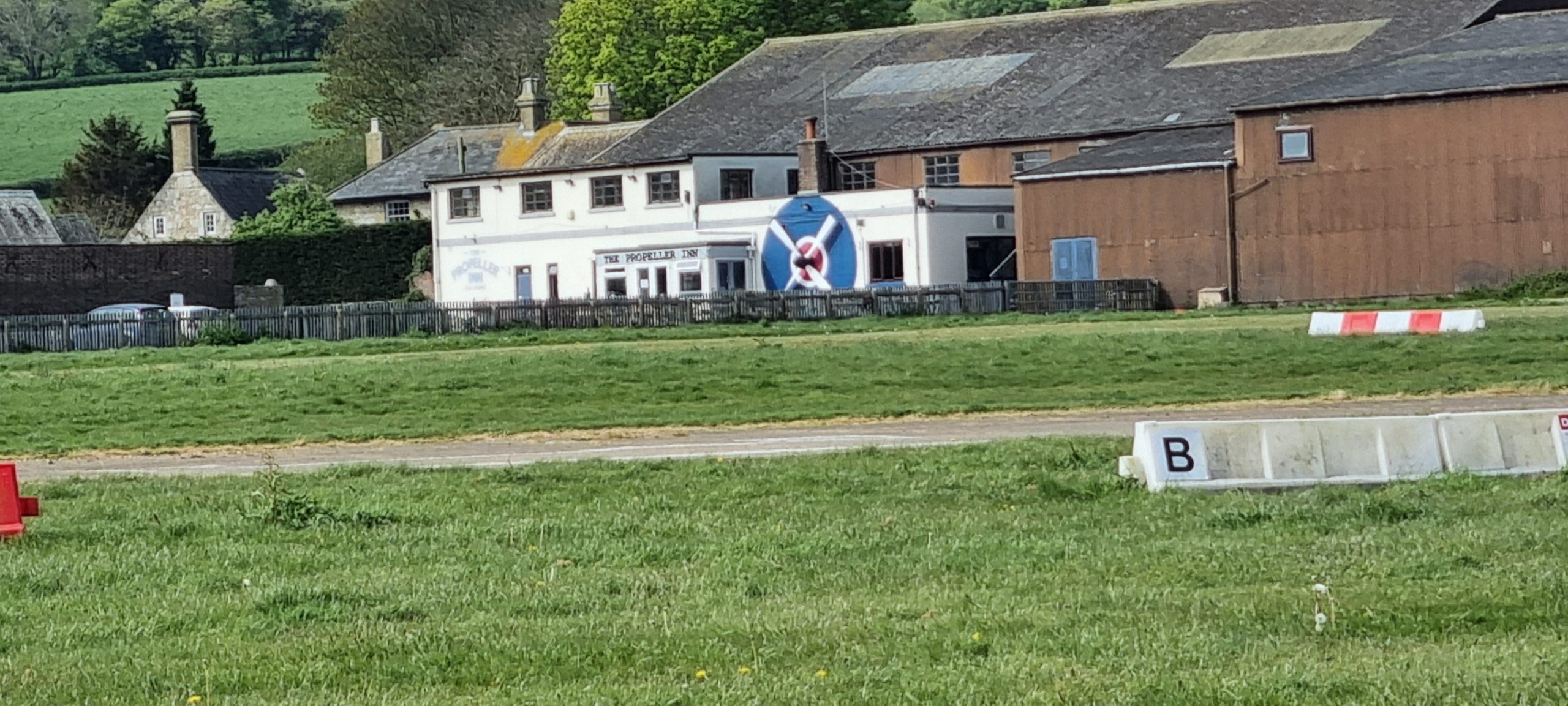
This is the Propeller Inn, Bembridge. I spent many a happy hour there in 2015 with Fiona and our friends on our camping holiday. More on the Inn later!
G-CSAM parked up at Bembridge. I was the first arrival of the day; it got a bit busy later on!The Cirrus aircraft with the red tail, parked beyond Alpha-Mike, is a Canadian-registered one. A local asked me if it was my aeroplane because I was wearing a Canada baseball cap… well I need something to keep the sun out of my eyes when up in the sky, and my brother (who lives in Canada) had sent me it a number of years ago, so I use that. You’ll see it in a later picture.

On the way to check in at Air Traffic Control, thought I’d bag this lovely view straight down Runway 30; the footpath passes directly across the extended centreline.

Back on the airfield after paying my very reasonable £15 landing fee, I got this nice shot of Alpha-Mike on the deck with her flaps down. What always gives me a really strange feeling during a landaway is that I look across the airfield at the parked aeroplanes, single out ‘my’ aeroplane, and think like ‘Crumbs, I came here in that, and that’s how I’m getting home too’. Similar to parking a car, I suppose, but evoking an unparalleled sense of wonder at the same time.

Anyway, In the background, there’s the treeline…and behind that treeline is the caravan site where we stayed in 2015 for that holiday I mentioned. Although now it’s all static caravans, not touring caravans like mine.

Listening out on my airband radio, and also watching on my phone app, I could see David’s Warrior aeroplane approaching the Isle from the mainland. Because of this, I was ready to shoot this video of his landing using Alpha-Mike’s tailplane as a rest 😉 You can hear the radio chatter on my airband radio. The strange buzzing engine sound is not David’s aeroplane; it’s another aircraft off-camera that had a weird sort of buzzing noise for its engine sound. Maybe it was powered by an electric shaver or something, I don’t know.

So once we’d met up, hugged and signed them in, we set off on a lovely walk down into Bembridge town proper, including a yummy lunch at the Harbour View Cafe. After wandering along the beach for a bit, we walked back up to the airfield. Many more aircraft had arrived by this time! Alpha-Mike is third from the left in the front row; David’s Golf-India is fifth from the left, next to the Canadian-registered aircraft to the right of Alpha-Mike.

Here’s a close-up of David’s chariot for the day, the beautiful Piper PA-28 Warrior II, G-EDGI.

Now we were back at the airfield, we popped in for a lemonade at the adjacent Propeller Inn. Like I said, I had stayed on that caravan site next to the airfield in 2015 for two weeks, and since then I have always wanted to do a landaway there. Although there’s now that treeline we saw earlier blocking the view from the campsite, and the Propeller Inn is under new ownership – they have sacrilegiously removed all the aircraft models from the ceilings[22] and there was a bartender bot with absolutely no personality whatsoever; couldn’t even call him an NPC as he had no script – anyway things haven’t changed all that much over there. Things hardly ever change on the IoW, except that now they have a decent phone signal.

But we had to leave at some time, so we said our goodbyes and boarded our aeroplanes to fly home again.

Here’s the view down Runway 12, lined-up and just prior to beginning my take-off roll. This view is simply unbeatable:

 

Five minutes after liftoff and already at 3,000ft, here’s a view of Shanklin, IoW, with Sandown just to the right/East. Sandown airfield is visible in the centre of the photo. From up here, I could see the entire Island and the Solent, Portsmouth and Southampton all in one go. Simply stupendous.

Time for another scenic cruise around the south coast of the IoW, and here’s Ventnor Downs again. Note how much the visibility has improved. You can see for miles now.

Coming up on The Needles again, the western tip of the Isle of Wight.

What happened next was almost unbelievable; one of those things that happens occasionally when flying. It was completely unexpected when the Bournemouth Radar controller, from whom I was in receipt of a radar service[23] suddenly called me up and said, “Golf-Alpha-Mike, traffic is a Spitfire, one thousand feet below you on a parallel heading. He’s probably headed for The Needles”. I heartily agreed that looking out for a Spitfire would be a great idea and she told me it was in my 2 o’clock low. So I looked and Tally-Ho! – I’d spotted him[24]; the Spit was very low on first sighting; as she said, about 1000ft below me, and I kept sight of him for about a minute then lost him in the background clutter. A minute or so later, I glanced at the Needles, which I was just passing, and there he was! The aircraft can be seen in this photo if you zoom riiiight in just left of centre, and just in front of my wing. As is always the case with amateur aerial photography, he was a lot closer in reality than he looks in the picture! This was very much a point-and-hope shot which fortunately worked out rather well. The black thing at the bottom middle of the photo is the Needles themselves. Can you see the Spitfire? What a great thing to have briefly shared airspace with such a legendary aircraft! 

After my epic encounter, I still had to cross the Solent! Here’s Hengistbury Head coming up ahead. The black marks on the picture are the way in which the camera picks up the propeller blades whirling around.

Over Hengistbury Head, a lovely shot looking at early evening mist in the direction of Swanage. Poole Harbour to the right of the shot.

Swanage and Ballard Down, with Studland in the foreground. Look how clear the air is.

Portland Bill and Weymouth again. If you compare this photo with the one from the morning, you can see how much the visibility has cleared up.

I don’t often do selfies but here’s me displaying the ‘RV-9A grin’. It’s going to take me a few days to lose that, I think. And there’s my Canada ball cap too:

Final shot of the trip, approaching Lyme Regis to my left. After this, things were a bit busy, so no more photos I’m afraid. Flying almost directly into a low-ish sun, with haze still present over home plate despite the clarity here, and trying to look out for other aircraft in that muck too, also trying to see my home plate at Exeter coming up. Certainly not a time to be mucking about with a camera, even with the autopilot in operation. 

So, like I said, a lovely day out and it took me at least a week to lose the grin! And what an adventure, especially with the Spitfire sighting![25]

The RV-9 grin. What a lovely aeroplane and I am privileged beyond measure to be trusted with flying this little beauty. And also to have been able to share, in some small measure, my adventure to the Isle of Wight. Even now, over a week later, I am still enjoying flashbacks of the things I saw and experienced on that trip. I will go again this summer, I think!

Footnotes

Footnotes
1 She now lives at Lasham, home to one of England’s main gliding clubs. Given that she has a glider-towing attachment, I would not be surprised if it were the case that they were using her for that purpose.
2 The aircraft’s name is given by the last two letters of her registration, so, ‘Golf Charlie Sierra Alpha Mike’, becomes ‘Alpha Mike’.
3 The designer, Richard VanGrunsven, uses his initials to name his different aircraft designs, hence the initials ‘RV-9A’. The RV-9 is the tailwheel version; the RV-9A (like Alpha-Mike) is the tricycle version with the nose wheel
4 Although, Van’s Aircraft do actually sell completed aircraft too.
5 To put it politely 😉
6 I used to fly gliders back in 1991, with the Leeds University Gliding Society, but as that was affiliated with the RAF Gliding and Soaring Association, it was heavily subsidised and therefore very cheap.
7 The sole minor exception is that she has only two seats rather than four, but that doesn’t really matter as I have very rarely flown a four-seater with a full load of passengers, and in any case the logistics of getting four people together to go flying all at the same time is quite something!
8 Over the course of my flying ‘career’, I have flown something like fourteen different aircraft types, including four gliders (Grob Acro, Schleicher Ka-2, Schleicher K-7, Schleicher K-13) and ten powered types (Cessna 152, Cessna 150 Aerobat, Diamond DA-20 Katana, Piper PA-28 Warrior II, Piper PA-38 Tomahawk, Robin R2160, Ikarus C42, Sportavia RS-180 and of course the Van’s RV-9A).
9 As opposed to 90kt (100mph) for a Cessna 152 and 100kt (114mph) in a Piper Warrior.
10 ‘Leaning’ refers to the adjustment of the fuel/air ratio (the ‘mixture’) going into the engine, by using the red ‘mixture’ knob visible on the photos in this article. As the air density decreases with altitude, you can end up with too much fuel in the mixture – known as a ‘rich’ mixture – so you need to make the mixture more ‘lean’ (hence: ‘leaning’) in order to correctly match the proportions of air to fuel. The reverse happens as you come down; the air gets more dense so there will be too little fuel in the mixture (it will be too ‘lean’), so you need to enrich the mixture again using the mixture control.
11 Having the VP prop also meant that the group’s Pilots had to have additional training to get the VP prop rating put on our licences, as we also had to for the Garmin EFIS (the Electronic Flight Information System or ‘glass cockpit’) too. So now we are all VP prop-rated and EFIS-rated Pilots as well as our basic Private Pilot’s Licences (and I have a Night Rating as well, of course). These ratings are lifelong and they mean that we can now fly any aeroplanes with VP props and/or EFIS avionics.
12 This activates emergency glide protocols in the event of an engine failure, including turning the aeroplane towards the nearest airfield within gliding distance. Really clever!
13 Taxying is the term used for driving an aeroplane around on the ground, as opposed to up in the air.
14 Propeller wash, or ‘prop wash’, is the high-speed airflow around the aircraft’s fuselage caused by the propeller acting like a giant fan, which, I suppose, it is…. 😉
15 A ‘landaway’ is exactly what its name suggests: a landing away from your home base. Most private pilots’ sport flying careers consist of simple local jaunts where they take off from their home plate, fly around the local area a bit, and then return to the place they set off from. A landaway is where you fly out to another aerodrome and buy a coffee, lunch or breakfast, then fly back to base after you’ve had a wander around on the ground at your landaway destination. With G-VIZZ, one of my favourite landaways was the short grass strip at Bolt Head near Salcombe, Devon. I’d land there, go for a lovely cliff-top walk, then return to the airfield and hop back into the aeroplane to fly back to base at Exeter.
16 Where you’ve crashed 😉
17 The sea!
18 The blue hangar in the middle distance, to the left of centre, is the hangar in which we built the aircraft.
19 I could really get used to that autopilot!
20 For those who are used to interpreting a Garmin G3X display with autopilot, you may be wondering why the autopilot is executing a descent when we are below the requested/preset operating altitude. That’s simply because I am still learning to drive the thing; using an autopilot is not as simple as just pressing a button and it takes over. Well, not once you get under the hood, anyway. I had sorted it all out within a few minutes!
21 Everyone knows that light aeroplane engines are powered by a hamster running on a little wheel, under the engine cowling; this makes the propeller go round very fast.
22 Sacrilegious, because how can you have a pub right next to an airfield, keep its name as the Propeller Inn, have a giant propeller stuck on the outside of it, and then remove all the pre-existing model aircraft from the ceiling in the bar?? Seriously, someone needs to be shot for that!
23 A radar service is basically where the radar station has you on their screen; they keep a lookout for other aircraft in your vicinity and warn you if there’s any chance of getting too close to each other. No substitute for keeping a good lookout, of course, but it does add an additional layer of safety. It’s like having an extra pair of eyes.
24 Tally-ho! was the code word adopted during the Battle of Britain in 1940, which RAF airmen used to tell their radar controller that they’d seen the aircraft (usually enemy!) that they’d been vectored to intercept. While it is not correct radio procedure nowadays to use ‘Tally-ho!’, still I do use it occasionally and they know what I mean 😀 I think I used it on this day, but I can’t remember for sure!
25 Only twice in the past have I seen anything similar; on both those occasions I was flying in the same bit of airspace as the legendary Red Arrows. Once was in 1991 at RAF Dishforth near Ripon, where I used to fly gliders with the Leeds University Union Gliding Society, which was affiliated with the RAF Gliding and Soaring Association. Just as I was completing a winch launch at about 1000ft above ground, two Red Arrows Hawk jets flew over me about a thousand feet higher up and going in the opposite direction. There was an air display going on that day at RAF Leeming, ten miles further up the A1. So I could legitimately say I’d flown with the Red Arrows! 🤣 The second time was a couple of years after I got my licence. On one day in August 1999, I was flying solo circuit practice at Plymouth Airport when a voice came over the Tower frequency, “Plymouth, good afternoon, The Red Arrows!”. Tower was unfazed. “Station calling Plymouth, say again your callsign”. So funny. I’m afraid I don’t think he’d misheard, nor was it that he couldn’t believe his ears; I think he was trying to wind them up. I suppose you had to be there. Anyway, the unflappable Red One calls back, “Plymouth – The. Red. Arrows! Crossing ten miles north abeam your airfield”. And so both I and the controller looked, and there they were, a close group of little aeroplane-shaped dots in the distance which were nevertheless, very distinctly, red. I think they were on their way to display at Fowey in Cornwall, they do tend to display there at least once a year even to this day – although last year (2025) it was at Falmouth.

A Dark Testimony VI – Christy’s Story

This entry is part 27 of 39 in the series The Problems of Evangelicalism
Trigger Warning – Contains stories of severe spiritual and religious abuse and trauma. You have been warned!

Here is a heart-rending testimony from my dear friend, Christy Lynne Wood; a lady whom I have never met in person but nevertheless I count as a friend because we support each other’s online ministries remotely.

Christy came from a background in the ‘Institute in Basic Life Principles‘ (IBLP) group, which I would name as a cult in just about every way[1] and founded by Bill Gothard in 1961. (That’s before I was born!) In common with many other Christians with whom I have had positive online interactions over the last decade or so, Christy is therefore a cult survivor. She has had the courage to identify and name the problem, and to do something about it. And now, she blogs about her wisdom and experiences. My heart always rejoices when I see a notification in my inbox telling me that she has published another blog post!

Christy’s post contains things that parallel closely many of the previous ‘Dark Testimony’ articles in my series ‘The Problems of Evangelicalism‘, and so I have now included it in that series. Although not strictly-speaking an Evangelical church, some of the IBLP group’s teachings have been gradually and insidiously introduced into modern Evangelicalism – such is the cross-pollinating nature of religion, even across different denominations – and so their attitudes have also been incorporated into Evangelicalism, including Christy’s old church, where IBLP principles were held by most of the families in the congregation[2]. That’s another reason why this is relevant to the series. In common with all Evangelical or pseudo-Evangelical groups, these are the sorts of things they don’t want you to know about. And that’s the biggest reason of all why they should be shared in public!

Anyway, Christy is herself an experienced teacher and an excellent writer who clearly and indeed prophetically expresses what is on her heart. Other than this short introduction, I need add no more to what Christy has to say. I’m sure you’ll find her story helpful.

Over to Christy:


Seven Years Ago Our Bubble World Shattered

Yet another story of spiritual abuse and religious trauma in the church

Telling My Story

Seven years ago, on March 9th 2017, our little Christian bubble world finally splintered into pieces. But we were forced to pretend everything was fine for two more months.

This is the first time I’ve purposefully and clearly written about this part of my story. I’ve hinted at it, skittered around it, and gave vague suggestions, but today I’m telling the truth. It’s a weird combination of re-traumatizing and validating.

I’ve had seven years to process, seven years to learn I’m not alone, and seven years to try and pick up the pieces so that I can heal. It’s not just my story though, it’s also my husband’s story and he has dealt with it differently.

So today this is for all of you who have faced spiritual abuse and religious trauma and been able to heal and grow, but it’s also for those of you who haven’t. It’s for those who’s faith has been shattered, who’s trust has been destroyed, and who struggle to step foot into a church. I want you to know that I see you and feel immense compassion for your pain. We all experience trauma differently and there is no “right way” to move forward (despite what the Christianese phrases tell you).

I met my husband at a Christian summer camp. We worked together at camp for a couple of years, so going into Christian ministry of some sort seemed like the thing to do. We were young, idealistic, and passionate about serving God. Four weeks after getting married, we loaded up a moving truck and our junky, little Honda Accord and took off for the state of Wyoming.

The town of LaGrange doubled in size for nine months of the year while the students were in town. In the summer it went back to the original 322 residents plus a few married couples like us. We spent three years in the Wyoming prairie surrounded by more cattle than people while studying at Frontier School of the Bible.

Having met at camp, we originally had dreams of doing camp ministry. Then my husband landed a part-time youth pastor job at a “local” church forty-five minutes away. We did everything as a team back then so youth pastoring a bunch of junior high kids was fun too, especially since the church ran a rustic camp for three weeks each summer.

After graduation, we came back to Michigan and started an internship at the camp where we first met hoping to eventually come on as full-time staff. Three summers and two babies later, we realized—much to our disappointment—that there was no potential for a job there. However, the church we’d been attending for the last couple of years needed a youth pastor. It seemed like the perfect open door, so we walked through.

Full-Time Ministry

Within the first few months there were red flags. But we were young, idealistic, and filled with the belief that this was God’s plan. It didn’t hurt that we’d just been used and abused at the camp where we interned, so the church felt healthier to us. It was easy to make excuses. Maybe we were just misinterpreting things. The senior pastor was probably just trying to make jokes and didn’t mean the hurtful things he said about my husband from the pulpit.

Sometime within our first year at the church, the senior pastor took a much anticipated three month sabbatical. I think he expected the church to fall apart without him around. Instead it thrived. My husband was relational, organized, and passionate. He never meant to try and usurp anything, but there was tension when the senior pastor came back that simmered under the surface for the next four years.

We saw flaws pretty quickly at the church, but we hoped that God would use us to help heal them. We knew that no place was perfect and we were willing to ignore or make excuses to keep the peace. Sadly, I’m much more realistic and skeptical these days.

man in black pants and pair of brown leather lace-up shoes sitting on brown carpeted stairs inside room
Photo by Ben White

There was tension between my husband and our senior pastor within the first year of working together. My husband believes that everything should be done with excellence. He is not afraid to push back when he feels things are unethical or wrong which earned him the nickname of “Pastor Picky.” The senior pastor had been in charge for enough time to want to keep power in his own fist. He didn’t appreciate criticism of any kind and had surrounded himself with elders who were either “yes-men” or solidly on his side. I didn’t know it at the time, but this is a pattern for abuse within the church.

It was never a healthy situation. My husband always struggled. But we loved the people at the church. The youth group was growing. It looked successful on the outside. I think we also like the title of being in ministry. It was part of our identity.

It All Started at Camp

I decided to back to camp for a couple of summers as a health officer. I should never have gone back. I knew how we’d been treated during our internship. I swore when we left that I was done. But I loved camp.

I’d found freedom in Jesus there. I’d met my husband there, my babies had been born there, and my dad was currently working on staff as the maintenance manager.

So I loaded up my two small children and we spent two summers riding around on a golf cart, doing clean cabin checks, handing out meds and Band-Aids, and comforting homesick campers. My husband worked at church during the day and then came and spent the evenings with us. Parts of those summers were amazingly fun! I’d always dreamed of being the health officer. I had a golf cart. My children thrived. I loved supporting the young adults on staff. But there were dark clouds too, especially the second summer.

I should have handled everything differently. But I was not the same person back then. I was still stuffing my leadership gift and passionately avoiding conflict. I was still trying to be sweet and not strong.

I should have confronted the abuse I witnessed. I should have boldly stood up for the broken people. I should have challenged the unethical behavior and the potential affair. But I didn’t. Instead I talked to other people who also noticed. We tried to figure out what to do together. And because we noticed a problem, we became the problem. I was labeled a gossip while the true problems were ignored.

I should have quit half-way through the summer. But I didn’t.

People who were involved in the mess at camp were also from our church, so the summer trouble followed us back. Big time.

And Followed Us Back to Church

I was distraught about what I’d witnessed at camp and also about the abuse my dad had experienced. (Little did I know that the exact same things would happen to us.) Seeing that I was a wreck, our senior pastor offered to counsel me. I use that word in the loosest possible way. For six weeks I sat in his office and spilled everything to him. He took what I said, tried to gaslight me, and then instead of protecting me, told everything to the other person who was at camp with me. I’ve never had an enemy before, but I did after that summer.

We tried—my husband and I. I knew that I hadn’t handled everything perfectly. I’d made mistakes, and I tried to reconcile. But it went from bad to worse. I was still reeling from the spiritual and emotional abuse I’d experienced at camp, still broken by what had happened to my dad and other summer staff members. Still upset that what looked like an affair was being ignored. Our pastor was the only one I could share with because he wouldn’t let me tell anyone else. And even though he was also abusing me, at least I had someone to talk to. Then he went on a mini-sabbatical for a month because they were adopting a child from overseas.

I honestly thought he told me that I could tell our new associate pastor and his wife if I needed to talk to someone while he was gone. And I didn’t tell her about the affair, just about the abuse I’d witnessed. She was a licensed counselor and I thought she might be able to help. Like any sane person would be, she was horrified at what I shared. So she told her husband. Who told the senior pastor when he got back. And I got in trouble.

I was called a gossip again. I was kicked out of women’s ministry with no hope of going back. I was no longer allowed to sing with the worship team. Every Monday, no matter what I did or didn’t do, the senior pastor would yell at my husband about how terrible I was and how I wouldn’t change.

Because he couldn’t break me. I refused to take all the blame. I knew that what happened at camp was wrong. And that what was currently happening was wrong. I refused to stop noticing the problem.

These were the hardest months of my life. They nearly destroyed me. I felt like the woman caught in adultery just waiting to be stoned.

We Should Have Quit

We prayed about quitting. We should have. But we loved the people. We loved the teenagers we worked with. We believed that God could work a miracle in the heart of the senior pastor. So we stayed. Until we couldn’t stay any more.

Eventually my husband was called into a meeting and told that we didn’t have chemistry with the senior pastor and therefore we were being forced to resign. It was March 9th. He was informed that the elders wouldn’t be telling the church until May and that if we said anything before that, or told the truth about what had been happening, we would be kicked out immediately with no severance package.

person looking out through window
Photo by Noah Silliman

We should have quit right then and there. But we didn’t because we were poor, emotionally ragged, and had two small children to feed.

For two months we carried this horrible secret. And every Monday my husband was told how awful I was being even though I was just literally hiding in the church basement making coffee every Sunday. It was the only ministry I was allowed to do. My husband endured verbal, emotional, and spiritual abuse during this year from hell. But we didn’t have the words to describe it as abuse back then.

During these two months, our pastor decided that I was such a mess that I needed professional help, so he sent me to Miriam. At the beginning of the first session I had three questions for her. I wanted to know if she was familiar with Bill Gothard’s teachings, if she thought they were wrong, and if she would promise to keep everything I said confidential from my pastor. When she confirmed those things, I poured out my heart for forty-five minutes. At the end Miriam looked at me and said four beautiful words, “Christy, you’ve been hurt.”

It was the first time someone validated me instead of blaming me. The church paid for eight beautiful sessions with her. I finally realized I was being abused and not going crazy. Sure enough, our pastor called after the first session, but Miriam had heard enough and refused to talk to him.

The End

Eventually they told the church. The senior pastor called a church wide meeting to announce “God was calling us elsewhere.” People were upset and confused. But we didn’t tell them the truth. We stayed quiet. The church originally asked us to stay through July, then it changed to the beginning of June. Shortly after our resignation was announced, we were told to stop coming to church at all because we were too sad and it was making everyone else sad. So it all just ended.

We got our severance, they got our silence, and we lost our community, our friends, our children’s godparents, and our identity.

Why Tell This Story?

There are plenty of people who question the validity of telling these kinds of stories. They push back by asking about motives, suggesting exaggeration, or claiming that we need to stay quiet “to protect God’s name.”

But the sheer amount of these stories says otherwise.

I’ve realized over the past seven years that for every story that goes public, there are probably hundreds that never get shared. For every one pastor who is exposed for being abusive and controlling, many others will go on abusing without being caught or stopped. This kind of thing is an epidemic in the church right now. I’ve read some wonderful and validating books. My favorites are in the picture below.

Not only do we need to tell these stories for accountability, but we also need to tell the stories so that those who have experienced this type of abuse can recognize that they are not alone. Reading Beth Allison Barr’s story of her husband’s forced resignation in The Making of Biblical Womanhood was eerily familiar—to the point where I wondered if they pass around a script. Hearing the stories on The Rise and Fall of Mars Hill validated my own.

It is helpful to know that we are in good company even if we are all a bit mangled.

Stronger than Ever Before

Personally, I’ve risen from these ashes with new strength. I see through lies faster, approach Christianese with more cynicism, and am quicker to call out abuse. But I’m also gentler and have less answers for those who have been through hell and come back. I have more compassion and empathy. I will sit and cry with you and say nothing.

My own faith in Jesus is more solid than ever. But I will also stand up and quit next time so that I can tell the truth. This abusive control we are experiencing is not Jesus and it needs to stop now.

If you have been spiritually abused, I just want you to know that you are not alone and it’s not your fault. You have been hurt.

Looking for God’s Grace

I’m going to close with Miriam’s ask for me after that first counseling session. She wanted me to look for God’s grace each day. It might be in a sunrise, or a baby’s smile, or a small green leaf poking out of the dirt.

That was something I could do.

Can you find it too?

macro photography of green grass
Photo by Emmanuel Mbala


Thank you, Christy, for your gracious and indeed enthusiastic permission to reblog your post! As you will see, I have just copied it and pasted it more or less straight in to my blog  😊

Here is the link to the original article

Grace and Peace to you all ❤️

Footnotes

Footnotes
1 They market themselves initially as a sort of personal improvement course, but this is just the ‘hook’; the ‘gateway’ to deeper involvement and eventual indoctrination, enslavement and abuse – some of which is of course sexual. They call themselves ‘non-denominational’, which has increasingly – to me at any rate – come to suggest strongly that they are some sort of cult. Certainly, the church I wrote about in my recent article ‘I Was A Stranger‘ would claim to be non-denominational. The term always hoists red flags for me nowadays! Although they are not a fully Evangelical group (they differ from Evangelical doctrines in several ways), their methods are pretty much the same in many respects, and so I am using Christy’s story as a parallel to the exact same things that happen in Evangelical churches. In addition, the IBLP are also strongly into home-schooling which, while a valid method of schooling children where the children can’t otherwise access education (say if they are housebound due to a disability or something), in other cases is simply a means of isolating children from the outside world so that they can be effectively indoctrinated without any interference from reality. It seems that wherever humans gather in the name of Religion, these things happen.
2 It might be relevant to mention at this point that the extremely problematic and yet very popular TV series, ’19 kids and counting’ (or whatever number of kids they’d reached at the time of filming 🤣), was about the Duggar family who were/are still themselves part of the toxic IBLP movement.

Vision of the Valley – Reblog

This entry is part 26 of 39 in the series The Problems of Evangelicalism

Nearly eleven years ago, I published this blog item about the way that hard and unbending Religion treats people. I used Don Francisco’s epic song, ‘Vision of the Valley’ to illustrate the concept, and also wrote quite a bit of prose to go along with it.

Back then, I had no way of knowing that now, over a decade later, I would be writing a blog series describing exactly the same issues in Christianity; the only difference being that I am being more specific and focusing on Evangelicalism, because that’s where I came from in terms of my faith point of view.

Since the original publication of my article, Evangelicalism has got worse. Without getting political, I am sure that my readers are well aware of the excesses and apostasy of, particulary, American Evangelicalism, but also noticed that British Evangelicalism is going in a similar direction. Heaven help us. Oh, Heaven, help us!

As we have seen from my recent extended piece describing the disgraceful ignorance of an Evangelical congregation near me, it is apparent that religious people are getting more and more polarised away from the very people . ‘The World’ – that they are supposedly meant to be ministering to; trying to ‘save’ them, even. They take more and deeper entrenched positions, they stubbornly resist the changes in society like as if they were trying to stem an advancing tide, all the while claiming that ‘it’s the World that needs to change, not the Bible’. They remain fully unaware that the very faith they are ‘trying to protect’ was itself once a ‘change in society’; Britain was not always a Christian nation (if indeed it ever really was). The ignorance of history displayed by these people is simply staggering!

But anyway, less of that. I will pass you over to the Tony of 10 1/2 years ago, where I describe why I was posting the essay I wrote, and what it was all about. And I am sure you will realise that, in terms of Religious polarisation, things have gotten much worse since then.


In 1991, the Christian musician Don Francisco published an album entitled ‘Vision of the Valley. The title track, ‘Vision of the Valley’ was a prophetic song depicting God’s feelings against the fake shepherds of the Christian Church; those interested in being leaders only for the money, the power and/or the prestige and social standing that the ‘job’ gave.

Now, almost a quarter-century later[1], I believe that this song is echoing what Father is doing in this time.

You see, for too long, many (but not all) churches all around the world have concentrated on god’s anger, judgement, ‘holiness’ (in this context, meaning his being ‘set apart’ from, or in other words allergic to, ‘sin’), rules and laws, and other unsavoury aspect of the character of ‘angry god’ portrayed especially in the Old Testament. Churches have been harsh and unbending, they have been unwelcoming to those that don’t fit in. The way they treat their members, at least those who deviate even slightly from the ‘normal’ behaviour, is reprehensible. They have persecuted the minorities – such as gay/lesbian/transgender people, they have rejected the widows and their children (divorcees and remarried people – see my article on this here) and they have shunned those who do not agree with them on absolutely every point of doctrine.

There are people bleeding and broken by ‘heavy shepherding’ – bullying, strong-personality leader types who make their congregation do things without question and order them around in God’s Name, and confront them with their ‘sins’, supposedly ‘in love’.

Love could not be further from these people. They are not being Christ to their people, nor to those outside. Is it any wonder, then, that the world looks in on the Church of today – whether that particular congregation is guilty of this or not; they are all tarred with the same brush by those outside – with contempt. This is the face of Religion – cold, hard, unbending, unmerciful. The Church, generally, is no longer seen as representing Christ  to the world – the Christ Who turned the cold face of Religion on its head and redefined how people can relate to God…..

So what Father is doing is that there are many people around the world who do represent Jesus, and He is raising these people up and bringing them out into the limelight. People whom before we ‘…hadn’t noticed’. People in every walk of life who love Jesus and love others. People like me, who have recently ‘come out’ as an affirmer of Lesbian/gay/transgender people. People like good friends of mine, who have realised that the harshness of the Old Testament is not a true reflection of God’s nature, and that proper interpretation of Scripture is essential in determining doctrine, if indeed you even need doctrine as such, but in any event at least where that doctrine dictates how you treat others.

Jesus is in this day reaching out to those who need Him in their lives. The broken, the bleeding, those damaged by bullying religion, those bound up by archaic rules and laws that Jesus came to set us free from.

So, here’s the song – Vision of the Valley – by Don Francisco, used here with his permission:

Vision_of_the_Valley

The vision came unbidden, at an unexpected pass
Where the winds of change blew colder
Whippin’ snow that cut like glass
But like an old man in regret
For foolish sins and wasted youth
The scene that lay before me
Had no beauty save its truth

For the wind came down the mountains
Never slow and never still
And the sheep were scattered shepherdless,
Alone across the hills
They were prey to every beast that roamed,
And entrapped by every curse
And they stumbled in their sickness,
In their weakness and their thirst

Below them in the valley,
The polluted waters flowed
Where the shepherds that were hirelings sat
And argued what was owed
And the ambitious and the abusive bragged
And they boasted on their might
And their profits from the slaughter
Of the ones who could not fight

And the wind just kept on howling,
As I cried, “Oh Lord, how long
Will your people be the victims
Of the ruthless, proud and strong?”
And at once there came an answer
In the quiet of my soul
“The time has come for judgement
And to make the wounded whole”

“For my heart is still a shepherd’s heart
I know each one by name
The ragged and the beautiful,
The healthy and the lame
And I myself will lead them out,
And I’ll feed them on the best
In pastures by still waters
In a place of peace and rest

O, but woe unto the shepherds who abuse my sheep and kill
With harshness and severity you’ve bent them to your will
And today I am against you as I take them from your hand
When the fire of judgement comes
The stubble will not stand!”

Then darkness filled the valley
And I saw it take up form
Screaming winds and fire and lightning
More than any earthly storm
Where it passed were no survivors
For the land was cleansed and bare
But the streams flowed clear and purified
And the grass grew green and fair

I saw a man come walking
And his heart glowed like a flame
All the sheep began to run to him,
And he called each one by name
He spoke to them in gentle words
And he soothed their fearful minds
And he healed the brokenhearted
And the crippled, sick and blind
Then many others like him,
All with hearts that glowed the same
That before I hadn’t noticed,
From the farms and fields they came
They weren’t famous, wise, or noble
But they spoke a common word
A word the flock could recognize
And follow when they heard

They led them in green pastures,
By still waters in the light
Standing guard against the wolves
And other creatures of the night
Going out into the mountains
In the darkness and the cold
Bringing back the lost and wounded
To the safety of the fold
And the news went out around the world
In every street and town
That something wonderful was here,
That heaven had come down
And millions gave their hearts in trust
That long had been betrayed
And the bride at last was ready,
And the trumpet call was made

And the news went out around the world
In every street and town
That something wonderful was here,
That heaven had come down
And millions gave their hearts in trust
That long had been betrayed
And the bride at last was ready,
And the trumpet call was made

The ‘many others like Him’ are those people who, in this time, are spending time getting to know the Great Shepherd’s Heart, and then expressing that Heart to those around them. They are the ones who have forgotten their ability to judge others, and instead have decided to preach the Good News of the Kingdom either directly, or by the way they express the Love of Jesus in their lives.

Are you one of those people? Would you like to be one of those people? Maybe if you listen to ‘Vision’, your backbone feels like there’s electricity running down it right from that opening harp arpeggio right at the beginning of the song? Does your heart burn with the dual emotions of excitement of believing what God is doing today and the deep weeping for those so badly treated by those who should know better? Does your heart weep for those sheep, and long for them to be released into the freedom that Jesus bought for them? If any of these descriptions strike a chord with you, then the Spirit is indeed speaking this to your heart – so be encouraged! He will work this out for you if you ask Him.

What does this mean, then, for the ‘shepherds’? What is this ‘woe’ that the song speaks of, reflecting the passages in Ezekiel 34:2-10 and Jeremiah 23:1?

Quite simply, as people leave the churches of these people, they will be out of a job! Sure, their existing congregations might well stay the same size, since they will probably be made up of people who are equally hard and harsh. But as Holy Spirit works on the hard hearts of those people, and even on the leaders, they will come round to His way of thinking. And the Church will grow, but not the churches that are hardened, at least not with people who know their relationship with Jesus has saved them from the hell of a life lived on the streets without Him. They will form their own groups around those who go out and find them; in short, relationship will win over rules and organisation. Don’t forget that God loves even the harsh shepherds, and longs for them to realise their error and to come into the fulness of His Kingdom in this life. They are missing out on so much!

So, listen to the song again and again. Soak in it; hear its message, and if you are one of these hard-hearted people, then let the Spirit change you into the person you always wanted to be.


Edit: Here’s another version of the song, live by Don Francisco, in the 1989 UK ‘Vision of the Valley’ Tour. The keyboard player is Yorkshireman Dave Bainbridge, of the band ‘Iona’; I played piano at his baptism….

Footnotes

Footnotes
1 Of course, at the time I am publishing this reblog of the original essay, it’s now not only a quarter-century, but more like half a lifetime later!!

My God and King

“…. With Eyes for Only You”

Years ago now, I discovered this beautiful song by the brilliant and talented Shauna Chanda. I had discovered it during the time of intense personal grief, a few months following the loss of my darling wife Fiona to cancer in 2016. And it brought me great solace. At the time, I shared the effect it had on me, in a post in Fiona’s series that I wrote for the three years following her loss.

Back then, the only version of the song that I had heard was the Terry Macalmon version featured in my blog post in 2017. But lately I have discovered a gorgeous version sung by GMS Church in Jakarta, Indonesia.

Here it is:

As with so many worship songs, I find myself spontaneously worshipping along with the track, complete with hands coming up and everything else. I just can’t stop it; not that I would even try!

I know that recently I have been posting a lot of stuff about the Problems of Evangelicalism. And my, well I suppose you call them ‘criticisms’, still stand.

But as I have maintained throughout that series, there is also a lot of good that comes out of Evangelicalism, despite its flaws[1], and one of those good things is the worship music, much of which is amazingly good. And this song is one of the best, especially the way in which these guys present it. It just goes to show that Jesus isn’t actually too bothered about doctrine, and shows up for worship meetings wherever His people gather in His Name, just as He promised He would (Mt 18:20), and accepts their worship in Spirit and truth, again just as He said (Jn 4:23-24).

So, listen, soak, and just sit in the Presence of the One Who loves you so much.

Bask in His glory!

Grace and Peace be with your spirit ❤️

Footnotes

Footnotes
1 Some of them serious.

I Was A Stranger….

This entry is part 25 of 39 in the series The Problems of Evangelicalism
“I was a stranger, and you did not welcome Me”
– Matthew 25:43 (ESV)
Passing the Test? – A Real-Time Experiment

I have a friend who began going to a church near me – a congregation that I’d never heard of – and they suggested to me that I might like it and even want to go. And, given how much my friend was being blessed in this church, I thought I might indeed take a look.

Being Autistic, I needed to check them out a little first. Autism, for all its amazing benefits – which I would not be without! – has some downsides too, the main one for me being that I have a perception that I will not fit in because I am so ‘different’; so ‘odd’. This has been the case since my schooldays; fortunately I have spent the majority of my Christian life in congregations where they accepted me exactly as I am[1]. So I wanted to see if there’s a chance that this one will accept me like that too.

Because of this, I adopted the sensible approach, and took a look at their website. I gave particular attention to their ‘Statement of Faith’ which (usually, anyway) sets out what they believe[2].

And fair enough, there it is: they’re an Evangelical church; they believe in Biblical infallibility (that is, the Bible is always right), and in ‘eternal conscious torment’ (i.e. ‘Hell’) for those who do not believe in Jesus. All clear so far 🙂

Nothing in their Statement of Faith presented any particular problem to me; no matter what church I attend, I am mature enough in my faith to be able to spit out the bones and eat the meat – to learn the things of God while internally rejecting those things that don’t sit right with my spirit in terms of doctrine or anything else. It’s a shame more Christians don’t do this! So, things look good so far 😊

But I still needed to do my Litmus Test. I have written on this before; the Litmus Test is where I ask a potentially contentious question[3] to see how they cope with it: how they answer; and indeed whether they answer!; and what they say in their answer. Using this method, I can make a pretty good guess as to how I would be welcomed despite my ‘differences’ and therefore how ‘safe’ I will feel in their group!

Because my questions have been ignored in the past, when asking other Evangelical groups the Litmus question, this time I’m going to keep track of my questions; the times I sent them, and any replies, so that my attempt at communication works out like a real-time experiment, with me writing down each ‘test’, and its result, in real time. In that way, it will read as a story; it will be productive in that you will be able to learn from what really happened, as it happened; and you will see my methodical approach to the whole thing. And I hope you enjoy it!

And so, to begin, I found their church contact page, and I simply asked them my question, via their online electronic contact form. Here’s the question as asked:


Hi there

I have been looking with interest at your church website and, in response to the things I have seen there, I wanted to ask a couple of simple questions about your practices.

Here we go:

How do you, as a church, cope with people of ‘different’ sexualities (like Lesbian, Gay, Bisexual, Queer etc. (LGBTQ+))? I have contacted churches with this question in the past, and have not once received a clear reply!

What I mean by my question is, how much do you integrate people of ‘alternative’ sexualities into your church? I’d really love to hear an honest answer from you on this subject.

For example, do you really preach ‘come as you are, don’t worry, we’ll accept you’, or is it instead the sort of thing where it’s really ‘come as you are but we want to change you’?

Or can an LGBTQ+ person come along and be fully accepted just as they are, without any expectation of changing to your pattern, along with any partner they may have?

Are LGBTQ+ people treated in any way differently from other people in the church? Are they fully accepted but with reservations? Would people be in any way judgmental about them?

And can an LGBTQ+ person hold a position of responsibility in your congregation?

In other words, can people feel ‘safe’ in your church?

I know that’s a lot – more than just a ‘couple’ of questions, in fact! – but I am asking all these honest questions in order to ascertain whether or not this is a safe church for all people, or just those deemed ‘normal’.

I look forward to reading your reply!

Thanks for your time

Anthony


So it’s Sunday 22nd March, and I’ve just sent that question off. Because this is being written in real time, I will now actually stop writing this essay for a few days, giving them until later in the week to respond, at which time I will resend the question if they haven’t already replied.


Hiding behind the Sofa!

It’s now Thursday, 26th March. Did they pass the test by answering the question? Or are they hiding, terrified, behind the sofa[4], hoping that the stranger (figuratively) knocking on their door (me!) will just go away?!🤣

Well, I’m sad to say that there was no response. I am still ‘in the dark’; I don’t know if they got my message and decided to ignore it (by hiding behind the sofa!), or whether it never got there, or if they just haven’t had time to read it yet! But I’m not going to just go away. I still don’t know how ‘safe’ I would be at that church, and I would like to know because my friend’s recommendation carries considerable weight for me. So, I’m going to try again a couple of times until either they answer, or it becomes plain that not only are they still hiding behind the sofa, but have possibly even been there for so long that they have died back there and no-one has found the body yet[5] 😂 .

And so, I am sending them the question again today (26th March):


Hi there, back on Sunday 22nd, I sent you a question about your church, and I was disappointed that I haven’t received a reply yet. I suspect you might have been on holiday! Anyway, I will re-send the question for you here, rather than have you troll through your inbox to try to find it. Here we go:

[Copied and pasted the original message in, verbatim]

So, again, let’s wait and see! Let’s also hope that the bodies behind the sofa aren’t beginning to smell too badly….


Monday, 30th March.

There’s been no response from the church yet.

It did occur to me that they may not be monitoring their communications from that contact page; their website is set up in the form of a WordPress blog (like this one) and their last posts were in December 2022, so just over three years ago. Maybe their comms aren’t being looked at, then. Maybe the guy who designed their website and monitors their comms is one of the bodies behind the sofa, and as such is terminally incapacitated 🤣

Or something.

Ok, then, let’s control that part of the experiment by sending them another, more innocuous message that doesn’t contain anything even remotely unusual. And we’ll send it via the contact form again because that’s the system we are testing with this message. I won’t write here the message I sent; suffice it to say that it was a routine sort of enquiry similar to ‘do you take a collection’ sort of thing, and giving a different email address from the one I gave for my previous messages. Who knows, maybe my other address was being blocked for some reason. You never know!

Now, if the message doesn’t get through, then no harm done; no-one will have read it. If, however, it does get through and they reply, then that tells me that they do indeed receive contact requests through their website and they are deliberately ignoring my original messages. The small subterfuge of asking a trivial question in order to try to get a message through is, in my opinion, justified[6].


Tuesday 31st March

Well, my innocuous message got a reply from the pastor! This tells me that messages sent via the online contact page are indeed being received; that they are monitoring communications sent via that page. And this leads me to believe that the Litmus Test messages I sent were actually received but were being ignored (back behind the sofa we go!). There are a couple of other possibilities. It could be that they don’t read their contact form messages all that often. That would explain the lack of response so far to my questions, but only if this is in combination with the pastor possibly needing to consult with his leadership team (if they have one; in common with most Evangelical churches, they probably do) with regards to the best line to take when replying to that impertinent LGBTQ+ query! It would need to be a combination of both late reading and working out an answer, because the receipt of the innocuous email shows that their system is working at a normal speed for electronic communications – i.e. it’s fast – so any delay in replying is a human factor. If it were me in their position, I would have written back and said something like ‘We’ll get back to you on your query; bear with us’, which would be fine. Well, kind of, anyway; if you think about it, anything other than a big, hearty ‘YES!!’ to LGBTQ+ inclusion has to be viewed as showing the strong possibility that actually they don’t accept people with ‘differences’. But let’s cut them some slack. There’s always the chance they might think in depth and come up with a decent policy.

As an aside at this point, let me also tell you something good about this church: they do welcome homeless people. Like I said, I had a friend at that church and they told me that there were all kinds of different people there, from professionals, to everyday blue-collar people, to farmers, to homeless people; you name it. I wonder then if they have any LGBTQ+ people there and, although they welcome them, they believed that my question was some sort of ruse? I mean, it isn’t; it’s a genuine question that will help me determine whether or not it is a ‘safe’ church for someone like me to attend. As I’ve already described, my neurodivergence means that I am someone who is very different from ‘normal’ people. This is why I do the Litmus Test; their attitudes towards LGBTQ+ people will be a good indicator about how they relate to ‘different’ people in general.

Another point about that church was that I recognised someone in one of their website photos, and I had actually met him a few years back – he was at work and he served me as a customer – and I just knew he was a Christian because I could feel the Spirit on him. And so yes, Jesus is ‘in’ at least one person at that church! 😉 I have no doubt that God turns up every Sunday and that the people walk with Jesus. No, sorry, I’m being facetious; I am sure that each person at that church knows the Lord, not just that one bloke. It’s just that what puzzles me is still that glaring point: so if Jesus is so much a part of their existence, like He is with me, then why the problem with answering contact requests? I still, I ehhh, well I just don’t get it. Like I said, my friend’s recommendation, and their favourable impressions of the church, do carry considerable weight for me, which is why I find it puzzling. Aaaaanyway….

Well, in order to give them another fair chance at a reply, I then actually emailed using a ‘proper’ email message, as opposed to simply contacting them through their website form. In this way, we bypass the contact form altogether. To check I had their email address right, I actually drove up to their physical premises! and found out their email address from their signboard.

So I emailed them, to that ‘official’ email address, the same message that I sent on 26th March, as above, and I now await their reply. I’ll give it a few days, as per normal, before I call it a day on the experiment, write it all up and publish. I have to say, though, that by now I would be very surprised were I to receive a reply to my questions.


Right, so now it’s Tuesday 7th April, the Tuesday after Easter this year. I’ve left it so long because I did them the courtesy of not burdening them with my terrifying question over the Easter weekend and thus spoiling it! 🤣 But I still have not heard back from them – good job I didn’t hold my breath; I’d be purple by now! – and so I’m going to write to them again in a slightly different manner; in the form of a gentle appeal. I’m using direct email and writing to the church email address, and also copying in the pastor on his personal email account. Here’s what I’m sending:

Please answer my question

Hi there

Over the past couple of weeks, I’ve been hoping for a reply from you regarding my question – sent several times and via different pathways – via your church contact page, and via direct email to your church email address which I got from the signboard outside your premises – about to what extent LGBTQ+ (Lesbian, Gay, Bisexual, Transgender, Queer and other sexualities) people are integrated into your church. In my contact attempts, I set out clearly my questions, and gave a clear and valid reason why I am asking those questions.

It saddens me greatly that I have not yet received a reply. I do believe that the messages have been getting through to you, so I can see only five possible reasons for the lack of a reply:

1) I was wrong; the messages are not in fact getting through to you;
2) The messages are getting through to you, but you are on holiday or very busy, or both;
3) You suspect that my neutrally-expressed question is from someone who would not want to come to your church if they thought that LGBTQ+ people *were* welcome there;
4) You suspect that LGBTQ+ people would not want to come to your church if they thought they would *not* be welcome there, but you don’t want to put them off by telling them that;
5) You and your leadership team are as yet undecided on your stance on LGBTQ+ issues, or at least on how to respond to my questions. In which case, please acknowledge this with a simple, ‘We’ll get back to you’, unless of course you’re not going to get back to me!

Whatever the reason, I would like to make a final request that you answer my question, please, and, in its shortened form, it’s this:

*To what extent are LGBTQ+ (Lesbian, Gay, Bisexual, Transgender, Queer and other sexualities) people integrated into your church?*

I have deliberately done you the courtesy of not burdening you with this over what is likely the busiest weekend in your church’s calendar!

I won’t trouble you with the question again after asking this time. That said, though, this isn’t going to just go away. Even though this is the last time I will ask, someone else will ask you again, sooner or later.

I hope this time to hear back from you.

Thanks

Anthony

Note how I have simplified it down to just ‘to what extent are LGBTQ+ … people integrated into your church?’ I also gave him five reasonable ‘excuses’. I really am trying to be gracious here!

Again, let’s wait and see…


Well, Saturday 11th April has dawned and still no word. Because they could indeed have gone on holiday after surviving the hectic Easter weekend – which is a realistic possibility – I am going to leave it until Monday 13th April before I publish this. Let’s give them every chance!

But in the meantime, let’s just consider the ‘no-reply’ reasons that I suggested in the email above. We may be able to glean something that might explain why I haven’t heard anything back.

1) I was wrong; the messages are not in fact getting through to you

This is not the reason; I know from the ‘innocuous question’ test that I asked that the mails are getting through to them.

2) The messages are getting through to you, but you are on holiday or very busy, or both

This is possible, which is why I’ve given them so long before publishing. But given that I copied my final email to the pastor’s personal email account as well as the church one, I’d have thought that it would have got through to someone at least. If I do hear back at a later date, and they were/are still on holiday, then I will update this essay to reflect that. Can’t say fairer than that.

3) You suspect that my neutrally-expressed question is from someone who would not want to come to your church if they thought that LGBTQ+ people *were* welcome there

…or (I will lump these two reasons together)

4) You suspect that LGBTQ+ people would would not want to come to your church if they thought they would *not* be welcome there, but you don’t want to put them off by telling them that

In other words, they are worried that I might not like their answer, for either of those reasons or maybe some other reason. In which case, if they’re in any doubt, they should ask for me to clarify the question, and not just ignore the email. Another church I once asked this question of, at least offered to come and have a chat with me, which I graciously declined. Now that’s the way to handle this if they’re in any doubt. But, especially regarding the opinions of other believers as I mentioned in point (3), it is worth mentioning that the fear of man (and man’s opinions) has to do with voluntarily placing the ownership of our lives into the hands of men, whether we realise it or not. We change our behaviour in order to be accepted. Well, there’s no need to do that, not ever. Jesus didn’t do it, and neither should we. It’s not about pleasing men at all, not even other believers who want you to conform. Your life, your reputation, your ministry, and your church belong to God, not to the people who would try to judge you. Proverbs 29:25 (KJV) says that “The fear of man bringeth a snare but whoso putteth his trust in the Lord shall be safe”. It’s worth remembering that.

5) You and your leadership team are as yet undecided on your stance on LGBTQ+ issues, or at least on how to respond to my questions. In which case, please acknowledge this with a simple, ‘We’ll get back to you’, unless of course you’re not going to get back to me!

This would kind-of be fair enough, and, again, if they need to decide on something, then maybe they will contact me later – I will update the essay if they do. But there was also no ‘we’ll get back to you’ note either, so I seriously doubt I’ll hear back unless, as we’ve already considered, holidays.

There’s a sixth reason that I left out of the email because it’s not all that polite; remember I was trying to be reasonable, a) in the hope of getting an answer and also b) to not want to offend a brother in Christ. And that sixth reason is that they just decided to ignore the problem and hope it will go away. It’s very cosy behind that there sofa…. 🤣🤣🛋️ Well, I might go away, but my writing won’t 😂 This is the cowardly approach, to put it bluntly. What would it have cost them to reply to me? And even if the cost was huge, in whatever terms, would it not be worth it in order to rescue a ‘sinner’ from the pit?

There’s also the additional possibility that they think it’s all a joke or a ruse; that I’m just trying to wind them up, provoke them, or something else – maybe they thought I was a militant anti-Christian just using the LGBTQ+ question as a way of starting an argument! – and therefore to reply would be to feed the trolls. Well, in response to that, I’d say that while in this piece I have indeed tried to keep a humourous slant on most of the prose[7], the question was not asked as a joke, nor as a wind-up or provocation, and nor should it be assumed to be one. It should be standard practice to treat seriously any question from a new/unknown contact, unless and until they know for sure that it was a joke or something worse. As we have seen in my explanations above, the questions were genuine in that I was trying to ascertain how ‘safe’ the church would be for me, and that was clearly expressed in my original messages. That I could write it up, in the same manner as if it were an experiment, is simply my way of trying to make sense of it using the analytical mind that God has given me. So, it’s not a ruse; it is a perfectly valid question, asked for a real and clearly-stated reason.

To sum up all that blather: There’s just no excuse!


Monday 13th April, in the evening. Ok, still no reply after yet another week. In fact it’s been like three weeks now, just over. I’d say it’s time to stop the experiment, and publish my results.

And I will also send them the reassurance that I will not be bothering them again:

Lessons Learned

Hi [Pastor’s name]

Well, you’ll be pleased to know I won’t be asking you that LGBTQ+ question again. It’s sad that you didn’t feel that you could reply, by hey-ho; I’m sure you had your reasons.

I had hoped for better; [I then shared something personal which I won’t go in to in public, but it’s about me identifying with the pastor as a brother and fellow human].

Anyway, I asked the LGBT question because I was thinking of coming to your church, and I needed to know how safe it is for people who are ‘different’, as I openly said in my initial messages.

I’ll tell you straight off that I am not gay, nor am I of any other ‘alternative’ sexuality. I am actually autistic, and I have several personal disability issues that make it very hard for me to be in a public place, because I am so ‘different’. The LGBTQ+ question is simply a litmus test that I use in order to try to find out whether or not I will feel comfortable attending a church, despite my differences. 

And I had so much to give. I am a recently retired NHS professional and with a classical education; I have a Bible college qualification; and I have formal qualifications in theology. On 12th July this year, I will have been walking in love and power with Jesus for 46 years. I am a highly experienced and talented Charismatic worship leader, having led countless worship meetings varying in size from housegroups up to congregations of hundreds of people. I am a gifted musician, and I have also done much public preaching work. I have had extensive training and experience in ministering in spiritual gifts, with proven proficiency in words of knowledge, in prophetic ministry, and in spoken and written word, doing only what I see my Father doing. I have even ministered on a couple of occasions at Brunel Manor. However, I do not put my good works on show; I do not do things for human approval, so you’ll not have heard of me. I’m just a humble minister of Jesus who practises His work quietly and behind the scenes; I am one who does the will of his Father in Heaven.

Sad to say, then, that the lack of any answer to my question has made me completely sure that I will not attend your church, unless of course the Lord tells me very clearly that He wants me to do so.

I was a stranger, and you would not take me in. You wouldn’t even answer my serious question.

I have written this experience up factually, and have published it on my blog at

[Gave him the link to this article]

I haven’t named anyone, neither church nor individual. Jesus doesn’t work like that, and neither do I.

Grace and Peace to you and, despite your failure to respond to me, I pray every blessing on your ministry; Grace is not dependent on behaviour. We will meet in Glory, but likely not before.

Shalom, shalom

Anthony

I might get a reply; I might not. Probably not, given their previous record. And to be honest I’m not bothered whether I do or I don’t. I simply would not want to be a part of their congregation; I just can’t be doing with rudeness like that. And from fellow brothers in Christ too!

Conclusion:

The bottom line for the experiment, then, is this: They fail the test.

They fail to convince me that they are a church where Jesus would fraternise with ‘tax collectors and sinners’. If this were not so, then they would have proved it to me, simply by replying to my question. Sure, they may have homeless people there. But that’s not the whole story, as well they will know. Had they been an ‘accepting’ church, then they’d have given their questioner the benefit of the doubt, should any doubt exist. It seems to me that, in their church, judgment triumphs over mercy. And by comparing that attitude with their Rulebook, in James 2:13, I’d say they’ve got that back-to-front from how God wants it.

But it answers my question. It’s not a church I could go to, simply because I would not feel safe there. They failed to be up-front about a simple question; there’s no telling what it would be like to actually be in that congregation. So I won’t be going. I wouldn’t dream of attending a church where such an offensive attitude is displayed towards complete strangers. This is Evangelicalism at its worst[8].

Because they were not upfront about answering the question, to me that demonstrates that they are just as closeted and inward-looking as any of the other more culty Evangelical congregations. They will claim that they want to be a ‘witness for Jesus’, and they’ll want to try to grow their church by dragging in more ‘converts’, but this will happen slowly and at the end of the day their converts will be ‘..twice the sons of Gehenna that [they] are’ (Mt 23:15), because they will have to conform to the societal norm within that group – which is to be inward-looking. I have had long experience with groups like that, both from inside and out, and they look to be just the same old, same old as other groups I have been part of.

No, these people have nothing to offer me; there is nothing good for me here, and, conversely, I am sure that anything I bring from my own storehouses (Mt 13:52) would not be welcomed by them. And so, I have nothing to offer them either. If they had wanted my ‘services’, based on what looks quite like a resumé on my final message to them 😂 then that message would have been responded to in, shall we say, positive terms. I have also noticed that groups like this are absolutely terrified of people with ‘proper’ theological qualifications, even though these qualifications, in and of themselves, don’t really mean anything in terms of spirituality. I think it threatens their internal power and authority structures, but that’s just my personal opinion. These are people who are afraid of proper theology because it could end up changing, even if only slightly, their cherished beliefs; in short, they are not going to be teachable[9].

Also, the complete lack of any answer to the question, “…to what extent are LGBTQ+ people integrated into your church?”, means that the answer is actually this: They’re not.

And therefore they will also likely have difficulties in accepting people like me, with my ‘differences’. The Litmus Test has done its job and saved me from a world of hurt!

So, to sum up:

I was a stranger[10] and they would not welcome me. For whatever reason, they will not answer my reasonable question even though their systems are working.

Do they think that Jesus would be pleased with that attitude, given that He said that inasmuch as they didn’t do it for the least of these, they didn’t do it for Him?

I will leave you to ponder….

Grace and Peace to you all


As part of the process of writing this article, I also thought of a lot of things that might be useful for churches and their leadership who might be interested in beginning to accommodate LGBTQ+ and other ‘different’ people in their congregations. The work is pretty unpolished but it might be useful, and so I have published it as an Appendix below.


I Was A Stranger – Part II – Appendix
Discussion, Ramifications and Recommendations

(What it means if you hide behind the sofa!)

I wanted the results of the experiment to be constructive: for me; for my readers; and for the leadership of that church if they do follow the link that I gave them. And, indeed, I also want it to be constructive – indeed edifying! – for any person in a position of church leadership who might read the essay. If I am highlighting faults with the attitudes of Evangelicals, or indeed of any church, towards the full acceptance, or otherwise, of LGBTQ+ people, then it wouldn’t be right to just present the problems without proposing some solutions as well.

Let me begin by explaining that LGBTQ+ inclusion is becoming a major hot-potato issue in the church worldwide, and not just in Evangelicalism. Here’s an excellent quotation from Bill White:

“…non-Christians are asking the L.G.B.T.Q. question before they even enter the door as a litmus test[11] as to whether they will even come in the first place. We can argue about whether that’s fair or not, but we can’t argue about whether that’s reality. They simply will only come to a church that is welcoming of L.G.B.T.Q. people, and not what they call ‘pretend’ welcoming into what they call “second-class citizenship.”
– Bill White

I also found some good evidence of groups who not only see and appreciate the problem, but they also do something about it. For example (and it’s well worth reading carefully, and in detail):

“[In our group] there are no tricks, no half-measures, no false promises, no crossed fingers when it comes to our welcome, affirmation, and celebration of LGBTQ+ people. We affirm the LGBTQ community in all its variations, colors, identities, and expressions”

– The Faith Community (link is here)

That’s what I would call the proper attitude for a congregation who really want to welcome the ‘tax collectors and sinners’ that Jesus had no problems with welcoming and associating with (Mt 9:10). It’s important, then, for modern Christianity in general, and Evangelicalism in particular, to get up to speed with the issues that are caused when LGBTQ+ and other ‘odd’ groups are discriminated against in the church.

Maybe you might think I was hounding that church in my original essay, by asking the Litmus question several times. But I wasn’t. I had a genuine question that, as a potential new congregant, was perfectly valid and perfectly reasonable – and they should have answered it. In essence, it’s no different to asking them if they take a collection/offering, or what kinds of songs they sing. There was no need for them to hide what they think, nor is there any need for them to hunker down behind the titular item of furniture. If they have an existing ‘policy’ (for want of a better term), then they should just get it out there and tell me. If they don’t have a policy, then that’s what they should tell me. If someone asked, ‘Do you serve coffee afterwards?’, I’m sure that would have received a prompt reply. I mean, I haven’t even said I am gay or anything; I have simply asked how they integrate LGBTQ+ people into their group. And that’s all.

As my readers will know, I am a veteran Christian, coming up on 46 years of walking with the Lord; Bible-college trained and with a classical education including formal qualifications in theology; and with decades of experience in the anointed leading of Charismatic worship meetings, playing live instruments, doing musical ministry. I have a gentle, pastoral outlook that just wants to bless people; I just want to be Jesus to others. I’m not going to be modest here: I’d have been a real catch! But of course they didn’t know that. All they see is someone asking an awkward question about how well LGBTQ+ people are accepted. Surely not a major threat[12], nor any reason to not reply?

I don’t know; maybe they think I am gay myself, and therefore it doesn’t matter if this ‘sinner’ doesn’t come along; best be shot of me even before I begin with them! Maybe they’ve forgotten that Jesus Himself welcomed ‘sinners’, including prostitutes!, much to the chagrin of the Religious of His day. Maybe they are scared of damage to their reputation with other Evangelical Christians if they were to do likewise. Guilt by association. Jesus wasn’t bothered by that, and neither should any Christian be.

Well, here are some suggestions for people in leadership of this kind of church, who have been patient enough to have read this far. Kudos to you, if you’re one of them! The suggestions are meant to be constructive, but sadly many Evangelicals would consider them to be anything but. However, I’ll try. The points are raised in no particular order of importance and they are not necessarily linked conceptually with previous points. I probably even repeat myself on occasion. These points aren’t supposed to be a polished treatise like my other pieces, or even the main essay; they’re more of a ‘thought shower’.

  • Nowadays, more and more people are using this question, or a similar one, as a litmus test for churches. If you want to get people in to your church, you need to think right now about how you’re going to answer it, and what ramifications, and indeed consequences, your answer will have with regard to the growth and relevance of your church. And you need to have that answer ready.
  • I understand it that you don’t want to compromise in any way. On the one hand, you don’t want to ‘water down’ the ‘whole counsel of God'[13](Acts 20:27) because it’s “…the world that needs to change and not the Bible”. On the other hand, you also don’t want to tell the whole truth because you know that the truth, as you understand it, is unpalatable to ‘sinners’.  So, what do you do? Do you risk compromise by ‘watering it down’ to make it more palatable, or do you insist on your (likely to be unpopular) interpretation and put people off coming? If we’re being honest, you likely don’t want such awkwardly-different people in your group anyway. And so maybe you need to look again at the doctrinal points that you hold on to so tightly, why you hold them, and whether or not you can let go of them because they are not part of an unchanging truth; maybe they are simply ‘doctrines made by men’? (Mt 15:9) These are exactly the things that Jesus was talking about in that verse in Matthew; and these doctrines actually cause others to stumble.
When you find your belief system to be the thing keeping you from becoming a better person, summon the courage to become a better person than your beliefs.– Jeff Turner
  • Related to the above, remember that most if not all firmly held doctrines are based on someone’s (an individual’s or a group’s) interpretation of what various Scripture passages mean, when those Scripture passages were not originally written to us today anyway[14]. This is why dogmatic adherence to fixed, set-in-stone doctrines is not a good thing, especially when others are damaged, hurt or excluded by those same doctrines. The first few chapters of the Acts of the Apostles tells the story of a group of people whose faith (which isn’t even called ‘Christianity yet at this stage in the story) has taken a remarkable turn from their previous faith of Judaism, and their ideas are still in a fluid state and they’re trying to come to terms with it all. This is the normal state of being for people (i.e. you and me) who are constantly trying to make sense of the whirlwind of amazing things that God is doing in our time, just as He was doing back then in their time! So, what it should look like for people who claim they want to ‘be like the early Church’ is that they should be constantly changing the way they relate their faith to society, and be in a constant state of fluidity. Solid doctrines don’t really have a place when God is constantly moving; concrete foundations are not very mobile.
  • Remember that the people you are rejecting, or causing to stay away – which amounts to the same thing – are Jesus. “Inasmuch as you did not do this for the least of these, you did not do it for Me” (Mt 25:45). And especially, in my case, where I am a stranger – you don’t know me – and you did not welcome me Mt 25:43). You didn’t even say, Come along anyway and judge for yourself’, which would have been far better in terms of acceptance and even Scriptural – see John 1:45-46. Yes, you love Him; that’s not in doubt here. But you also need to love these people unconditionally – without conditions of any kind – just the same as God loves you. That’s part of what Grace means.
  • You may well be afraid, generally, of presenting a ‘bad witness’, by being seen doing things like smoking or swearing, but this is worse. Here, you are displaying a lack of transparency, the appearance of trying to hide things (or at least not declare things up-front, which amounts to the same thing) and indeed a knowledge or a suspicion of, yes, just how absurd and out-of-date many of your ideas are. But you need to rethink your idea of ‘the word of the Lord endureth forever’ (1Pet1:25; Ps 119:89; Isa 40:8), and apply that Scriptural concept properly and contextually in your lives and beliefs.
  • By not answering perfectly valid questions such as mine, you show a great disrespect for your questioner, because you are showing that their question is not worthy of an answer. In fact, I personally feel quite devalued in human terms, if I’m honest. I didn’t deserve to be ignored. You have devalued me even without meeting me, which is really quite an achievement! I would say that your stubborn ignorance in this case made me realise that you are not the kind of group I would feel safe joining anyway, for several reasons – not least the strong potential for rejection. So I am also glad that you ignored the question, because now I have not had to waste emotional energy on developing relationship, only to have it all count for nothing further down the line.
  • You are also demonstrating pre-judgmentalism, where you have judged the assumed motives or alignment of your questioner’s heart, but without sufficient evidence or personal context. God knows your questioner, and values them individually and personally. And so should you, if you claim to live in Him (1Jn2:6).
  • You will miss out on the unique gifts and talents of people who would have been able to give much to your congregation, both to your enrichment and to theirs. And that’s without you ever knowing them, irrespective of whether they were gay or not.
  • You may well pride yourself in the people you accept. Maybe you accept homeless people alongside mansion-dwellers, and that’s great. But if you reject certain types of people for other reasons – and let’s face it, those reasons are subject to your own personal decisions (we will accept homeless but no gays, thank you very much) – then you are no different from other churches who also reject people for their own, different, reasons and criteria. Maybe you feel better for being a church that does not reject the homeless, whereas ‘that lot down the road’ won’t let someone join the church unless they drive a BMW. Well, by rejecting LGBTQ+ people, and even innocent and valid questions about your church’s attitudes towards them, you demonstrate that you are, in fact, just as bad as ‘that lot down the road’ 🤣 . Acceptance based on behaviour is judgmentalism. If you accept me despite being ‘weird’ due to my autism, but don’t accept LGBTQ+ people, then you are showing a selectivity based on your perception of a person’s worthiness based on their behaviour or inclinations – and this is not a selectivity that God has. You do not reflect your Father in Heaven if you behave like this.
  • You may see this entire thing as being a persecution, or an ‘attack’ from the Enemy. Most Christian organisations, who are entrenched in their beliefs, pass off any criticism (even that intended to be constructive) as such, so that they feel justified in ignoring it. But fellow believers can also make edifying comments and criticisms that are supposed to help you. Iron sharpens iron, and all that (Prov 27:17). This means that the essay is possibly prophetic for you, in a similar way to how the prophet Nathan ministered to King David in 2 Sam 12. If this is the case, then you will have to ask the Lord what He wants you to do with the things you have read here, if indeed you have the ears to hear. Accept or reject? Spit out the bones and eat the meat (i.e. accept some of it, reject some of it)? Either way, do not miss out on what the Lord wants to do with your congregation in order to help you bear more fruit for Him.
  • Remember that, in damaging your own reputation, you are also damaging God’s reputation. So much of your effort is spent on not being a ‘Bad Witness’, and yet, sadly, this is exactly what happens when you a) are not transparent, b) ignore sincere questioners, and c) reject LGBTQ+ people – people that Jesus certainly would not have rejected, and that He died for while they were still ‘sinners’ (Rom 5:8).
  • Like it or not, ‘the World’ aren’t stupid; they know what Jesus looks like, despite the best efforts of the church to misrepresent Him. And in many ways I’m afraid they know what He looks like better than you do, because your vision is skewed by the rules you have to keep. And this means that they will not see Jesus in your congregation, because you do not behave like the Friend of Sinners. Whoever claims to live in Him must walk as Jesus did (1Jn2:6). In your zeal to remain faithful to the Bible, you are neglecting other more important parts of that same word. Woe to you Pharisees neglecting the important parts (Mt 23:23). In effect, you shut the door of Heaven in men’s faces (Mt 23:13). Ignoring a valid and polite question, which came with a clear explanation of its purpose, tells me that you have something to hide. Is it not a colossal red flag where any group, not just a church, is anything less than fully transparent when it comes to openly and unambiguously stating their beliefs?
  • If one of your main objectives is to save people from Hell – and I am assuming that a) you believe in Hell and therefore b) this is indeed your objective – then surely any changes you need to make with regard to the way you relate to people – any people – must be worth it? According to Jesus, it’s the sick who need a doctor (Lk 5:31). And in the way that you acknowledge that you yourselves are ‘sinners in need of a saviour’, you proclaim that not only do you need that Doctor too – don’t we all?! – but also that your particular need for the Doctor does not disqualify you from, for example, full inclusion in the Church, whereas others’ needs for that same Doctor – like being gay, for example – does disqualify them. If all sin is equal in God’s sight[15] then you yourselves are no ‘better’ than those you would disqualify from full inclusion and involvement in your congregation. If all sin is equal in God’s sight, then either you should not disqualify LGBTQ+ people from full inclusion including holding positions of responsibility in the congregation, or you yourselves should not hold such positions. According to your own rules, their ‘sin’ is no worse than your ‘sin’ in God’s sight. In some ways, they’re even doing better than you are: at least their ‘sin’ is out in the open. Only you and God know of your own ‘secret sins’ that you struggle with every day; these are not out in the open[16]. You know exactly which sins I am talking about.
    Don’t you?
  • If you discriminate (because that’s what it amounts to) against people in certain groups, like LGBTQ+ people, or smokers, or those with tattoos, for example, then you are declaring yourselves to be somehow ‘better’ than they are; somehow more ‘deserving’ of God’s Love and Grace, like the Pharisee in Luke 18:11. As your Rulebook says, you know that you should not consider yourselves better than others (Phil 2:3, Rom 12:3). In Micah 6:8, where it says,

“He has shown you, O Man, what is good
And what does the Lord require of you?
To do justice
And to love mercy
And to walk humbly with your God”

…you need to remember that part of walking humbly with God involves not considering others to be in any way inferior to yourself, and you also probably don’t know that God is non-discriminatory in the way in which He gives His Grace. You see, if they don’t deserve it, then neither do you. Fortunately, though, Grace is not so much undeserved (which I know is the standard Evangelical line) so much as it is unearned – nothing you have ever done, nothing you are doing, and nothing you will ever do will make you any more or less worthy to receive God’s Grace. It is a free gift – by definition, a gift is free; who ever paid for their own gift? – and, unlike the standard threat to kids at Christmas where parents tell their child that if you do not behave, then it’s no presents for you, God does not have a naughty list (Heb 8:12). It doesn’t matter if you’ve been naughty or nice; God gives His Grace and His gifts freely to those who do not deserve them, either by actions or by inclinations. And the same criteria apply to those that YOU deem unworthy! But, you might argue, does that mean that a person can ‘sin’ as much as they like and God will still like them? Well, go and honestly work it out, is all I will say on that matter. Ask God for wisdom (Jas 1:5). I could give you some pointers, especially to my own articles, but this is the sort of thing you need to work out for yourself so that you can own your own conclusions.

  • Whether you like it or not, all Christians are one Body in Christ (Gal 3:28). This includes every believer, gay or not, smoker or not, alcoholic or not, gambler, adulterer, whatever. We are one Body. And you have no right to exclude some members of the Body on the basis of your own beliefs, whether or not you consider these as being Scripture-based. Remember you could be wrong, even if your beliefs are based in Scripture. You may think that ‘God never goes against what is written in Scripture’, but that is incorrect, because when Jesus said things like, “You have heard that it is written [something], however I say to you [something different]”, that’s exactly what He was doing; He was going against Scripture. Unless of course you are claming that Jesus isn’t God, which is something that I very much doubt that you would do!
  • Your idea that ‘whoever approves of these things shares in his evil work'[17] is a man-made concept derived from context-dependent verses from two particular letters in the Bible – these verses are found in 2 John 11 and Romans 1:32 (the latter being another verse that is routinely and blatantly ripped out of context). Many Christians use these verses to justify lumping people who support ‘sinners’ in with the ‘sinners’ themselves. Well, you will have to decide. Do you go with your interpretation of St. John’s or St. Paul’s verses, then, or do you emulate Jesus who associated with ‘tax collectors and sinners’ without mentioning their ‘sin’; without bringing it up at all in fact. The Religious of His time saw His association with these people as tacit approval of their ‘behaviour’ or their ‘sin’. How is that different, then, from you saying that whoever approves of, say, gay people, ‘shares in their evil work’? (2 John 11; Rom 1:32) Jesus accepted unacceptable people; He accepted those rejected by the religious. He even died for you while you were still sinners. Should not your attitude be the same?
  • People are more likely to want to come to your meetings if they know they’re not going to be judged or looked down on. Your attitude to LGBTQ+ people models what your attitude would be towards anyone who doesn’t fit in, for whatever reason. Remember that outsiders see Christians as people who love to judge others[18]. Outsiders want to know whether or not, should they join your ranks, they can lead a fulfilling church life including everything they are called to. But they’re gay, then you’re not letting them do that, are you? If it means compromising, then compromise, in the name of Love. Let mercy triumph over judgment (Jas 2:13)!
  • When thinking about caring for ‘the least of these, it is important to note that caring,  also includes valuing them as a person, no matter how ‘unworthy’ you consider them to be, by extending to them the same Grace that God extended to you when you (as you see it) weren’t worthy either. You have become so steeped in religious language, rules and procedures that you have forgotten what it’s like to be a person – say a sympathetic unbeliever or one who is considering believing – on the fringes. Holding these people at arms’ length is, again, shutting the doors of Heaven in men’s faces (Mt 23:13)
  • Let’s do a thought experiment. Just imagine for one moment being a gay person. You join the church, and you ‘become a Christian’. You begin attending a church, and you begin to form close and meaningful friendships with church members, and you invest time and money and talents into the church. No-one knows you’re gay because it just never occurred to you to tell them. But then, you find out (only two months after becoming a Christian) that god hates gays[19]. And he also hates those who affirm them, because guilt by association of course. So, now what do you do? In all innocence, you’ve joined this group of people who will suddenly all[20] have a beef against you. And you wish someone had told you before you joined their group, because now you have a ton of hurt, judgment and rejection to cope with, and you as a new, fledgling Christian who doesn’t know how to cope with all these ‘solid’ Christians telling you how wrong you are and how you have to change or leave. **Thought Experiment Ends!** Think: How would that situation make you feel? Can you see the problem here, in relation to the subject of this essay?
  • I think it’s also a reasonable conclusion that not only would you as a church not be good with LGBTQ+ people, but neither would you be good with those who support and affirm them. So, look at that! You’ve just alienated two groups of people that Jesus loves, for the price of one! Congratulations! Remember that your brother Christians who do affirm LGBTQ+ people are not ‘fallen away’; they are not ‘backslidden’ nor is it the case that ‘they were never true Christians in the first place’. Chances are they said the exact same ‘sinner’s prayer’ that you did, and have lived a Christian life very similar to yours in most respects. Maybe, then, it’s just that they have been listening to Jesus – Who, remember does contradict Scripture when it suits Him (see above) – and He has shown them His heart towards LGBTQ+ people. Maybe their hearts have grown in their walk with Him, and are now more aligned with His heart in this regard. That’s no reflection on you; no-one’s saying that you’re not a Christian or anything like that, or that you don’t listen to Him. It’s just that He has explained to them things that either He hasn’t told you yet, or He has and you weren’t listening or didn’t want to hear. Either way, He’s told them things that you haven’t heard yet, and that’s fine. Maybe now is the time when He wants to tell you these things, maybe not; I wouldn’t presume to tell you that. You will have to listen to Him for yourself.
“If you find that your heart has grown bigger than your doctrine, know that it is the doctrine that needs to go, not the heart that needs to be restricted.”
– Jeff Turner
  • What are you hiding and why? And are you hiding other stuff too? Shouldn’t you be shouting your acceptance and inclusion of ‘tax collectors and sinners’ from the roof tops? Jesus welcomed everyone! Churches who are not upfront about this sort of thing are a red flag; what else are they not telling people?
  • At the end of the day, your failure to even respond to, much less answer, my question, is indicative of cowardice. Yes, you’re hiding behind the sofa! I am guessing that you, like many Christians of the Evangelical persuasion, are running on fear rather than Love. This is the dark side of the coin with such a real and fervent belief as Evangelicalism gives. Yes, there is a real belief in God, in how much He loves us, and that He demonstrated that in Christ Who died for us while we were still sinners (Romans 5:8). God is real, Jesus is alive and lives in us, and we know that (well most of us do, anyway) by His Spirit. That’s the bright side of the coin. But that strong belief and faith has a potential dark side as well. It means that if God is indeed real – and our experiences with Him tell us that He is – then it also means that He’s entirely the wrong person to cross, to annoy, because of how powerful He is. He could wipe us out without even thinking about it. In other words, for some Evangelicals, their relationship is based on fear rather than Love[21]. People who believe that seem to think it’s too good to be true that God just accepts us as we are; surely there must be some sort of threat or fear or something involved? But Jesus demonstrated that no, that’s not the case at all. Jesus’s best friend, John the Apostle, put it like this,”And we have come to know and believe the love that God has for us. God is love; whoever abides in love abides in God, and God in him. In this way, love has been perfected among us, so that we may have confidence on the day of judgment; for in this world we are just like Him. There is no fear in love, but perfect love drives out fear, because fear involves punishment. The one who fears has not been perfected in love”. (1Jn4:12 (NLT), emphasis mine) This is pretty straightforward to me, and if you want to choose the opposite, then that’s your loss. But if you dare to believe that although it seems too good to be true, it is actually true that God loves you and is not mad with you. This means, then, that He will not smite you or those you love, like a cosmic crime boss, just because you choose to pick the way of loving others, rather than rejecting them. Those who reject others are amongst those to whom Jesus says, in the Parable of the Sheep and the Goats, “Away from Me, I never knew you!”, because when you rejected the least of these, you rejected Him.
  • Parallel to the fear of God is the fear of Men. Time after time, in the Gospels, Jesus tells his listeners that the opinions of other humans are not important. His teachings against those who pray in public to gain ‘cred’ with onlookers. Those who ostentatiously tip huge amounts of money into the temple coffers to demonstrate their spirituality. And there are others. Paul mentioned it too. And there’s the verse in Proverbs 29:25 which says that,
    “Fear of man will prove to be a snare,
    but whoever trusts in the Lord is kept safe”
    Refusal to answer my question based on your fear of judgment from other Christians is in opposition to that Proverb. Additionally, 1Cor2:15 says that the spiritual man is subject to no human judgment. So, what on Earth is it that you’re worried about?
    I’m sure that God will continue to come along to your meetings; that He’ll continue to bless you no matter what, simply because He’s like that.
  • Your lack of a reply also tells me how you might cope with people with doctrinal differences – in short, you wouldn’t!
  • You need to learn how to bring out new treasures as well as the old (Mt 13:52). The old really is old; it is tired, dusty and samey, and belongeth back in the nineteenth century where it doth originate. You have drained all the life and love out of your faith; all the vibrancy, and settled for a dull, grey, comfortable sameness where all your boundaries are defined and known. You believe essentially the same things now as they did 100 years ago, back when the mobile device you might be reading this on, right now, would have been seen as sorcery. You need to adjust to society, while giving serious thought to how relevant your interpretation of Scripture is in today’s world. You may not realise this, but many of today’s accepted ‘norms’, both in society and in religion, were once completely unacceptable. Gradually, even Christianity changes in order to ‘allow’ things that weren’t previously ‘allowed’. Failure to change with the times is not a virtue; a praiseworthy ‘sticking to the Scriptures’. It is in fact sticking to the old ways where Scripture actually does not designate such old ways as being ‘correct’ nor does it forbid doing things in new ways. Even deeper than that, the Scripture is fully capable of adapting, and being adapted, to whichever society or time period it finds itself in. What they believed back in the fifteenth century was very different to what we believe now, in just about every aspect of society. To adapt your behaviour and beliefs so that the Scripture is relevant in today’s society is actually to honour it, not to relegate it to irrelevance. This is one of the great beauties of Scripture, and to not allow it to do that is to do it a great disservice.
Concluding comments

And my final conclusion is this: No. That church is not a safe place, either for LGBTQ+ people or, for that matter, for anyone else who is ‘different’. This experiment has exposed red flags galore in this church; even just their simple refusal to answer a single harmless question tells me so much.

No, sooner or later, if you are a person who, for whatever reason, does not fit in, say by being the kind of person who might ask a slightly awkward question, then I can guarantee that you will suffer some kind of spiritual abuse in this church. Maybe not right away, when they want to indoctrinate you in order to ‘keep’ you, during the ‘honeymoon period’, but further down the line; it will happen. Maybe minor abuse, maybe major; the point is it will happen. If they have something to hide, then red flags they be a’flyin’; I’mma stay well away!

The only solution for these churches, if they want to continue to be relevant, is to offer full acceptance in every way, to everyone. In twenty years’ time, people will look back at the attitudes of Christians in this time and say, ‘Why were they so reluctant?’

Grace and Peace to you.

Further Help

If you have been challenged, encouraged or helped by this article, or if you are a member or supporter of the LGBTQ+ community, and you’re wondering if there are indeed churches in the UK who do support LGBTQ+ equality, then please check out the groups linked below to see how they do things. If you’re looking for a local congregation, well even if they don’t have a congregation near you, they may well be able to put you in touch with someone in your area who has similar values. Such churches are more than likely to be accommodating of people with all kinds of ‘differences’. One day, many more churches will do things this way!

Reimagine Church, Nottingham

Oasis Waterloo


Footnotes

Footnotes
1 Although, as I have written in other posts, maybe this was because of my brilliant musical gifting; another Autistic trait! They’d put up with me if it meant I would play the piano for them… 😉
2 On such websites, I also always look for their Safeguarding Policy. I am sad to have to report that such vital information is usually missing from most church websites I have checked out. There have been some I have found, though, that are really quite proud of their safeguarding systems, and they proclaim those systems openly and enthusiastically! And that’s great. 😁 Religious organisations, more than anyone else, should set up safeguarding as a matter of priority, given the strong association between religious organisations and child sexual abuse as well as other forms of abuse. Lack of a safeguarding policy is always a massive red flag to me, either because they haven’t thought of having one (unlikely given today’s litigious climate); they don’t think it’ll ever happen to them (they’re too righteous for that sort of thing ever to happen in their church!); they don’t want to be under someone else’s scrutiny (so, it’s a leadership accountability/power issue); or because it’s actually going on in their midst and they don’t want to prevent it (sick but possible; ’nuff said). Or maybe a combination of the above. I can think of no other reason why a church will not have a publicly available safeguarding policy set out clearly on their website. And that’s pretty poor really. Oh, btw, this church didn’t have one; not that I could find, anyway.
3 It’s ‘potentially contentious’ because, for some, churches, the question I ask will be a non-issue; for others, not so much.
4 The original title for this piece was going to be ‘Hiding Behind the Sofa’; hence the header picture of a terrified bloke who daren’t come out from back there….
5 Check out my essay ‘Thinking In the Box‘ for a previous, true real-life example of this sort of behaviour, although probably nobody died behind the sofa on that particular occasion. But hey, who knows… 😉
6 If you don’t think so, well I’m sorry but I myself will sleep just fine tonight 😉
7 This is partly to protect my mind from the quite frankly offensive sheer ignorance and rudeness displayed by their ignoring my messages – which is at the same time both disgraceful and disgusting. I really don’t understand how ministers of the Gospel could be so rude as to not reply to a perfectly inoffensive question.
8 Well, nearly so; I mean obviously things like child sexual abuse and stuff is a lot worse. But ignoring the messages is in itself a form of abuse, and that’s before I’ve even darkened their doors with my presence!
9 I sometimes think that this is why so many churches just stick to reading and discussing familiar Bible passages, because of the warm and comfortable, familiar feeling it gives them. Which is fine, if that’s what they want, but for me nothing short of the fizzing, solid presence of God will do!
10 They don’t know me, so by any definition I’m a stranger.
11 Interesting how he, quite independently, uses the Litmus Test terminology that I too have adopted! I used it because I am a retired professional pharmaceutical scientist, so it meant something to me at least!
12 I apologise for calling you Shirley, unless of course that is actually your name 😉 Yes, that’s from the classic movie ‘Airplane’ (1980), “Surely you can’t be serious?” “I am serious. And don’t call me Shirley” 🤣
13 I mean here that you don’t want to ignore any important verses that you consider pivotal in forming your doctrines and policies. In practice, however, for most churches this usually turns out to be not so much the ‘whole counsel’ meaning the entire sweep of Scripture, as they claim they mean, but just the verses they have chosen to not ignore. People who claim that they proclaim ‘the whole counsel of God’ never actually do so.
14 All you need to do is to look at the same passage in a number of different English translations of the Bible (I have twelve of these, including a Hebrew and Greek Interlinear, and a Greek-only New Testament Interlinear with a different Greek text; am I a sad man or what!) to see that the wording of the translations (even in the Greek) is slightly different. How then can someone hope to form a cast-iron doctrine on what is essentially a paraphrase of the original-language text, both in wording and possibly even in meaning?
15 This is a standard  doctrine in some (but not all) branches of Evangelicalism, probably based on Romans 6:23: “For the wages of sin is death”, and the nature of the sin required to qualify for that death is not specified simply because all sin pays the same wages: death!
16 And knowing what Evangenitals are like (Evangenitals being Christians with an unhealthy interest in what others do with their private parts! 🤣 ), they are probably sexual ‘sins’.
17 A standard argument to prevent gentle Christians from affirming (well, openly, at any rate!) LGBTQ+ people and their relationships.
18 I have to be fair and say that this is a human trait, not just a Christian one. There are those for whom it appears that their entire purpose in life is simply to judge others. I wouldn’t want to live like that!
19 For the purposes of this thought experiment, let’s say that ‘god hates gays’ is that particular church’s attitude towards gay people; not all of them are like that, but this hypothetical church is!
20 And it will be all of them; the entire church will know within a matter of minutes. Church gossip is one of the most lethal and unstoppable forces in the Universe!
21 And they’ll justify that by claiming that the fear of the Lord is the beginning of wisdom. That’s not quite what that verse means….

Do Not Fear the Gate-keepers – Reblog

This entry is part 24 of 39 in the series The Problems of Evangelicalism

One of the things that happens when people believe something very strongly – whether that’s something religious, political, scientific, pseudo-scientific, or even just a belief about life in general – is that they hold it closely and defend it against all comers[1]. And that’s perfectly natural; humans construct belief systems and knowledge systems in order to feel more secure in what is really a very uncertain world. If something (or someone) comes along and threatens that perceived security which is engendered by those belief systems, then they themselves feel threatened.

Where the problem lies with this, at least in terms of the many denominations of the Christian faith – groups of people who all profess to believe in Jesus of Nazareth, but all believing slightly different things from other such groups – is when those people holding those beliefs insist that everyone else’s beliefs are somehow ‘wrong’, and that they themselves – and only them – have it all right and correct. And that means that their own belief system indirectly depends on someone else’s belief system being wrong. So the trouble begins when they go on to tell others just how wrong those others are. And this is part of the Religious Spirit, as I describe in this article.

Sometimes, though, the very worst of these people appear on forums and blast those with whom they don’t agree. Not only does this constitute the dreaded ‘Bad Witness‘!, in that it tarnishes God’s ‘reputation’ amongst unbelievers[2] but also it damages their chances of coming to a close Relationship with God. He has His ways around this, of course, but it’s not good when people carry baggage into that Relationship that they picked up even before they were believers due to the efforts of those of the Religious spirit. And yes, you’ve guessed it: most of these people identify as Evangelicals!

Anyway, one of the worst things these people do is to try and appear to be able to decide who is ‘in’ and who is ‘out’. Who is ‘saved’ and who is not ‘saved’. Which is quite a stretch for anyone, if you ask me!

And so I go into this behaviour in full detail in the following article, which I first published in December, 2016 – but which is still relevant today, hence the reblog. I hope it blesses you!


I am the gate; whoever enters through me will be saved. They will come in and go out, and find pasture. (John 10:9)

As my regular readers will know, I very often contribute on forums where some of the worst excesses of Christian judgementalism can be seen. On those forums, there are some pretty nasty examples of hard-line, dogmatic religious types who are so harsh and unbending that they portray a horrible image of my Father God. And so, I go on the forums in order to show the hurting, the true seekers, the rejected of society, that not all those who profess to follow Jesus Christ are harsh and ungracious. I go on there to demonstrate the gentleness[3] of Jesus to those who are sinking in the mire of everyday drudgery and hopelessness. I go on there to show people that God loves them, exactly as they are, and that He loves them in spite of everything that they think stands in between them and Him; everything that would cause their sensitive consciences to believe that they are not welcome in His Presence – when in actuality, they are fully welcome there. In short, I go on there to counter the nastiness exhibited by those who claim to be working ‘from the Scriptures’, and yet don’t even come close to exhibiting the character of the Christ revealed in those Scriptures. And I have to say that sometimes it’s hard to be gracious and gentle with these people, whom God also loves, but I do the best I can.

So of course I come under heavy fire from the harsh and judgemental. Because I do not agree with what they preach, and indeed I actively stand against it, I too become ‘unacceptable’ in the eyes of people I don’t even know; unacceptable both to them, and, they hasten to tell me, to god as well. No doubt the words ‘heresy’ and ‘blasphemy’ have featured in replies to my comments more than happens to most people! It seems that some would rather espouse a gospel of harshness and nastiness than one of love, joy, peace and all the other fruits of the Spirit. And, to be honest, sometimes this type of action is damaging; occasionally I need to take a break from the battle and recharge.

Well, this article is about why, despite their vitriol, I am not afraid of these people, and also about why you in your turn need not be afraid of them either.

Gentle soul, honest seeker after Truth, be encouraged!

Let me tell you that nothing that these people can say can change the reality of God’s love for you, nor can they change the passion with which He seeks you – although by the way they talk (well, ok, write!), anyone would think that they are the people who decide who ‘gets into heaven’ or whatever. (Actually writing that down in black on white re-emphasises for me how ludicrous that statement actually is!).

I do believe that they like to think of themselves as ‘God’s Gate-Keepers’! – but we do not need to be afraid of them! They hold no power to do the things that their writing suggests they imagine they can do!

Remember that these people have neither the right nor the mandate to be God’s ‘Receptionists’ – people who would like nothing better than to screen others in order to determine their acceptability as people who are/are not allowed into God’s Presence. What I am saying is that, well-meaning and sincere though some of these people may be, they are not the Gate-Keepers.

Probably the principal harm that they can do is that they ‘shut the doors of heaven in men’s faces’; they make it appear as if it is impossible to please God – except, of course, by following their particular set of Rules and Requirements – and thus put people off following their hearts’ desires and seeking God. Their efforts at ‘evangelism’ by pointing out ordinary folks’ ‘sin’ actually puts their victims off following a path of faith, when actually they were quite amenable to the idea before they met these people! The other main harm they do is to give others a really bad idea of what god is like; to outsiders, their god looks vicious, mean and nasty! And who would want to follow a god like that?

This is all, to my mind, completely reprehensible, because the Christian Life is so full of blessing, and the Gate-Keepers are denying that blessing to those whom they damage with their harsh attitudes.

These are indeed the people of whom Jesus said, “Woe to you, teachers of the law and Pharisees, you hypocrites! You shut the door of the kingdom of heaven in people’s faces. You yourselves do not enter, nor will you let those enter who are trying to”. (Mt23:13)

So, let me tell you again that these people are not the Gate-Keepers. Jesus said of Himself, “I am the gate; whoever enters through me will be saved [kept safe]. They will come in and go out, and find pasture” (Jn 10:9).

Nobody can take away God’s call on your life: “However, those the Father has given me will come to me, and I will never reject them” (Jn 6:37 NLT). As a believer, your life is “…hidden with Christ in God” (Col 3:3) – it is kept safe where thieves cannot “…break in and steal” (Mt 6:19). At worst, all they can do is hurt you in earthly terms, as Jesus said in Lk 12:4, “I tell you, My friends, do not be afraid of those who kill the body and after that can do no more”. Jesus was not talking here only about unbelievers who persecute Christians; He was also talking about anyone who tries to steal your assurance of salvation, including, and especially, other believers. No one else is ‘religious’ enough to even want to steal your assurance! And that, then, is the other major harm that these people do.

But the truth of the matter is this: if you have a relationship with Jesus Christ, then no one can take that away from you, no matter how much they might try to devalue your faith and beliefs. They can quote scripture at you all they like but you know, you know that you’re safe. And there ain’t a thing they can do about it.

Let me say it again: you do not need to pay any heed to what these people say. You do not need to be afraid of them. They have neither power nor authority over you. Your salvation depends on Jesus, not on pleasing men; giving them cause to have a good opinion of you. The fear of man has to do with voluntarily placing the ownership of our life in the hands of men. We change our behaviour in order to be accepted. Well, there’s no need to do that, not ever. It’s not about pleasing men at all, not even other believers who want you to conform. Your life belongs to God, not to the Gate-Keepers. Proverbs 29:25 (KJV) says that “The fear of man bringeth a snare but whoso putteth his trust in the Lord shall be safe” Put in more modern English, the Good News Bible says, “It is dangerous to be concerned with what others think of you, but if you trust the Lord, you are safe” (Prov 29:25 (GNB))

And finally, to me, the crowning verse is this. In 1Cor2:15, in the middle of a treatise on handling others’ insistence on ‘doctrinal correctness’, St. Paul says that:

Did you see that? If you are a spiritual person, that is, guided by the Holy Spirit, you can do all the thinking and reasoning about your beliefs, thinking things through, coming up with answers, and learning new things about God, and nobody – nobody! – can judge you. You are simply not subject to others’ judgement – period.

Maybe none of this makes any sense to you; maybe you have never encountered one of these people, at least not on the forums. But I’d wager you will have encountered them in ‘real life’. Maybe you’ve heard certain street preachers (And I’m not tarring them all with the same brush here!) saying harsh things about you being a ‘sinner’, or maybe someone has knocked on your door, and under the pleasant veneer you have detected a hard, unbending religion. Maybe you’re in a church where the leadership is strict and authoritarian, and permits neither questions nor deviation from the ‘norm’. Or maybe there’s someone at your place of work who tells you that as far as God is concerned, your best is simply not good enough and is worthless in eternal terms. You see, we are all subjected to these kinds of people, and I’m here to tell you today that you do not need to take any notice of them, whether you are a believer or not.

Don’t get me wrong; I firmly believe that these ‘harsh’ people are people who believe in, and love the Lord Jesus Christ. I also firmly believe though, that they are acting from a tragically misguided[4]) view of God (again, as detailed in this article) and that their actions are based mainly on a desire to see people believe in what they see as a ‘right doctrine’. In other words, they want others to live their religion in the same way as our harsh friends do. But until God reveals more of His loveliness, His gentleness and His mercy to these people, they simply will not be able to see it, so blinded are they to God’s goodness; blinded indeed by their religion. Doctrine has become more important then walking with Jesus. This is why I try to be gentle with them; they are simply wayward children who do not understand. There is more on this in this article, which in general is themed similarly to this one.

No, the reason I wrote this present article was to encourage those who have been attacked by these people and (as is usual in these situations) had their faith and/or ‘salvation status’ called into question. You’ve been told you are an heretic; you have been told these are ‘demonic lies’ and that you are ‘in danger of hell fire’, that you are in gross error and you need to change your ways, and that it’s especially bad because you are publishing these ‘lies’ in the public domain for everyone to see. I know the arguments and the threats of these people; I have seen them so many times and they are boringly familiar.

But be encouraged! God thinks so much more highly of you than you can possibly imagine, and He has His best for you in your life no matter what the Gate-Keepers would like to say. Remember they can’t touch your salvation; they may rock your boat, but only if you let them by taking notice of their threats.

Remember this: These people are NOT the Gate-Keepers. Your salvation is safe and secure in Christ, and their words mean absolutely nothing!  Isn’t that great?

Do Not Fear the Gate-Keepers!


Footnotes

Footnotes
1 There is, or at least there should be, an exception to this in that most actual, properly-trained scientists will consider even contrary evidence and adjust their ideas accordingly.
2 Not that God needs His reputation to remain intact of course; God is perfectly capable of defending His own reputation. The effect it does have, though, is to put people off seeking Him because His purported followers portray Him as being like they are: judgmental, condemning, yes cruel, and just in general no fun to be around.
3 I have a particular friend on one forum who refers to me as his ‘gentle Anglican friend’. This is a guy who is an excellent theologian and gives the online Pharisees ‘what for’ (as we say in Yorkshire) in similar terms to how they do it. We kind-of do a ‘good cop, bad cop’ routine 😉
4 I use the term ‘misguided’ in its literal sense: these people have indeed been mis-guided by others who have taught them the harsh doctrines they too have been raised on. These beliefs get passed on from one generation of believers to another, to the detriment of the quality of life of those who live by those beliefs. Jesus came to break the cycle of harsh, unbending, dogmatic religion, which was why He went so hard on the Pharisees of His day – these were the harsh doctrinal types in those days. Notice also how Jesus was a ‘Pharisee magnet’ – because He was teaching ideas of freedom from religious Rules, the Pharisees simply had to take Him to task on it. They just couldn’t leave it – isn’t that exactly the same as these people on the forums, then? :

Is it a Sin to be Weird?

A Classic Illustration of Sin Obsession.
And its cure.

This was a post in a social media group for autistic Christians. Most of the Christians whose posts I read in that group are Evangelicals, and the discussion is very often about ‘sin’. What is a sin, what is not a sin, what is forgiven, when is it not forgiven, what about the ‘unforgivable sin’, all that sort of thing.

In some ways, this is a typical absolutist autistic comment in a faith already recognised for its black-and-white thinking and attitudes, and which is probably not helped by the group being autistic people; one common trait among autistic people is that of black-and-white thinking, which dovetails nicely with culty Evangelical thinking. But still the principle holds: sin-obsession, even to the point of being worried that an aspect of one’s personality is in and of itself a ‘sin’, sin-obsession itself is a very real problem and is a major trip hazard for neurodivergent and neurotypical people alike when it comes to their faith walk. And so, even neurotypicals among my readership may gain some benefit from considering this question with me today.

Nevertheless, the post was genuine, and reflected to me the heart cry of a person who is struggling with ‘sin’ and also struggling with his uniqueness in his autism. As autistic, neurodivergent people, we are different – different from non-autistic (neurotypical (NT) people) – but we are also different from each other. No two autistic people have the same wiring in their brains, despite them both being autistic. To be autistic is, in many ways, to be alone with your uniqueness. Personally, I actually like being like that, but many autistic people struggle with it. And I get that. But, in short, we are all weird; each of us uniquely so.

Of course, there are no Bible verses about ‘weirdness’, nor about it being a ‘sin’. In fact, the Bible is actually strangely non-specific about ‘sin’ in its pages; rarely is a particular action or behaviour identified as ‘sinful’, and in fact the whole concept of ‘sin’ is not clearly explained at all.

But anyway, I saw here an opportunity to encourage the original poster (the ‘OP’), as did others in the group. All of the answers that expressed an opinion said that ‘No’, it is not a ‘sin’ to be weird. I especially liked a comment where the person said,

No Bible verse, but I’m coming here to say that “weird” is needed to be a space for other “weird” people to be welcoming and connected to as they embrace one another as brothers and sisters in Christ. We are a spectrum of humanity, and I think God loves that! And when Jesus came here, he was beyond “weird” in terms of not conforming to what was expected of Him at the time. It got Him crucified. So weird in itself, no not a sin as long as your weird isn’t to sin”.

And so that person kind of turned it around, from it being a sin to be weird, to saying that the only sin would be if your weirdness made you sin. Or something like that. And also, more importantly, gave it a positive feel by giving it a context of humanity. Very nicely done!

But, naturally, I, with of course my own brand of autism, noted that the emphasis in people’s comments was, while rightly being on the question itself, was also quite heavily on ‘sin’ too[1], which, as we know, is pretty typical for sin-obsessed Christians. And so I thought I’d put in my two penn’orth, with an emphasis on freedom from the worry of sin and the benefit of that mindset. Unlike my normal practice, I also gave quite a few Scripture references[2]. This was because a) the OP asked for Bible verses; and b) I was fully aware that my audience would comprise many people who would need Scripture verses for every. damn. thing. else they wouldn’t listen. Plus, the teaching I gave was the sort of thing that is hard for many Christians to accept (e.g. Jn 6:60; 2Pet 3:16), and so, the more I could back it up with Scripture, the more they’d benefit from it. I also phrased it to make it clear that although I have some solid ideas, I too am on a learning journey. At least, I hope that’s how it came across, anyway. Here’s what I wrote:

Is it a Sin to be Weird? 

No. It’s not. And there doesn’t need to be a Bible verse for that!

However, let me give you, as a Bible verse, a possible interpretation of Hebrews 12:1, ‘Let us throw off the sin that so easily entangles…’.

I now interpret that to mean that it’s not the sin itself that entangles, like addiction or compulsive behaviour or similar. That is part of it, yes. But my current understanding of that passage – which understanding may not be for everyone, I appreciate – is that it is the obsession with sin itself that is the entanglement. (There is actually a modern translation – the Mirror Translation – that translates it like this: “As with an athlete who is determined to win, it would be silly to carry any baggage of the old law-system that would weigh one down. Make sure you do not get your feet clogged up with sin-consciousness.”)[3] And by this, I mean that if we are sin-conscious all the time, then there is no room in our hearts for the ‘focus your thoughts on things above’ (Col 3:2), nor for the ‘Whatever is true, noble…think on these things’ (Phil 4:8).

Focusing on these higher things, especially according to the Colossians verse (Col 3:2) is our privilege and indeed our right, resulting as it does from our position as people raised up in Christ and seated with Him in heavenly places. Being sin-conscious – being constantly fretting about whether we are sinning or not in any particular situation – is one of the main things that cripples Christians from walking in the Spirit; such people are so sin-conscious that there is no room for them to be Christ-conscious. The verse ‘consider yourselves dead to sin but alive to God in Christ Jesus’ (Rom 6:11) is referring to exactly that. We were made to walk free in the forgiveness of the Cross: all sin, past, present and future is forgiven. That’s what ‘It is finished!’ (John 19:30) means, and it’s also what ‘I will remember their sin no more’ (Heb 8:12) means too.

So the question is not so much, ‘Is [insert action of choice] a sin?’, but more ‘Where are we going together today, Jesus?’. One is a set of rules. The other is a way of life. I know which way I’d rather go.

Actually, on further consideration, there actually are a couple of Bible verses for you, on the back of what I wrote above. The first is the classic Romans 8:1, that “…there is now no condemnation for those who are in Christ Jesus”. If you are in Christ Jesus – and remember that it is God Who has placed you in Christ (2Cor 1:21), not you, so that’s a relief! – then there is no condemnation for you. So whether ‘being weird’ is a sin or not, that’s not the point any more; the point is that no matter what, if you are in Christ then there’s no condemnation. The second verse is in Romans 14:17, that the Kingdom of God is not about food or drink, but about righteousness, peace and joy in the Spirit.

Again, as I said above, being part of the Kingdom is not about following rules – “do not handle! do not taste! Do not touch!” (Col 2:21) but about what we already have in Christ. All that a sin preoccupation does is to distract from, and dilute, who we are in Christ!

Do you see the contrast? Rules about unclean food and things are the old wineskin; freedom in Christ is about realising the righteousness we already have in Christ, the peace that He gives, and the joy of the Holy Spirit. It’s life in a different dimension; rather than living to please the Law and follow its rules, we leave all that behind and just live for Him. And that’s why the old wineskin will burst; it cannot contain a freedom as huge as that!

People sometimes ask me (usually in an accusatory tone!), ‘So then, do you still sin?’ And my answer is invariably, ‘I don’t know! It’s been a while since I looked!’ I’m too caught up with following Jesus to worry about that. That’s why He set me free from it, so I could follow Him without having to worry about things like that. That’s what ‘freedom from sin’ actually means. If God has forgotten my sins (Jer 31:34, Heb 8:12), then why should I dredge them back up again?

And by walking in the Spirit, not thinking about sin or being concerned by it, that means that I do not fulfill the desires of the flesh (Gal 5:16). Walking in the freedom of the children of God (Rom 8:21) means that sin is no longer a problem because I am dead to it; conversely, I am however alive to God in Christ Jesus (Rom 6:11), hallelujah! It is Grace that teaches us to say no to ungodly desires (Titus 2:11-12) and by walking in that Grace which includes the free gift of God’s perpetual forgiveness (Jude 24), sin is no longer our natural way of life. A new heart He has given us! (Ez 36:26; 2Cor 5:17)


Well, that’s what I said. So far, no-one has reacted in any way to the post, but as usual I am not discouraged by this! The people who needed to see it; those who needed to hear its message, will have done so and will have been blessed. In fact, I would estimate that some people are afraid to react positively in public to that sort of teaching, because it’s not exactly mainstream with regards to the belief structures of the group as a whole. And that’s ok. It is nevertheless a viewpoint that is fuly supported by Scripture, and, for those who have the ears to hear, it will be a source of great blessing.

And, of course, there’s you, my readers, seeing this here today. Only when I stand before Him will I know how many people have been helped by what I shared with the autistic brother that day, and by my re-sharing it on here.

Grace and Peace to you all!


I haven’t included this article in the series, ‘The Problems of Evangelicalism‘, because ‘sin-fixation’ isn’t a problem which is confined only to that branch of Christianity. It features heavily in it, of course, but it’s pretty widespread in the faith as a whole. So I thought I’d leave it more open than just saying this is an Evangelical quirk; it’s not.

Footnotes

Footnotes
1 Yes, I do realise that ‘sin’ was part of the question and therefore valid for comment!
2 Hopefully, that wasn’t proof-texting, because I wasn’t trying to prove things, just to support. Proof texting is where someone rips a verse out of context in order to force a point of view; this was much more gentle than that. But I’ll let you be the judge!
3 Hence my use of an athlete sprinting, as my header picture!

Spring Forward, Fall Back

By the time you read this, it might be too late!

If you went to church this morning, you may well have noticed some regular congregants sneaking in at the back about an hour after they would normally have arrived. They’ll have been looking quite sheepish, I’d have thought.

In fact, you may even have been one of those sheepish people yourself; you’ll know by now why this happened, and this post is indeed too late for you!

My apologies for being completely unhelpful. 😉

Last night, (or, more accurately, this morning at 02:00), daylight saving time came into effect here in the UK; the clocks went forwards by an hour. This means that everyone who forgot about this annual event[1] will have been running an hour late today until they realised what was going on. Spring Forward, Fall Back. In the Spring, you move the clocks forwards an hour. In Fall (autumn) you move them back an hour. Nice and simple, or so you’d have thought!

When I led Sunday worship on a weekly basis, at my old church in Leeds, on that last weekend in March there were always some people who came in an hour late. Always! I was usually strongly tempted to welcome them by name, as they tried to sneak in unobserved at the back[2], and even maybe invite them to come and sit at the front like naughty schoolchildren 🤣 Believe me, the temptation was almost irresistible![3]

Despite the ‘lost’ hour, depleting our precious weekend by sixty irreplaceable minutes (you’ll see why they were ‘irreplaceable’ in a minute!), we were never once treated to an hour’s shorter sermon[4] on one of these Spring Forward weekends. Or even no sermon at all! But of course that never happened either.

And what makes it even funnier is what happened at the other end of the year, in the autumn, (usually the last weekend in October) when the clocks go back an hour so you get to spend an extra hour in bed if that’s what you want to do. Or, maybe you might want to take things a little easier on the Sunday because, if you think about it, you’ll actually be going to bed an hour later that evening and you’ll be wondering why you feel tired!

But not with our church. Oh, no. In our church, on the ‘Fall Back’ weekend, we were ‘invited’ to turn up an hour early for church, so as to be able to engage in an hour-long prayer meeting before the main service. The idea was to ‘redeem the hour in the Name of the Lord’, for goodness’ sake[5]. You’ve got an extra hour to spare (a huge assumption at the best of times!), so, then, why not come and join our prayer meeting!

Now in some ways that would be fair enough. Spend an hour in the presence of God, in the company of fellow believers, and all that.[6]

But my problem with it was that yes, let’s spend that hour in a prayer meeting, but then why not return the favour in six months’ time by, as I said above, reducing or even removing the sermon so as to pay us back? Now there’s an idea! That really appealed to my sense of fair play, if I’m honest; at least, it would have done had they actually done it. But they didn’t, of course! 😂This is Religion we are talking about here! Novel, inventive or original thought is not, generally, a feature of the Religious mindset.

Still, at least in a sermon of over an hour’s duration, and considering that we’d all had one hour’s less sleep on the previous night, we still might have got the chance to recover that lost extra hour’s sleep that we’d forfeited those six months previously….

As long as the beady-eyed pastor doesn’t spot you, anyway! 🤣

Grace and Peace to you!


Footnotes

Footnotes
1 Some might argue it’s a biannual event, but it’s not; I’m only talking there about the clocks going forwards in the Spring!
2 Of course, as the meeting leader I was always facing towards the back, so I spotted them coming in even if no-one else did!
3 There was a dear couple in that church, with whom I am still in regular contact, and they were notorious for never being on time for anything. They were reliable in terms of attendance, in that they rarely missed a meeting, but they were always late. For everything. And they still are. They are very dear to me, and they often come down to Devon on holiday, so we invariably arrange to meet up. And they are always at least 20 minutes late at our pre-arranged rendezvous. For us, if someone in the church asked us before a meeting, “Are [the couple’s names] coming today?, my reply would usually be, “Yes; if they haven’t arrived yet, that means they’re coming!”
4 Anyone who has been to an Evangelical church on a regular basis will know that in some instances, sermons can last over an hour. It’s enough to make one believe in Hell 😉
5 As if God lives to a strict timetable…
6 And to be really fair, I actually enjoyed prayer meetings; the sense of God’s presence was really strong there – as it should be! – and in fact I used to go to a weekly early-morning prayer meeting at 0600 on a Monday morning in Otley, a town a few miles from my house (I got a lift there with another church member  who went there regularly too). At a certain point in the meeting, I would get up and leave in order to go to the bus station, which was just around the corner, to get the first bus into Leeds City Centre where I worked.

Thinking In The Box – Reblog

This entry is part 23 of 39 in the series The Problems of Evangelicalism

Eight years ago, I published this essay about how Evangelical Christians can’t seem to ‘think outside the box’. Because I have an upcoming essay on how Evangelical Christian leaders seem unable to answer perfectly reasonable questions[1], I thought that, in preparation for the publication of that essay (in a couple of weeks’ time), I would whet your appetite with this little gem. Enjoy!


About twenty years ago, my lovely wife Fiona was making enquiries about going to a Bible week[2] – can’t remember whether it was Stoneleigh or New Wine, or even something else – and she was going to go with her friend Yvonne. In the end, they didn’t go, for whatever reason.

Anyway, as part of the ‘registration’ process, there was a couple of pages of Rules. Like, please keep quiet after 10:00pm, no cars allowed on site after initial unloading, no alcohol, please don’t block the toilets, that sort of thing.

One of the Rules, though, was a bit of a Legalism thing. Bearing in mind that, at the time, I had just begun my major detoxification-from-Fundagelicalism event which lasted fifteen years, so it was a bit of a trigger…

This particular Rule was that no unmarried, mixed couples were allowed to share a tent.

So, I guess if you’d wanted to go along with your fiancé/fiancée, forget it: it’s separate tents or no dice.

Quite who was going to police this Rule (and how they were going to do it) was not specified 😉

Anyway, I simply couldn’t resist it. I wrote to their admin people and asked if it was alright if I and my gay partner were allowed to share a tent, despite not being married (I don’t think gay marriage/civil partnerships were even a thing back then!) pointing out that given the Rules as written, we would still be ok as we were a same-sex couple/unmarried, rather than a mixed couple/unmarried..

No reply was forthcoming.

And so I wrote to them again expressing disappointment that my question had not been taken seriously/answered, and emphasising that because we were not a mixed couple, we would be abiding by the Rules and therefore where’s the problem?

Still no response.

I wonder why.

Maybe those religious people were in a ‘box’, perchance?

Still, that lack of any response was a great help for me in my deconstruction, illustrating that not only were such Rules ‘doctrines made by men’ (Mt 15:9) but also that, when it really came down to it, nobody in those religious groups ever think things through to their logical conclusions, probably because they’re not allowed to.

I still laugh about it now, of course. And it makes an excellent after-dinner joke amongst like-minded believers 😉


Here’s a link to New Wine’s website. At the time of the publication of my original essay eight years ago, thir camping events were called ‘United’, and I doubt it bore any reference to any football team. It’s more likely to mean that you had to fit in in order to be allowed to go 😉

Footnotes

Footnotes
1 As I write this, that essay is in draft, and I am performing an experiment and narrating it in real time. So the essay can’t be published until the experiment is concluded! All will be made clear in a couple of weeks! [Edit: Here is the link to the published final article]
2 For those who don’t know, a Bible Week is a sort of Christian rally where thousands of Evangelical (usually) Christians have like a camping week, usually at an agricultural showground (because of good space and facilities). It’s usually in the summer, and it usually rains. The program normally goes something like this. Mornings: workshops and/or seminars where people can attend teaching sessions or learn basket-making. Or how to lead worship or write songs, as if people can do that without the proper gifting… Usually the workshops are quite arty-farty things and very rarely anything scientific (of course), although one I went to in 1984 (Festival ’84) at Staffordshire County Showground did, uniquely, have a workshop on Amateur Radio, which led me on to eventually qualifying as a Radio Amateur; Afternoons: Free to roam the surrounding area just like normal tourists; Evenings: An extended worship and sermon session (very much like a long Charismatic church service, which is not normally as bad as it sounds. In fact, they were good fun (although the sermons were usually boring) and we always used to learn lots of great new songs there. Then, after a week of that, its pack up your tent and join the traffic jam to get off the site. That’s a Bible week.

Twisting the Scripture

This entry is part 22 of 39 in the series The Problems of Evangelicalism
How Evangelicalism twists Scripture in order to support its most evil doctrine

One of the favourite things that modern-day Pharisees, the hard-hearted religious types, love to do is to trot out various Scripture passages that apparently justify their hard-line viewpoints, while at the same time belittling those they have a beef with by claiming that their victims’ faith is somehow ‘wrong’.

Scriptures like ‘…the whole counsel of God’ (Acts 20:27), ‘Many will say to Me, ‘Lord, Lord…’ ‘ (Mt 7:22), and, ironically, ‘Preaching another Gospel’ (Gal 1:8)[1] and, specifically for this present essay, ‘Twisting the Scripture to their own destruction’ (2Pet 3:16). These ‘Pharisees'[2] love to accuse people, with whom they have Biblical disagreements[3], of ‘twisting the Scripture'[4]. I mean, who’s to say who is twisting it? Who’s to say who’s ‘right’, if indeed anyone is? Anyone could twist any Scripture, and to accuse someone else of doing it means the assumption that a) there is a ‘right’ way of reading a Scripture, and b) that person doing the ‘twisting’ accusation is assuming that they have the (only) correct interpretation! Well there are methods for exegeting (determining the meaning of) Scripture verses, and context is one of the main tools used by serious Bible readers to determine that exegesis.

When misused by these Pharisees, most of those oft-misused Scripture verses mentioned above are not only twisted out of their contexts but are also simply quoted by rote, by NPCs,[5] without any regard for their context, their relevance, and without any useful explanation for their use.[6] And, in any case, no-one – myself included – has the right to accuse anyone else of not believing ‘the right thing’. When it comes to the things of God, we are all of us on a learning journey and, while I am sure many of us have some good insight, none of us really knows anything for sure – at least not to the extent that our beliefs give us the right to impose our beliefs on others, nor the right to accuse others of believing ‘another gospel’ or other such nonsense. And accusations of incorrect exegesis are simply another way in which the modern Pharisees misuse the Bible to harm others.

The reason that this essay is included in my series on the Problems of Evangelicalism is that this sort of thing is rife within the ranks of Evangelicalism. And so, I am here giving an example of how a Scripture passage can be twisted and then accepted without any thought by other believers, and used to create and support Evangelicalism’s most evil doctrine – the diabolical concept of humans suffering everlasting, conscious fiery torture in Hell if they die without ‘coming to Jesus’. This doctrine is known as the doctrine of ‘Eternal Conscious Torment’ and I will abbreviate it to ECT for the purposes of this essay[7]. I have written reams on this subject before; suffice it to say that I do not believe in such a place nor in such a fate for most of humanity – or indeed for any of it.

The Scripture passage in question, then, is the Parable of the Rich Man and Lazarus[8], found in Luke 16:19-31[9]. And the reason I chose that passage is because that is probably the main Scripture that supposedly informs and supports the ECT doctrine. There are others, but that’s the main one. This Scripture really has to be twisted in order to generate the ECT doctrine from that parable – and how they excuse their twisting is that they claim that it’s not actually a parable, but is a true story. Believe it or not, that’s what they do! The reason for this is that they acknowledge that a parable should not be taken literally, so in order to accept the Rich Man and Lazarus passage as being literal, they have to claim that it’s not actually a parable. Makes sense in a way. And, in doing this, they have indeed ‘twisted the Scripture to their own destruction’ as well as, diabolically, the destruction of others as well.

And so, in response to all this, I would like to give you a few reasons – evidence if you like – why it is plain, to me at least, that this passage of Scripture is indeed a parable, and from that evidence you can then decide for yourself if it should be taken literally or not, and therefore whether or not they are twisting that Scripture in order to make it fit into their proofs for the ECT doctrine. I hope that makes sense.

The first argument for this passage being a parable is from Scripture itself. In Matthew 13:10-13, it says, “The disciples came to him and asked, “Why do you speak to the people in parables?” [Jesus] replied, “Because the knowledge of the secrets of the kingdom of heaven has been given to you, but not to them. Whoever has will be given more, and they will have an abundance. Whoever does not have, even what they have will be taken from them. This is why I speak to them in parables:

‘Though seeing, they do not see;
though hearing, they do not hear or understand’ “.

In the entire context of the Rich Man and Lazarus story, in Luke chapters 14 to 16, Jesus is teaching a mixed audience; crowds comprised both of His disciples, and of people who were not His disciples. Even though, then, the ‘Parable of the shrewd manager’ at the start of Luke 16 begins with the words, ‘Jesus told His disciples…’, there were also Pharisees present (and likely others too) who were also listening to the story (Lk 16:14) – and Jesus knew they were listening[10]. And this therefore strongly suggests that He was speaking in parables at that point, because His disciples were not the only people who were listening. Even just looking at the mode of speech that Jesus was using there is evidence that the stories He was telling were used figuratively – parables – in that section of Scripture. And there is no contextual reason to suppose that all of a sudden, by the time we reach the story of the Rich Man and Lazarus, that Jesus had ‘switched mode’ and was suddenly telling a factual story and not a parable. This is a section of mixed teachings including parables and non-parables; even Evangelical hardliners agree that the story parts of the written account are all parables, except for when it comes to the Rich Man and Lazarus story, simply because they don’t want to admit that it is a parable.

That’s the first point.

Secondly, I recently read an excellent piece by my online friend Andy May, where he looks at the Rich Man and Lazarus story and explains why it cannot be a story which is meant to be taken literally – i.e. it’s a parable. Here’s what he wrote:


Why the Rich Man and Lazarus Cannot Be Literal

If you insist that the story of the rich man and Lazarus is literal history rather than a parable, you inherit a set of theological conclusions that contradict the rest of Scripture, the character of God, and even basic moral reasoning.

Here’s why the literal reading collapses under its own weight.

1. A literal reading teaches salvation by socioeconomic status, not by faith.

In the story:
– The rich man is never described as wicked.
– Lazarus is never described as righteous.

If literal, the message becomes:
– Rich → hell
– Poor → heaven

This is not Christianity.

It’s fatalistic classism.

It contradicts Abraham, Job, Joseph of Arimathea, and every biblical teaching on salvation[11].

If your interpretation makes Abraham—the wealthy patriarch—someone who would be damned under his own system, your interpretation is broken.

2. Abraham becomes cold, unmerciful, and unrecognizable.

In the literal reading, Abraham refuses to give the rich man even a drop of water.
That means:
– Abraham shows no compassion
– Abraham denies mercy
– Abraham refuses even minimal relief
– Abraham endorses eternal suffering

This is not the Abraham of Scripture.

It is not the God of Scripture.

It is not the gospel.

If your interpretation requires Abraham to behave like a villain, the interpretation—not Abraham—is the problem.

3. The saved must watch the damned suffer forever.

In the literal reading, Lazarus and Abraham can see and hear the rich man’s agony.
That means heaven includes:
– Watching people burn
– Hearing their screams
– Feeling nothing about it

This is not a biblical picture of heaven.

It is a moral nightmare.

If your doctrine requires the righteous to enjoy the sight of eternal torture, your doctrine is not coming from Jesus.

4. The story uses impossible imagery, proving it is symbolic.

Literalists must explain:
– How people in heaven and hell converse across a cosmic canyon
– How souls have tongues, fingers, and bodies before the resurrection
– How Lazarus is physically carried by angels
– Why the damned can request errands from the saved

These are narrative devices, not metaphysics.

Jesus also speaks of:
– Logs in eyes
– Camels through needles
– Trees thrown into fire
– People swallowing camels

No one insists those are literal.

Why insist this one is?

5. The story fits perfectly into Jesus’ parable pattern and Luke’s themes.

It begins like a parable.

It uses reversal imagery like a parable.

It uses symbolic names like a parable.

It delivers a moral warning like a parable.

The only reason to deny it’s a parable is to protect a doctrine—ECT—that the story itself does not actually teach.

6. A literal reading destroys the moral message.

If literal, the message becomes:
– You had comfort in life, so now you burn forever.
– You had suffering in life, so now you’re rewarded.
– And no one will help you because you deserve it.

That is not justice.

That is not mercy.

That is not the gospel.

That is not Jesus.

The parable makes sense only as a warning about indifference, not as a map of the afterlife.

Conclusion

If you insist the story is literal, you must accept that:
– Wealth damns
– Poverty saves
– Abraham is cruel
– Heaven includes watching torture
– No mercy exists
– No repentance is possible
– No relief is allowed
– God endorses eternal suffering without compassion

If that is the theology you want to defend, then you are not defending Scripture—you are defending a doctrine at the expense of Scripture.

The parable reading is the only one that preserves:
– the character of God
– the integrity of Jesus’ teaching
– the coherence of the gospel
– and the moral logic of the story

 – Andy May, shared with his kind permission


I would also like to add these follow-on thoughts too. Literalists would also need to explain how the story can be read as if it were intended to be true, when Jewish thought at the time was that the dead go to ‘rest with their fathers’ (e.g. 2Chr 33:20, 1Ki 16:28), in the place called Sheol (e.g. Ps 16:10) – the abode of the dead; the grave or the ‘pit’ – which was thought of as the shadowy world of nothingness where the dead await the final Resurrection. The whole idea of Hell as a place of torment[12] was not an accepted part of Jewish thought at the time. Here’s my essay on why this is apparent from Scripture. And how would Jesus have been able to say with any authority what happens to people when they die, given that at this time He was still subject to human limitations and not all-knowing despite being God in the flesh? (e.g. Mt 24:36) Given that His listeners did not know anything about Jesus’s true nature, they would never in any way have expected Him to talk about any afterlife ideas, as if they were truth, with any real credibility. They would have had no reason to imagine that He’d do that. And even if they did think that He was telling them ‘what really happens after death’, then why did His listeners not question Him about this; after all, everyone wants to know what happens when you die! If this hadn’t been a parable, they would have questioned Him as to where He got His facts from, as well as asking after the source of all that knowledge about after-death experiences! No, this was never intended to be taken as a true story, and the listeners at the time knew that full well. This argument is a great example of what is known as ‘cultural and historical context’, where factors outside the actual written text are taken into account[13].

Another time, I wrote a short piece to try to explain to a sincere questioner about this parable, where he was asking why Luke 16 should not be used as a proof-text for the existence of a literal, fiery Hell. Here’s what I wrote:


[My friend], I think the thing with this passage in Luke 16:19-31 is that it has always been used as a ‘proof-text’ for Hell, because of the vivid description of the fiery fate that happened to the Rich Man.

The problem with proof-texting, amongst others, is that it generally ignores the context and is simply a set of ‘magic words’ that people use to deny others’ arguments.

With this in mind, then, it is well worth looking at the context of the entire adventure in which Jesus gave this parable. Firstly, there’s the parables of the lost coin, the lost sheep, and the Prodigal son. Then, the ‘shrewd manager’. Then a couple of bits about adultery and whatnot. Does the parable of the Rich Man and Lazarus connect with the adultery teaching and the other parables? It’s not clear; however, what is clear is that Jesus has been talking in parables for the last chapter at least. Therefore it is a very reasonable assumption that this too is a parable. (My opinion is that it is more about the way in which the Jews had been keeping their religion and God to themselves, rather than giving it to those who needed it).

Of course, the thing about parables is that the very last thing we should do with them is to take them literally. They are not meant for that, and to do so does them an injustice; rather than contemplating the parable and getting all the richness out of it, it is easier, and lazier, but far less fruitful, to simply accept what it says at face value. Could you imagine taking the Parable of the Sower at face value? We’d all be out in the fields throwing seeds all over the place.

It’s also worth noting that the idea of an eternal furnace of torture was not in the Pharisees’ minds at any time during Jesus’s ministry. If they had believed in Hell, they would have threatened Jesus with it at every opportunity. For today’s equivalent of the ancient Pharisees – judgmental Christians who hate everyone who doesn’t agree with them – it’s always their first weapon of choice when someone says something they don’t like. But they didn’t. Therefore if this parable was about Hell, then it would have gone completely over their heads.

I also consider that the context of the Lost Coin, Lost Sheep and the Prodigal son are included before the Rich Man/Lazarus story because the writer wanted to set the scene of God being loving and willing to rescue even the one who ran away and/or was lost. For those who would say ‘Well yes, so Jesus was saying what would happen if people *didn’t* respond to God’s love’, that’s not what this is about at all. There is no storyline link (except for the context) between the loving/searching/returning parables and the Rich Man/Lazarus parable; nothing saying that if that lost coin refused to be found, then it’s off to Hell. If anything, the Prodigal story is more about the response of the ‘obedient’ son, who thought of the Father as a tight-fisted taskmaster rather than a generous giver.

And finally, remember that the Rich Man/Lazarus parable has a number of differences from current Evangelical theology as to how to avoid the Rich Man’s terrible fate. Firstly, Lazarus just died and went straight to ‘Abraham’s bosom’. There was no Sinner’s Prayer, no forgiveness of sins needed; nothing. And Abraham is not the Father; he’s not Father God. The word Jesus used for ‘Hell’ is Hades, which simply means the ‘grave’ or ‘the pit’; it is the Greek word meaning the same concept as the Hebrew word ‘Sheol’, which is a dark shadowy place of restless spirits; not a flaming torture chamber. The Old Testament – which is what Jesus’s theology would have been founded upon, as well as that of his listeners – does not refer to Sheol/Hades as being like that. I don’t know why Jesus added in the torment detail for Sheol; maybe it was added later by the church? No, Lazarus’s ‘salvation’ is nothing at all like how evangelists today would describe it. Whatever he received in Abraham’s bosom, it likely wasn’t ‘Heaven’ and the converse, missing out on Abraham’s bosom and ending up in fiery Hades, is therefore also not the point of the story. Jesus wasn’t saying ‘If you die righteous (or very poor) you go to Abraham’s bosom; if you die rich you get burned. Also it doesn’t say that the fiery torment lasted forever either.

So you see there’s so much wrong with the Luke 16 passage being used as a proof for Hell, because in so many ways it just doesn’t fit with its use as a proof-text.

Hope that helps. Sorry it was so long.


In short, if you’re going to use Luke 16 as a proof-text for Hell, then you also have to accept that the standard Evangelical ‘salvation model’ of saying the ‘sinners’ prayer’ is not relevant to whether or not a person ‘goes to Heaven’.

Well, I think that’s enough for us to be able to draw some conclusions on whether or not this passage has been twisted to make it fit in with Evangelical doctrine. Of course, if it has indeed been twisted, then it raises the question of what other Scriptures they have twisted in order to form and/or support other key doctrines? And it also makes me ask whether or not these people actually look into the Scriptural basis of any of their doctrines in any great depth? Personally, I think that those who do so enquire are few and far between. I think they generally just believe what they are told, without questioning it. And then regurgitate it to order when challenged, giving out the standard line on any issue without actually owning their answers. Because only when you have thought things through can you say Yes, this is my belief; this is what I really think, and not just what someone else thinks recited parrot-fashion.

So there we are. Yet another Problem of Evangelicalism – the twisting of Scripture in order to make it say not only what it doesn’t really say, but even to make it say anything that we want it to say. If you know your Bible well enough, you can quote a Scripture verse to back up any assertion you want!

Jesus said in John 16:12 that He had so much more He wanted to tell His disciples, but that they weren’t ready for it just yet. He then said that He’d send the Spirit of Truth in order to lead His people into all truth; that the Spirit would take from what belongs to Jesus and make it ours too. (Jn 16:14)

Listening to the Holy Spirit, then, is far and away the best way to form any ideas about God and His ways.

And She does not twist the Scripture – She doesn’t need to. Anything beyond that is ‘doctrines taught by men’ (Mt 15:9), and Jesus had no time for that sort of thing. None whatsoever!

Grace and Peace to you!


Header image shows a tornado storm system; a ‘Twister’, probably one of the most locally destructive, eerie and terrifying forces of nature in existence. And the deliberate twisting of Bible verses can have a similarly catastrophically destructive effect on people’s spirits, hence my use of the picture here.

Footnotes

Footnotes
1 The irony here is that usually the people using that Scripture are legalists; those who think that righteousness before God is based on our behaviour instead of on the free gift of God’s Grace – and the letter to the Galatians is all about Grace and not about Law. In that letter, St. Paul is writing specifically against the ‘other gospel’ of legalism – hence the irony of legalists using that verse against people who are living free from religion and its hidebound, legalistic rules.
2 I put ‘Pharisees’ in inverted commas because they are of course not, strictly speaking, members of that very specific ancient Judaic sect, but they are of the same spirit!
3 Which, let’s be honest, is probably just about everyone outside their own particular group!
4 A word of explanation: ‘Twisting the Scripture’ is the concept where a Bible verse can be claimed to mean something different from the meaning held by the person making the ‘twisting’ accusation, i.e. they’re accusing someone else of ‘twisting’ it. This is a bit rich, given that anyone familiar with Bible reading and interpretation knows – and indeed expects, for themselves at least – that God can speak different things to different people through the same Scripture verse. It is generally wielded as an accusation by those who habitually see the Bible as a book of cast-iron Rules, dos and don’ts, ‘sins’ and prohibitions; those who take it literally and prefer the ‘plain reading’ method of interpreting Scripture; and those who are not willing to learn anything new.
5 Non-player characters; people who just recite programmed scripts as if they are bots in a video game. See this article for more on this idea.
6 Scripture-bombing, the weaponization of Scripture for the harm of others, would be a good case in point here!
7 It’s actually known as ECT in general theological terminology anyway; I’m using the abbreviation here because it is a well-established concept for discussion.
8 Also known as ‘Dives and Lazarus’, it’s always mispronounced by people who do not know any Latin. You see, the Latin word ‘dives’ means ‘riches’, hence the ‘rich man’. And it’s pronounced ‘dee-ways’, not ‘dyevs’ (rhyming with ‘chives’). If people are going to try to show off their supposed knowledge of classical languages, they should at least learn the correct pronunciation! 🤣🤣
9 Here is the link to the full passage in case you’d like to read it.
10 At that time in the ministry of Jesus, people just couldn’t get enough of His words: the general crowds because His teaching was blessing them so much; the Pharisees for quite different reasons.
11 All these three men were described in the Bible as being wealthy.
12 In the Rich Man and Lazarus story, Jesus referred to the place where the Rich Man was as ‘Hades’; the Greek word equivalent to Sheol, so He was referring to Sheol – which I have already explained above.
13 Many Fundamentalists discredit this type of context, notably in cases where they disagree with conclusions reached using this method; in cases where they agree, they will accept its arguments. They do the same with science and also with anything else they sometimes agree with, and sometimes disagree with. We agree with science; science good! We disagree with science; science bad! Typical unsurprising religious double standards! 😂