Matthew Distefano is a regular contributor on the Patheos blog ‘Unfundamentalist Christians‘, where I tend to hang out if I’m on Patheos. I’ve even had a couple of my own articles published on there. I love his insights and his thinking, which amazingly (but unsurprisingly) often gels exactly with what God has been saying to me only hours before I read Matt’s pieces.
Here’s a link to Matt’s article on the problems he has found with the idea of ‘Biblical Inerrancy‘, that is, that the Bible “…is without error or fault in all its teaching”
Here’s a great post from Mo, one of my Facebook friends:
“Jesus and the teachers of the law both quoted a lot of scripture.
“The stunning difference was in the lens through which they saw it, the lens that defined its purpose and set its context.
“The Pharisees used the scriptures to condemn, to accuse, to prove guilt. Present-day people are pros at this pastime and propose plenty of proof-text piles to penalize perpetrators.
“I’ve done this too often, sad to say.
“Jesus came to show that the entire scriptures pointed to Him (Luke 24:27), the One who came to bring healing, forgiveness, wholeness, restoration, peace and Life.
“The Pharisees “weaponized” the scriptures, while Jesus came to disarm them and bring to us an entirely new way of engaging with the world. . .
“A way informed by His Love, built on the foundation of His Shalom.
“Selah.”
I have written on this subject before. Some people see the Bible as the Word of God, and that the ‘Word of God’ is not only the ‘Sword of the Spirit’ (Eph 6:17), but also ‘…quick and powerful, cutting [really deeply]’ (Heb 4:12). I personally have likened the idea of the ‘Sword of the Spirit’ as being the ‘Lightsaber of the Spirit‘, albeit jokingly.
But I am concerned when Christians conduct what I would call ‘friendly fire’ attacks on fellow believers by wielding the Bible as a club, sword or other weapon. As I quoted in the first of the articles in the paragraph above,
“Every time [Scripture] is used, it should be used in a way that matches the heart of God. If it is not, it is being abused.”
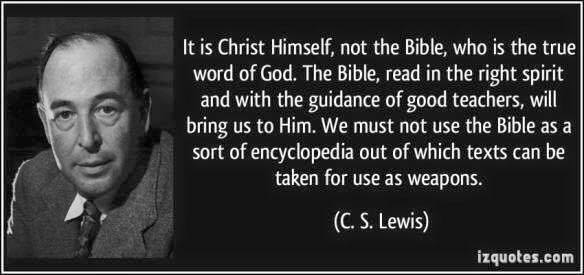
How true that is. The great Christian theologian and apologist, C. S. Lewis, also agreed:
A-flippin’-men to that. Yes, it is Jesus Who is the Word of God (Jn1:1), not the Bible, although it does contain some of thewords of God – some of the things He said. And the Bible is, as Lewis says, is one of the devices God can use to bring us to Christ. It is so sad, then, that in these days, people use the Bible as a judgemental weapon to beat up both those in the Church, and those outside it. Is it any wonder that I get so frustrated seeing, time and again, ‘believers’ hurting others with this powerful book – albeit a book that only has real power when people agree that it has. In other words, for those that do not believe in things written in the Bible, it holds no power.
Conversely, though, the Bible holds the power both to build up or to destroy those who do believe in what the Bible says. This is why the message of inerrancy – that the Bible is always right – is so damaging, because firstly the Bible was never intended to be always right; secondly, those who have dogmatically decided that what they believe is right are the ones who batter people over the head with their own beliefs, based on their own interpretation. That there are many ways of interpreting the Bible is beyond doubt; that is why there are tens of thousands of Chistian denominations all across this world of ours.
The damage caused by this sort of behaviour is at least twofold. Here are the two principal types of damage I can think of: firstly, those who believe the Bible is an authoritative document are led into lives of slavery and misery by those who claim to have everything all ‘right’; all their doctrines lined up neatly like ducks in a row. Secondly, people outside the Church see all this theological infighting and decide, quite rightly, that they want nothing whatever to do with this sort of thing. In a very real way, the ‘gatekeepers of Heaven‘ are shutting the doors of Heaven in men’s faces by their misuse of this book which is such a precious spiritual resource but which is misused so often, as in the Lewis quotation above.
Instead, then, let’s use the Bible as the way to build people up. Let’s use it for its primary purpose, which is to lead people to the true Word of God, Who is Jesus Christ – not in an accusatory or condemnatory way, but in portraying God as Jesus portrayed Him: full of mercy, compassion and Love. When we lift Jesus up, He draws all men to Himself (Jn 12:32).
This is so much more upbuilding than causing vast spiritual and emotional damage akin to waving a razor-sharp sword around.
So, to my mind, it’s about time people stopped waving this lightsaber around like that.
They’ll have someone’s arm off….* 😉
*This is a reference to how, in most of the Star Wars movies, someone’s arm gets lopped off by a lightsaber. I have heard it jokingly said that it’s not a proper Star Wars movie unless someone loses an arm… 😉
I’m sorry to say that many Christians today think that the very best efforts of humanity, to do good, appear as ‘filthy rags’ (Is 64:6) in God’s sight. I have written on the subject before, but I’d like to say that I’m not the only modern thinker that believes that this idea is utter rubbish.
In this piece, Christian writer and theologian Jeff Turner tackles this issue with his usual clarity and insight. Over to Jeff:
“Are all of your “righteous works” *really as filthy rags?
“In short, no.
“To insult a person for poor decisions or immoral actions is one thing. But to insult them for actions that are admirable is an entirely different thing. If even your best attempts are met with mockery and derision, your soul will quickly shrivel and die.
“Today’s popular form of Christianity is a belief system that comes with a message of scorn and derision, not simply to the morally bankrupt sorts, but even to those whose hearts and souls yearn only to do good. It assures them that their best attempts at being kind, upright, decent humans appear as disgusting, filthy rags in the sight of God. It humiliates, denigrates, dehumanizes, and demoralizes, even the best among us.
“If one makes a careful read of these “filthy rags” type of passages in scripture itself, though, one won’t find the God who rubs our faces even in our successes, as though they were indistinguishable from our messes. Rather, one will find that the people being rebuked in such instances have sunk to depraved lows in their behavior, and become morally bankrupt. It’s not that even their good has become bad, but that there is no good to be had, or when there is, it’s merely an attempt at hiding greater evil. Scripture does not teach that *your every attempt at being a decent human appears as filthy rags in God’s sight, but that Israel, at particular times in her history, had embraced a mode of being in which the good was almost utterly absent. This is not the same as claiming that, from birth, even the smallest of babies is counted as a sinner, and that even the most kind, decent, loving of humans is a filthy sinner in the eyes of God!
“How awful and destructive a doctrine we spread when we make these claims!
“Listen, that people believe in anything *at all is a major accomplishment in a world like ours. That people can get themselves out of bed most mornings is an act of God. That the whole lot of us aren’t tearing one another to bloody ribbons, what with the chaos and tumult our world is in, is miraculous. Let’s be honest, that most of you are still even breathing is a feat you deserve to be commended for. To look then, upon suffering people, who are simply doing the best they can to live and get by, and tell them instead that their best attempts are vile in the sight of God, is reprehensible, and so outside the character of Christ that I think it could rightly be called satanic.
“We have our issues, to be sure, but Jesus does not come to assure us that even our struggling through life just to smile and raise our families is a disgrace in God’s sight. No. That message is a disgrace. Not you. God is near the broken-hearted and present with the suffering, struggling one. And he’s present in the form of one who is for you and on your side.
“Peace”.
Brilliant piece. I have to admit that, once upon a time, I was a judgemental Christian like that too. I believed that any good that non-Christians did was worthless. It makes me feel sick to remember that I once felt like that… but thank God He gave me the chance to change. Every good deed has value, irrespective of its source. The value of the deed is to the recipient. The homeless man doesn’t care whether the hot meal comes from a believer or a non-believer; the main thing is he gets his meal. All good things come from God. What about when Jesus said ‘if anyone gives you a cup of water because you are My disciple, he will certainly not lose his reward’? He didn’t specify any required belief structure!
No, all good deeds are good; they are not filthy rags. The context in Isaiah 64:6, where the ‘filthy rags’ comes from, is about thoe who put on righteous acts for their own sake; for show. That’s what it’s about, not about secular people’s deeds being worthless. They are indeed not worthless.
This is yet another example of how the Spirit is using modern-day prophets like Jeff, to put out there these ideas that so many other believers are hearing at the same time! Truly the Holy Spirit is at work in these days 🙂
The other day, I was privileged to meet Lauren Richardson, aerobatic display Pilot and former British Female Aerobatics Champion. Lauren performs her superb routine, in her customised Pitts Special S1-S aeroplane, at airshows all over the UK, before crowds of tens of thousands of people or more.
Lauren flying her Pitts Special aeroplane in a classic ‘knife-edge’
I also got to meet her partner, Simon Wilson, who is himself an accomplished diplay Pilot, displaying the vintage Percival Provost at airshows all over the UK.
The gorgeous Percival Provost at Torbay Airshow, flown by Simon Wilson
Lauren and Simon are well-known in the British airshow circuit for their highly professional, sparkling displays of these two classic aircraft; displays that are so different (although both aerobatic) and each riveting each in their own unique way. Apart from their immense skill, what makes display Pilots like Lauren and Simon so special is that they have to perform their displays at a low level, typically below a maximum height of about 2,000ft, because if they went any higher than that, the crowd wouldn’t be able to see them well enough. In fact, that figure of 2,000ft is only the very apex of their manoeuvres; most of the display is actually performed much lower than that. And this kind of low-level flying, and the consequent lack of time for recovery from an error, means this: there is no such thing as a minor incident in low-level aerobatics. These guys have to get it right first time, every time; there is very little margin for error. Flying like this requires a precision that is unmatched in virtually any other type of flying, with the possible two exceptions of fast-jet operations on aircraft carriers, and low-level terrain-following flight.
Lauren has recently begun publishing ‘behind the scenes’ videos of her flying, detailing such subjects as why she loves what she does, what preparation she has to do before each display and so on. She has also started doing, well, not exactly ‘how-to’ videos, because you can’t just hop in any old aeroplane and perform these manoeuvres, but at least videos showing how she personally is handling the aeroplane in each manoeuvre. I find these videos quite fascinating, so I have showcased this video today, the second in the series, with Lauren’s permission. Here it is; enjoy!
Wisely, Lauren concludes the video with a ‘don’t do this at home’ disclaimer, which is spot on and wholly correct. You can’t do this sort of thing in a Tomahawk, a Cessna 152 or a Warrior.
I would also like to point out that not only does Lauren do public airshows, but she also performs routines of up to 12 minutes for private functions too, such as weddings, corporate functions and the like. The service Lauren provides includes all the paperwork and insurance and what-have-you, so it’s totally hassle free for you. If you’re interested in booking Lauren for your event, click the image below or follow this link for further details.
Picture Credits:
Header photo: Hushkit.net
Lauren’s Pitts in Knife-Edge: BritishAirshows.com
Percival Provost photo: Photozone72.org.uk
Private function photo: lauren-richardson.com
I make no apology for including yet another Terry MacAlmon song on my blog, nor indeed for it being another number in which Shauna Chanda doubles the brilliance of the piece by leading with her amazing voice and obvious love for Jesus.
This one’s called ‘Praise Him‘, by Lynn DeShazo. As usual, let the song lift you as you agree with the singers (Terry MacAlmon, Shauna Chanda and Ruth Ann Johnson) and, indeed, praise Jesus for all His goodness towards you.
Praise Him, Praise Him Praise Him, Praise Him
We have assembled to praise the One we love We join the chorus of the angels up above, oh yes… They sing hosannas and praises to our King So we lift our voices all together now and sing
Praise You, Praise You Praise You, Praise You
We are Your children, we’re here just to seek Your face Lord we come boldly before Your throne of Grace To love and worship You, and listen to Your voice You are our Father, and how our hearts rejoice
Praise You, Praise You Praise You, Praise You
We love You, We love You We love You, We love You
I love seeing the worship responses of the different people in the congregation. Some are actively singing with their hands lifted up. Some just standing and not singing, but just receiving. Some just sitting quietly listening, one couple sitting close together and just soaking in the worship. No self-consciousness at all, in fact; they are just concentrating on Jesus, each in their own way worshipping their Lord. This is simply beautiful, and it’s at times like that that I realise how much of an honour it is to have the privilege of leading precious people like these in their worship. This is beautiful worship, with beautiful music, to our beautiful Saviour.
It always amazes me how people who say they believe in the Love of God have this idea that there’s one ‘Special Sin’ that God just can’t find it in Himself to forgive.
Like if someone insults your mother, y’know, that sort of thing.
It just doesn’t make any sense, and the passages in Mark 3:28-30 and Matthew 12:31-32 must mean something different from what people usually think, because Jesus did not deal in harshness; He dealt in love, compassion and gentleness.
But, we are told, there is such a ‘sin’, and it’s called the ‘Blasphemy against the Holy Spirit’.
All you need to do is to Google ‘Blasphemy against the Holy Spirit’ and you will come up with a huge swath of hits, not only of people waving this idea around condemnatorially, but equally of people worried (sometimes literally) to death that they are destined to burn forever in Hell because of a few careless words.
We must remember that the ‘angry God’ model of the Scripture always defaults to the harsh, threatening interpretation, whereas the Jesus model takes us to the better, more gentle and loving interpretation. However, today’s Pharisees, just like those of old, love to find condemning Scriptures that they can use to bash people’s heads in, and because of this they will always default to the harsher interpretation.
Naturally, they seem to revel in the idea that there’s an ‘unpardonable sin’, which seems to be tailor-made for them to wield against the latest set of hapless believers to whom they have taken a dislike: maybe those who believe in Grace; maybe the inclusionists; maybe those who don’t believe that the Bible is infallible and inerrant; certainly anyone who does not agree with them on all small points. (Which is just about everybody, when you think about it!).
The idea is that they gleefully swing this horrific weapon and leave bleeding and despairing people in their wake, feeling that they have passed forever beyond all hope of forgiveness. In truth, there are fewer Scriptures that have brought more misery than this one. Think about it. As a Pharisee, using this most beloved of all your Scriptures, you can verbally condemn someone to believing that oh they’ve really gone and done it now; they will never, ever be forgiven. What better weapon could a Pharisee want?
But this is not the way of Jesus. Of course God forgives all sin. But because this verse is wielded as such a powerful weapon, joyfully weaponized by those who are almost the Enemy’s servants in order to bring all that untold misery and despair to people, it needs to be addressed.
So, what did Jesus mean when He mentioned the ‘unpardonable sin’?
Well, here’s a beautifully simple exegesis of the Matthew passage by my friend Nathan Jennings, where he puts it really clearly. This explanation of the text closely dovetails with my own opinion on the matter. Over to Nathan:
“BLASPHEMY OF THE HOLY SPIRIT
Thoughts on Matthew 12:31-32
“Often, I am asked what to do with these verses in light of what we know of the grace and mercy of God through Christ. There are probably a few good ways to look at this. First we have to remember that Jesus, being the full revelation and character of God, forgave his enemies on the cross and throughout his time pre-resurrection. Also if you look at the verses leading up to this we see the Pharisees denying Jesus having the spirit of God as being the means of his healing people and said that it was the spirit of the devil. Immediately following the next set of verses, which begin with a “therefore” indicating the message about to be given is a response/result of the previous text, it states:
“Therefore, I tell you that people will be forgiven for every sin and insult to God. But insulting the Holy Spirit won’t be forgiven. And whoever speaks a word against the Human One will be forgiven. But whoever speaks against the Holy Spirit won’t be forgiven, not in this age or in the age that is coming” –Matthew 12:31-32
Immediately we can see and deduce that insulting /blasphemy of the Holy Spirit is unbelief in the work of the Spirit due to the passage in the text right before this.
Also the word ‘forgiveness’ is better translated as ‘freedom’ or “freedom from something” so, to me, what is basically being said here is:
“Therefore, I tell you that people will be freed from the power of every sin and insult to God. But unbelief in the power and work of the Holy Spirit and the freedom it offers you will result in enslavement, because you’re not believing the truth. And whoever speaks a word against Jesus can still see freedom because the spirit can still be seen. But whoever doesn’t believe in the work of the spirit won’t experience the freedom of their true identity, in this age or the next.
Matthew 12:31-32″
I think that’s brilliant. And, if you feel that you have ‘blasphemed the Spirit’, be reassured: you haven’t. Because the ‘blasphemy against the Holy Spirit’ means essentially a refusal to recognise that it’s the Spirit at work, if you are conscious of the Spirit’s work then you can’t be ‘blaspheming’ Her.
And, in any case, all sin was dealt with at the Cross, once and for all, forever. All sin, including this one. Don’t concentrate on sin, concentrate on Jesus. Christians today are far too preoccupied with sin; they need to leave it in the grave where it belongs!
I have previously written three pieces* explaining how the Bible, despite being the book that speaks to us about God more than any other, is sadly sometimes effectively given a higher spiritual standing than God by some Christians. The main reason it’s sad is because these people are missing out on a real, full relationship with God Himself; they are missing out on much of what Life in all its fulness is about (Jn 10:10). And that’s more than sad; it’s tragic. And then telling others that their narrow way (<sarcasm on> because Jesus mentions a ‘narrow way’ in the Bible, therefore it must be true! <sarcasm off>) is the only way; that’s even more tragic because then they spoil it for others too; indeed, they shut the doors of heaven in men’s faces (Mt 23:13).
I’d like to recap a little before I begin. In my piece, ‘A Relationship With a Book??‘, I quote from a website where the author claims that the only way to have a ‘relationship’ with God is through the Bible, and that’s the only place you can find such a relationship. Now, (apart from the obvious flaw here in that we should ask exactly what sort of relationship believers had with God before the Bible was compiled!) this is clearly a major issue. This is because the overarching theme of the books of the Bible is that God wants to have a loving, close Relationship with each individual human being, and therefore the Relationship (deliberate use of the capital ‘R’ because this is the most important Relationship there is) is one that must be God-centred, and not Bible-centred. Sure, God speaks to us in the Bible, and for some of us, presumably including the writer of that website, there is a definite sense of His presence when we read it. But this is not the pinnacle of the experience.
And, in fairness, I should also say that most Evangelical Christians do not believe that this Bible-based relationship is the whole package; I write this piece not to them, but to those who have been told that the Bible is indeed all that’s available for those seeking a Relationship with God – because it’s simply not true! There is more!
I’d therefore like to use an analogy to explain why there is more – far more – to the Relationship than simply meeting God in the Bible.
I’m sure that website author would agree with me that many Evangelical Christians think of the Bible as ‘God’s Love Letter’ to His people; some also see it as ‘God’s Autobiography’. Certainly it is mainstream Evangelical doctrine that all Scripture is inspired by God (2Tim 3:16) and many also see it as inerrant and infallible. (This is not entirely my viewpoint, but that’s not really relevant here except in that I am approaching this argument from the standpoint of Evangelical Christianity). But the take-home message is that if God ‘wrote’ the Bible, through the ‘inspiration of the Holy Spirit’, then even though it was actually penned by humans, in a way it is still God’s Autobiography because He inspired their writings**. Had it simply been humans writing about God without any kind of inspiration, then it would have been simple biography, and not autobiography. Clear so far?
So, if the Bible is indeed ‘God’s Autobiography’, then here’s how I see things with regard to the Relationship:
An autobiography is a book in which a person writes about themselves. So it might be their life story so far, it might be just a part of their life, but it’s me writing about me; you writing about you. If you write your autobiography, it will be about you.
When you read an autobiography, you can learn a lot about the person who wrote it, much more indeed than if someone else wrote the book (and that would then be simply a biography, as we saw above) because you get an insight into their thought processes, the things they have done, the way they work. Remember that although the Bible was written by humans, we are still working with the assumption that God wrote the Bible ‘through’ those humans. And so, this Bible, we presume, is the nearest thing we can get to getting God’s thoughts in written form. And therefore we can learn a heck of a lot about Him, and especially about people’s interactions with Him and their impressions of His character. In short, we get a pretty good picture, and especially when Jesus comes along and shows us how to interpret the Old Testament by showing God’s nature as being loving, kind, longsuffering, forgiving, serving, and many, many other characteristics. And to cap it all, He sends His Spirit not only to teach us more about Him (Jn 16:13) but also, wondrously, to actually live in our hearts. That’s just incredible, isn’t it? And so it is easy to see the mechanism by which God does indeed speak to us, and in fact conduct a relationship of sorts with us through the pages of the Bible.
But here’s the thing. There is so much more to it than that book-based relationship. You see, unless an autobiography is published posthumously, you can also potentially go and meet the author. You could go to a book signing; you could correspond with the author, you might – if you are lucky – even get to know the author personally and go out for a pint with him, maybe catch a movie; you get the idea.
So, if we can meet a human autobiographer, how much more will this be the case with God, who is not only alive and well, but everywhere at the same time and instantly available to all who would seek Him? It simply makes no sense whatsoever that the Living, teeming-with-life, love and creativity Creator God is not available to chat about His autobiography and maybe even go out for the proverbial pint with those who would seek to know Him better.
Now, Jesus said that eternal life is ‘…to know the Son, and the Father who sent Him’ (Jn 17:3). Jesus said also to the Religious people of His day:
‘You study the Scriptures diligently because you think that in them you have eternal life. These are the very Scriptures that testify about me,yet you refuse to come to me to have life’. (Jn 5:39-40)
This is a plain as day. Yes, study the Bible, but let the Bible lead you to come to Jesus Who is the One who gives Life. Again, that Life in all its fulness (Jn 10:10). That’s the Relationship – that we know the Father and the Son Whom He sent. That’s a Relationship – knowing Someone.
Jeremiah 31:34 foretold this when he said, “And no longer shall each one teach his neighbor and each his brother, saying, ‘Know the LORD,’ for they shall all know me, from the least of them to the greatest…”
So, how then can anyone say that the only way to know Jesus is through the Bible, when Jesus Himself expressly says that the Life is with Him? Let’s therefore meet the Autobiographer in person, as well as reading His book!
It’s also analoguous to love letters – as I said above, another analogy that some believers use about the Bible is that it’s ‘God’s Love Letter’ to His people. So, let’s imagine two people who have met on an Internet dating forum and are falling in love. They will write letters/emails back and forth, professing their mutual affection and growing love for one another. Also, they discuss their intended future lives together; what they will do, where they will go, what their hopes and dreams are. And this is all very good and right and proper, but there comes a point where they actually have to get in a car/bus/train/aeroplane and actually go and meet each other face-to-face. The letters alone are simply no substitute for this; indeed, at some point, the letters will actually express the desire to meet up at last. And then, once they have met, sure, the letters will still be important (I still have the letters Fiona and I wrote to each other when we were at separate Universities!), but once they move in together the letters will become largely redundant because they have been replaced by a real live face-to-face relationship. Sure, they can still write little letters and notes to each other, but their relationship itself becomes the primary focus.
And so it is with the Bible. I still meet God in the Bible, but I also carry Him around with me in my heart (that’s evoking really funny images in my head; carrying the Creator of everything around with me like some sort of pet, lolz). I am aware of His presence most of the time. I talk to Him, and He talks to me. It’s real. Of course, I am by no means advocating throwing out my Bible as useless; no, I love my Bibles and I treasure them.
My Bibles: a 1939-printing KJV and a 2008 NIV cross-reference edition which uses the better 1979 translation
But still the Relationship with God in addition to and external to the Bible ‘relationship’ is far more important to me. It’s interesting that one of the ‘heresies’ levelled against ‘The Shack‘ (the article is linked to in this piece) is that the book promotes this same idea of a relationship with God over and beyond that in the Bible. This belief that there is nothing beyond the Bible is apparently quite deeply-rooted in some believers’ theology.
But the Relationhip with God is exactly that. Jesus says things to me, and to countless other believers all across the world (ironically, almost certainly including those people who claim that the Bible is all there is!) that are not in the Bible. God cannot, almost by definition as God is infinite, be contained only within the thousand or so pages of a book.
I suppose that one reason why some believers (especially leadership) have a problem with this ‘free’ Relationship is because it’s outside the limits of their control. Either controlling leadership or those believers who would like to have, shall we say, ‘constructive input’ (read: sin-policing!) in others’ lives; both these groups stand to lose much of their control if each individual believer has their own individual, autonomous Relationship with the Higher Power that we call God. All of a sudden, these fortunate individuals with this Relationship are answerable only to God. And some of these controlling people might say, ‘Well, we can’t have people just ignoring the Rules in the Bible and going off doing their own thing’. Well actually this is precisely what God lets us do, once we are free from the shackles of Religion and its controlling influence. We are free to walk as God would have us walk, not answerable to men with their home-made doctrines (Mt 15:9).
It seems that, according to the ‘controlling’ types, we ‘sinning’ humans cannot be trusted to have a Relationship with God that is free of Rules (or even Guidelines, which in the hands of legalists always become the same thing!) because we will always wander off into ‘sin’. No, we have to adhere to what the Bible says and that’s the only source of our relationship with God. Back to that again.
Do they really think that God has not factored human freedom into His plans? That freedom of choice is essential in order for us to make decisions at all; else it is no freedom at all? And so the Relationship, yes, becomes ‘risky’; God actually takes the risk that we will go our own way, we will ignore Him, we will see our freedom as a ‘licence to sin’ [Edit: I address the issue of the ‘Licence to Sin’ in this article] – but nothing could be further from the truth. Because, you see, that Relationship removes the desire to sin; in fact, the Relationship is indeed the life lived ‘in the Spirit’ which is the life of perfect freedom. And therefore, because we love Him, we live our lives to please him, not because someone (or the Bible) tells us to, but simply because that is our desire. The risk has paid off; we are His people by our own free will, which is the only way that Love works anyway, through free will. If it’s not a free choice, it’s not Love.
So, then, let me encourage you – which is always my objective in my blog posts anyway. If you have become frustrated with the relationship you have with God in the Bible, let me assure you that there is more. Do not be afraid (the most common phrase in the Bible!) of ‘wandering off’; God knows your weaknesses and He works with them. This is not error; this is the overarching theme of the Bible, the redemption of humanity in order to enable us to walk in Relationship with God in the power of the Spirit. If you are worried that maybe this growing Relationship you have felt is somehow dangerous or anti-Scriptural, please be assured that it’s not. Remember that you died to the Law (Rom 7:4). Remember also that if you are afraid of ‘punishment’ for ‘sinning’ in any way, that God’s perfect love drives out all fear, for fear has to do with punishment (1Jn 4:18) and as a believer, you are eternally unpunishable in any case. But of course those who would ‘control’ don’t want you to know that!
No, you can rest in your Father’s Love at all times, because underneath are the Everlasting Arms (Dt 33:27). In God is the Relationship that the Bible hints at. Yes, there is indeed more, and it’s found in the Relationship with Father God through Jesus and the Spirit. In the same way as Father, Son and Spirit have existed forever in the eternal dance of mutual love, so you too can join in and be part of that Relationship. All you need to do is to ask God to lead you into it, and then take the first steps as He leads.
Grace and peace to you. Be blessed!
*Here are links to the previous articles I mentioned:
**The natural extension of this idea is that when modern-day people write about their experiences with God, people like me, people like any modern-day Christian writer, some of it is going to be inspired too. My writing stems directly from my Relationship with Jesus, as does that of other similar writers. In that way, what I and others write is also inspired writing. We too are bringing God’s Word, that is, Jesus, into the limelight for people to see and learn about.
This post marks the ninth month since we lost my gorgeous wife Fiona. Once again, like last time, it’s another musical post, to celebrate Fiona’s tremendous musical talent and at the same time to take a look at more of the tremendous Love of God that has kept me afloat for three-quarters of a year.
Fe and I used to sing a lot of songs together, sometimes with both of us singing, sometimes with me just backing her on the piano or guitar. One of our favourite songs was one that ranked in our ‘personal memories’ scale nearly as highly as ‘our’ song ‘Where you go, I will go‘, and it was called ‘Rest in Your Love’, by Phil McHugh, and recorded by Mo James, a gifted Leeds-based singer whose talent was sadly never really recognised nor developed as far as it could have been. The song is from her only album. More Love, released in 1982*.
I must testify that, for all our lives, we have rested in God’s Love. I have especially rested in that Love since Fiona died, for ‘underneath are the Everlasting Arms’ (Dt 33:27). That’s why I chose the top picture for this post: firstly to illustrate Fiona’s stunning, radiant beauty, and secondly to show little Lucy, our grand-daughter, ‘resting’ in Fiona’s love as she feeds her. This picture is such a good illustration of what this song is about – resting in God’s immense, illimitable parental Love. Fiona and I loved singing this song, and, in so doing, giving the testimony of the words that meant so much to us and which were so real in our lives.
This is why I have shared it in this post.
Here we are, then; Rest in Your Love, sung by Mo James.
It appears that the tempter never sleeps
It seems my best is always just out of reach
But I take comfort from the promise of Your unending care
I will rest when I reach out and find You’re there
And I can rest in Your Love, I’ll rest in Your Love It brings such a healing, When life’s got me reeling
There’s no sweeter feeling than to rest in Your Love
It’s not easy to be human, You know that first hand
The flesh and the Spirit both make their demands
But here I am on this road of life, I’ve got to walk it through
And the best way is to walk it right beside You
Well I can rest in Your Love, I’ll rest in Your Love
It brings such a healing,
When life’s got me reeling
There’s no sweeter feeling than to rest in Your Love
I’ll always need You, I’ll always need You
Rest in Your Love, I’ll rest in Your Love
It brings such a healing,
When life’s got me reeling
There’s no sweeter feeling than to rest in Your Love
Here’s a great blog post by Ken Nichols. I won’t spoil it by doing a preamble.
On Salvation, The Gospel & Imputed Righteousness
While folding some laundry this morning (typical weekend chore), I had a nice “chat” with the Holy Spirit on a variety of topics. It was like a stream of conscious that was interrupted here and there by a thought from the Spirit that then led me in some new directions (for me). I apologize for the length, but I hope, if you take the time, you will be blessed as I was.
My first thoughts were about the subtle difference between the church’s idea of salvation and the salvation that Jesus provided. They seem so close, in fact, I was thinking it was so close that maybe it doesn’t REALLY matter if people believe the traditional paradigm. I mean, the result — a heart that understands the love of God — is the same, right?
Actually, no, the Spirit convicted me and impressed on me that I need to tell the truth, even if it is uncomfortable.
The church’s idea of salvation, the one that you will hear from 95% of pulpits today is based on this: We are saved by grace through faith. Sounds great. Sounds “right”. It fleshes out something like this… When we believe in Jesus, which means believing a litany of things about Him: His Godhood. His sinlessness. His love of humanity. His act of sacrifice in our place on the cross, we are saved. The cross is where He took the world’s sin upon Himself, so that God could punish HIM for our sin instead of us, and in that act we could be forgiven and have the righteousness of Jesus cover our own sin. Believing ALL of that and recognizing your place, your NEED of it, allows God to forgive YOU personally and accept you (adopt you) as His child. To simplify… believe in Jesus (as described above) and be saved (be forgiven/accepted by God). Your repentance and belief results in your salvation by God. Again. Sounds good, sounds right, right? Well, yeah, it’s what we’ve always been told.
But it is wrong. So subtly wrong. We are saved by our faith yes, but it is not the faith that causes or allows God to save us. We are saved THROUGH (via the process of) our faith. It is not the faith which allows God to change our position before Him. It is our faith that allows us to see our ALREADY (and before time) position before Him, where before we DIDN’T see/believe it. Our faith is not just in what happened on the cross. Our faith is in what that TELLS us about who God is and what He thinks of us. And when we BELIEVE that God really does love and forgive us no matter what we do (including killing Him), then we are saved from what we USED to believe about Him (our foolish ideas about God as judge looking to punish us for wrongs done which offend Him). What we are saved from is not “Hell”, or God’s wrath (directly), or punishment, but our FALSE ideas. And when we have FAITH, we are dispelling/denying/repenting of (changing our minds) about those ideas and agreeing with who JESUS says and PROVED on the cross that God IS.
Such a subtle difference, but it means SO much because it changes how we see God. And THAT is the crux of being “saved”. Our false view of God is the “SIN” that Jesus came to save His people from. There is more to it, more details, more to unpack, but that is the “big picture” paradigm shift that we experience at “salvation”. And that brings me to the 2nd thought I had today.
We have “the gospel” wrong.
Traditionally the gospel is said to be the cross. The sacrifice, and the EXCHANGE that happened — our sin for His righteousness — is the good news. That we can appear righteous before God (and be accepted) because God punished our sins in JESUS, instead of in us.
But that’s NOT the good news (gospel) at all.
I submit that the GOSPEL was declared LONG before the cross. The gospel was declared at the incarnation. At Jesus’ birth. When the heavenly hosts said, “Peace, goodwill towards men, on whom His favor rests.” THAT is the gospel. God ALREADY favors (accepts/delights) in us. God ALREADY has nothing but GOOD in store for us (not punishment or wrath) and God is in the process of bringing PEACE to the world through His Son, and not JUST “spiritual peace” between God and man, but actual, practical world-changing, life-saving, war-ending peace.
It started when Jesus was born, and that is STILL the gospel message. God’s peace, God’s favor, God’s goodness. For you. Right here and now.
So how does the cross fit in?
The cross PROVED that this was true. The cross proved that even though we were allowed (Jesus laid down His life) to kill our OWN God, that when He rose again and came back, the first thing He said was to repeat what was said the day He was born, “Peace be with you.”. NOTHING you do will change the good news of God’s favor, goodness and peace. The good news is that we had God wrong, but NOW we can see, because of Jesus and because of the cross, what God is REALLY like and how He REALLY feels towards us. Mankind killing Jesus was not “good news”. It was a horrible act. But it is what God felt was necessary to PROVE to us who He really was.
What’s so bad is that now we found a way to believe in the cross, but STILL miss who God is. Not only that, but now we have used the cross to ENFORCE our terrible image of God as judge and punisher of evil, and have made Him into a child-sacrificer to boot. How BAD can we make Him look? How far short of His glory CAN we fall in disparaging His good reputation? We have TWISTED the cross and twisted God’s image in the process. And most everyone believes this is the truth. It almost makes me believe in the devil again because it’s such a subtle, but deadly deception that has totally derailed the gospel message of God’s peace, goodwill and favor toward man.
It’s time to RECLAIM the true gospel that was declared to man when Jesus arrived here. God’s favor rests on you. You, as you are. Not you as religion wants to MAKE you so God will accept you. Not you who believes just the “right things” about Jesus so God doesn’t have to avert His eyes from your loathsomeness. But you RIGHT NOW. THIS news will transform lives. I know because it has mine. It has given me such a love for God and for humanity that I never even understood before. I always believed I loved, but now I can see how superficial (though sincere) that love really was, because it was still based on a God who is looking to ERADICATE evil and punish and torture all those who break His moral standards.
And you can’t really love a God who tortures people. You can SAY you do, but it’s half-hearted at best, even if you BELIEVE it is whole-hearted. I know, again, because I’ve EXPERIENCED it. You can only see it from the OTHER side. (Yeah, I know how ‘conceited’ that sounds, but I’m really being sincere here). I couldn’t see how “weak” my love of God was until I really understood who He is and how much He loves me.
You cannot love humanity, when you think the majority of them are lost forever because of their depraved state before God. You can PITY them, yes, but pity is NOT love. Pity does not give them the intrinsic worth and love that God gives them AS THEY ARE, “evil” and all. Yes, INTRINSIC worth, not IMPUTED worth. Which brings me to my third, final and most profound thought of the day.
The traditional view of “imputed righteousness” says that when Jesus died for our sins, He took them on Himself and gave US His righteousness, so that when God looks at US (if we’ve “accepted Christ”), He sees Jesus’ righteousness instead of our sin. It’s kind of like we are wearing a Jesus-cloak of righteousness that covers up our “filthy rags” of sin. But let’s examine this idea more closely.
The first problem is our misunderstanding of the word “righteous” or “righteousness”. We have equated this with “sinless” and “sinlessness” or “perfect goodness” or “purity”. And the word CAN be used that way in Greek, but it’s meaning is much more about trajectory than about purity. Righteousness is “going in the right direction”. That’s what the word actually means. If you were travelling down the road, and you stopped and asked for directions, and found out you were headed the wrong way, you were “unrighteous” (headed in the wrong direction). You needed to be made righteous (ie. JUSTIFIED, adjusted) and placed in the right direction (made righteous), so that then, as you continued your journey, you would be displaying “righteousness” in being headed in the right direction, and people could actually follow YOU if they wanted to know the right way to go. THIS is the picture of what righteousness is.
God is ALWAYS righteous, always headed in the right direction, towards peace, goodwill and love. His desire is to make us righteous, as well. To place us in the right direction, with the right goals. Now go back through your Bible and read all those verses that talk about righteousness and insert this idea into them and be amazed at how much sense they make. Not EVERY verse will work, as there are other words that have been translated as righteousness in the Bible. But most will work with this “going in the right direction” meaning. No, really, go look some up. I’ll wait. 🙂
So, then, how does this affect the idea of “imputed righteousness”? Can you only LOOK like your headed in the right direction, but not REALLY be righteous yourself? No. Jesus doesn’t just make us LOOK righteous. He places us in the right direction (justifies us), so we ARE headed in the right direction.
Then I started thinking about the idea of wearing Jesus righteousness like a garment. There’s a verse that says to “put on” the breastplate of righteousness. So I was thinking about whether there were any other places in the Bible where putting on a garment had to do with changing or going a particular direction. And the Spirit brought Elijah’s cloak to mind. Elijah passed his cloak on to Elisha in the old Bible story. However, my mind immediately dismissed this as I have always been taught that the cloak represented God’s power and authority being passed from Elijah to Elisha and that had nothing to do with going in a particular direction.
I continued thinking about this idea of righteousness being about being headed in the right direction, and thinking if about how FAITH puts us in the right direction (is counted as righteousness). When Abraham BELIEVED God, that God would make him a great nation and give him a land, he started out on a JOURNEY, both spiritually and physically, with God. He started on a particular trajectory. He was “made righteous” (placed on a certain path with a certain goal) THROUGH his faith. He certainly wasn’t thought of as “good” as in pure or morally perfect. Far from it. He made awful choices. God wasn’t OVERLOOKING those because Abraham believed in Him. His righteousness was not about what he did, but the TRAJECTORY of his life.
And then AGAIN, the Spirit brought up the cloak of Elijah. And I said, “OK, how does this fit, God, because I don’t see it?”
And then, I did.
The cloak of Elijah was how Elisha was COMMISSIONED, how he was “chosen” for the task as a prophet of God. When he took on the cloak, he took on the job, the mission, the PATH that was set before him by God. He “put on” his righteousness, because the cloak put him on the path that would determine the rest of his life. My jaw dropped. This is how Jesus “imputes” His righteousness to us. He gives us HIS commission to be HIS ambassadors of reconciliation. To continue down the path that He showed us. The path, the trajectory, of peace, goodwill and love towards mankind. And we “take up” this cloak (or breastplate), when we BELIEVE in the message of Jesus, in the Gospel. When we ACCEPT the commission (the way pointed out) of Jesus.
Our faith is counted as righteousness. I hope this blessed you today.
Click the graphic below to go to the post on Ken’s site:
Recently, I have found, when reading my Bible, that instead of hearing the gentle voice of the Spirit, I have instead been feeling the dry, grating, harsh legalism from those harsh people with whom I have engaged in Bible debates. I have found that I can’t read the Bible without its passages being contaminated with the nastiness and horror of some people’s worldviews that, while purporting to be Christian, still are not reflections of the loving Christ that I know so well.
It’s time for me to step back for a while from all the Bible debates on the forums, and to let myself bask in the closeness of the Holy Spirit once again. Time for worship; time for just rejoicing in His goodness.
Even after my recent post expressing why I do these debates (for the upbuilding of the invisible, silent listeners), still I need to recharge every so often. I still need to learn to pace myself and to give myself space.
Just a few short hours after I made the decision to do this, the following post, by William Stell, appeared on the Unfundamentalist Christians channel on Patheos. And it was like an RAF air strike: right on time and right on target. Thank You, Lord!
This article is so perceptive and penetrating; it’s one of those pieces that you can immediately see is really outstanding. It describes things really well, so, why not take a look for yourself and be encouraged.
These are wise words, from a wise man.
If this is your burden, be released and be free.
Over to William:
4 Reasons Why I Gave up Bible Debates
Don’t get me wrong: I’ve done my homework. I’ve been reading the Bible for as long as I’ve known how to read, and I studied it in classrooms for nearly a decade. I studied the biblical languages of Hebrew and Greek, studied the cultural contexts in which these ancient texts were written, studied hermeneutics and histories of interpretation and theology and all that convoluted jazz.
And I loved it. That’s part of why I was so willing to share my views on same-sex love, Christian faith, and the Bible after I came out as gay (around the time I started seminary). For several years, I eagerly corresponded with anyone and everyone who asked me questions about my pro-LGBTQ beliefs: a childhood friend here, a former professor there, with an acquaintance who I hadn’t seen in, like, twelve years thrown in. Some of these people were nice; others were nasty. Regardless, I considered engaging in this correspondence to be an essential part of my ministry.
But after several years, I started to say, “No thanks.” Most of the time now, I just refer them to a few published resources, then walk away. Here’s why:
The Bible debates can drain your soul.One of my seminary professors, Rev. Dr. Yolanda Pierce, once told her students: “I’m not going to talk with you about why women can speak in church, because talking about that actually reduces who God made me to be.” Tempting as it is to defend ourselves against every attack on our dignity, and important as it is to spread defensive strategies among those who need them, defensiveness can take an inner toll over time. Toxins are still toxic for those who are trying to neutralize them, and oppressive ideas are still oppressive for those who repeat them in order to refute them. To echo my professor, I believe that God made us to share our gifts with the world, and constantly standing on guard against our naysayers can slowly erode our inner confidence and sap us of energy we need to share our gifts well.So, if you are an LGBTQ person of faith or a woman of faith who has felt targeted in the Bible debates and felt compelled to respond in battle, consider that laying down your weapons at least every once in a while may be necessary for your spirit’s health.
The Bible debates are frequently futile.Many of those who seek out the Bible debates are not the kind of people who are worth engaging. Often, they are the kind that prefers diatribe over dialogue, the kind that is more occupied with accusing others and justifying themselves than they are with asking questions and learning something new. Not every person who asks you a question is really asking you a question, by the way. Some people, I’ve learned, use questions as an avenue for condemnation. Some people are just trying to get their foot in the door, and once it’s opened, they’ve got you in their line of fire. In fact, some people appear to be genuinely convinced that they are asking you a real question, but then once they realize just how coherent and compelling your answers can be, they show their true colors.Several years ago, when I spoke with one of my seminary professors about some of my family members who did not support me as an openly gay man, he invoked the following words of Jesus: “Do not throw your pearls before swine, or they will trample them under foot and turn and maul you” (Matthew 7:6). There are plenty of “good Christian folk” out there who are acting like swine. Think twice before stepping into their muddy pit.
The Bible debates have stunted the Christian imagination. We have invested so much in addressing the so-called “clobber verses” that many of us have neglected alternative means of demonstrating that Christian faith and LGBTQ identity are compatible. A dozen verses after that line about pigs, Jesus says, “Every good tree bears good fruit, but the bad tree bears bad fruit. A good tree cannot bear bad fruit, nor can a bad tree bear good fruit.” Why get bogged down in arguing with people about whether or not we are good trees, when we could just bear good fruit and let that speak for itself? According to 1 John 4:7, “Everyone who loves is born of God and knows God.” Why not just love well, then let our love testify on our behalf?
We don’t have time for this.Seriously. We have families, friends, jobs, goals, dreams, faith. Who has time for those haters? What do we owe them? Haven’t they already taken enough from us?
Of course, you are free to debate haters and non-haters alike as frequently and as fiercely as you please. As for me, I have decided to turn my focus elsewhere. The way I see it, we were made to enjoy life to the fullest and to share our gifts with the world, and I want to dedicate more of myself to that and less to justifying my right to do so.