Category Archives: Insights

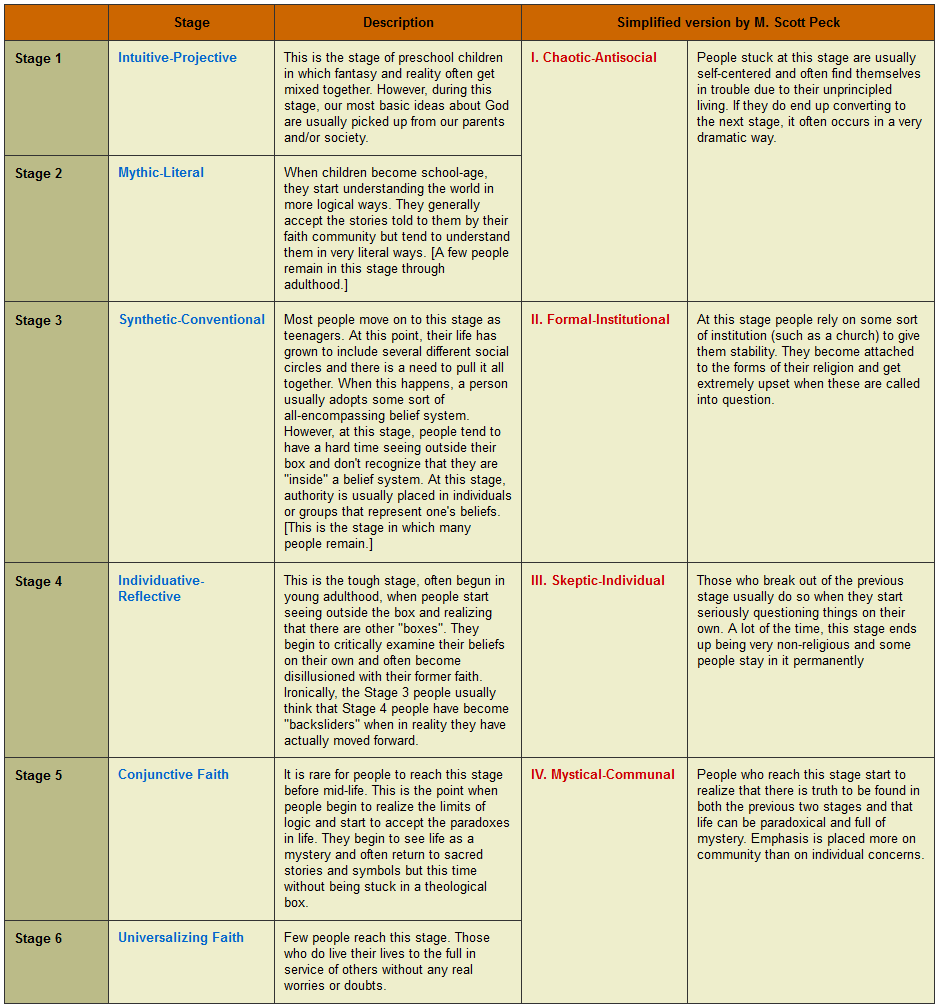
For My Inerrantist Friends…

“For My Inerrantist Friends: Why Appeals to Inerrancy are Totally Ineffective in Discussion”

One of the most refreshing Christian blogs ‘out there’ in the blogsphere is Jesus Without Baggage. I know the author will be reading this – hi Tim! – but it’s true. Tim writes with a perfect blend of incisiveness, perception and gentleness, without judging and without condemning even those whose ideas he has issue with.

Anyway, less of the hero-worship 😉

The doctrine of Biblical inerrancy claims that the Bible (at least in its original form, whatever that means) is completely without error or fault.

In this blog post, Tim writes on the problems with using inerrancy as a valid argument, and he raises an excellent set of points, which are well made and well explained. The article also dovetails nicely with his article on ‘Proof-Texting’, which I shared some months ago.


For My Inerrantist Friends: Why Appeals to Inerrancy are Totally Ineffective in Discussion

Frequently, I receive comments from those who disagree with me—and this is as it should be! I enjoy dialog with those who disagree with me because I never learn anything if I only talk with people who already agree!

However, it is often impossible to have real dialog with some inerrantists because their main arguments are based on inerrancy, and no response contrary to inerrancy is satisfactory to them. If we cannot discuss an issue without appealing to inerrancy then it is no discussion at all for those of us who do not accept inerrancy.

I, myself, used to be a committed inerrantist. But I no longer am so appeals to inerrancy have no persuasive value to me—at all. And it seems that inerrancy is the only argument some inerrantists have. I think the only place where appeal to inerrancy works well is when both discussion partners share the same presupposition of inerrancy.

Now, I do enjoy dialog with inerrantists, just as I do with anyone else, as long as they can argue from other points; but if they cannot defend their positions without appealing to (or assuming) inerrancy the discussion just can’t go forward. The issue at hand is no longer the stated topic but, instead, becomes inerrancy itself. Of course we can talk about inerrancy–but it is its own topic.

Unless we get beyond appeals (or assumptions) of inerrancy we cannot deal with the issue at hand, as I recently discussed in a previous article.

I’m not being stubborn, I am just saying that appeals to inerrancy are ineffective arguments to me. So argue from a different direction.

blog Bible Inerrancy

The Inadequacy of Proof-texting

Proof-texting forms a lot of the argument for inerrantists. I love discussing biblical passages, but simply presenting a biblical passage as an argument, as though it is sufficient proof within itself, gets us nowhere.

And sharing a biblical passage without comment is of little value. Do you think I haven’t already read that passage—usually times without number? Do you expect me to be surprised by it? If you are going to use a biblical passage for support, then explain what you think the passage means and how it is pertinent to the conversation—without reference to inerrancy. Otherwise the proof-text is just hanging out there taking up space.

Context is very important, and stand-alone phrases and verses lifted out and offered without context do damage to the context.

Even less useful is making a statement followed by chapter and verse references alone without including the text or indicating what it says. If a dialoger doesn’t provide the text, or a link to the text, then I am not likely to look it up.

Accusations Inerrantists make as Arguments against Progressive Believers

Progressive believers encounter a number of common accusations from inerrantists. These accusations often come when proof-texting doesn’t work but are sometimes used a first response.

1. A very common accusation is that progressive believers are cherry pickers—choosing what they like and neglecting what they don’t like. This is simply not true—not for me anyway. As I have questioned beliefs I had been taught (which were all based on inerrancy), I worked hard examining each belief to determine if the proof-texts used for it were solid and to consider alternative perspectives.

Now, I think some people ARE cherry-pickers, there are cherry-pickers on both sides, but I don’t think this is the norm. Nor do I think most believers conveniently choose what they like and ignore what they don’t like. Rather, I think for the most part believers on both sides sincerely believe what they say.

2. A similar accusation is that progressives make the Bible into whatever we want it to be. I can say that reading the Bible without assumptions of inerrancy is not such a shallow exercise as this; it is a lot more work! An inerrantist can simply read a passage without regard to context or genre and decide what it means. Progressive believers must dig deeper.

3. If you can’t trust the whole Bible how can you trust any of it? I approach the Old Testament as Jewish national literature which forms a big part of the cultural background of Jesus and his audience. It is much like reading an American Literature book. We will likely find the Declaration of Independence, a Martin Luther King piece, a story from Huckleberry Finn, Jonathan Edward’s Sinner’s in the Hands of an Angry God, and perhaps Paul Bunyan and his blue ox, Babe. All of these are important to the American heritage, but if we find inconsistencies do we throw out the entire collection?

The New Testament is the story of Jesus and his impact on his earliest followers. I look at each part of of the Bible individually, analyze it according to what it is, and use the results of scholarship.

4. You need to read the Bible! I guess the assumption is that if I read the Bible I must come to the same conclusions they do. I was ‘saved’ in a fundamentalist church when I was 7, and by the time I was 9 or 10 I began reading the Bible voraciously. I am now 63 and I pretty much still do that–along with commentaries and other biblical tools. So that’s over 50 years of fairly intense Bible-reading.

5. You didn’t answer my question. What inerrantists usually mean is that I didn’t answer their question to their satisfaction, so they often pose the same challenge over and over even after it has been addressed. Because, to an inerrantist, everything eventually boils down to inerrancy; and any answer inconsistent with inerrancy is unsatisfactory.
These are not arguments; they are only accusations.

Let’s Dialogue!

I like talking respectfully with inerrantists. So, if you are an inerrantist and want to talk about issues—let’s talk! But be aware that appeals to inerrancy will not be effective.


Click here to go to the original article

Stage 3 – ‘Synthetic – Conventional’

This entry is part 5 of 11 in the series The Stages of Spiritual Growth

In this fifth part of my series, ‘The Stages of Spiritual Growth’, we come to Stage 3 – the ‘Synthetic, Conventional Stage’.

I may as well tell you now, this Stage will be familiar to most of my readers – probably all – because you will either be conscious of having passed through this Stage, or you may recognise that you are still in it. Many people don’t even realise they are in this Stage – for reasons that we will see – until after they have passed through it. I’d say that this is the Stage that many Christians in the Western world are in. And that’s fine, because as I said before, God has His own timing for all of us for our spiritual growth, and this is not something to be rushed.

I therefore want to be very sensitive in writing this piece, and the next two pieces as well, because these three essays will certainly be the key instalments in this series. Indeed, this is one of the dangers of knowing about these Stages; that we may feel like we are not moving fast enough or something. But remember what I wrote in the Spoiler! piece: these Stages are generalisations and are actually representative of no one particular person’s position. This is not a competition, nor is it a race (despite various Scriptural usages of  a ‘race’ as an illustrative point)! This is the walk of discipleship with Jesus Christ. The only thing to realise is that this is simply a Stage, and you have not ‘arrived’. None of us will ‘arrive’ this side of the veil, if even then. Simply realise that there are others who have gone through this Stage; we will talk about those people more in the next piece. As I said in the closing statements in the ‘Spoiler!‘ piece, where I try to put the Stages of Spiritual Growth into perspective,

“I’m not saying that these ‘Stages’ are definitive, and (as I have already mentioned) they are to some extent a generalisation. But I must say that I can definitely identify with these Stages of growth in my own mind, and at the very least, these ideas should confirm for us that there are indeed spiritual growth stages of some sort out there, and that if we find ourselves changing under God’s guidance, we should not be surprised when we can indeed identify with some of the indicators of the Stages put forward by Fowler/Peck. So, when I am presenting and describing these Stages from both Fowler and Peck, I am not asking my readers to try to decide at any time which Stage they are in – although I realise this is a natural tendency – nor am I encouraging anyone to feel ‘superior’ or ‘inferior’ to other Christians because of the ‘stage we are at’. This isn’t about others; this is about realising that we are all on a journey, that these Stages do exist in some form or another in most people, and that this is perfectly normal and nothing to be afraid of. Indeed, I am not proposing that anyone be constantly mindful of the Stages and/or ‘trying to work out where we are on the scale’. While introspection can be useful, I would far rather we are simply aware of these Stages as a perfectly normal part of personal spiritual development, as information that is useful in working out what is happening to us, but all the while still majoring on keeping our eyes fixed on “…Jesus, the Author and Finisher of our faith” (Heb 12:2). He’s the important One!”

Furthermore, not everyone will identify with this concept of ‘Stages’. And that’s fine too; faith certainly is not a ‘one size fits all’ kind of thing!

I would suggest that two more Scriptures we need to keep in mind as we read, then, are these:

“Being confident of this very thing, that he which hath begun a good work in you will perform it until the day of Jesus Christ” (Phil 1:6 KJV)

“Now unto Him that is able to keep you from falling, and to present you faultless before the presence of his glory with exceeding joy…” (Jude 24 KJV)

Remember, it is Jesus Who performs the work in us, and He will continue it to completion. God does not make mistakes.

Right then, here we go:

Stage 3

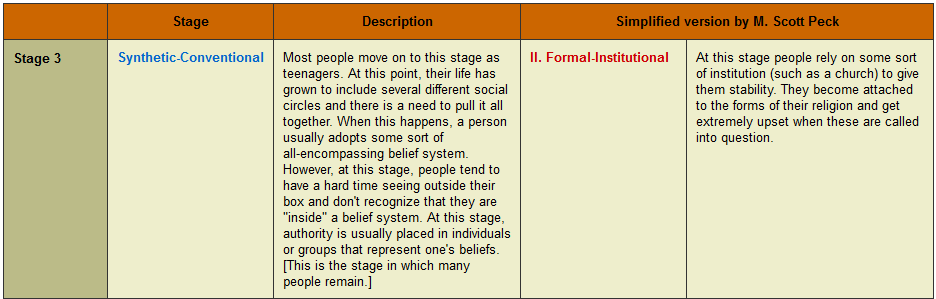
To quote from the Stage 3 part in the chart of Fowler’s Stages, “Most people move on to this stage as teenagers. At this point, their life has grown to include several different social circles and there is a need to pull it all together. When this happens, a person usually adopts some sort of all-encompassing belief system. However, at this stage, people tend to have a hard time seeing outside their box and don’t recognize that they are “inside” a belief system. At this stage, authority is usually placed in individuals or groups that represent one’s beliefs. [This is the stage in which many people remain.]”
A person will normally move into the third of James Fowler’s Stages, the Synthetic, Conventional stage around puberty (although it could happen at any time, even their late teens) but, apparently, many adults never move beyond it. Fowler estimated that 30% of adults remain at this stage.

People in this Stage most often hold to ‘…a set of tacitly held, strongly felt, but largely unexamined beliefs and values’. Here authority is located outside the self – in the church leaders, in the government, in the social group. When Fowler says that religious concepts are “tacitly” held, he means that the person is not fully conscious of having chosen to believe something. Thus the name “Synthetic” – beliefs are not the result of any type of analytical thought. This stage is also synthetic in the sense that it weaves together faith out of a variety of sources, in a synthesis:  Fowler describes part of the work as learning to ‘form a story of one’s stories’. People who ‘convert’ to a Stage 3 position, from a background of not having much education in the matters of a certain faith structure, will tend to ‘absorb’ the belief systems from their peers by attending meetings, listening to talks, teaching and testimony, and from reading their holy books.

The Stage is ‘Conventional’ in that faith is at this stage formed in a social or group context (e.g. family/gang/church), and the individual follows the norms of the group, rather than adopting particular views after thinking them through for themselves. “Conventional” therefore means that most people in this stage see themselves as believing what “everybody else” believes and would be reluctant to stop believing it because of the need they feel to stay connected with their group.

It turns out that most of the people in traditional churches are at this stage. And in fact, Fowler comes right out and states that religious institutions “work best” if the majority of their congregation is in Stage 3. And that could indeed explain a lot of the preaching we hear about that appears to be intended to discourage people from questioning. To properly assure their continuance, churches apparently need people to remain in Stage 3.

People in this stage place a large amount of trust in external authority figures and tend not to recognize that they are within a belief system “box” as their beliefs are internalized but have not been examined. We are immersed in the ‘thought system’ of our faith community in a similar way to a fish that does not perceive the water it which it swims. This is one of the main reasons why most people in this Stage do not realise that they are in it, until they have grown beyond it.

This is therefore a ‘conformist’ Stage in which the individual is acutely attuned to the expectations and judgements of significant others – leaders, ‘spiritual fathers’, and so on. It is also a ‘tribal’ stage, where being part of the tribe is powerfully significant to the person – and being in a community of like-minded believers. They usually hold deep convictions and are loyal and committed workers and servants. Beliefs are typically not examined critically and are therefore tacitly held to. That is, they know what they know but are generally unable to tell you how they know something is true, except by referring to an external authority outside of themselves – “The Bible says” or “My Pastor teaches this”. Any attempts to reason with a person in this stage about his beliefs, any suggestion of demythologizing his beliefs, is seen as a threat.

Often, people in this Stage predominantly have a vision of God as an external, transcendent being with little reference to God as an immanent, indwelling God. Among adults, this is the Stage most commonly found amongst church members. Most find enormous meaning in their faith, as they share in church activities – worship, prayer, mission, teaching etc. Many express a strong sense of belonging, “being at home” or having “arrived”. Emphasis is on the “family of believers”.

Dualistic thinking is very prevalent: Christian/non-Christian; saved/unsaved; heaven/hell; black-and-white thinking, along with being a part of, and being accepted by, the faith community.

In this way, most people in this Stage feel comfortable, safe and secure ‘in their faith’ on the surface, as long as they do not look too deeply at their questions, if indeed they have any. This is  because they have a set of lines drawn; a set of well-defined boundaries, maybe rules, expectations both written and unwritten, taboos, and tacit, shared beliefs, and a social structure based on those shared beliefs, within which they feel safe. It is a paradox that, whereas most religious belief systems encourage complete openness, honesty and trustworthiness, in fact many people have to hide their ‘doubts’ or questions and effectively have to lie about, or at least conceal, their true feelings. Therefore, if/when tricky questions arise, these have to be either pushed down or ignored, but the questions can’t be asked. This is because despite the claimed openness of the group, the person may be (and usually is) afraid of rejection by the group, maybe because such questions are frowned upon since a tacit belief is held that such questions are unhealthy and show a ‘lack of faith’. In fact, any rejection would usually occur because the questions threaten the belief systems – and therefore the security and cohesion – of the group, most of whom, remember, will likely also be people in Stage 3. In addition, the security found in the ‘knowledge’ that a person has in this Stage, is, quite rightly, tightly held, because at this point, letting go of those tightly-held beliefs is a terrifying prospect; this is true especially if the context is one where ‘eternal damnation’ is the perceived penalty for ‘going against the grain’ in the group. Most people who remain in their environment like this are therefore content to live with/ignore their questions, and just get on with their lives, including church activities.

Therefore, whereas, as we have already said, a person will normally move into this Stage sometime between puberty and their late teens, many adults never move beyond it. This will come as no surprise to people who have engaged in ‘discussion’ with people in the ‘Synthetic – Conventional’ Stage.

Either having no questions, or suppressing them if/when they do have them, is one of the main reasons why many people do not move any further forward from Stage 3. We feel safe there, and we don’t want to ‘rock the boat’. And actually that is admirable in some ways, because there is a concern there for the well-being of the others in the group. The transition to Stage 4 almost always involves facing into dissatisfaction, awkward questions, or other such disillusionment, and this is always uncomfortable at some stage, as we shall see.

There are many positives to this Stage. Most people in this stage are genuinely happy; happy with their lives, happy in their faith, happy knowing God in the way that they do. Churches are usually involved in some way with making the world a better place to live in; maybe they want to ‘make a better world’. They work with the poor, they work to better society by taking up political posts in order to perpetuate their beliefs into societal structures. They are sincere, they are honest, they are trustworthy, they are usually kind and generous to others – surprisingly, even sometimes when those they are being kind to are members of ‘forbidden’ groups, like gay people or other types of ‘sinners’ as they see them.

Personally, for example, when I was in this Stage, I found that although I was a die-hard Fundamentalist and stood very firmly against people with ‘alternative sexualities’, when I actually met such a person, I just loved that person as God loves them. The story is here. I do not deny that the love of God is present in most of the people at this Stage; I just don’t think they quite know how to express it because they are hindered by the taboos of their belief structure. Jesus had no such scruples. Jesus associated with those whom society – and remember it was a religious society – had rejected and had cast on to the rubbish heap. But still He loved them.

Now let’s have a look at how Peck describes this Stage. In his system, he refers to it as  Stage II:

Peck’s Stage II

Peck makes more valid points in his Stage II, which will enrich our understanding of Fowler’s Stage 3. Although it can be seen as reading quite harshly, this passage does make some excellent and perceptive, if possibly disconcerting, points:

“Formal, Institutional, Fundamental. Beginning the work of submitting themselves to principle – the law – but they do not yet understand the spirit of the law, consequently they are legalistic, parochial, and dogmatic. They are threatened by anyone who thinks differently from them, as they have the “truth,” and so regard it as their responsibility to convert or save the other 90 or 99 percent of humanity who are not “true believers.” They are religious for clear cut answers, with the security of a big daddy God and organization, to escape their fear of living in the mystery of life, the mystery of uncertainty in the ever moving and expanding unknown. Instead they choose the formulations, the stagnation of prescribed methods and doctrines that spell out life and attempt to escape fear. Yet these theological reasonings simply cover over fear, hide fear and do not transcend it in spite of with acceptance in expanding movement. All those outside of Stage II are perceived to be as Stage I, as they do not understand Stage III and Stage IV. Those who do fall, reverting from Stage II to Stage I are called “backsliders.”

“There is a [four famous Fundamentalist preacher names, removed because I don’t like to denigrate people – Ed] mentality (one-sided thinking – ignorance that produces hostility) in every religion, the one-sidedness, in every ideology. Christianity cannot be condemned as responsible for the fundamentalists who claim to represent such. One just has to look at Mother Teresa or Martin Luther King, Jr. to see the opposite of such thinking. You can find the [Fundamentalist preacher name] in Hinduism, Judaism, Buddhism, Jainism, Mohammedism and of course Christianity. That is the narrow one-sided exclusiveness that limits insight to one set of rules and one objective truth, under the literal logic or rationialism, that fails to apprehend the unseen intuitive essence of existence and ignorantly labels outsiders as misled sinners, while surrounding themselves with interior neurotic and finite walls of security and certainty. All is safe in this illusion, but all is not just, nor fair, and does not transcend prejudice that surpasses tribal identity, an identity that must be scrapped in order to bring higher consciousness of planetary cultural peace and love based on principle with intuitive insight.

“There is also a [name of a famous ‘terrorist’ leader] (evil intolerance) in every religious culture and teaching, in every social, political and cultural view. Islam cannot be condemned as responsible for the extreme fundamentalists who incorporate harm and war. One just has to look at the other side within Islam, to the Sufi of compassion and peace, that of Bawa Muhaiyaddeen or Hazrat Inayat Khan. Yet the evil of extreme fundamentalism resides in all facets of society, those who would kill and destroy, torture and humiliate, all in the name of their theological and ideological views. They are of course the extreme fundamentalists, yet all forms of fundamentalism, both moderate to extreme, Stage II mentality, fails integration with non-acceptance, that of one-dimensional perception.” (1)

While, as I said, this looks quite harsh, remember that these Stages are not intended to describe any particular set of people or any individuals. While we may recognise some or indeed many of these traits in people or churches we know, I am absolutely sure that most people do not hold any of these points of view with any sort of malice or ill feeling. They are simply acting out of what they believe. Remember that this is all perfectly normal when we are thinking about spiritual development.

Peck then expands on these ideas:

“…There are several things that characterize the behavior of men and women in Stage II of their spiritual development, which is the stage of the majority of churchgoers and believers (as well as that of most emotionally healthy “latency” period children). One is their attachment to the forms (as opposed to the essence) of their religion, which is why I call this stage “formal” as well as “institutional.” They are in fact sometimes so attached to the canons and the liturgy that they become very upset if changes are made in the words or the music or in the traditional order of things. It is for this reason that there has been so much turmoil concerning the adoption of the new Book of Common Prayer by the Episcopal Church or the changes brought about by the Vatican II in the Catholic Church. Similar turmoil occurs for similar reasons in the other denominations and religions. Since it is precisely these forms that are responsible of their liberation from chaos., it is no wonder that people at this stage of their spiritual development become so threatened when someone seems to be playing footloose and fancy-free with the rules.”

“Another thing characterizing the religious behavior of Stage II people is that their vision of God is almost entirely that of an external, transcendent Being. They have very little understanding of the immanent, indwelling God–the God of the Holy Spirit or what Quakers call the Inner Light. And although they often consider Him loving, they also generally feel He possesses–and will use–punitive power. But once again, it is no accident that their vision of God is that of a giant benevolent Cop in the Sky, because that is precisely the kind of God they need–just as they need a legalistic religion for their governance.” (1)


So, how do we use this knowledge?

For anyone reading this far, you will have noticed that these descriptions and discussions of Stage 3/II are quite revealing, and maybe it feels uncomfortable for you – either because you recognise traits that you yourself have, or you see traits that you used to have and it makes you feel uncomfortable, or maybe you don’t identify with any of it. All of these reactions are perfectly ok; I am not making any value judgement on where you are ‘at’ in your spiritual walk, and neither should you. The point is that we are aware of these different Stages, and how they sometimes manifest themselves, and to realise that this is to a great extent what makes people respond in the ways they do when talking about the things of faith. Everyone’s faith is different; even those who are in a ‘conformist’ stage will each believe something slightly different from his neighbour. And that’s fine. God causes His sun to shine on the righteous and unrighteous alike, and just because people in a certain denomination or faith tradition can feel the Presence of God in their meetings, in their lives, or whatever, it does not mean that they have everything taped as far as doctrine or belief goes. My own personal view – and you may or may not agree – is that God loves everyone, and He loves to make Himself known to them, and that He’s not particularly bothered what they believe as long as their hearts are turned towards Him. This may be seen by some as threatening to their belief system, but the thing to realise is that just because others’ belief systems ‘work’ for them, it doesn’t mean that yours is somehow ‘wrong’. It isn’t wrong; it’s what you believe. Now, granted, many of us believe many things about God which are incompatible with others’ beliefs, and some will indeed be correct and some will not, if indeed we can make such an assertion about knowledge of the infinite. But it is not for us to say that others’ belief systems are in any way invalid, because, for those others, they work.

For instance, Jesus said, “I am the Way and the Truth and the Life; no-one comes to the Father except through Me” (John 14:6). I believe that. But I also believe that those who come to the Father in other faiths also come through Jesus, it’s just that they don’t yet realise that this is the case. In Romans 3:23, St. Paul indeed says, “for all have sinned and fall short of the glory of God” – and many believers incorrectly stop short of the second part of the Hebrew poetry-style writing and omit the next crucial part of the verse: “…and [all] are justified freely by his grace through the redemption that came by Christ Jesus”. That sounds like a Universalist perspective, I appreciate, but that’s what it says. Who are we, then, to tell others that their experience of God is not valid? To me, that’s the height of arrogance – but having seen how dogmatic people can be, it is unsurprising.

At Stage 3, we need the humility to realise that we have not yet ‘arrived’; indeed, if we feel we have, then we most certainly haven’t! God wants to take us further – but all in His own good time. This stuff can’t be contrived, nor can it be rushed.

St. Paul also has some practical advice about how to cope with different stages of growth. Although the concept probably hadn’t been formally recognised at that point in history, it’s clearly something that was on Paul’s mind in Romans chapters 14 and 15. In there, people are passing judgement on one another because some were more free than others, and hurt was flowing both ways. There’s more on these ideas in my piece, ‘How Not to Cause Others To Stumble

And don’t let anyone judge you by anything that you find acceptable, when they do not, or vice versa (Col 2:16) – it’s not their place to do so and neither is it yours. It may be disguised as ‘loving concern’, but the vast majority of the time, people wanting to change something about what you believe is as a result of them judging you, and they will keep on doing so if they get the opening. But you can choose to respond gently and lovingly. This is the key – take Paul’s advice that he puts in so many of his letters – bear with one another in love and all that sort of thing.

And don’t worry – trust God to bring you through, and to bring your brother or sister through too. Part of trusting God is to let go of the things that you feel are so important that you have to sort them out yourself.

Maintain a sense of humour. Learn to laugh at yourself and not take yourself – or life – too seriously. This was one of the things that the humourless religious elite of Jesus’s time had a problem with. One of the first things to be lost in any legalistic setting, whether it’s a church or a totalitarian state, is the sense of humour. Legalists love to be sense of humour police, amongst other things. This is one reason why the attempted imposition of legalism on those who are free is so repulsive; they are trying to drag you back to where they are. Remember that, if you are being so dragged, and also remember – and stop it – if you are the one doing the dragging. Live and let live. Let people follow their own walk with Christ!

If you learn nothing else from this series, the thing I want you to hold above everything else is that you can trust God. If He is for us, who can be against us?


Let’s finish with Fowler’s formal description of this Stage:

In Stage 3 Synthetic-Conventional faith, a person’s experience of the world now extends beyond the family. A number of spheres demand attention: family, school or work, peers, street society and media, and perhaps religion. Faith must provide a coherent orientation in the midst of that more complex and diverse range of involvements. Faith must synthesize values and information; it must provide a basis for identity and outlook.

“Stage 3 typically has its rise and ascendancy in adolescence, but for many adults it becomes a permanent place of equilibrium. It structures the ultimate environment in interpersonal terms. Its images of unifying value and power derive from the extension of qualities experienced in personal relationships. It is a “conformist” stage in the sense that it is acutely tuned to the expectations and judgments of significant others and as yet does not have a sure enough grasp on its own identity and autonomous judgment to construct and maintain an independent perspective. While beliefs and values are deeply felt, they typically are tacitly held-the person “dwells” in them and in the meaning world they mediate. But there has not been occasion to step outside them to reflect on or examine them explicitly or systematically. At Stage 3 a person has an “ideology,” a more or less consistent clustering of values and beliefs, but he or she has not objectified it for examination and in a sense is unaware of having it. Differences of outlook with others are experienced as differences in “kind” of person. Authority is located in the incumbents of traditional authority roles (if perceived as personally worthy) or in the consensus of a valued, face-to-face group.

“The emergent capacity of this stage is the forming of a personal myth-the myth of one’s own becoming in identity and faith, incorporating one’s past and anticipated future in an image of the ultimate environment unified by characteristics of personality.

“The dangers or deficiencies in this stage are twofold. The expectations and evaluations of others can be so compellingly internalized (and sacralized) that later autonomy of judgment and action can be jeopardized; or interpersonal betrayals can give rise either to nihilistic despair about a personal principle of ultimate being or to a compensatory intimacy with God unrelated to mundane relations.

“Factors contributing to the breakdown of Stage 3 and to readiness for transition may include: serious clashes or contradictions between valued authority sources; marked changes, by officially sanctioned leaders, or policies or practices previously deemed sacred and unbreachable (for example, in the Catholic church changing the mass from Latin to the vernacular, or no longer requiring abstinence from meat on Friday); the encounter with experiences or perspectives that lead to critical reflection on how one’s beliefs and values have formed and changed, and on how “relative” they are to one’s particular group or background. Frequently the experience of “leaving home” – emotionally or physically, or both – precipitates the kind of examination of self, background, and lifeguiding values that gives rise to stage transition at this point.

“The movement from Stage 3 to Stage 4 Individuative-Reflective faith is particularly critical for it is in this transition that the late adolescent or adult must begin to take seriously the burden of responsibility for his or her own commitments, lifestyle, beliefs and attitudes. Where genuine movement toward stage 4 is underway the person must face certain unavoidable tensions: individuality versus being defined by a group or group membership; subjectivity and the power of one’s strongly felt but unexamined feelings versus objectivity and the requirement of critical reflection; self-fulfillment or self-actualization as a primary concern versus service to and being for others; the question of being committed to the relative versus struggle with the possibility of an absolute.” (2)


References

Wikipedia’s page on James W Fowler

Wikipedia’s page on M. Scott Peck

Website of Margaret Placentra Johnston

Richard Cooke – Stages of Faith: a Tool for Curing Souls

Bill Huxley’s blog page on Fowler’s Stages of Faith

1. The Stages Of Spiritual Growth, by M. Scott Peck, M.D. (The Different Drum by M. Scott Peck, pages 187-203) – Abridged by Richard Schwartz

2. James W. Fowler, Stages of Faith: The Psychology of Human Development and the Quest for Meaning. Harper San Francisco, 1995, p.121
 

Quotes Again

I realise that modern media love their fixation with ‘sound bites’; small quotable lines from politicians and other celebs. And it can get quite samey and predictable.

But, you know, ordinary people come out with some really good wisdom in everyday life. All you need to do is to keep your ears and eyes open, and you will see them – in films, books, songs, even (dare I say it) poetry, although I tend to avoid that like roadkill.

Remember that there is wisdom hidden everywhere, even ‘out there’ in the world – despite what Fundamentalist types might tell you about the ‘wisdom of the world’ being twisted or sinful or some other such tripe. The truth is that the Spirit can speak to us and teach us through all kinds of things, from a song to a sunset. So, here’s yet another batch of gems from various sources, that have made me think, laugh, ponder, weep and feel very smug (the ones I wrote 😉 ). Enjoy:

“The golden rule is [to] treat people how you would want to be treated.
The platinum rule is treat people how they want to be treated.” – Steven Gilmore

“Y’know, if these are Britain’s brightest families…then I’m not sure we should leave Europe” – Giles, GoggleBox

“In reducing God to a state you can understand, you have effectively made him less than a human being. Humans are complex. The God you envision is a machine, and you have the hubris to imagine you’re working the levers.” – ‘Sam’

“Have you ever noticed that self appointed heresy hunters are far more ravenous than those they call wolves? The wolf in sheep’s clothing is not the one who believes wrong. It is the one who devours. Let love be your guide.” – Barry Smith

“There is irony here; the man you fell in love with was a Klingon… There is also Grace: For what greater source of peace exists than our ability to love our enemy?” – Sarek of Vulcan, Star Trek Discovery, Series1, Episode 14

“True justice is not unilateral” – Me

“You cannot stop Ragnarok. Why fight it?”
“Because that’s what heroes do.” – Thor, Ragnarok

“Before you ever speak into someone’s life about any issue, before you utter a single word, make absolutely certain that the person feels unconditional, complete love from you. If you have any doubt about that, if they have any doubt about that, love them more and just hold off on the issue.” – Susan Cottrell 

“Part of trusting God is to let go of the things that you feel are so important that you have to sort them out yourself.” – Me

“The problem is not an interpretation of the text. The problem is [actually, that of] not giving Jesus authority over the texts. The very nature of the fundamentalist’s view of scripture is that it is all inspired equally and that Jesus is just another added voice to the mix. Jesus didn’t add his voice to the prophets but made manifest the mystery they didn’t understand. Jesus, not the prophets, is the explication of scriptures.” – Scott Bennett

“Flying…is like good music. It elevates the senses, and the experience of being alive” – Harrison Ford

“The question we need to ask ourselves as modern believers, is whether we really trust God to speak clearly and directly to someone, independent of the Bible” – Mike Douglas

“If the church wants to be something more than the mirror image of the culture in which it is embedded, it should start by ditching the idea that someone with a differing view on this subject or that, equals someone being a malevolent enabler or purveyor of evil. It could just be that they see the world differently. There’s no need to infer diabolicalness when something as simple as diversity will do.”- Jeff Turner

“Prayer is God’s way of empowering the powerless” – Me

Early Stages

This entry is part 4 of 11 in the series The Stages of Spiritual Growth

This is Part 4 in my series ‘The Stages of Spiritual Growth‘, in which I discuss the ‘Stages of Faith’ as described by James W. Fowler and M. Scott Peck.

In the second instalment of the series, I gave you a general overview of the Stages of Faith, whereas last time, we looked at the ‘pre-faith’ Stage 0, which is not generally recognised as a Stage of Faith, but which we saw is actually very much a Stage of Faith. Today, we will be concentrating on the next, but still ‘early’, Stages of faith: those called, in our Fowler/Peck models, Stage 1 and Stage 2 (Fowler) and Stage I (Peck).

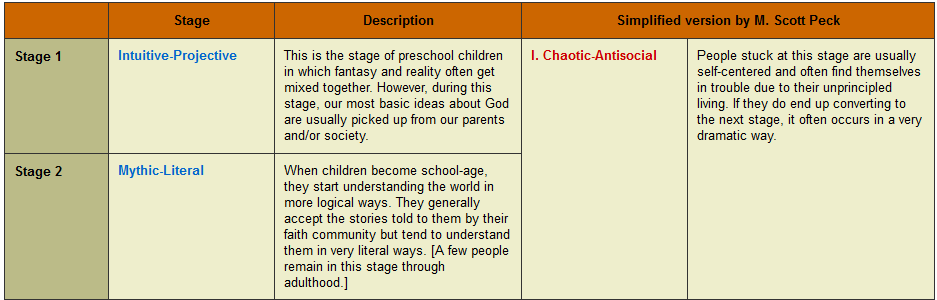
So, to recap from that general overview, here’s the descriptive chart for those early stages (click the image to enlarge):

Stage 1

When thought and language begin to open the child up to the use of symbols in speech and ritual play, the child moves on to Stage 1: “Intuitive-Projective” Faith which is typical of children ages 2 through 7. Here the child is egocentric, in other words self-centred, or self-seeking; you might even think of this stance as being ‘selfish’.

In other words, the world essentially orbits around the child. This is not a bad thing, as it would be seen to be in adults, because a) it is all part of the learning process and b) it is part of normal development. Selfishness is only a problem if a person chooses to be selfish; at this stage, a child has no choice – ‘selfish’ is the only way a child of this age knows how to be, and being unselfish is a learned behaviour; this learning takes place during this time of the child’s life, both at home and at school. At any rate,  it is in this stage that the child’s imagination is formed. This is because this Stage is characterized by the psyche’s unprotected exposure to the ‘unconscious’, and marked by a relative fluidity of thought patterns. This is the Stage of preschool/early school children in which fantasy and reality often get mixed together and are somewhat undifferentiated. Therefore, during this Stage, our most basic ideas about God and faith (although it will not yet be recognised as ‘faith’ as such) are usually picked up from our parents and/or society, and through experiences, stories, images, and the people that one comes in contact with, and the consequent interaction of these stimuli with the imagination, the unconscious, and the senses of fantasy and reality, together and in opposition.

In some ways, a partial reversion to these ways of thinking, for example the fantasy element, can indeed be helpful even in adulthood, and when at a more ‘mature’ Stage of spiritual growth. This is a good reason why the Stages of Spiritual Growth should not be seen as steps on a ladder which are left behind as ‘below’, ‘beneath’ or useless, but as part of the path we used in order to get to where we are now. In other words, our previous spiritual attitudes should not be entirely discarded, but instead be recognised as having value even though we have ‘moved on’ from that part of our lives and from those modes of thinking, because the spiritual tools and coping strategies we learned to use in those times can still be useful for us in our faith walk today. It can in fact be a good thing to ‘never grow up’!

In this stage, as I mentioned already, reality is usually not well-differentiated from fantasy. For this reason, adults preaching about the negative aspects of religion – for example, the devil and the evils of sin – can cause great harm to a child of this age, leading them towards a very rigid, brittle and authoritarian personality as an adult. Also, stories, concepts and ‘facts’ presented to the child at this level are deeply absorbed and can still be thought of as being ‘true’ and ‘factual’ – possibly unconsciously – even once the child has grown to adulthood. This can happen especially if the child tends to accept things at face value without questioning their veracity – something easily done at this level of maturity. This is one reason why I feel very strongly that children should not be taught about negative aspects of faith – such as Hell – especially if those teachings are being used in order to get the child to behave well or to conform to their parents’ wishes, or indeed those of any other authority figure. This Stage is the opportunity for a child to begin to learn to act out of love, liking and respect for people, rather than fear of punishment; a gradual weaning process (taking several years) from the selfish to the unselfish. Sadly, this opportunity is often missed.

Let’s finish this Stage description with Fowler’s formal summary:

Stage 1 Intuitive – Projective faith is the fantasy-filled, imitative phase in which the child can be powerfully and permanently influenced by examples, moods, actions and stories of the visible faith of primally related adults.

“The stage most typical of the child of three to seven, it is marked by a relative fluidity of thought patterns. The child is continually encountering novelties for which no stable operations of knowing have been formed. The imaginative processes underlying fantasy are unrestrained and uninhibited by logical thought. In league with forms of knowing dominated by perception, imagination in this stage is extremely productive of long-lasting images and feelings (positive and negative) that later, more stable and self-reflective valuing and thinking will have to order and sort out. This is the stage of first self-awareness. The “self-aware” child is egocentric as regards the perspectives of others. Here we find first awarenesses of death and sex and of the strong taboos by which cultures and families insulate those powerful areas.

“The gift or emergent strength of this stage is the birth of imagination, the ability to unify and grasp the experience-world in powerful images and as presented in stories that register the child’s intuitive understandings and feelings toward the ultimate* conditions of existence.

“The dangers in this stage arise from the possible “possession” of the child’s imagination by unrestrained images of terror and destructiveness, or from the witting or unwitting exploitation of her or his imagination in the reinforcement of taboos and moral or doctrinal expectations.

“The main factor precipitating transition to the next stage is the emergence of concrete operational thinking.  Affectively, the resolution of Oedipal issues or their submersion in latency are important accompanying factors. At the heart of the transition is the child’s growing concern to know how things are and to clarify for him- or herself the bases of distinctions between what is real and what only seems to be.” (1)

When a child attains the capacity for concrete operational thinking, he can begin to move toward the second of James Fowler’s Stages.

Stage 2

Fowler’s Stage 2 is called the ‘Mythic, Literal Stage’. Here the child (or adult person stuck in this phase, as we shall see) is likely to start sorting out the real from the make-believe. Story becomes the major way of giving unity and value to experience, but the symbols in those stories are seen as one-dimensional and literal. Moreover, beliefs, moral rules and attitudes are also held literally. Thus, God is an anthropomorphic (human-like) being in the sky; heaven and hell are viewed as actual places.

The person in this, the second of James Fowler’s Stages, is also more able to take or appreciate the perspective of another person, but his view of reciprocity is also rather literal. “If I follow the rules, God will give me a good life.” “If I pray, God will grant my wish.” In some faiths, this is expressed as a form of ‘Karma’ or ‘what goes around, comes around’.

Notably, Stage 2 is also the first Stage in which it is very possible to reach this stage and then never move on, even as an adult. Virtually everyone reaches Stage 2, even those without a ‘concrete’ faith or belief structure, because it is perfectly acceptable for people to live in the ‘Mythic-Literal’ Stage without having to realise any stated belief structure or religion. Some people in fact remain in Stage 2 for the rest of their lives.

Indeed, Fowler suggests that 20% of the adult population may best be characterised by this kind of faith. These adults, if they have a Christian faith, tend to appreciate churches where a more literal interpretation of Scripture is encouraged, along with offering security, deep conviction and commitment. God is viewed as stern, and being a just but loving parent, with rules and authoritative teaching being the norm. “A person may begin to grow out of Phase 2 when he encounters conflicts and contradictions in the stories he is interpreting literally and begins to reflect on the real meanings”.

As I have described this Stage, maybe people may have come to mind – even people of faith – whom you feel may still be in this Stage, or at least still show elements of it. In some ways, this is not necessarily a lack of spiritual progress, because as we shall see, most people, as they progress through the Stages of Faith, retain practices and beliefs that are still useful to them in their spiritual walk. And that’s possibly what could be happening – but remember, it’s not our place to judge or to ‘grade’ others on what ‘level’ they are at; this is not the point of this series. God moves each person along at the pace that is right for them.

Here’s Fowler’s formal description of Stage 2:

Stage 2 Mythic-Literal faith is the stage in which the person begins to take on for him- or herself the stories, beliefs and observances that symbolize belonging to his or her community. Beliefs are appropriated with literal interpretations, as are moral rules and attitudes. Symbols are taken as one-dimensional and literal in meaning. In this stage the rise of concrete operations leads to the curbing and ordering of the previous stage’s imaginative composing of the world. The episodic quality of Intuitive-Projective faith gives way to a more linear, narrative construction of coherence and meaning. Story becomes the major way of giving unity and value to experience. This is the faith stage of the school child (though we sometimes find the structures dominant in adolescents and in adults). Marked by increased accuracy in taking the perspective of other persons, those in Stage 2 compose a world based on reciprocal fairness and an immanent justice based on reciprocity. The actors in their cosmic stories are anthropomorphic. They can be affected deeply and powerfully by symbolic and dramatic materials and can describe in endlessly detailed narrative what has occurred. They do not, however, step back from the flow of stories to formulate reflective, conceptual meanings. For this stage the meaning is both carried and “trapped” in the narrative.

“The new capacity or strength in this stage is the rise of narrative and the emergence of story, drama and myth as ways of finding and giving coherence to experience.

“The limitations of literalness and an excessive reliance upon reciprocity as a principle for constructing an ultimate environment can result either in an overcontrolling, stilted perfectionism or “works righteousness” or in their opposite, an abasing sense of badness embraced because of mistreatment, neglect or the apparent disfavor of significant others.

“A factor initiating transition to Stage 3 is the implicit clash or contradictions in stories that leads to reflection on meanings. The transition to formal operational thought makes such reflection possible and necessary. Previous literalism breaks down;new “cognitive conceit” leads to disillusionment with previous teachers and teachings. Conflicts between authoritative stories (Genesis on creation versus evolutionary theory) must be faced. The emergence of mutual interpersonal perspective taking (“I see you seeing me; I see me as you see me; I see you seeing me seeing you.”) creates the need for a more personal relationship with the unifying power of the ultimate environment.” (1)

Peck’s Stage I

Fowler’s Stages 1 and 2 are simplified by Peck into a single Stage which he calls the “Chaotic – Antisocial” Stage. It can happen that a person can get ‘stuck’ at this Stage, and never progresses beyond the ‘selfish’ mindset and behaviour pattern. Peck recognises here that such people still in this stage (so, Peck Stage I or either of Fowler’s Stages 1 and/or 2 (generally 2)) are usually self-centred, and can often find themselves in trouble (financial, legal, emotional or personal) due to what amounts to their unprincipled living.

Margaret Placentra Johnston puts it like this:

“A stage of undeveloped spirituality, people in Stage I of spiritual growth are manipulative and self – serving. Though they may pretend or even think they are loving toward others, they really don’t care about anyone but themselves. There are no principles (such as truth or love) important enough to these people to override their own desires.

“Because they don’t allow any principles to govern their existence, there is a lack of integrity to these people and a chaos to their existence. Personally, I find the term “anti – social” most misleading here. Some of these people are very engaging and personable and can really fool you. Some even rise to positions of considerable power, such as presidents or influential preachers.”

[For an expanded version of this concept by Peck himself (abridged by Richard Schwartz, see below]**

I can think of at least one such famous person right away. Maybe you can too 😉

In terms of spiritual growth, Peck’s Stage I appears to me to be where a person’s faith is generally not all that well-structured or thought through, if at all. Maybe there are a lot of assumptions made and attitudes picked up from one’s environment, parents or peers, and which are accepted as being correct almost without question. Because of this, the word ‘antisocial’ is not necessarily used to indicate that a person is a right prat who is literally very antisocial, but it could also be that the person’s faith does not take on a social aspect in that it is very much self-contained and does not require others’ input, at least not consciously; although, as we have already seen, the environment, including other people, is very much a part of the formation of the person’s faith attitudes. People in this Stage who do not consciously ‘have a faith’, or those who are indeed very anarchic and/or otherwise ‘antisocial’ in their behaviour, might well be people who will remain in this Stage right through adulthood. If they do end up ‘converting’ to the next Stage, it often occurs in a very dramatic way and with huge changes in their lives. An example of this from Scripture would be the story of Zacchaeus the tax-collector (an ancient equivalent of today’s parking enforcement officers? 😉 ), who was self-serving and self-centred in that he cheated people out of money and in so doing made himself very unpopular. Jesus came into his life and he changed in an instant. His story is found in Luke ch. 19.

Other examples of this kind of ‘conversion’ were seen in ‘revivals’ in the past, where great numbers came to faith where previously they had no faith at all. And, in so doing, they moved in to Stage 3 (Fowler)/Stage II (Peck).

We’ll have a look at these Stages next time.


*In these definitions, the word ‘Ultimate’ is used by Fowler to indicate concepts such as God, Heaven, Afterlife and Worldview. So, the ‘Unifying Power of the Ultimate Environment’ means God; the Ultimate Enviroment being Heaven and/or ‘Creation’.

**  “Most all young children and perhaps one in five adults fall into Stage I. It is essentially a stage of undeveloped spirituality. I call it antisocial because those adults who are in it (and those I have dared to call “People of the Lie” are at its bottom) seem generally incapable of loving others. Although they may pretend to be loving (and think of themselves that way), their relationships with their fellow human beings are all essentially manipulative and self-serving. They really don’t give a hoot about anyone else. I call the stage chaotic because these people are basically unprincipled. Being unprincipled, there is nothing that governs them except their own will. And since the will from moment to moment can go this way or that, there is a lack of integrity to their being. They often end up, therefore in jails or find themselves in another form of social difficulty. Some, however, may be quite disciplined in the services of expediency and their own ambition and so may rise in positions of considerable prestige and power, even to become presidents or influential preachers.

“From time to time people in this stage get in touch with the chaos of their own being, and when they do, I think it is the most painful experience a human can have. Usually they just ride it out unchanged. A few, I suspect, may kill themselves, unable to envision change. And some, occasionally, convert to Stage II.” (2)


References:

Wikipedia’s page on James W Fowler

Wikipedia’s page on M. Scott Peck

Website of Margaret Placentra Johnston

Richard Cooke – Stages of Faith: a Tool for Curing Souls

Bill Huxley’s blog page on Fowler’s Stages of Faith

1. James W. Fowler, Stages of Faith: The Psychology of Human Development and the Quest for Meaning. Harper San Francisco, 1995, p.121

2. The Stages Of Spiritual Growth, by M. Scott Peck, M.D. (The Different Drum by M. Scott Peck, pages 187-203) – Abridged by Richard Schwartz


We Did So Well!

This entry is part 24 of 38 in the series Fiona

In my last post in this series, The Fight, I described how it was for us during the fight against pancreatic cancer. My lovely wife Fiona went to be with her Father in October 2016 after fighting this dreadful illness for over two and a half years. In that last post, I described how we found the strength to carry on, and how we lived life to the full despite the illness.

Now, I have just recently finished a series of sessions with my volunteer bereavement counsellor. In our final session together, she used a phrase I hadn’t thought of; she said,

“And you did so well!”

It was interesting that she should say that. I had to think about it a little, but she was right, you know. Y’see, when you’re actually going through these shattering events, you don’t notice how well you are doing; it’s only when someone tells you – maybe how ‘brave’ you are – that you take notice and think, ‘Oh yes! I hadn’t noticed that!’.

Not long after Fiona was diagnosed with the cancer, I remember chatting to someone about our approach to the illness. I said that if Fiona was supernaturally healed, or cured medically, great – and we’d all celebrate and have a well-woman party and say “well done, everyone!” because it would have been a team effort. Everyone would have done their very best and we would express our gratitude for that, and for its fruits – Fiona being well once again.

And the other scenario was that we would lose her to the illness, and we would of course mourn her, but the underlying principle would be the same: We could reassure ourselves in the knowledge that we did our best; we tried our hardest. And that is indeed what happened. Virtually everyone who knew and loved Fiona rallied round us in some way. They provided meals; they sent flowers; they came round for a chat; they shopped for us; they abided by our house’s infection control policy*. Some of Fiona’s close friends set up a charity to raise money for a special medical procedure which I consider gave Fiona an extra year of life; moreover, it was a year free of pain and other symptoms of the cancer. It cost £14,000 to do that, and they raised the money for it. We will always be grateful to these amazing ladies for doing their best too, and working so hard for Fiona. Wow!

And then there’s the courage, the hope, the lessons learned, the bearing up under pressure. How we respond to our tribulations is just as important as the tribulations themselves. Gaining these benefits and life-skills means that the suffering was not all wasted; it was not all in vain. And the same can be said for members of my family: in going through this furnace, this crucible, they have all emerged as better people for it. And our friends were with us on this walk, in that furnace, and on this learning curve, too. All of those who walk through the fire in this way are changed by the experience, and it’s our choice, as we walk through that fire, whether to let it change us for the better, or for the worse.

As you will have read in the other posts in this series, I have learned so much, been so much closer to God, had so much insight (which has already been a tremendous help to others in similar situations), that I would not have had if I hadn’t gone through the dark times. So, rather than moping about and complaining, we just got on with the everyday business of living life to the full. And that meant that all the darkness, all the pain, all the loss, it all had a benefit in the end. We packed so much fun and life into that time, in the midst of the horror and despair. And then we carried on with that attitude once we had lost her. In this way,  the life-lessons learned and the insight and wisdom gained have not been lost; this means that Fiona’s loss does in many ways still carry meaning. And that these lessons have not been wasted would have been just what Fiona would have wanted for us. Of course, I’d still rather not have lost her, but making the best of the situation is a great way of not letting it defeat you.

Not that I believe God throws these things at us; not for one minute. He’s fully aware that terrible things happen in life; shit happens, and it’s how we cope with it that counts. Nobody is exempt from having tribulation in their lives at some point; its how we cope with it that counts, and God promises to be there for us in those hard times. Never will I leave you or forsake you (Heb 13:5, Dt 31:6) says God, and He means it. The most famous of the Psalms, the 23rd Psalm, says this:

“Yea, though I walk through the valley of the shadow of death, I will fear no evil; for Thou art with me, Thy rod and Thy staff they comfort me.” (Ps 23:4 KJV).

David, the guy who wrote that Psalm, went through some pretty horrific stuff in his life, yet still he wrote that verse and likely meant what he wrote, and it was evidently true from his words that he’d had the same experience as I and many others who pass through the valley of the shadow of death. God is with us in that valley. He’s had personal experience there Himself. He knows His stuff, and He leads us too into knowing that stuff. Indeed, we walk through the valley, but He is with us.

So, yes.  We did so well! Thanks to the Grace of God, His unearned favour, we are coming through that valley, and we are reaping the rewards of our faith. We did our best – for Fiona – and we are still doing our best. It doesn’t stop once the mourning and the grief are lessening. There is no other person’s hand I’d rather be holding than that of Jesus, because He holds on tight, and healing flows through that Hand just like it did two thousand years ago.

Be blessed!


*Because, as I described in The Fight, chemotherapy patients are usually immunosuppressed as a side-effect of the treatment, and are therefore highly susceptible to infections – and these can easily be fatal. Because of this, I put in place an ‘infection control’ system in our house where anyone who had an infection – a cold or whatever – was respectfully asked not to come in to the house. In addition, we had a hand disinfectant bottle just inside the door, and anyone who did come in was asked to sanitise their hands as they came in, thus minimising the risk of Fiona getting a potentially lethal infection.


Header picture shows me, Fiona and Ellie at breakfast on our ‘House of Anubis Road Trip’; a week-long tour that we did in September 2014, in between doses of Fiona’s chemotherapy. (We called it that because one of the purposes of the trip was to visit the filming locations for the teen mystery drama series House of Anubis‘). We did not let the illness defeat us; we took it on the nose and carried on enjoying life to the full. Look how radiant Fiona is!

The bandage on Fiona’s arm is the covering for the PICC line, which is described in the article The Fight.

Stage 0 – “Pre-Faith”

This entry is part 3 of 11 in the series The Stages of Spiritual Growth

Ok, I said that in my series ‘The Stages of Spiritual Growth‘, I was going to look at each Stage individually in more detail*. And the first instalment of that is presented here today.

In all of these commentaries, I will of course be using my own ideas, but I will also incorporate ideas and descriptions from others, some of which text will be copied and pasted directly since I consider that they are best expressed like that. I will not differentiate these passages in the text, but I will include links to my source materials (if used) in the References section at the end of each piece.

I should say here that the early Stages of Spiritual Development (Fowler 0, 1 and 2; Peck I) are not what we are mainly concerned with in this series, since most of my readers will no longer be in the ‘early’ stages, although some may yet be, as we shall see. But I will be discussing those early Stages in these first two instalments because they are important and relevant not only to people still in those Stages (and to those caring for these people) but also as a stepping-stone to show how we got here from there.

Today, I’m going to look at the ‘formative’ Stage 0 – a stage mentioned only by Fowler and considered by some to not be a ‘Stage of Faith’.

Stage 0

James Fowler’s stages start with what he calls a “pre-stage” that refers to infancy, called ‘Undifferentiated Faith’. It is also referred to as ‘Stage 0’, and it can also be thought of as “Primal or Undifferentiated” faith. It takes place from birth to approximately 2 years. It is characterized by an early learning of the safety of their environment (i.e. warm, safe and secure vs. hurt, neglect and abuse). If consistent nurture is experienced, one will develop a sense of trust and safety about the universe and the divine. Conversely, negative experiences will cause one to develop distrust with the universe and the divine. Transition to the next stage begins with integration of thought and language which facilitates the use of symbols in speech and play.

In this ‘pre-stage’, the infant, (it is surmised, since they are rarely interviewed!) develops basic trust and mutuality (or lack thereof) with the ones providing care. The quality of interactions in this phase underly all future faith development for the individual.

So this means that, despite this Stage being seen by some as not even earning a mention as a recognised Stage, still this is a vital area in a person’s spiritual development. Remember that humans begin their development – physical, emotional, psychological, spiritual – from the very moment they are born. It is therefore equally vital that a child at this age is given a safe, secure and well-provided environment in which they can grow healthily in all of the ways mentioned above. As we are talking here about Spiritual Growth, let’s concentrate on that aspect. Interestingly and paradoxically, although we might not see children of this age as having ‘faith’, in actual fact they very much do so.

It is in fact a faith in those who are (or should be) providing that growth environment.

Think about it. A very young child has to have absolute trust – which, at this Stage, is analogous to faith, if you like – in those who provide for them – family, foster parents, whoever. What else can they do but to have that trust? Where else will they get what they need? They certainly cannot provide or obtain anything for themselves; there is a complete helplessness in this Stage that is quite unlike that experienced in any other Stage. Certainly the Biblical phrase ‘defining’ faith (amongst other things) as being ‘… the substance of things hoped for, the evidence of things not seen’ (Heb 11:1 (KJV) ) is quite apt in this context!

And therefore the model, if you like, of any object worthy (or otherwise) of our trust is based very strongly on our formative times with these providers and/or carers. If we are well-loved and cared for, we will generally be people who find it easier to trust in God later in life. It’s a very simple form of trust, a ‘childlike faith’, if you like, that simply knows that everything good will be provided by benevolent carers, without needing to worry about the source, frequency or quality of that provision. On the other hand, a bad experience at this age will undoubtedly set the child up for a difficult time in being able to trust. And the main take-home message for us fron this stage is this : Faith and Trust are closely related. In fact, at this Stage, they are indistinguishable.

Fowler himself formally puts it like this:

“In the pre-stage called Undifferentiated faith the seeds of trust, courage, hope and love are fused in an undifferentiated way and contend with sensed threats of abandonment, inconsistencies and deprivations in an infant’s environment. Though really a pre-stage and largely inaccessible to empirical research of the kind we pursue, the quality of mutuality and the strength of trust, autonomy, hope and courage (or their opposites) developed in this stage underlie (or threaten to undermine) all that comes later in faith development

“The emergent strength of faith in this stage is the fund of basic trust and the relational experience of mutuality with the one(s) providing primary love and care.

“The danger or deficiency in the stage is a failure of mutuality in either of two directions. Either there may emerge an excessive narcissism in which the experience of being ‘central’ continues to dominate and distort mutuality, or experiences of neglect or inconsistencies may lock the infant in patterns of isolation and failed mutuality.

“Transition to Stage 1 begins with the convergence of thought and language, opening up the use of symbols in speech in ritual play” (1)

So, when thought and language begin to open the child up to the use of symbols in speech and ritual play, the child moves on to Stage 1: “Intuitive-Projective” Faith which is typical of children ages 2 through 7. We’ll take a look at Stage 1 next time, along with Stage 2, and compare these Stages with Peck’s Stage I.

See you soon.


References:

Wikipedia’s page on James W Fowler

Wikipedia’s page on M. Scott Peck

Website of Margaret Placentra Johnston

1. James W. Fowler, Stages of Faith: The Psychology of Human Development and the Quest for Meaning. Harper San Francisco, 1995, p.121



*I must say at this point that although I am a Polymath (that’s someone who knows a lot about/is good at a lot of different things), I am not trained in any form of psychology, psychiatry or anything similar apart from in basic counselling skills, and that was a long time ago 🙂 Much of what I write here is from a layman’s point of view, but based on a fair bit of life-wisdom and personal experience in observing and participating in discussions between people at different Stages of Faith.

Thoughts and Prayers…

Yet another tragic shooting in the United States. And it has of course brought out the usual plethora of one group of people saying, ‘Our thoughts and prayers are with you…’ and, predictably, the other group of people who rant on about how valueless ‘thoughts and prayers’ are.

In the very same Facebook group (that I am a part of), I saw two consecutive posts, one saying how useless ‘thoughts and prayers’ are, and the very next post saying that this person appreciated the ‘thoughts and prayers’ that had been expressed for his situation.

Make your minds up, folks.

I know that some politicians and other professional apathists use ‘thoughts and prayers’ as a platitude. And I know that it’s sickening. I know, right?

But I also know that there are many millions of others who, appalled at the violence and suffering, do indeed hold up the victims of these crimes, and their families, in their ‘thoughts and prayers’.

Sometimes, when you live thousands of miles away, ‘thoughts and prayers’ is the best you can do. I’m not trying to be insensitive, but everyone has their own problems and worries and, while we do all we can to help – maybe send money and whatnot – the sheer fallacy of condemning those who ‘have thoughts and prayers but do nothing’ is fallacy indeed. What, do they want us to drop all our responsibilities and fly over to the disaster zone to help personally? What a ridiculous notion. I sometimes think that, in their rage, these people don’t even know what they are talking about; they don’t know what it is they actually want.

And let me tell you something. I have personal experience of the power of prayer. Here’s an example. I know someone who was having an extramarital affair. One night, Fiona and I decided that enough was enough, and we engaged in a thorough prayer battle about that situation, we kicked the enemy’s ass good and proper, and the very next morning the person in question called their spouse and asked to meet up to talk it over. That couple is now back together again and have been so for 25 years or more. The person having the affair ‘suddenly realised’ (at exacty the time we were praying) that this was not the person they wanted to be. Call it coincidence if you like, but it is my firm belief that this person changed their mind because we prayed. I have other examples too but that one will have to do for now. I want to get on with my rant.

My point is that prayer can change things. It is also especially galling that those who decry ‘thoughts and prayers’ are often themselves Christians who profess to believe in the power of prayer. Sorry, but yeah, right. I have actually stopped following one particular person’s Christian blog (and removed it from my recommended blogs/links page) because every third post or so he would continually rant about the worthlessness of ‘thoughts and prayers’.

Listen: Prayer is God’s way of empowering the powerless.

Who are we to say that ‘thoughts and prayers’ are useless?

How dare these people insult the beliefs and caring practices of countless millions of compassionate people, of all faiths and belief systems, all across the world who care enough to think and pray deeply and sympathetically about these poor people who have suffered so? For some of these compassionate people, ‘thoughts’ are the only thing they know how to give. For others, they can think but they can also pray – using the Godly gift that can move mountains. For most, indeed ‘thoughts and prayers’ are all they can give.

So do not belittle the care and compassion of the countless millions who are ‘thinking and praying’ right now for these victims and their circumstances.

You have absolutely no idea how ungrateful you sound.

And you have absolutely no idea what things God is prompting millions of unsung heroes, behind the scenes, to do right now.

Including ‘thoughts and prayers’.

Rant over.


[Edit]: And I must also add that my friend Darren has only today posted on Facebook this very thing:

“Of all the ‘actions’ that you can perform to influence and change another person’s life for the best, secret prayer is the greatest and most effective!”

Thanks Darren! 🙂

Spoiler!

This entry is part 2 of 11 in the series The Stages of Spiritual Growth

In this, the second piece in my series on the Stages of Spiritual Growth, I’m afraid I’m going to kind-of lay out right at the very beginning an overview of where this series is going, and indeed issue a bit of a spoiler! I’m not going to keep you waiting; I am going to explain up front what the various Stages are, and in later posts I will flesh out each Stage with examples and commentary. In this way, you can also do your own reading and research around the subject so as to be able to develop your own ideas and concepts that fit with your own personal journey, and then compare those findings with mine. I am actually not keeping any ‘secrets’ here; all the initial ‘cards’ will be laid out on the table and my own comments and ideas will follow in future posts, on the back of that. And remember we are all on a learning road together!

So, without further ado, here we go.

There are two, very similar, ‘schools of thought’ on the stages of spiritual growth.

The first is the ‘Six Stages of Faith’ (sometimes quoted as the ‘Seven’ Stages*), put forward by the late Prof. James W. Fowler.

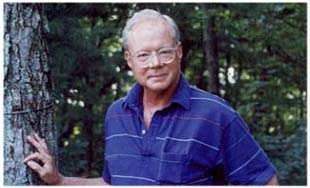
James W. Fowler

Fowler’s Stages are fully described in his book, “Stages of Faith: The Psychology of Human Development and the Quest for Meaning“. The six/seven Stages are:

  • Stage 0“Primal or Undifferentiated” faith (birth to 2 years)
  • Stage 1“Intuitive-Projective” faith (ages of three to seven)
  • Stage 2“Mythic-Literal” faith (mostly in school children)
  • Stage 3“Synthetic-Conventional” faith (arising in adolescence; aged 12 to adulthood)
  • Stage 4“Individuative-Reflective” faith (usually mid-twenties to late thirties)
  • Stage 5“Conjunctive” faith (mid-life crisis)
  • Stage 6“Universalizing” faith, or what some might call “enlightenment”.

(Stages generated from Wikipedia article on James Fowler)

Each of these Stages, and the ages at which they are thought to occur, are of course generalisations – some people may not have all the ‘characteristics’ of each stage, but they are reached (if they are reached at all) in sequence since each Stage builds on the things learned in previous Stages. Some believers may not reach the further Stages at all, and the ages are of course different from person to person. These Stages are summarised in the following chart, along with a short description:

I would imagine that you may already be identifying with much of what you have seen in that chart…

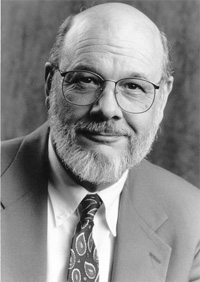
The other school of thought is known as the ‘Four Stages of Spiritual Development’ and was proposed by the late Dr. M. Scott Peck, from whom we have already heard in the previous instalment of this series.

M. Scott Peck

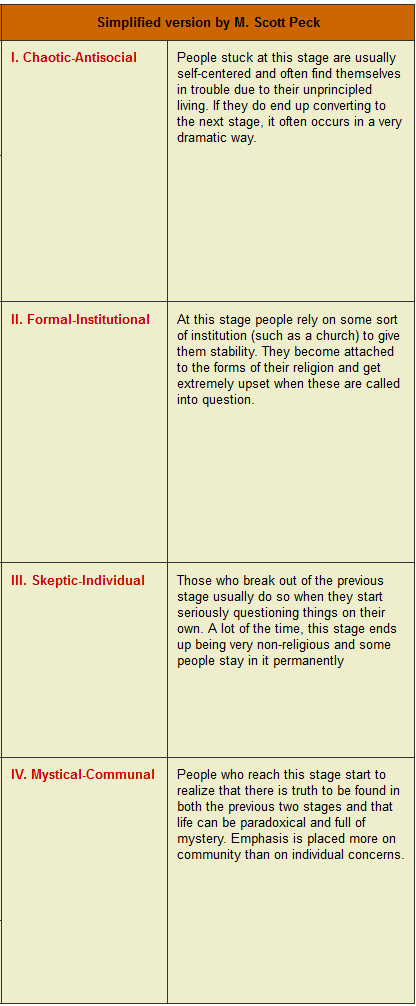
Peck writes of the ‘Four Stages of Spiritual Growth’, and he does refer to Fowler, in passing, in an excellent [albeit abridged] version of his ideas which can be found here, and which refers to Peck’s book ‘The Different Drum‘ is where he expounds his ideas on his ‘Four Stages’. These ‘Four Stages’ follow a broadly similar structure to Fowler’s but are slightly more simplified. These are Peck’s Four Stages:

  • Stage I is chaotic, disordered, and reckless. Very young children are in Stage I.
  • Stage II is the stage at which a person has blind faith in authority figures and sees the world as divided simply into good and evil, right and wrong, us and them.
  • Stage III is the stage of scientific skepticism and questioning.
  • Stage IV is the stage where an individual starts enjoying the mystery and beauty of nature and existence.

Furthermore, Peck also argues that while transitions from Stage I to Stage II are sharp, transitions from Stage III to Stage IV are gradual. Nonetheless, these changes are very noticeable and mark a significant difference in the personality of the individual.

(Stages and that last sentence generated from Wikipedia article on M. Scott Peck)

I’d also make the observation at this point that Stage III can, in my opinion, be one of the points at which the person may go through a ‘Dark Night of the Soul‘. It certainly was for me. This also corresponds with Fowler’s Stage 4. The transition experienced during Stage 4/Stage III may be sharp or it may be prolonged, and will vary in duration from person to person.

Again, Peck’s Stages can be summed up in a chart:

Note that these Stages, like Fowler’s, are generalisations in a similar way to those described for Fowlers Stages.

Now, let’s marry up the two sets of Stages so that we can compare them, in yet another chart (which you can click on to get a zoomable image to make it easier to read). Here you can see how Fowler’s and Peck’s Stages overlap and compare with each other:

(Source for the above charts: http://www.psychologycharts.com/james-fowler-stages-of-faith.html )

I’m not saying that these ‘Stages’ are definitive, and (as I have already mentioned) they are to some extent a generalisation. But I must say that I can definitely identify with these Stages of growth in my own mind, and at the very least, these ideas should confirm for us that there are indeed spiritual growth stages of some sort out there, and that if we find ourselves changing under God’s guidance, we should not be surprised when we can indeed identify with some of the indicators of the Stages put forward by Fowler/Peck. So, when I am presenting and describing these Stages from both Fowler and Peck, I am not asking my readers to decide here and now (or indeed at any time) which Stage they are in – although I realise this is a natural tendency – nor am I encouraging anyone to feel ‘superior’ or ‘inferior’ to other Christians because of the ‘stage we are at’. This isn’t about others; this is about realising that we are all on a journey, that these Stages do exist in some form or another in most people, and that this is perfectly normal and nothing to be afraid of. Indeed, I am not proposing that anyone be constantly mindful of the Stages and/or ‘trying to work out where we are on the scale’**. While introspection can be useful, I would far rather we are simply aware of these Stages as a perfectly normal part of personal spiritual development, as information that is useful in working out what is happening to us, but all the while still majoring on keeping our eyes fixed on “…Jesus, the Author and Finisher of our faith” (Heb 12:2). He’s the important One!

In the light of this knowledge we now share, it is worth refocusing temporarily at this point and thinking about the effects that this knowledge may have on others who are at different Stages in their own walk of faith. St. Paul mentions something similar in Romans 14 where he talks about people whose faith is ‘weak’ (his words, not mine!), and not causing such people to stumble. I go into considerable detail on this idea in this piece. Please therefore remember to treat this knowledge as good and useful but at the same time potentially harmful to those who might feel threatened by it. Some people just aren’t ready to hear it yet. Jesus said in John 16:12 that, ‘I have so much more to tell you, but you are unable to bear it yet’. He was sensitive to the level of spiritual maturity in His disciples, and we should be no different in our attitudes towards our fellow believers. This is our chance to show Grace to others by considering them!

Anyway, as I have said, I will flesh out these ideas about the Stages of Spiritual Growth in future articles. In the meantime, I will leave you with the words of two wise men concerning the Stages we have just discussed, and relating to what Stage we ourselves are ‘at’:

“Once you say ‘higher level’ (regarding one’s level of spirituality), you appeal to the ego, and all the wrong instincts in people.”

-Fr. Richard Rohr

“When you begin to refer to where you’re at on your journey as a “deeper place,” “higher level,” “another dimension,” or some other such thing, you create a space where pride, arrogance, and superiority can thrive in the name of spirituality. No, we’re journeying, and on this journey, mountains are laid low, and valleys exalted. Every place is an equal place for the sincere, it’s just that we are never all in the same place at the same time, and tend to assume wherever we’re at is the place to be.

“The place to be is wherever you are”.

-Jeff Turner


*The reason that Fowler’s ‘Six Stages’ are also known as the ‘Seven Stages’ is because the first stage is actually ‘Stage 0’, at which point it could be argued that the person does not actually have any sort of faith because they are too young to be able to form one, and therefore it doesn’t count as a Stage of Faith because there is no faith present. This of course is different from person to person; my eldest son had a faith structure from a very early age. But that’s the explanation, at any rate.


**One writer puts it like this:

“It is really important to recognize that no one person actually exists in any given one of these stages. The stages are more like a tendency that can change over time – sort of like optimism versus pessimism, or being an extrovert versus an introvert. No one is 100% in either of these camps, and may tend more or less so according to changing circumstances. 

“So why do we study these stages if not to judge at which one a person exists? The real value of these stages is to understand what values, characteristics and traits are typical in spiritual maturity. They provide a roadmap showing which way is forward. Not all factors in our society (including many churches) strive to lead a person in a forward spiritual direction.”

(From the website of Margaret Placentra Johnston)

The Stages of Spiritual Growth

This entry is part 1 of 11 in the series The Stages of Spiritual Growth

The Christian Life is often described as being a journey. It’s a journey with Jesus; a journey of change; a journey of being ‘transformed’ into the likeness of Christ. We are actually intended – designed, if you will – to grow spiritually. And the Christian can walk secure in the knowledge that Jesus is the One Who will carry the work to completion:

“Being confident of this very thing, that he which hath begun a good work in you will perform it until the day of Jesus Christ” (Phil 1:6 (KJV))

Now, if you ask any Evangelical Christian about God working change in a believer’s life, he will certainly agree enthusiastically with the idea. The potter’s wheel (Jer 18:1-6), the Refiner’s Fire (Mal 3:3), being ‘…transformed from one degree of glory into another’ (2Cor3:18); these are just three Scriptures that contribute towards forming standard Evangelical doctrine on God’s transforming of believers on an ongoing basis, and there are many more such Scriptures. This is a well-established part of the Christian life, and you won’t find many dissenters on that point.

But the thing is, many believers don’t actually think beyond this concept; they have no idea what this transformation will actually look like in practice – and in any case it’s also going to vary from one person to another. What Jesus works in one person is always, almost by definition, going to be different from what He works in another (Jn 21:22); we are all different and Jesus meets each of us at our point of need.

An example of part of this transformation process is undoubtedly the ‘Dark Night of the Soul’, which I have written about before here and here. And since this Dark Night is not actually all that well known about within Evangelical Christianity (although more people are discovering it for themselves simply by going through it), many believers either give up the walk entirely, or they stagnate at that point and can grow no more until they pass through it, if indeed they ever do. Or they live with their doubts and questions and just accept them, but this is not progress in the transformative sense. In my old Evangelical circles, they always used to say that until you have let God do the work He wants to do at the moment, He will not let you progress any further until you’ve jumped that particular hurdle in your life. While I don’t believe that God is actually that two-dimensional, I do sort-of agree with the sentiment behind it in that until you have grown in a particular area, you can’t really make any more progress in that area because part of your ‘toolkit’ of essential background will be missing. But of course, Father is pretty creative when it comes to finding solutions to our individual hurdles, and He does offer us a path through – but still He prefers our co-operation. If we insist on sitting still, He will usually honour that, but your spiritual growth will be delayed in that area until you let Him do what He wants.

So, what does spiritual growth actually look like? Well, by definition, growth implies change. The believer’s attitudes, doctrines, belief systems, trust, faith, will all change with growth. Like with the Dark Night, one of the main obstacles to change is this: that this change is not always understood nor welcomed by fellow believers. The person may be accused of ‘backsliding’ or of ‘falling away’; he may be threatened with ‘hell fire’ if he does not return to his conformative ways; conforming, that is, with the beliefs of the group he is with at the time – church or whatever. In some ways, this is understandable as the group as a whole feels threatened by anything ‘different’; maybe they feel that ‘false doctrine’ may be brought in which will threaten their carefully-constructed faith/doctrinal/belief structure, and the whole thing will come crashing down like the proverbial house of cards. You can’t really blame them; in some ways it’s actually an animal herd-instinct kind of thing. But the simple fact is that someone undergoing spiritual growth will change. It’s the normal way of things. And it may cause the changing believer to feel alienated, rejected and alone. Sometimes this is exactly why some people simply live with their doubts or other change pressures; they want to conform, they have a fear of rejection and so they stay where they are. And the irony here is that many Evangelicals – I remember it clearly from my time under that banner – would say that ‘if you’re not moving forwards, you’re backsliding’. Personally, I disagree with their physics/navigation in that idea, but the irony still stands. And we should not be trying to please men – which is what the ‘herd instinct’ wants to do – but God (Gal 1:10; Jn 12:42-43, Lk 16:15)

But the thing is that, no matter what the believer’s acquaintances think, this change is real and it’s God that’s doing it. So what’s the answer? Well, as usual, a little bit of knowledge goes a long way. What if Evangelicalism has become so insular, so inward-looking, and so suspicious of outside influences, that Evangelical Christians in general are unaware of what’s happening? What if, in fact, unbeknownst to Evangelicalism in general, it is a recognised phenomenon that spiritual growth implies (often radical) change?

Well, in fact, this is indeed the case. It is indeed well-recognised that an individual’s faith and belief structure should normally go through doubt, questioning, revision and similar changes. We are mere mortals; how can we ever imagine that we can understand the vast mysteries of God in one go? So, in order to make this stuff a little clearer, and to reassure my readers that this is indeed a normal part of Christian growth, I would like to advance the idea of the ‘Stages of Spiritual Growth’ in this series – which may span several weeks, or even months – and the instalments of which will likely be interspersed with articles on other subjects.

In this series, then, I will be exploring this idea of the Stages of Spiritual Growth*, which is actually one of the most important discoveries/observations for a modern believer to be aware of.

To quote Dr. M. Scott Peck, from whom we are going to be hearing much more in this series,

“Just as there are discernible stages in human physical and psychological growth, so there are stages in human spiritual development… But I first came to an awareness of these stages through my own personal experience.

“The first of these experiences occurred within I was fourteen and began attending Christian churches in the area. I was mainly interested in checking out the girls but also in checking out what this Christianity business seemed to be about. I chose one particular church because it was only a few blocks down the street and because the most famous preacher of the day was preaching there. It was in the day before the “electronic church,” but this man’s every sermon was broadcast over almost every radio frequency across the country. At fourteen I had no trouble spotting him as a fraud. On the other hand, up the street in the opposite direction was another church with a well-known minister–not nearly as famous as the first but still probably among the top thirty in the Who’s Who of preachers of the day-a Presbyterian named George Buttrick. And at age fourteen I had no trouble spotting George Buttrick as a holy man, a true man of God. What was I to think of this with my young brain? Here was the best known Christian preacher of the day, and as far as I could discern at age fourteen, I was well ahead of him. Yet in the same Christian religion was George Buttrick, who was obviously light years ahead of me. It just didn’t compute. So I concluded that this Christianity business didn’t make any sense, and I turned my back on it for the next generation.

“Another significant non computing experience occurred more gradually. Over the course of a decade of practicing psychotherapy a strange pattern began to emerge. If people who were religious came to me in pain and trouble, and if they became engaged in the therapeutic process, so as to go the whole route, they frequently left therapy as atheists, agnostics, or at least skeptics. On the other hand, if atheists, agnostics, or skeptics came to me in pain or difficulty and became fully engaged, they frequently left therapy as deeply religious people. Same therapy, same therapist, successful but utterly different outcomes from a religious point of view. Again it didn’t compute–until I realized that we are not all in the same place spiritually.

“With that realization came another: there is a pattern of progression through identifiable stages in human spiritual life. I myself have passed through them in my own spiritual journey. But here I will talk about those stages only in general, for individuals are unique and do not always fit nearly into my psychological or spiritual pigeonhole.

“With that caveat, let me list my own understanding of these stages and the names I have chosen to give them…”

And that is where we are going. I will be examining why we feel and behave the way we do as believers, why we face so much opposition from our peers, and  why these changes in our lives can produce so much fear, uncertainty and division amongst people who love and care for us, and are fearful of, and disturbed by, the changes they see – fearful either for us, or for themselves. And I will also be hoping to encourage you by reducing or even removing completely that fear, and to help you to reassure others too in a similar way. And, who knows? This knowledge may even help us on the path towards reconciliation between the various warring factions of Christendom.

This is an exciting project for me, which I have been thinking deeply about for a long time, and it will be hard work, but equally it will be well worth it. I believe that education is a very important tool that can open up entirely new areas that we never dreamed possible, and that’s my intention with this series. You will doubtless find yourself reading certain things and thinking (maybe even out loud!) “Oh, yes! That’s exactly how I feel!” And in so doing, your eyes will be opened, your understanding increased, and your Christian maturity deepened.

That’s my prayer for you for this series.


*Note that, in this series, I will be using the terms ‘Stages of Spiritual Growth’ and ‘Stages of Faith’ interchangeably. This is quite deliberate.

Even More Quotes

“Faith is not believing in creeds, doctrines or dogmas; faith is trusting the divine presence in every moment”. – John Shelby Spong

“A woodcarver creates his masterpiece, not by addition, but subtraction. The more material he creatively and skillfully removes, the more beauty emerges.

“So it is with God-talk. Sometimes the less we say about God, the more His beauty is seen. The more we remove the generally accepted mythos, the more the Truth is revealed, even without being directly spoken”. – Jeff Turner

“When Jesus said ‘Do not worry’, He was talking about daily needs like food and clothing. If He’d been at all concerned that we were not worrying enough about our ‘eternal destiny’, He would have preached a whole lot more on hellfire and damnation, rather than about us simply not worrying about where our next meal was going to come from”. – Me

I think there can’t be any greater joy in life than knowing someone else’s life is richer because you lived – Rich Mullins

“Is your relationship with your loved ones based upon a book or what’s in your heart? It should be no different with your relationship with God”. – Barry Smith

“I don’t see the Gospel as something that makes your life a sacred experience, or that gives you a sacred life to replace the one you have. Rather, the Gospel is an introduction to the sacred nature of the life you’re presently living, and as an empowering call to live in harmony with it”. – Jeff Turner

“There are bigger issues in life than girls who date girls and boys who date boys” – Anon

“In fact, I believe that the biggest sin is in trusting in ouselves to jump through all the right hoops, in the right order, and at the Pastor’s command. Oh that’s such self-sufficiency, rather than relying on He Who began the good work in us to bring it to completion”. – Me

“The cross was not some kind of blood magic ritual that released the forgiving potential of a formerly mercy-withholding god, but rather an act of human barbarity and cruelty, that allowed for the revealing of the forgiving nature of an always already merciful God.” – Jeff Turner

“Adding your works (performance) to what Christ has accomplished for us at the cross as a means of salvation is an insult to God and the cross. Think about it!” – Chikezie Obika

“If morality is your way of living, you are living way beneath your privileges. Living by love in the power of the Spirit is true living and there are no rules–there are none needed. The one who lives by love will live a life like Jesus lived which is so far above living by rules the difference is like night and day!” – Mike Rough

“The murder of Jesus is a reflection of human, not divine, justice. The resurrection and revivifying of the mangled corpse of an innocent man is a reflection of divine, not human, justice.

“We are not as good as we think we are, and God is far better than we’ve been told he is”. – Jeff Turner

“That death is no longer the end has profound ramifications. Absolutely profound. Rather than spoon-feed you, I’ll just let you think about it for yourself. Ask yourself this question: ‘What attitudes would change in my life if death is no longer the end?’ If you think about this in any great depth, the results will change your life. It did for me”. – Me*


*Originally from my blog post ‘The Fight‘.