Category Archives: Insights

From the Heart

Today, I’d like to share with you one of the best blog posts I have seen in a while.

Christy Wood is a lady whose blog I read regularly, and whose work I have shared several times on my blog before. Christy has recently been writing a series on ‘Finding God’, and, in this, the last article of the series, she writes a heartfelt piece full of longing for the Presence of God, and for a deep Relationship with Him.

Perceptive and encouraging, and at the same time written from the heart with a passion that is infectious, I absolutely love this post. Over to Christy (click the image below to go to the article):

Five Ways Jesus Challenged the Status Quo

Another blogger whose work I really like is Mike Douglas, who writes the blog ‘Getting Back to my Future’.

In this article, Mike describes a Jesus who would probably not be allowed in to some of today’s Conservative churches, particularly in America. Jesus did so many things that were repugnant to the religious people of His day, and sadly there are many people around these days who think the same way as those religious types, and who would treat Him the same way. Without more ado, here’s Mike’s article. The link to the original article is given at the end.


In the 70’s, it was popular to portray Jesus as a rebel, a revolutionary bent on changing the world. It was also common to portray Him as a hippie. Both images are accurate. I love seeing Jesus as a hippie who refused to bend to social pressure.

He was always going against the social and religious norm. I LOVE THAT! He touched lepers [think who in your world who is considered the most disgusting]. He called a tax-collector as a disciple [no occupation at the time had a worse reputation]. He also let prostitutes wash His feet, spoke to a Samaritan WOMAN, and healed a Roman’s servant.

Could you imagine a big religious leader getting his hands dirty with such people? For example, the Roman servant thing is like a good Christian church leader helping a terrorist’s child who needed assistance.

If you think of Jesus as a kindly hippie, it might surprise you that not everyone was a fan. While he taught about a loving God and urged people to love others, Jesus also told people to quit ripping people off and to get rid of the extra garbage in religion that made it hard for people to know God’s love. That didn’t always go over so well. It didn’t go over well because some were getting rich off it.

But He rejected the criticism. He countered with, ‘you have let go of the commands of God and are holding on to the traditions of men’.

Obviously, these types are still with us today, all the extra garbage remains, and many are still as resistant to changing as ever. And, there are still many people outside the religious ‘acceptable’ standard that need to know that’s not how Jesus was or how He sees you.

Let me tell you more about my hippie, revolutionary brother Jesus. He is so cool!

Here are 5 ways Jesus challenged the status quo.

1. Jesus rejected “business as usual”

In Jerusalem, he attacked the money changers, who were running a scam trading Jewish money for Roman money at a profit. He didn’t just chew them out, he physically threw them out. When a corrupt tax collector decided to follow Jesus, he returned all his ill-gotten gains and then some. “Business as usual” just couldn’t continue when Jesus got involved.

That kind of teaching made more than a few enemies among those who would profit from the status quo. But my hippie brother cared more for people than profit.

2. Jesus turned the religious laws on its head.

There were hundreds of religious and, honestly, ridiculous laws that the religious leaders had added to Scripture. They turned 10 Commandments into over 600 laws. Jesus railed against a religion that focused more on rules than people – more on rules than love.

For example, the Bible says Jesus intentionally healed people on the Sabbath, knowing it would violate the religious law. And the religious leaders hated it. Think of it, a man receives a remarkable and visible healing, yet the church leaders were upset that it happened on a Sabbath. That’s what religion creates.

Jesus scolded them for hypocrisy and corruption. In turn, they accused him of hanging out with the wrong kind of people. What self-respecting leader would go to parties with prostitutes and swindlers? They called Jesus a “friend of sinners,” and the crazy part is – he didn’t seem to mind!

Why Jesus hated these ‘extra’ laws was because they were so burdensome most regular people would just give up, thinking they were not good enough for Jesus and His Father. Jesus wanted them, and us, to know He didn’t feel that way. He reached out to those struggling and saved His harshest criticism for those held them down and ripped them off. That’s my hippie brother!

3. Jesus shunned politics.

If you think our politics are complicated, look at the time Jesus lived. The Romans had been occupying and oppressing his home country for a century. Some groups tried to appease them, others coexisted, and still others fought back. Among his disciples, Jesus had at least one rebel who was a hardcore Jewish freedom fighter.

He generally avoided the political—but he did talk about the kingdom of God. Some people would see that as a return to Jewish independence, with a God-ordained king in charge. But, as he explained to Pilate, “My kingdom is not of this world.”

You see, Jesus didn’t come to make the world a better place as we would understand it. He didn’t try to reform the politics or change society. He came to replace it with the Kingdom of God. He didn’t come to take sides, He came to take over.

4. Jesus Had Women Followers

Today that has no shock value, nor should it. But it did in Jesus’ day. At the time, it was commonly believed that girls could not learn so were not given the opportunity. It was further believed that you were only born female because you did not mature completely in the womb. Seen as lesser value, they were treated as lesser value. Unfortunately, such attitudes still exist in some parts of the world today.

Again, Jesus blew that crap out of the water. That’s my revolutionary, hippie brother! Later, His disciples spoke often about the equality of all people.

Some think He may have had a circle of female disciples. The Bible mentions women followed Jesus to care for His needs. It was women that stood at the foot of the cross and it was women who first went to His tomb the day He rose from the dead.

5. Jesus made outrageous claims.

At his hometown synagogue, Jesus read a prophecy about a savior and announced He was it. When he scolded them for disbelief, they tried to kill him.

Jesus usually avoided blowing his own horn, but when people started calling him Messiah or Son of God, he didn’t correct them. When he healed people, he often asked them to keep quiet about it, but they rushed out and told their stories (who wouldn’t?), which spread like wildfire.

Yet Jesus also fed the fury at times. He once said, “Tear down this temple and in three days I will build it again.” The religious leaders treated it like a terrorist threat, but the temple he was talking about was his own body. He was forecasting his own resurrection.

Why did some people have a hard time with Jesus? He challenged their greed and misuse of people. That’s my hippie brother!

Has this post changed your image of Jesus? I hope so. He is so cool. Can you see why I love Him so?

– Mike Douglas


Click here to read the original article

The Fight

This entry is part 23 of 38 in the series Fiona

It’s fifteen months ago today since my lovely wife Fiona left us to go to her Heavenly reward. A year and a quarter. My goodness.

I have to say that I feel like I personally died, figuratively, several times over the time leading up to her loss. By nature, I am an ideas man; a fixer, a problem-solver. I can fix anything. But I couldn’t fix Fiona. When you can’t fix something; you can fix everything else but not the thing that’s most important, it leaves you thinking you can’t fix anything else. Here’s a quote from a chap on the Channel 4 series ‘Escape’, who had lost his daughter at the age of one month old – “When you come up against a challenge you can’t win; you just physically can’t fix – I couldn’t fix her – no-one could – and that’s the thing that makes you wonder if you can do anything ever again.” I can so identify with that. This was something I couldn’t fix, and that’s hard for me to accept. In this post, I would like to try to describe what it’s like to engage in that terrible fight with cancer, and how I coped with it. I’m sorry to share this even at all, but I figured the message of hope it contains more than makes up for the darkness!

The Fight

Over the three and a half years of Fiona’s illness, my heart was battered so many times by so many colossal blows, like standing in the sea and being smashed by a series of huge waves: Fiona’s early pains in mid-2013, where, being a professional in the medical field, I had a pretty good idea of what was going on; the shocking diagnosis itself in early 2014 and feeling the ice water of terror running through my bloodstream (an experience I would not recommend); seeing Fiona waste away under the terrible effects of the chemotherapy; not knowing from one day to another what was going to happen; how long we had left. The uncertainty. The worry. The anguish. Seeing the girl whom I love beyond any other mortal person fighting the fear, the pain, the symptoms. Seeing her weaken and not be able to do the things she wanted. Living for all that time under the death sentence that is pancreatic cancer, not knowing whether or not she would be healed, knowing that the only human chance for her to be made well would be to have a brutal operation that could well remove the tumour, but an operation in which one patient in twenty dies on the operating table. An operation which she could not have, in any event, because the tumour was wrapped around too many important blood vessels thus making the tumour inoperable. An operation which, even after all that, gives only a 50% chance that the cancer will not return (I had a friend who actually did have the operation, and he died last year despite it). Living each day knowing that her condition could (and eventually would) suddenly deteriorate and that each day could be her last. Living with this constant companion of horror, of fear, of – as I said – the death sentence. It’s like being on death row together.*

Can you imagine the kind of psychological and emotional pressure that this creates for the patient, for her family, and for someone like me who was her prime carer? The weight of the constant vigilance for certain signs and symptoms that might indicate a serious infection (due to the chemotherapy suppressing the immune system), and the responsibility for making sure she gets the proper care in that event? In my lifetime, I have personally saved several people’s lives, from that of a girl I was going out with (before I met Fiona) in early 1982, whom I saved from being hit by a truck, to a friend in my car when I was driving and we were nearly forced off the road by a rogue trucker, to my own father in whom I diagnosed a serious, acute, life-threatening illness and got him to hospital just in time. But Fiona’s life I saved several times, particularly on one especially memorable occasion when my daughter Ellie called me home from work because her Mum was really ill, and I got home and took one look at her and knew exactly what was going on. Without our intervention right there and then she would have died within a couple of hours, that was how serious it was – a condition called ‘neutropenic sepsis’ – a systemic infection which simply runs rampage because the immune system can no longer fight that infection effectively. It just goes to show how amazing our (working) immune system is; every couple of hours there are infective threats like this dealt with silently and unobtrusively by our body’s defences, and we don’t even notice it! But when someone is immunosuppressed – that is, the immune system is degraded for whatever reason (in this case, the chemotherapy) – the chances of a lethal infection are quite high.

Another time, she was on a new chemotherapy regime and she had what’s known as an ‘adverse drug reaction’, a name that speaks for itself. Her heart rate went tachycardic (very, very fast, in this case getting on for 190-200 beats per minute) and if I had not called it, she would have died there and then. And this kind of thing takes its toll. What this stuff does emotionally and psychologically to a person, to a family, is beyond description. Unless you have personally lived through this sort of thing, you have no way of knowing what it will be like – it’s different for everyone – or how you will cope.

(Warning: This next section contains a couple of mildly medical pictures. If you’re squeamish, you might want to be careful 🙂 )

Well, each of us copes in different ways, and one of the ways in which many carers, partners and relatives care is by doing things to help. So long as the help is welcome (remember that the patient may not want to feel dependent on others, so there needs to be sensitivity here) then this is a good way to feel you are doing something positive. Helping with shopping, transport, cleaning, cooking, washing, writing to officialdom, and of course just being there when needed. I have the useful ability to be able to come instantly, fully awake at any time during the night, and that was really useful if Fiona had bad chemo side effects at night, so I could check her signs and symptoms with a clear head, and decide whether or not medical intervention was needed.

Also, although I am not medically-trained, I am, as I said, a professional in the medical field. For 12 years, I was in medical research, and I have now worked in pharmaceuticals for over twenty years, and for all my adult life I have been a trained First-Aider. For that reason, the nursing staff in the chemo ward were happy to train me to service Fe’s PICC line, which is a simply amazing bit of kit.

Allow me to explain. A PICC line is a ‘peripherally-inserted central catheter’ and is simply a plastic tube that goes into a vein in the patient’s arm just above the elbow…

…and continues right inside into the chest cavity, exiting in the superior vena cava, which feeds directly into the heart.

This allows us to administer things to the patient easily, like antibiotics, saline drips, fluids, and of course chemotherapy, all of which can be administered via the same route and without having to make any extra holes in the patient, which is of course painful, uncomfortable and not without risk, especially when administering chemotherapy. The PICC line also allows us to take blood samples directly as required, again without causing pain or discomfort to the patient. It’s all very clever and very useful, improving patient comfort no end.

But the PICC line needs to be ‘serviced’, and that means flushing it with saline and anticoagulant once per week; also the skin around the insertion site needs to be cleaned and the dressing changed weekly. Normally, this would mean a visit to hospital, or at least staying at home so that the District Nurse can come in and do the honours. But being able to service the PICC line ourselves, without ‘outside’ help, meant that we were free to go off on holiday (or even just service the PICC line at home when we wanted to, rather than wait in for the Nurses), and simply take the PICC line servicing kit with us – dressings, saline, syringes, sterile wipes, blood sampling tubes and what have you. I would say that, for us, this was the main specialised way in which I could help and free up a lot more time simply for us to be together. I have no doubt that others reading this may be able to use their specialist skills to help their loved one in a similar way.

Another part of the fight, though, was the pain of seeing my lovely lady wasting away. Fiona always had all the right curves in all the right places, but chemotherapy plays havoc with the body in so many ways, and one of these ways is the loss of appetite, and sometimes the inability to keep food down.  And so, Fiona lost a lot of weight over those years, as well as having much of her hair fall out. Notably, though, in many ways this allowed Fiona’s inner light to shine out all the more strongly. So far on my blog, I have posted pictures only of the healthy Fiona. I have not posted pictures of her as she was during her illness, because seeing those pictures brought back the memory of the horror and pain of those times. But now, thanks to talking these things over with my grief counsellor, I can look at those pictures more easily.

So today I have posted pictures of her, radiant, even with little hair and sometimes much thinner than she was.

So, why am I writing all this? Why all this talk about the literally life-changing illness that cancer is? Why describe all the horror, the adjustments, the changes?

Because in all this, in all the despair and hopelessness, I want to testify to the closeness and comforting Presence of Jesus. In all this stuff, all this horror, He was constantly there, letting us feel His Presence, letting us feel His peace, such that people commented on how ‘brave’ we all were. But this was the ‘peace that passes understanding’; the supernatural peace that comes when you know God has got everything under control, even if the eventual outcome is probably not the one you would have wanted. It’s not so much that God necessarily changes our circumstances; it’s more that He helps us get through them. Some would say, ‘Why use God as a prop? Most people cope without him!’ Well, I am not sure they do. How do we know that God is not the One Who provides the strength for people to cope even when they do not acknowledge Him? God causes the sun to shine on the righteous and unrighteous alike (Mt 5:45); why not also His Grace, albeit unasked, to cope with our circumstances as they happen? Surely God draws near to the broken-hearted, no matter what their faith background, because that’s just what He’s like. Christians by no means have a monopoly on God’s favour; they are simply more aware of it than others.

As I have said before, I have a steady confidence that death is no longer the end**. I believe that I will see Fiona again. I also believe in God’s healing power and His ability to work miracles. I tried on two occasions to raise her after she had died, on the proviso that if God did choose to raise her, He had to do it without bringing the cancer back with her. But it was not to be; she has gone to be with Him and I am content with that. As I’ve said before, I would not now, even if I could raise Fiona from the dead from her ashes – which is something that I have not the slightest doubt that God could do – I would not want to bring her back. Although my heart was broken over and over again over the three years fighting the cancer, and in finally losing her, I would not ever want to pull her away from what she has now.

You see, God’s hand has been in this all along. In the midst of the suffering, terror, anguish, pain, horror and death, One has walked beside me Who has been through all that Himself. Jesus is no stranger to human suffering. But after all He went through, He was raised back to life. I believe that not because the Bible says it, but because I personally have experienced Him walking with me in everyday life. And if that’s true, then He is simply the forerunner, the downpayment, of the life after death – a new kind of life which is unimaginable to us now – and the demonstration and guarantee that death is indeed not the end. Knowing this changes a person’s entire outlook on life and death, and everything that goes in between.

It also gives us hope, which I believe is absolutely vital when fighting an illness like this. Hope is what keeps you going; hope is what you can hold on to even when the future looks impossible.

When you are first given the diagnosis, and there is little medical hope, still there is the chance – however slight – that something medical might be possible. New research is always coming up with new ideas and treatments, sometimes even actual cures. I should know; I was a professional in the field of  medical research for 12 years. This is not wishful thinking; this is what medical science does. We are always coming up with new things.

When medical science gives us no hope, still there is the hope that God might well perform a miracle. My readers know that I believe in this sort of thing; I have been supernaturally healed of things in the past, and I have been involved in others’ healings too. I have seen and experienced these things at first hand. That guarantee that death is not the end, that I mentioned above? The same Power that raised Jesus from the dead is alive and living right now in my heart and in yours (Rom 8:11). For God, all things are possible, even healing incurable conditions. Remember that for something to be a miracle, you have to have something that’s impossible for us to do ourselves. And that is in itself a real hope.

But sometimes the answers to your prayer are not the answers you hoped for. In this case, Fiona died. But still I have that hope – that I will see her again – because of the supernatural assurance I have in my heart of the Love that will not let me go; nor will He let go of Fiona. Again, this is not wishful thinking. This hope is founded on my own real experience of a real Jesus, in real life.

Finally, I want to share also this stunning testimony, which again reinforces my claim to my supernatural hope. I have a friend in America called Steve. Steve has been praying for Fiona and our family since hearing of her diagnosis in early 2014. Here’s what he wrote to me in response to my email informing him of Fiona’s passing on that day fifteen months ago:

“God woke me up this morning at 5:35am my time (about 11:30am your time), which is unusual. I felt He wanted me to pray, so I got ready and went for a walk. I felt an unusual burden to pray for Fiona this morning from 6:15 until 7:15 this morning. I felt led to pray for God to anoint her with His grace, and to help her finish her race well, to wrap her in His presence, and to strengthen her spirit – and yours.

 “Precious in the sight of the Lord is the death of His saints. He is so wonderfully present, so kind, so engaged.

“I grieve with you, my brother. I am grateful for the times and the words and the faith that has passed between us over these last years.

 “I celebrate with Fiona, my sister, who receives her reward today.”

Steve didn’t know it at the time, but 7:15am his time was 1:15pm our time; the precise moment when Fiona died. Even at times like that, God’s hand is so obviously present.

Even though we can’t see it at the time, God’s hand is indeed on everything that we do. He takes a minutely detailed, utterly fascinated and absolutely loving interest in every detail of our lives, not in a creepy way, but in a getting-involved sort of way. I want to encourage you today in that I want you to know that nothing that you are going through, nothing you are doing, have done or is happening to you, nothing can separate you from the Love of God in Christ.

This has been my experience:

“No, in all these things we are more than conquerors through him who loved us. For I am convinced that neither death nor life, neither angels nor demons, neither the present nor the future, nor any powers, neither height nor depth, nor anything else in all creation, will be able to separate us from the love of God that is in Christ Jesus our Lord” – Romans 8:37-39

 God is our refuge and strength, a very present help in trouble” – Ps 46:1 (KJV)

If you are going through a fight like this right now, be encouraged. God is so much closer than you think. He cares, and He holds you in His arms. And nothing and no-one can change that.


Header picture shows a radiant Fiona at Godshill, Isle of Wight, in July 2015.


*I know that my family, Fiona’s family, and our friends and colleagues all suffered too, each in their own way. And it is not my intention here to downplay that suffering in any way. But I am writing this only from my point of view, which is the only point of view that I can report on accurately. We each take these things, and process them, in our own way. I do not feel it is either my prerogative or my duty to make assumptions on what others were and are feeling. That is their story.


**That death is no longer the end has profound ramifications. Absolutely profound. Rather than spoon-feed you, I’ll just let you think about it for yourself. Ask yourself this question: “What attitudes would change in my life if death is no longer the end?” If you think about this in any great depth, the results will change your life. It did for me.

But Jesus Isn’t White – and Why it Matters

This is a great post by one of my favourite bloggers – Christy Wood – and I found the article to be very gentle, well-balanced and thought-provoking.

In some ways, it doesn’t really matter what Jesus looks like; it’s Who He is that’s important. But some of our skewed, modern mental images of Him can sometimes predispose us to think of Him in terms that just are not realistic, and thus can influence our attitudes towards our fellow humans. I will let you think of your own examples of this.

Meanwhile, this article by Christy really is outstanding and I highly recommend it.


Back when my husband was a youth pastor, one of his favorite object lessons was to print a bunch of images of Jesus and lay them on the floor. He would ask the teens to choose a picture that they resonated with and stand by it. He found some really crazy Jesus’s as well as more traditional ones.

Sweet Jesus in white robes, surrounded by children.

Tough Jesus, arm wrestling Satan.

Gentle Jesus, holding a lamb.

Powerful Jesus, calming the storm with one outstretched hand.

Bad Ass Jesus, with his sleeve rolled up showing a “love” tattoo on his muscular arm.

Hot Jesus, tall and handsome with a confident stride.

There were some similarities in the Jesus pictures, most noticeably His apparent ethnicity. In almost every image, Jesus had fair to medium skin tones, long hair, and light eyes. He appeared to be tall, thin, and good looking with definite European features.

But here’s the problem. Jesus isn’t White.

swirl-2780178_1280

Why do I love that so much? I think it’s because I can trash my mental image of Jesus along with my churchy, Christianese ideas of who He was. I’m super excited about starting from scratch!

While the Bible doesn’t give us a clear snapshot of what Jesus looked like, we definitely get some clues from Scripture as well as from history.

Jesus was a Jewish man in the 1st century. So, He looked Middle Eastern, with dark hair and eyes, and a medium to dark skin tone. Historians agree that 2000 years ago, the average human was significantly shorter than we are today. It’s likely that Jesus was just over five feet tall! And, don’t freak out, but there is absolutely no evidence that He had long hair or even a beard.

Jesus grew up in Roman occupied Israel where the cultural norm for men was short hair. I think people confuse the fact that He was a Nazarene (meaning He grew up in Nazareth) with being a Nazirite (someone who took a specific vow that included not cutting your hair). Jesus was not a Nazirite, so He probably had shortish hair….definitely not the long feathered locks we see in many traditional images.

As far as beards go, the only Biblical reference to a beard is a prophecy about the Messiah in Isaiah 50:6 “I gave my back to those who strike me, and my cheeks to those who pluck out the beard…” The gospels of Matthew, Mark, and John mention soldiers slapping Jesus in the face before they crucified Him, but that is all. No beard pulling.

Does your mind feel boggled yet? 

autumn-2815427_1920

It gets better. We know that Jesus was a carpenter before He started His 3+ years of ministry…or we think we do. “Carpenter” in our language means someone who makes things out of wood or potentially builds houses. I’ve seen many movie scenes with a tall, slender, European Jesus making wood shavings. But there is a problem with this picture. Israel doesn’t really have trees and they don’t build with a lot of wood.

When we were visiting Israel in 2015, I noticed this fact almost immediately. Historic and modern buildings are built from stone (along with things like chairs and mangers).

It is more likely that the real Jesus was some kind of stone mason. There goes slender, wimpy looking Jesus. If the real Jesus hauled around stones for a living, he probably had some decent muscles…which explains him easily flipping tables in the temple. ? (Matthew 21:12-13.)

A prophecy in Isaiah 53:2 says that “…he had no form nor majesty that we should look at him, and no beauty that we should desire him.”

Jesus was just an average looking Jewish man. He blended in well. So well in fact, that he was able to slip into the crowd and disappear on more than one occasion. (Luke 4:30, John 6:15, and John 10:39 for example.) Jesus was so ordinary looking that sometimes people didn’t even know who it was who healed them (John 5).

Why does this matter?

It matters because Jesus is the image of the invisible God (Colossians 1:15) and everything about Him points us to the Father. The truth is that the All-Powerful God of the Universe chose to come to earth as an ordinary man, a very ordinary man. His humility blows my mind and makes me catch my breath.

amazing-736881_1280

It matters because if our mental image of Jesus is totally wrong, maybe other things that we believe are wrong too. Maybe there is a lot of tradition mixed up with our truth.

It matters because too often we modern Western Christians seem to think we have a special insight into Christianity, and we need to remember that we are just Gentiles. We don’t have a full grasp of the Bible because we don’t have a full grasp of the Jewish culture. (Wow, did I feel that when I visited Israel! It was so good for me!!)

I want you to throw out every image of Jesus you have ever seen, and instead picture a short, stocky Middle Eastern man with dark hair wearing neutral colored robes and sandals on his dusty feet. His looks might be average, but the things He says and does are radical! And that beautiful, ordinary, incredible, unremarkable man is also God in the flesh. He came to show us the invisible God, die for the sins of the world, and restore our relationship with our Creator. And that’s amazing news!!

Why does an accurate picture of Jesus matter to you?


Here’s the link to the original article

Go And Sin No More – Or Else!

Grace Gives You Wings!

A woman, caught in the act of adultery, is brought to Jesus for judgment. She’s as guilty as sin. In the eyes of the law, she is condemned to die.

But with wisdom that silences her accusers, Jesus saves the woman’s life.

“I don’t condemn you,” said Jesus. “Go now and leave your life of sin.” This was not a threat, but a declaration of freedom. “Leave your prison of sin.”

When you sin you will have many accusers. Your conscience will accuse you. The law will accuse you. The judge and jury will accuse you. But Jesus will never accuse you. Instead, he speaks in your defense. “Charge this sin to my account, and let the accused go free.” And God the Judge announces in a voice that will not be overruled, “Case dismissed!”

Such good news is hard to believe. “But your honor, you don’t know what I’ve done. I’ve done some bad stuff.”

And the court of heaven replies, “No, you don’t know what Christ has done. He who knew no sin became sin so that you who were never righteous might become righteous.” It’s a divine exchange, his life for yours.

This is what grace looks like. Grace breaks the bonds of sin and removes the yoke of guilt. Grace lifts us from the clay and sets us on the rock. Grace draws our gaze heavenward and gives us wings to fly.

“If anyone sins, we have an Advocate with the Father, Jesus Christ the righteous.” 1 John 2: 1 (NKJV)

(Ellis, Paul. Stuff Jesus Never Said (Kindle Locations 630-635). KingsPress. Kindle Edition)

Priorities

I recently read a great Facebook post by Jeff Turner, where he speaks about getting our priorities straight when besieged by so many social media pressures and bandwagons to jump on to.

My own personal motto is to do as I see Father doing (Jn 5:19) and if He’s not doing, then I’m not interested. This is the keynote ‘slogan’ of my blog, in fact. I learned some time ago how to prioritise things for the Kingdom’s action in my life, but it is refreshing to see the same principles being expounded by modern-day prophets like Jeff.

But anyway, over to Jeff:


“Anyone out there still worried about Joseph Kony? Anyone? No? Surely you remember him though, right? No? You mean, the African warlord that turned everyone on social media into an activist in 2012 doesn’t even register anymore?

“Huh. Who saw that coming?

“You see, social media has afforded us with a convenient way of feeling like empowered activists who are really doing some heavy, hard hitting work, but, alas, what it’s actually done is turned us into a school of halibut, who move instinctively wherever the crowd moves, but who are almost incapable of independent thought or passion. When we aren’t being fed a cause to be passionate about, we don’t have one. Fortunately for us, though, the internet doesn’t let a week go by where it does not introduce us to a new cause demanding our complete and total devotion. We change our profile picture, display our hashtag holiness for the world to see, and are then on about something else by Saturday night. This not only keeps us from ever actually devoting ourselves to something real, it also leaves the causes of the week, which may actually be legitimate, largely unaffected, since we have been trained to only become involved superficially.

“Friends, you cannot be truly devoted to every cause social media shoves in your direction, and you don’t need to feel bad about that. If you thinly spread yourself out over every need that exists in the world, none of them are getting your full attention, and so nothing is really being done. You can’t stop and weep over the corpse of every raccoon, opossum or armadillo you pass on the highway, or you’ll never get anywhere. You don’t have to be cold and indifferent to the suffering of roadkill, but you also can’t become so emotionally involved that you can’t drive a half mile without pulling your car over. You have to find *a thing, or maybe two, and give yourself to those things. That’s how you progress and make change. You have to be ok with other people not being ok with you not being a zealot for what they’re zealous about. You have to not allow yourself to be guilted into jumping on bandwagons you know you won’t stay on anyways, and you certainly should not be jumping on them for the attention it gets you.

“I discovered a long time ago that I have a message I’m passionate about, and that is what I need to keep on about. If I’m drawn away by every trending issue, I will lose the thing I actually care about. I can agree that your passion is good, and your cause noble, and I can even find ways of addressing those issues using my own medium and methods. I do not, however, have to become consumed and swallowed up by a collective calling for the head of Joseph Kony, the firing of a pizzeria manager for failing to be nice to a customer who then blogged about it, or whatever.

“You have to be passionate about what *you are passionate about! Don’t settle for the fake. And don’t just do what everyone else is doing, if you don’t feel it in your gut. Study the issue out and discover for yourself if you care about it. *Then, by all means, give it your everything.

“Just some random thoughts for this evening. Peace.”

Confused by the Bible?

My online friend Dave Carrington posted a real gem on a Facebook group we are part of, and I wanted to share it with you.

As background, let me explain that many Christians, myself included, were always taught that when reading the Bible, we should ask the Spirit to tell us how that particular passage* relates to us today, and how to apply it in our daily living. While this is an admirable sentiment, it can be extremely confusing because the Spirit may not be speaking through that particular passage you have been given/randomly turned to/whatever on that day, and so we have to try hard to wrest some sort of meaning from the passage even though that’s not really on today’s menu. As I have said before, the point at which any given Bible passage becomes the Word of God is when the Spirit makes it real and relevant to us now, and sometimes it might be that He’s just not saying anything through that particular passage at that time. In those circumstances, either ask for guidance or simply go and read something else. The truth is that while the Bible is indeed an incredible book, or indeed library of books, it is not a magical grimoire of spells and incantations to enable us to summon our god like some sort of spirit. And it can be confusing for some people when the things they expect from a ‘plain reading’ of the Bible simply don’t happen. You see, God is a person, not a book, and certainly not a vending machine, and He speaks as He wills; we can’t force Him ito our schedules! In these times, Christians are indeed re-awakening to the significance of the Bible, but under the much more relevant aegis of sensible, intelligent and spiritual interpretation under the Holy Spirit, and discarding the old ‘one size fits all’ approach. It’s so much better, because God gets more of a chance to use the Scriptures to speak to us personally, rather than generally.

So with all that in mind, let me pass you over to Dave for him to flesh out those ideas:


“There are things in the Bible 1) that have eternal significance to a universal audience. There are things 2) written to specific groups for specific reasons at specific times. There are things 3) that are historical alone, and things 4)that are not at all literal but allegorical in nature.

“Of course we can learn and gain certain wisdom from ANY of these by the Spirit of God- BUT when we don’t understand the base difference in these writings, we will a) be confused about our own life, b) confused about our relationships with others, c) confused about the nature and character of our Loving Creator/Father, and d) trying to apply things to our situations that have absolutely no application in our life whatsoever.

“If you’ve been taught that everything in the Bible applies to you currently or is somehow tied to future events in your life… then you have been taught in (confusing) error. And if so… you are not alone.

“Sometimes we don’t know just how confused we are until the scales are removed from our eyes and we can see TRUTH that SO greatly changes our vision awareness & perspective, that we are now able to see things that were always ‘there’, but were blocked (in our awareness) by things not meant to be there at all.

“Holy Spirit is moving some obstructional things that have hindered our vision and were never supposed to be there… so our awareness can be changed to behold the things that are; The things that are true.

“The Awakening. It’s here. You’ll see.”

– Dave Carringer


*Note: ‘Passage’, not ‘portion’. I really can’t stand it when people refer to a Bible passage as a ‘portion of Scripture’, like it’s a cake or a bag of chips…and like there’s not enough to go around…

Paul and Women

One of the huge scandals in some of today’s churches is the way in which women are handled. One aspect of this is the way in which the words of St. Paul have been used to stop women obtaining office in the established Church. And, in setting those rules, Church leaders have robbed their congregations of fully half of the real resources of their churches.

This is not a new phenomenon; it has been going on in one form or another for centuries. And it’s not going to change overnight. But things are indeed changing…

In this piece, my friend Tim Chastain of ‘Jesus Without Baggage’ writes a superb piece on how Paul’s writings have been, and still are being, misused.


The Many Women Leaders in Paul’s Circles Don’t Seem to Represent Christian Patriarchy

Those who embrace Christian patriarchy and restrictions on women in church often refer to 1 Corinthians 14 for support:

Women should remain silent in the churches. They are not allowed to speak, but must be in submission, as the law says. If they want to inquire about something, they should ask their own husbands at home; for it is disgraceful for a woman to speak in the church.

Another favorite passage is 1 Timothy 2:

A woman should learn in quietness and full submission. I do not permit a woman to teach or to assume authority over a man; she must be quiet.

Patriarchist usually attribute both passages to Paul, but Paul almost certainly did not write 1 Timothy and the passage in 1 Corinthians might be a scribal gloss. However, our purpose here is not to dismiss the passages but to compare their use to Paul’s actual experience with women in his ministry.

Women church leaders in the New Testament

Priscilla the Teacher

Paul’s letters (and the book of Acts) introduce a number of women who are leaders in the church. Perhaps the best known is Priscilla (Prisca) who is half the leadership team, Priscilla and Aquila. According to Acts 18, Paul first met Priscilla in Corinth; she and her husband had left Rome during the Jewish expulsion. Later Paul, Priscilla, and Aquila sailed for Ephesus.

Paul continued on from Ephesus but Priscilla and Aquila remained. When Apollos came to Ephesus preaching an incomplete version of the good news, Priscilla and Aquila pulled him aside and explained the good news more fully. We next find Priscilla mentioned in the final greetings of 1 Corinthians: ‘Aquila and Priscilla greet you warmly in the Lord, and so does the church that meets at their house.’ This is the only time Paul ever mentions Aquila before Priscilla.

Finally, in Romans (his last letter) Paul says: ‘Greet Priscilla and Aquila, my co-workers in Christ Jesus.’ They had apparently returned to Rome. Paul calls them his co-workers—both of them. It doesn’t sound to me that Paul was concerned about Priscilla’s leadership roles.

The Women Paul Knew in the Roman Church

In his final greetings to the Roman Church (Romans 16), Paul mentions a number of people—including a lot of women besides Priscilla. They include the Apostle Junia who was, according to Paul, outstanding among the apostles, and [was] in Christ before I was’.

Early Church Father, Chrysostom, wrote of Junia:

[T]o be an apostle is something great. But to be outstanding among the apostles—just think what a wonderful song of praise that is! They were outstanding on the basis of their works and virtuous actions. Indeed, how great the wisdom of this woman must have been that she was even deemed worthy of the title apostle.

There was also Mary, ‘who worked very hard for you’; I doubt she was known for her cooking and teaching of children. And Paul says: ‘Greet Tryphena and Tryphosa, those women who work hard in the Lord…Greet my dear friend Persis, another woman who has worked very hard in the Lord.’ As with Mary, I doubt they were celebrated as great cooks but rather were known for their leadership.

The Church at Rome seemed to be filled with women leaders, and Paul did not object—and he does not mention that they should be silent in the church.

In the same chapter Paul introduces Phoebe the Deacon—who apparently delivered the letter to the Roman church. The term ‘deacon’ technically means ‘servant’ but seems to be much more than that in the church context. The term for Phoebe is the very same term applied to Apollos, Mark, and Timothy.

I commend to you our sister Phoebe, a deacon of the church in Cenchreae. I ask you to receive her in the Lord in a way worthy of his people and to give her any help she may need from you, for she has been the benefactor of many people, including me.

Paul was actually quite progressive in his day regarding leadership of women.

Paul and the Gifts of the Spirit

Paul makes a remarkable statement in Galatians 3:

There is neither Jew nor Gentile, neither slave nor free, nor is there male and female, for you are all one in Christ Jesus.

Paul nowhere suggests that any group of believers (Jew, Gentile, slave, free, male, female) is restricted from any category of ministry. We are all one; no group is superior to any other group, but not every individual serves in the same way. However, Paul does tell us how believers find their place in the church.

1 Corinthians 12:

To one there is given through the Spirit a message of wisdom, to another a message of knowledge…to another faith…to another gifts of healing…to another miraculous powers, to another prophecy, to another distinguishing between spirits, to another speaking in different kinds of tongues, and to still another the interpretation of tongues. All these are the work of one and the same Spirit.

Paul adds:

Now you are the body of Christ, and each one of you is a part of it. And God has placed in the church first of all apostles, second prophets, third teachers, then miracles, then gifts of healing, of helping, of guidance, and of different kinds of tongues.

No restriction to any gift is based on being Jewish, Gentile, slave, free, male, or female. In fact, remember:

  • Junia the Apostle
  • Philip’s daughters who were Prophetesses
  • Priscilla the Teacher, and
  • Phoebe the Deacon

Women in Paul’s circles were active in leadership. I believe those who teach that women cannot be church leaders are gravely mistaken.


Here is the link to the original article

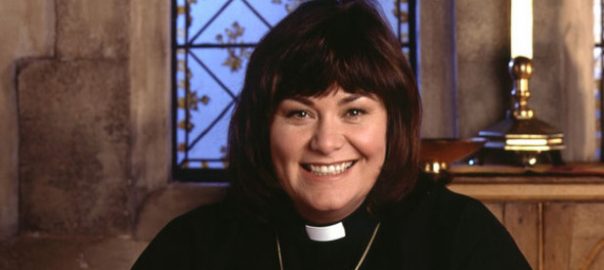
Header picture shows the brilliant Dawn French in her role as Vicar ‘Geraldine Granger’ in the classic British sitcom, ‘The Vicar of Dibley’

Matt Distefano on Universalism

One of the more controversial ideas in Christendom at the moment is that of Universalism – that everybody gets ‘saved’. It’s certainly not a new idea; there is in fact good evidence to suggest that it actually formed a major part of early Church doctrine. Personally, I am myself a ‘hopeful Universalist’, a bit like C. S. Lewis was. That is, I would like to think that God is big enough to be able to ‘save’ everybody, in some form or another.

Whatever our views on the subject, it is sadly true that many of the idea’s detractors have taken the ideas of Universalists and twisted them to mean what they were never meant to mean. Unfortunately, this happens a lot in religious discussion, but I am prepared to believe that this is more due to a breakdown in communications rather than deliberate misrepresentation.

For this reason, I would like to share a piece by Matthew Distefano, whose work I have mentioned before in my blog. In this article, he gently attempts to set straight the record on some of the points that some of his objectors have raised.

What about justice? What about Hitler? What about Scripture? It’s a really good article and definitely deserves to be read.

Clicking the picture below (that’s Matthew, by the way) will take you to the article on Patheos (opens in a new tab).

Enjoy!

Honouring the Bible

Over the last couple of weeks, it may look as if my blog posts have been hammering the Bible; the very Scriptures which are known and loved by billions all around the world – including myself.

But nothing could be further from the truth. As with all my posts that might appear critical of the Bible, I am simply trying to demonstrate the problems that occur when people – we everyday, ordinary humans – use and interpret the Scriptures in ways they were never meant to be used or interpreted.

You might rightly say, ‘Who are you to say that people are reading it wrongly? Surely they can read it how they like! Who’s to say what’s right and wrong?’. And I would agree. No one person or organisation has the monopoly on all the Bible’s meaning and truth.

Rather than demonstrating the futility of it all, instead it actually illustrates God’s wisdom in giving us such a broad book from which to draw our own spiritual conclusions. God hasn’t set it all down in black-and-white; if Scripture interpretation were that easy or if it was really that ‘plain’ in its meaning, then we would not have 40,000+ Church denominations, all of whom would claim to have the correct revelation and all of whom would call themselves Christian. So, here’s a piece by Richard Murray that hopefully wraps up the thoughts and ideas of the last few posts, on a positive note:

“Let’s avoid Bible bashing.

“It’s certainly okay to bash carnal man’s way of WRONGFULLY READING the Bible, but never the Bible itself.

“Don’t worship it either.

“But do honor and respect the supernatural promises it carries, the blood of the martyrs who died so that you could have it, and, most of all, the wondrous narrative imbedded in it which reveals the life of Jesus Christ through anointed “allegory,” terrific “types,” brilliant “shadows,” miraculous “metaphors” and spiritual “symbols.”

“Better yet, rescue the Bible from literalists by learning to read it by the Holy Spirit, the way the early church fathers did. You won’t be sorry. There is MORE to the Bible than meets the eye, not LESS.

“We have to be careful to not have a theology based on resentment. What you have resentment TOWARD, you will not be able to receive truth FROM.

“Don’t resent the Scripture.

“Revive it!”

–  Richard Murray