All posts by Tony

“Do, or do not. There is no ‘try’ “

Most of my readers know how much I love to use the mythology of Star Wars to illustrate theological points from the Christian faith. And of course there is no better character than Jedi Master Yoda when it comes to wisdom quotes. With his backwards-facing speech and small stature, it’s easy to underestimate him – until you realise that he’s over 800 years old and has lived under the guidance of the Force (the Star Wars universe’s version of God) for his whole life. He’s compassionate and gentle, wise and powerful. Someone once said to me that he thought that Yoda was ‘…a better Christian than some Church people I know’!

Although sometimes his sayings can be most confusing!

Take, for instance, the saying in the title of this piece.

“Try not. Do, or do not. There is no ‘try’ “

This is actually a fair summary of the message of God’s Grace, in a nutshell.

But first, let’s hear it from Master Yoda himself:

And I’m not the only one who found it confusing. For instance, in the Disney XD series ‘Star Wars Rebels‘, there’s an exchange between Jedi Kanan Jarrus and his young Padawan (apprentice), Ezra Bridger, talking about it:

As I said above, this is indeed a fair summary of the message of God’s Grace, in terms of what we need to do to please God. Naturally, I’m ripping it entirely out of its original context, and saying something completely different from what Yoda meant (I think, anyway!) – but still it’s useful.

“Do, or Do Not, there is no Try”, simply reminds us that in Christ we have the freedom to Do, or to Do Not. There is absolutely no need to Try.

This is so liberating!

You see, as my regular readers will know, I am a strong proponent of Grace. God’s Grace: the undeserved favour of Almighty God given freely and without hindrance or condition to His children. In all the world’s religions, there are really only two main approaches: there’s Legalism, and there’s Grace. And Christianity, at its core, is the only faith which promotes Grace, and this entirely through the finished work of Jesus Christ – although sadly, much of the time, it is bound up with so much other legalistic religious baggage that it’s undetectable in its true form.

Simply put, Legalism is: do this, do this, don’t do that, don’t do that. Try harder to impress God and He’ll look upon you with favour.

Grace, however, is: it’s already done! Because of the freedom Grace brings, Grace is “Do, or do not. There is no ‘try’. “

Grace gives you the freedom to choose to do, or do not, without the Law telling you what to do or not to do. Grace allows you to live life by the Spirit of God, life ‘in the Spirit’, completely unfettered by human expectations of how you ‘should’ obey God’s Law. In short, Do, or Do Not. If you begin to ‘Try’, then you immediately fall into Law and you have ‘fallen from Grace’ (Gal 5:4) in that you are no longer in the state where you are relying on Grace to do things for you, such as making you righteous, fulfilling the Law in Christ and so on. You cannot be in Grace and Law at the same time; it’s either one or the other. To coin a Star Wars phrase, again, you need to ‘trust in the Force’, to ‘let go’ and let God work out His will for you as you walk in the Spirit.

“Do, or do not. There is no ‘try’ “

Because the flesh and the law work together, there is no try, because try is doomed to failure. The Law is weakened by sin, and sin increases through the Law (Rom 7:5-6). The two therefore work together in a vicious circle to produce fruitlessness and death. If you want to live by Law, fine; you will still enjoy fellowship with God after a fashion, even though you will likely be adding in lots of additional burdens like rule-keeping, expected behaviour and having to toe the party line on certain issues like creation/evolution and gay/straight debates. There is a form of fellowship with God there, because God allows people to ‘do legalism’ without it affecting how He sees them. But it’s not because of the Rules you think you’re keeping so well (in fact you will probably be conscious of how badly you’re keeping them!); no, It’s because of God’s Grace, apart from Law (Rom 3:21), that you are already made acceptable to God in Christ. But unless you come into the real freedom of the Children of God (Rom 8:21) then you will never be free, completely free, from the desire to please others, from the jumping through man-made hoops in order to please God, and all that other baggage. Make no mistake – the desire to please God through following rules almost always turns into trying to please men, because in actual fact it’s their rules you end up trying to keep, not God’s. The Pharisees of Jesus’s day had the Ten Commandments and some other laws too, but they also added lots of other man-made rules of their own. You see the problem? This still goes on today…..

Grace is over Law – the Law of God which essentially states that everyone has to be perfect, and therefore naturally leads us to the point where we realise we can’t be perfect. And so it leads us to Grace, because the function of the Law is to show us our need for Grace (Rom 7:13). The key here is to realise that and accept it, rather than to go on struggling under Law!

“Do, or do not. There is no ‘try’ “

Paul, talking about God’s dealing with Israel with regards to the Gospel, (but the principle applies to Jew and Gentile believer alike), says in Romans 11:6, “And if by grace, then it cannot be based on works; if it were, grace would no longer be grace” (NIV) The King James Version actually adds in more, which I find helpful: “And if by grace, then is it no more of works: otherwise grace is no more grace. But if it be of works, then is it no more grace: otherwise work is no more work” Romans 11:6 (KJV). That elaboration in the KJV is helpful because it explains that whichever mode of belief you subscribe to – Law (works) or Grace – they are mutually exclusive. You cant exist in both states at the same time. To try to do so means you become ‘double-minded‘ because you are in and out of the ‘state of Grace’ and blown about all over the place (Jas 1:5-8)

“Do, or do not. There is no ‘try’ “

I still maintain that, for many believers (even those who understand Grace), the temptation to become acceptable to God through performance – ‘works’ – is a vestigial remnant of their desire to please God in their own strength. But what of where James says in Jas 2:14-26 that “faith without works is dead”? Don’t we need both faith and works? Yes, but only in that works are the fruit of faith. A life lived in faith will produce good works; as usual in many Christian circles a lot of people have got it back-to front and said that good works prove your faith. In one sense they do, but it is not the job of fellow believers to be ‘fruit inspectors’ who ‘police’ others’ works! And the interesting thing here is that actually even those whose walk is under Law still do produce some fruit, because their hearts are in one sense right before God in that they desire Him and desire to walk with Him. But the primary holdup with Law is that the Law-walking believer is never walking in the complete freedom that is his by birthright.

Why have I gone to such lengths to describe the futility of the walk under Law in this piece?

Because these are all examples of Try. It’s all about what we do, rather than about what Christ has already done. What part of Christ’s work does the Legalistic believer think was not completed properly, such that he needs to complete Christ’s work for Him? No, this is Try. Even for those who claim to recognise Grace, but then try to prove they love God by trying to obey rules, it’s not really living under Grace; it’s living under ‘mixture‘. True Grace is completely different. There is no compulsion to try to fulfil the Law in order to please God, because Jesus has already fulfilled the Law on our behalf. There is the freedom to Do – works for God flowing from the depth of our love for, and our relationship with, Him – but not in order to try to earn His favour, which we already have. The freedom to enjoy life with all its blessings without human rules and expectations getting in the way. There is the freedom to Do Not; the freedom to just rest in God and trust Him for all our own righteousness rather than try to earn it for ourselves – which we can’t do anyway!

Despite all my convoluted explanations above, it’s really very simple.

Under Grace, you have the freedom to Do; you have the freedom to Do Not.

But to Try – I think we’ve already seen how futile this is.

No, it’s always got to be this:

“Try not. Do, or do not. There is no ‘try’ “
do-donot-yoda-pie-chart


And May the Force be With You!

Blindsided by Grace!

For many years, I was a religious man. I won’t go into the details, but although I knew I was loved and accepted by God, indeed even that I am His child, still I felt that I had to add to my faith certain behaviours, certain rules and so on, that either proved that I was as Christian as I claimed to be, or that showed others my faith on the outside. Nowadays, I recognise this as part of a legalistic mindset. Over my fifteen-year ‘wilderness period‘ outside the Church, one of the main things I learned was that God’s favour is not dependent in any way on what I do or how I behave. His favour does not depend on me at all, but instead it depends entirely on Jesus. It depends not on what I have done, but on what Jesus has already done to reconcile us to God! And this is what is known as Grace – the unmerited, extravagant, undeserved, generous, wild and free favour of our God Who loves to give, give, give.

And the thing is that my religion blinded me to Grace. It was there all along, but I didn’t recognise how huge and important it was. To me, it was just a concept that I paid lip-service to; something that basically told me how unworthy I was to receive all that God had for me – despite being His child – and I just couldn’t see it! I effect, Grace was in my blind-spot, hence the title, ‘Blindsided by Grace!’

It was only as God revealed His Grace to me that it became clear – but when it did become clear, oh how thrilling! To realise that there’s nothing I have done, can do or ever will do that will change the way that God feels about me. Wow!

It’s interesting that although I thought I understood Grace and I did indeed acknowledge it that “…it is by Grace you have been saved through faith … not by works, so that no man may boast” (Eph 2:8), still I just didn’t ‘get’ it. But, thanks be to God, during my wilderness time He did lead me completely independently into the message of Grace, only for me to find  that while I had been ‘away’, He’d also been speaking to other believers all over the world on this subject and that now the message of Grace is being preached all round the world. What an affirmation that was!

Grace is the pure Gospel that God intended all along for us, in order for us to live full lives here on this Earth. Jesus’s prayer, ‘Your Kingdom come’ (Mt 6:10) finds its fulfillment in Grace, because those who know only Law rather than Grace, or a mixture of the two, will never know the fulness of the Kingdom freedom that comes only through Grace. You can’t have Grace and Law operating at the same time; the two are mutually exclusive and it does not work (Rom 11:6).

Be encouraged. Grace is there for the taking, indeed God is holding it out to you and saying, “Here! This is for you! Take it!”

The full acceptance of Grace means an end to struggling to please God, an end to worrying about your sinfulness, an end to having to explain yourself to others; it means total freedom to live life in all its fulness and in all the riches that God purposed for you in Christ. Everything that is in Christ is yours because you are in Him, and Grace enables you to avail yourself of Christ’s riches fully and freely like no legalism can ever accomplish. “…because as he is so also are we in this world” (1Jn4:17 (ESV) )

I can promise you that if you do indeed decide to take the offered gift of Grace, your life will never be the same again!


I’d also like to give you another perspective on Grace too. Christian writer Paul Ellis likens it to one of those 3D images that you stare at for ages without really seeing what’s there, then suddenly the image pops into view in startling clarity. I would like to recommend one of Paul’s articles on Grace, which you can reach by following this link. Alternatively, (and I am doing this as a standard procedure nowadays in case a website goes down in the future) here is the article in full:


How well did I understand grace before I understood grace?

Have you ever seen those Magic Eye 3D pictures that look random at first glance but then reveal a hidden picture? Maybe there’s a group of you looking and someone says, “Wow – look at that! It’s a ship!” Then another person sees it and now they’re both describing the picture to you. But try as you might you just can’t see it. They try to encourage you. “Look – it’s right there. It’s huge!” But still you can’t see it. You’re starting to think there’s no picture at all and they’re all deluded when suddenly, revelation comes and a ship appears! If you’re like me and you’re usually the last person to see these things, you’ll no doubt embarrass yourself at this point by shouting, “I see it!”

That’s how it was for me with grace.

I knew people who looked into the Bible and saw radical grace but I didn’t. Sure, there were pockets of grace but there was a whole lot of other stuff as well. Then one day, revelation came and I saw Grace! He’s right there on every page and in every book! How can you miss Him? He’s huge! I now find myself reading old scriptures with new eyes and saying, “Look! This is speaking of Jesus! This is all about Him – I never saw this before.” Now that I’ve seen Him once I see Him everywhere. I was saved decades ago and I have always loved God with my whole heart. But when I got this revelation of His amazing grace, it was like being born again, again.

A friend recently asked me, “How well did you understand grace before you understood grace?” Here’s my answer: I thought I understood grace perfectly well. For as long as I can remember I’ve considered myself a testimony of His grace. But when Grace Himself came into focus, I was floored. I realized that I had barely understood grace at all. Looking back I can identify nine signs that showed I did not fully grasp the grace of God.

1. I understood that I was saved by grace but not that I was kept by grace

I had received Christ by faith and without doing a thing, but I was not continuing in Him by that same faith (Col 2:6). Although I would never have said it, I had taken out a little works insurance. Faith is a positive response to what God has done, but I liked to initiate things. And so my walk became “do, do, do,” rather than it’s “done, done, done.” There was no rest, only performance anxiety. There was always another meeting to lead, another plank of truth to teach, another stray sheep to gather. I thought this was normal. I could get excited about the idea of being saved and saving others, but I was not drawing from the wells of salvation with joy (Is 12:3). I was constantly stressed and I treated grace as grease for my engine.

2. I felt obliged to serve

Jesus had done everything for me, what would I do for Him? Of course I didn’t use the word “indebted” – that would’ve alerted me to the poverty of my theology – but much of what I did was motivated by a sense of obligation. I thus cheapened the exceeding riches of His grace (Eph 1:7) by trying to pay Him back for His priceless gift. Inevitably this shifted my focus from Him and His work to me and mine. Instead of being impressed by what He had done, I was trying to impress Him with what I was doing.

3. I motivated others using carrots and sticks

Because my own motives were screwed up it was inevitable that I would preach rewards and punishments to others. Do good, get good; do bad, get bad. At the same time as I was preaching against legalism I was putting people under law! My gospel was like an ash-tray – full of “buts”! God loves you but… Jesus died for you but…  God’s gifts always came with a price to pay. But grace is free – you either receive it or reject it but the moment you start charging for it, you’ve missed it. There’s only one motive in the kingdom and that is love. The Son of Man didn’t come to threaten us, judge us, or scare us, but to demonstrate love (Rm 5:8). I no longer believe that evangelism means scaring the hell out of people. The good news that the world needs to hear is that God is good and He loves us. The new covenant of grace is the formal expression of His unfailing love for us (Is 54:10).

4. I saw myself as a servant rather than a son

My identity was in the things I did rather than in my Father. I saw myself as working for God (a noble cause!) rather than doing the works of God. I would not have said I was justified by what I did for I knew that grace and works don’t mix (Rms 11:6). Yet I was mixing grace with works like there was no tomorrow! But here’s the strange thing. Even though I preached servanthood more than sonship, whenever there was a crisis I was quick to relate to Him as Papa. It was only when I was strong and healthy that I was seduced by the religious need to do something for God. Happily, there were many crises!

5. I kept asking God to provide things that He’s already provided

I knew enough about grace to approach Him boldly in my hour of need, but I didn’t know that He has already given us everything we need for life and godliness (2 Pet 1:3). If someone was sick I would ask for healing when I should’ve just healed them (Mt 10:8). I would ask for more faith instead of living by the faith of the Son of God (Ga 2:20). Like the prodigal’s older brother I felt that God would bless me as I did my part. I didn’t realize that I was already blessed, deeply loved, and highly favored. In my ignorance I wasted a whole lot of time doing a whole lot of nothing. I thought I was being active and fruitful but in reality I was passive and faithless. God had already come but there I was face down asking Him to come again.

6. I was more sin-conscious than Christ-conscious

Like many Christians I was afraid of sin (keep it out of the camp!) and I was not known as a friend of sinners. I defined sin as bad works only and I taught that the solution to sin was repentance. I had read that the grace of God teaches us to say no to ungodliness (Tit 2:12), but I wasn’t quite sure how that worked. So when preaching against sin I used inferior incentives like fear and punishment that led, at best, to temporary, will-powered changes in behavior. I emphasized what people must do (repent!) more that what God has already done (forgiven us!). I kept the focus on us when it should’ve been on Him and my preaching was powerless as a result. If anyone failed to experience victory over sin, I just figured they were unacquainted with God’s transforming grace – even though I had given them none.

7. I always tried to do the right thing

Someone under grace says, “I trust Him from start to finish. He will lead me in the right path” (Ps 23:3). But in subtle ways I preferred rules to relationship. What I craved were clear Biblical guidelines for living. I thought I was choosing good, but then so did Adam. We both had an independent spirit that led us to eat from the wrong tree. I felt particularly good when people came to me for guidance. I thought I was giving them wisdom when really I should just have got out of the way and taught them to lean on Jesus (Jn 10:27).

8. I had a stronger relationship with the written word than with the Living Word

I did not read the scriptures to find Jesus (Lk 24:27) but to learn, what should I do? I read indiscriminately and was often confused by scriptures that seemed to contradict each other. My solution was to go for balance: A little of this, a little of that, for all scripture is profitable. But by failing to filter what I read through the finished work of the cross, I unwittingly poisoned myself. I was mixing the death-dealing words of the law with the life-giving words of grace. Although I was zealous for the Lord, in truth I was lukewarm. I was neither under the stone-cold reality of the law nor walking in the red-hot heat of His unconditional love and grace.

9. I knew I was righteous, but I didn’t feel righteous

When I stumbled I would more readily confess my sins to God than allow the Holy Spirit to remind me of the gift of His righteousness to me (Jn 16:10). I knew I was a new creation (2 Cor 5:17), but in many ways I acted and spoke as if I was merely an improved creation. I thought honesty about my struggles was the key to getting more grace. But I probably would not have struggled so much in the first place if I had just learned to see myself as God sees me – redeemed, righteous, and holy.

I am convinced that grace comes by revelation. If you don’t yet see it this post may sound like the ramblings of a man who is unbalanced. (Thank God I am! I’m done with balance!) If you do see Grace, then right now you will be resonating like a tuning fork. So let me finish with a few words for those of you in the first group. Please be patient with those of us who are leaping for joy. Don’t walk away from the Magic Eye picture scowling, “I can’t see it, there’s nothing there.” Just keep looking! Grace really is standing right there in front of you. And He’s huge!

___________

When Words Are Not Enough

Today’s post is a little different in that although I’m presenting yet another worship track, this time there’s an extra little something in the worship which we call ‘Singing in the Spirit’.

As my regular readers will know, I am a worship leader. I’m just one of many, many worship leaders all over the world who have God’s anointing to lead people into the Presence of God. Part of our anointing is to bring understanding to our congregations as to what worship can be like, and what sorts of worship are ‘out there’ that maybe people haven’t experienced yet. So, in this piece, I go into the way in which ‘singing in the Spirit’ is used in worship, and tell you a little of what it’s all about.

In the Bible, in 1 Corinthians chapters 12-14, Paul wrote that part of his letter to the Corinthian church because he was trying to introduce more intelligibility in worship. People had, in common with Christians all over the ancient world, received the spiritual gift (amongst other gifts) of ‘speaking in tongues’ (Acts 2:4; 1Cor 12:10) – actually I don’t like that term; I prefer to call it our ‘Spirit language’ – and they were using that gift in public worship – but that gift was getting out of control and wasn’t being used to build others up in their faith, which is really the whole point of meeting together in God’s Presence.

In 1Cor 14:15, St. Paul says this:

“So what shall I do? I will pray with my spirit, but I will also pray with my understanding; I will sing with my spirit, but I will also sing with my understanding”.

Here, Paul describes two ways of praying and singing: ‘with [his] spirit’, and ‘with [his] understanding’. This means that sometimes it’s our spirits that pray/sing, and sometimes it’s with our minds or ‘understanding’. It means that sometimes we say or sing things that are understandable, but sometimes our spirit says or sings things that are very deep down and therefore are hard to put into words. This, I believe, is where the Spirit gives us the words to say, using our ‘Spirit language’.

So if praying and singing (in this context, I’m assuming worship singing) with the understanding means that we understand what we are praying or singing, it will  therefore probably be songs in your native language, like hymns or simple worship songs. Paul is saying that, as well as singing or praying in our Spirit language – which is not intelligible to others – we should also pray and sing with our understanding – using words which are intelligible to others. But – and here’s the key – it’s not one or the other; it’s both.

And please be aware that it is perfectly possible to sing or pray ‘in the Spirit’ in your native language. In fact, ideally, all prayer and singing should be done in the Spirit, that is, under the influence of the Holy Spirit. It doesn’t have to be ‘in tongues’ to be in the Spirit! I’m not going to say that the gift of ‘tongues’ gives ‘deeper’ prayer or worship, because the two are complementary; you can have worship or prayer that is no less deep because it’s in your native language as well as prayer and worship that are in your Spirit language. The two work together. Singing or praying with the mind does not exclude the Holy Spirit; He inspires both.

So, I agree with Paul’s guidelines to the Corinthians, and they also provide a good framework for orderly, and yet still Spirit-led – worship in our time too.

But sometimes simply praying or singing in English, or whatever one’s native language is, is simply not enough. Sometimes there are thoughts and feelings we need to express that English simply can’t cope with. And so we use our Spirit language, in freedom, but also in consideration for others. Having said that, if everyone is singing in their Spirit language, then this is in keeping with the Scriptural guidelines* in 1 Cor 14 because everyone is doing it, and, most importantly, everyone is being edified – built up in their faith. In fact, I can think of no other worship experience that brings the people together so much as does a session of singing ‘in the Spirit’. It is beautiful, uplifting and upbuilding; people even get healed during these times, and who knows what amazing things we’re singing to God? The enemy certainly doesn’t!  Singing in Spirit language is a potent tool for both worship and spiritual warfare. It kicks the enemy’s butt even if that’s not your intention. And, most importantly, it blesses not only those singing, but also (and especially) the Lord Himself.

I’ll let you into a little secret here: when I’m in church, during the singing, if there’s a song I don’t like for any particular reason – maybe I don’t like the trite lyrics or for whatever other reason – I simply sing using my Spirit language. Nobody else can hear me because everyone else is singing too; it’s not important what I sing, the main point is I am lifting my heart to God in worship, and using the language He has given me in order to do this is a valid way to use the gift.

Let’s look at an example. Here’s a lovely worship video featuring the gifted worship leader, Terry MacAlmon**, as he leads a very receptive congregation in one of my favourite worship songs, ‘When I look into Your Holiness‘. Watch what happens from 4 minutes onwards:

The spontaneous singing from about 5 minutes in the video is a glorious example of ‘singing in the Spirit’, where the people are using their individual Spirit languages. That’s what it sounds like; it’s always different each time but this gives you the basic idea. It doesn’t always happen like it does in the video, sometimes it follows straight on from a song in English, sometimes is just rises up out of nowhere. The thing with learning to sing in your Spirit language is simply to not be embarrassed and just let go and trust God to give you the words to sing by the Spirit. The tune and the timing are also given by the Spirit. Sure, you could be forgiven for thinking that people are simply making it up, but I have seen this kind of worship countless times and in all cases it produces good fruit – joy, peace, love – and this is entirely Scriptural. This is of the Spirit.

You can also sing ‘in the Spirit’ in English too, once again trusting the Lord to provide the words, tune etc. An example of the public use of this gift is shown here.

In order to round off the subject today, I would say that the gift of ‘tongues’ is closely related to concepts in Romans 8:26-27 where Paul, writing on the subject of intercessory prayer (that is, praying for people, situations or things), says this:

In the same way, the Spirit helps us in our weakness. We do not know what we ought to pray for, but the Spirit himself intercedes for us with groans that words cannot express. And he who searches our hearts knows the mind of the Spirit, because the Spirit intercedes for God’s
people in accordance with the will of God”.

This means that that when we run out of words to say; when we can’t find the words; when sometimes mere words are not enough, then the Holy Spirit Himself steps in to pray for us – both actually praying for us and praying on our behalf – using inarticulate sounds, like groans and moans. Kind of as if even ‘tongues’ is not enough. I’ve found myself doing that quite a lot lately! We should not be surprised when, while we are trying to express the inexpressible either to or about an inexpressible God, we run out of words. And so the gift of ‘speaking in tongues’, in whatever role it is used, comes into its own; in fact, this is the main reason the gift is given – to express the inexpressible. Or even going beyond this into ‘groans’; both of these are valid forms of prayer, worship and intercession – in short, speaking with God.

You may be wondering how you too can receive the gift of your Spirit language – your own private prayer and worship language? It’s really quite simple. As a believer you have been ‘sealed’ with the Holy Spirit. He lives in you and gives you the life of God in your body (Rom 8:11; Jn 14:17). The gifts of the Spirit come as part of the package, as it were; they are already there, lying dormant inside you. So all you need to do is to ask God to awaken that gift in you and off you go. Find a quiet place by yourself, or maybe get someone to pray with you for the gift. For each of us, the experience is usually different from that of others; this comes as no surprise, for God is simply treating us all as individuals. There is no ‘normal’; no ‘stereotype’. Maybe begin by praising Him in English, and then just let yourself go. It’s really quite simple; to be honest the main hurdle most have to overcome is embarrassment. But don’t worry about that; just do it. And see what happens – and use the gift! The more you use the gift, the more comfortable you will become with it; practice, as with most things, does make perfect.

So, when words are not enough, use your gift!


*Note that here I am not advocating legalism in following ‘rules’, I am simply saying that, in certain cases such as this, consideration for others and the desire to build them up is in itself part of our worship. Worship that causes others to stumble is detrimental to those others. See my article on how not to cause others to stumble for more on this.

**This video is also a brilliant object-lesson in how to lead a congregation in worship under the leading of Holy Spirit. At about 4 minutes into the video, Terry doesn’t jump in with the next song; he doesn’t rush things or panic – you can see that he’s completely relaxed and focused on Jesus. And after about a minute of an ‘awesome silence’ (one where the people are simply looking to God in awe and wonder), the people spontaneously break out into singing in their Spirit languages. Terry’s just letting Holy Spirit have His way in the worship; he’s led the people to a position of awe and wonder and then he obviously feels the Spirit saying to him, ‘No more music just now, son, I’ll take it from here’. Notice how the people in the congregation are free to express themselves in their own way: some just sitting and listening, some sitting and singing or just raising hands, some standing up and giving it all they’ve got. And the way the dynamics work too – the volume changes, the ‘applause’, the harmonies, and then finally (interestingly, just as someone starts to go just a little outside the Spirit’s leading and starts to ‘squeal’ a little; this does happen sometimes!) Terry draws it to a close with a few gentle piano chords. Thoroughly relaxed, unpressurised, no ‘religious spirit’, pure worship. A lovely illustration of humans and God working together to produce lovely praise and worship to Jesus. This is worship leading at its best. Watch and learn, folks!

What makes a Christian?

I’ve just read an interesting article where it raises – somewhat tongue-in-cheek – how you can check if someone is a Christian – or not – using maybe a written test, would you believe, as in my header image above!?

And of course, as you might have guessed, it’s not quite as straightforward as you might think. From the ‘man-in-the-street’ who makes the judgement on someone, ‘He calls himself a Christian? Huh….’, up to the high theologians who plumb the depths of ancient manuscripts in search of the detail – no, its not that easy, is it? Click the logo below to go and take a look at the article and see what you think:

faith_forward

It’s a great article, I thought; and it’s interesting, but it’s important to realise that the Bible does not really define what makes a person a Christian. This is of course one of the reasons why there are so many denominations of Christianity.

I believe this (the lack of any definition) is deliberate, in that God allows each of us to come to Him in our own way. The things the Bible does say is that people come to God via Jesus, and that believing in Him is the way to the Father. And, given that the people who were first called Christians (in Acts 11:26) were people who believed in Jesus, that all seems to fit. But other than that, really, things aren’t really all that well-defined.

In fact, it is this very lack of definition, and conversely the multitude of opinions of believing Christians, that convince me that God actually isn’t all that bothered about the exact ‘method’ people use to approach Him. I find it impossible to believe that any one party, denomination or person has ‘got it all right’.

That said, to Christians, other Christians have a certain indefinable ‘something’ that makes them different. 2Cor2:15 says ‘For we are to God the sweet aroma of Christ among those who are being saved and those who are perishing…’; maybe that has something to do with it.

But often it’s easy, though, for anyone to recognise those who hear God’s Heart. Jesus said, ‘By their fruits you will recognise them’. So if a person is all angry, graceless, harsh or otherwise nasty, most likely they are not really listening to Jesus all that much. They might be a Christian, but only God knows that for sure. On the other hand, if there’s someone you know who is loving, merciful, Gracious and somehow reminds you of Jesus, chances are they’re someone who is close to His heart and therefore worth listening to. To me, their opinions would hold much more weight. That’s not what makes them a Christian, but it’s easy to tell that they are already one because you are seeing their fruit.

And they would pass the test, don’t you think? 😉

Let Your Glory Fall

A lovely song by David Ruis, just as timeless now as it was in 1996 when I first heard it.

Enjoy!

Father of creation, unfold your sovereign plan
Raise up a chosen generation
That will march through the land
All of creation is longing
For your unveiling of power
Would you release your anointing
O God let this be the hour

Let Your glory fall in this room
Let it go forth from here to the nations
Let Your fragrance rest in this place
As we gather to seek Your face

Ruler of the nations the world has yet to see
The full release of Your promise
The church in victory
Turn to us Lord and touch us
Make us strong in Your might
Overcome our weakness
That we could stand up and fight

Let Your glory fall in this room
Let it go forth from here to the nations
Let Your fragrance rest in this place
As we gather to seek Your face

Let Your kingdom come
Let Your will be done
Let us see on earth
The glory of Your Son

Let Your glory fall in this room
Let it go forth from here to the nations
Let Your fragrance rest in this place
As we gather to seek Your face

We are gathered to seek Your face

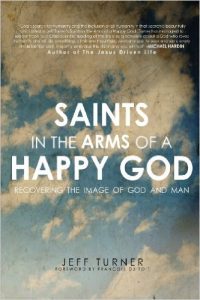
Saints in the Arms of a Happy God

I’ve been reading this book on and off for the last few months, dipping in here and there to read a little more of this revolutionary stuff.

In the book, which is ideally suited for mention on my blog – since I half-jokingly call it my ‘Heresy Blog‘ – its author, Jeff Turner, examines in detail the theology behind many of the presuppositions of (particularly) Evangelical and Calvinist theological ideas. He dares to ask questions, and challenge the status quo; something that many theologians – myself included – are doing in these days. We are asking the questions ‘why?’, ‘why do we believe that?’ and ‘are you sure about that?’ Questions that many Christian streams have ignored, brushed under the carpet or, worse, treated as forbidden questions – usually because they challenge the assumptions and power of those in charge. And this is exactly what Jesus did….

Using the security of relationship with Jesus as a solid basis, it is actually perfectly safe to ask awkward questions. Those who dare not ask them are actually, sadly, those with a weaker faith because they feel that their faith may be threatened by new knowledge, or that they may be rejected by their fellows because they might have to concede that they actually believe something different. But surely that’s the nature of the walk of faith; you never really arrive at the end because you are constantly learning new things about God, and some of those things may contradict what you were so sure you believed earlier.

The title is a parody of the title of a famous hellfire-and-damnation sermon called ‘Sinners in the Hands of an Angry God’, by one Jonathan Edwards, an eighteenth-century American Revivalist preacher.

I’m sure that Mr. Edwards believed most sincerely in what he was preaching – he was indeed a humble, Godly and thoughtful man – but the ideas he espoused (along with those of a similar persuasion; we can’t blame it all on Mr. Edwards!) have caused significant shifts in humanity’s perception of the Godhead, His relationship to us (and ours with Him) and in the subsequent credibility of the Church and its major doctrines. In this book, Jeff Turner challenges many of the the deeply-held doctrines of modern Christianity which are supposed to be Scripture-based, but, Turner says, are in fact incorrect. The modern-day image of an angry God as presented by Edwards et al is nothing at all like the God Whom the writers of the New Testament knew. This book is a well-reasoned treatise on how God has been misrepresented down the years as an angry, implacable Dictator – and this is one reason why I write so much on just how good God is. I’m just so fed up with Him being dissed in this way. In fact I’ve quoted from ‘Saints’ before on this blog, in a similar context.

Anyway, I would like to let you have a look at a review of the book by my friend David Matthew; far better for a scholarly man like him to give such a good book a decent review. For what it’s worth, I concur with just about every point that David makes in his review.

Click the book cover image below to go to David’s review. There are also links on that page to Amazon (UK) where you can buy the book; at the time of writing, the Kindle version is only a couple of pounds.

saints in the arms of a happy god small

Three Beauties

This entry is part 12 of 23 in the series Beautiful Destroyers

It’s been a while since my last post in the series ‘Beautiful Destroyers’. But here the series is back on track again with some lovely pictures of three beautiful aircraft participating in the joint Royal Air Force/Indian Air Force exercise ‘Indra Dhanush 07’, which took place in, you’ve guessed it, 2007.

In these pictures, we see the RAF’s latest fighter, the Eurofighter Typhoon, flying in formation with the RAF’s other main front-line fighter, the Panavia Tornado F3, and the Russian-designed Sukhoi SU-30MKI, which still carries the NATO reporting codename ‘Flanker’, which is currently in the inventory of the Indian Air Force. For identification purposes, in the header picture for this post and in the shot below, the aircraft nearest the camera is the Tornado, then the Typhoon, and the one furthest away is the Su-30.

typhoon_tornado_flanker_1

Clever stuff, all that formation flying; amazing what you can do with being able to keep an aeroplane straight and level. I’ve done formation flying myself only once, and I was too busy avoiding collisions to take any photos. But it’s an amazing feeling, seeing an aeroplane only a few metres away (in this case piloted by my son) and seeing it just like floating there. A photo doesn’t really do it justice; it’s like nothing else I’ve ever seen. There’s this plane just hanging there in the clear air, and you can see there’s nothing really holding it up. Remarkable.

Anyway back to the pictures:

typhoon_tornado_flanker_2

In the picture above, you can see the Su-30 in more detail. An extremely powerful, agile and well-armed aeroplane, the Su-30 (which is a derivative of the original Su-27) is a very capable combat aircraft, in fact probably one of the best in the world. She weighs 22 tons but her pilots throw her around the sky like she’s a Spitfire….

And finally, another photo like the main header photo above, but taken from a slightly different angle. And it’s bigger….

typhoon_tornado_flanker_4

So there we go. Sorry to have kept my aviation-fanatic readers so starved over the last couple of months. I know of one guy at least who only reads my blog for the aviation stuff; Captain ‘Pyet’, this one’s for you mate 🙂


More on ‘Recording God’

You may remember in one of my previous posts how I described the awesome phenomenon of what seemed like ‘recording God’. Almost as if you could get the Holy Spirit on tape…

Remember how I said that worship music stirs up the spirit of worship in the worshipper’s heart; how the reality of God’s Presence comes into focus as your heart turns towards Him?

Well, I’m writing this on the train to London, and I had some old classic Vineyard music playing (over my headphones, I might add!). Trouble is with that sort of thing is that when the spirit of worship arises in your heart, it’s very difficult to contain it. But I did my best; no more than a surreptitious raising of hands under my laptop….but for me the Presence of God was right there. I was almost in tears.

As a worship leader, I lead people into God’s Presence. It’s what I do. And I do that whether it’s in person or, like in this blog, by proxy. God is the same right there with you right now, as He is on this train with me.

So I thought I’d share this with you right now, so you too can join in. Fresh worship from an old song; fresh because the Creator God is right there in your heart, just as new and bright as He was on the Day of Creation and yet just as ancient as the universe, and even more so. The song is ‘Alleluia’, also known as ‘Jesus I love You’. Listen to it, join in, experience the Presence of God for yourself as you focus on Him.

Jesus I love You
I bow down before You
Praises and worship
To our King

Alleluia, Alleluia
Alleluia, Allelu

Oh, bless His holy Name. Glory to God!


A Tale of Two Trees

I’d like to recommend this excellent piece by Susan Cottrell of Freedhearts. Although the essay is primarily about the gay/christian debate, it’s also a decent and easy-to-read light theological discussion on the Tree of Knowledge and the Tree of Life.

Click the graphic below to go to the article.

Have a look. It’ll be well worth it.

freedhearts