There’s an odd, fairly obscure little Scripture, found only in Matthew 27:50-53, that describes how at the moment Jesus died, an earthquake broke open the tombs of ‘many’ holy people who were, at the same time, raised from the dead. After Jesus’s own Resurrection a couple of days later, these people were seen by many people in Jerusalem. Here’s the Scripture:
“When Jesus had cried out again in a loud voice, He yielded up His spirit. At that moment the veil of the temple was torn in two from top to bottom. The earth quaked and the rocks were split. The tombs broke open, and the bodies of many saints who had fallen asleep were raised. After Jesus’ resurrection, when they had come out of the tombs, they entered the holy city and appeared to many people.” – Mt 27:50-53
I’ve always understood this as happening because of the sheer power and Life that pulsed out from the Cross* as Jesus died. Somehow, however the ‘mechanism’ works, sin and death had been defeated and history had been changed. Nothing would ever be the same again. Life had been released into God’s Creation in such a way that had not happened since He first said ‘Let there be Light!’. And all this was because of the death of the most righteous Man Who ever lived. It’s no wonder, then, that all those people were raised by that power. And, when a Godly person dies, in a similar way that same power is released, bringing life to those who will receive it.
Most of my regular readers will know that my incredible wife, Fiona, passed away a couple of weeks ago. And in a similar way to that Life that poured out from Jesus’s death, I believe that I have seen this Life radiating out from from Fiona’s loss too. She was, without exception, the most Godly person I have ever known.
Within a day of her passing, just like when Jesus died, so much good fruit was released. There were fruits of joy, laughter, reconciliation. Fruit of healing. People felt a light-heartedness, despite the heartbreak of her loss, that could only be explained by remembering her as she was through her life and her final illness. Always radiant, full of joy and laughter, always looking for the joke, that was my Fiona.
And then at Fiona’s memorial service in our Church, every single one of the people who got up to speak about her said about how full of fun and joy she was. As I’ve said, she was always looking for an excuse to laugh about something. Mark, our Vicar, commented on this and said that she was so full of fun, joy and laughter – yes, because that was the way she was made, the way she was ‘wired’ – but that she was also so full of that joy because she was also so full ofGod. And she was indeed 🙂
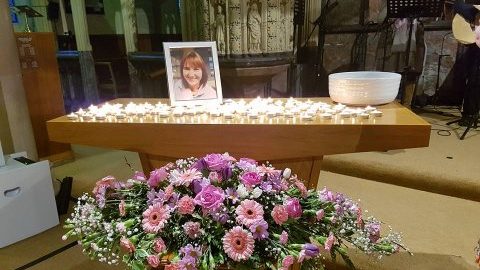
This is the candle table at Fiona’s memorial service, at which people were invited to place a candle in order to say goodbye to her. The lovely floral arrangement was the piece from the top of her coffin, which had been taken to the funeral at the crematorium earlier that day.
At the memorial service, many people – who were not all necessarily people of faith – were uplifted by the stunning testimonies of her influence on people’s lives. People I know who are not necessarily people of faith have been touched by the obvious light of this amazing lady’s life, character, friendships, life and death, and also by the shining faith and love manifested in lesser measure by those left behind. In this way, Fiona’s loss has radiated out new Life into people’s lives and hearts, in life-changing power. People who knew Fiona in life were, knowingly or unknowingly, being continually touched by the Love of Christ that was her driving force and the core of her being. At her memorial, even people who hardly knew her were moved deeply and felt something that they’d never felt before: the immense love of Christ that came from her life and ministry. The Presence of God filled that place and some people hadn’t felt that before. That’s much of the reason why it was so moving, because the testimonies to Fiona’s faithfulness and qualities were backed up by the actual Presence of God. Some might put this down to emotion or similar, and I agree that there was a lot of that about. Of course there was. But there was something more: the real Presence of Jesus right there in that place. If you were there and you felt that, and you were wondering what it was, hopefully that explains it for you. And that is partially why it felt as if Fiona was there with us, because Jesus’s Presence was so much of what you felt when she was nearby. I don’t think that anyone who was there went out of that place unchanged, in a good way.
So then, in Fiona, the life of Christ was made literally tangible because, as I have said previously, she was Jesus to others. And even in her death, that Christ-Life was still pulsing out in all its radiance and bringing Resurrection Life to those in that place, whether they realised it or not. It’s no wonder that people were finding the service so incredibly moving!
Precious in the sight of the LORD is the death of His saints – Ps 116:15 (KJV)
Finally, I would like to share with you the brilliant life-tribute movie that my daughter made to be played in the memorial service. It shows Fiona with her family in various places. The music track is ‘Into the West’ by Annie Lennox, from the Lord of the Rings movie ‘The Return of the King‘. Fiona always wanted it at her funeral….
*By ‘The Cross’, I refer (as does St. Paul in his writings) to, not specifically the actual wooden scaffold on which Jesus was crucified, but to the history-changing events that happened when Jesus died and subsequently rose from the dead. The self-sacrificial death that Jesus died is the single most powerful event in all of history, and that’s what I refer to when I talk about ‘The Cross’.
In the light of this article, here is another piece about coping with the grief of losing someone dear.
Here is a link to a free eBook by my friend David Matthew: Christian teacher and writer. The book is called ‘A Poke in the Faith’ and the subject matter is exactly relevant for readers of this blog who can identify with my enquiries into the ‘boundaries of faith’. In the book, he describes how evangelical Christians are calling into question certain tenets of their faith (like I do in my blog), and explains how and why it is safe to do this.
I’ve just finished the first chapter and I am captivated. This book deserves to be read – and spread – far and wide. The page I am linking to gives you links to a PDF version, and versions also for Kindle, Kobo and other e-readers.
Click the cover image below to go to the download page:
“…and I was being chased by at least three Focke-Wulf 190s…”
“What, in a Tempest? Couldn’t you just outrun them?”
“Well, no, it wasn’t like that you see…..carry on, you’re doing fine….”
What an honour, having veteran flying instructor, senior flight examiner and war veteran Rufus Heald have me fly him for my pre-solo check ride. This is the final check by a senior instructor, to see if he agrees with your Instructor that you are ready to take an aeroplane up by yourself for the first time – the First Solo. And what a real gentleman Rufus was, taking my mind off my nerves by regaling me with war stories – albeit stories about being chased by German fighters!
But I have to be honest and say that in some ways I kind of felt like I couldn’t wait to get him out of the aeroplane so I could go flying by myself for the first time ever. Rufus, if you read this, please accept my apologies, although I am absolutely sure you understand!
‘Any questions?’
‘Just the one, Rufus: if some clot decides to prang a Dash-8 [an airliner] right on the runway intersection, what do I do?’
‘No problem. Just follow the A38 eastwards all the way to Exeter, and land there’
‘Oh, ok, thanks.’ A sobering thought, that; if that happened, then my first solo would turn into my first solo cross-country flight, but fortunately that doesn’t happen. Good job too; I haven’t started my navigation training yet.
‘Right then, off you go and good luck!’
So, once Rufus had hopped out, it’s interesting to see how quickly the flying discipline comes in. Settle down, now; you’ve got to get this next bit right first time, there’s no second chances. Crumbs, this is scary, do I have to do this? Yes, you do; you’ll never be a Pilot unless you do this.
Right then, time to get cracking. Power checks: check clear behind, set 1,200rpm, check both magnetos on, brakes on and oil temperature and pressure (T’s and P’s) in the green, set 2,000rpm and check brakes holding. Select carburettor heat HOT and rpm drop within limits at less than 175rpm, also no rough running and select carb heat COLD and check the rpm recovers to 2,000, Mag drop right – 100rpm; mag drop left – 100rpm. Max drop 125rpm so within limits; difference between drops less than 50rpm (in fact they were the same) so that’s ok. Mags both on again, suction gauge showing 3″-5″ vacuum, ammeter charging, T’s and P’s in the green, Idle check – close throttle, 700rpm, that’ll do, reset 1,200rpm.
Now pre-takeoff vital actions: Trimmer set for takeoff, throttle friction nut set, mixture rich, magnetos both on and master switches both battery and alternator on, pitot heat off, primer IS locked, fuel on and sufficient, flaps up, Instruments: Direction Indicator, artificial horizon, altimeter has the QFE set [pressure setting to indicate height above aerodrome level], T’s and P’s again, landing light goes ON and transponder indicating 7000 and set to Mode C, doors and windows secure, straps tight, carb heat recheck then select COLD, controls full and free movement. Call: ‘Golf Tango Oscar, ready for departure’. I know my Instructor, Tim, is watching from the Tower right next to the Air Traffic Controller, in case anything goes wrong and I need any help. Not that he can give direct help; I think that when flying an aeroplane by yourself, you are more alone, and beyond direct help, than you can ever be in any situation on earth. Another sobering thought.
“Golf Tango-Oscar, backtrack line up Runway 31”
“Backtrack line up 31, Golf Tango-Oscar”
Right, this is it, then. Brakes off, and off we trundle from the holding point onto the active runway, rolling along to the far end of the runway and then turn the Cessna on a sixpence to line up. The familiar sight fills my view: the runway stretching off into the distance, promising imminent adventure, exhilaration, concentration and the ultimate in achievement – that of flying an aeroplane in complete defiance of the gravity that has held our ancestors earthbound for so many thousands of years. But this time I’m on my own; there’s nobody sitting in the right-hand seat and I know that the next five minutes or so are the real beginning of my flying career – if I get it right. But surely Tim and Rufus wouldn’t have let me go if they didn’t think I was up to the task?
Without any delay, the Controller’s voice comes in over the R/T: “Golf Tango-Oscar, clear takeoff runway 31, right hand circuit, surface wind three-three-zero, five knots”. Good, that’s the wind more or less straight down the runway, then; no significant crosswind component. “Clear takeoff 31 right hand, Golf Tango-Oscar”. So, hold the aeroplane on the toe-brakes, power to 2,000rpm and check T’s and P’s in the green, then brakes off heels on the floor [so toes away from the brakes] and full power applied smoothly. Everything happens very quickly but this is what I have been trained for. Check full power: 2,500rpm, T’s and P’s in the green, airspeed building, keeping straight using the feet on the rudder pedals and looking for 65 knots and rotate and….”AIRBORNE! Wooohooo!” the shriek of pure delight erupts spontaneously. I’m flying an aeroplane all by myself for the first time ever and the only way I’m going to live through this is if I get everything right. That’s honestly what I thought, you know! Right, concentrate now, five hundred feet, after-takeoff checks: Fuel is on and sufficient, Engine T’s and P’s green, radio tuned to Plymouth and we’ve got our clearances, Altimeter has the QFE in, landing light stays on because we’re staying in the circuit. Crumbs this aeroplane is performing so much better; we’re at circuit height, 800ft, already and only just turned crosswind. Must be because we’re so much lighter with only one person on board. ONLY ONE PERSON on board and I’m flying an aeroplane on my own oh my goodness this is crazy right settle down and remember your training. Set 2,000rpm for 80kt at 800 ft. And you’re going to land in a couple of minutes so you need to do something about that. Right then, turn downwind, level now with the end of the runway and report “Golf Tango-Oscar downwind to land” Just the one circuit for the first solo. “Golf Tango-Oscar, report final”. “Report final, Golf Tango-Oscar”.
Right that’s him told, now let’s do the downwind checks. Brakes are OFF (check them), undercarriage is fixed down, (and now miming the actions) mixture is rich, fuel on and sufficient, flaps up, instruments QFE in the altimeter – and we’re a little high; must be the excess power – T’s and P’s are good, landing light is on still, carb heat check – no rough running – and then selected COLD, hatches and harnesses secure; yours? Oh, there’s nobody in the right hand seat, now isn’t that weird? Aeroplane feels empty…. ok downwind checks complete, runway in my four-o clock position, time to turn base.
So, a neat 90-degree right turn and now I’m on base, the last part of the circuit before my final approach. Immediate actions: carb heat HOT, power back to 1,700rpm and hold the height as the speed decays; we are already within Vfe [maximum flap extension speed] so flaps to 20 degrees and watch the nose come down. Establish 70kt and 500fpm descent and re-trim the aeroplane. Everything’s looking good except that I’m still too high; now at 900ft instead of 800ft. I know exactly why; it’s because I didn’t have the weight of the instructor aboard (how ’bout that!) and so the aeroplane had excess power at 2,000rpm so she was climbing slightly. Anyway, never mind why, what are you going to do about it? Nothing for it but to select full flap; save that until you’ve turned final so you’re not trying to do too much at the same time. Don’t let the aeroplane get ahead of you; you need to stay ahead of the aeroplane all the time. Crumbs the workload is so high in the circuit; no wonder they use it as a First Solo test. If you can do circuits, you can do anything. Looking for 70kt on the airspeed indicator for the final turn; plenty of speed, nice and safe. Slow turns on final are what kills people.
So, lined up on final approach and the call, “Golf Tango-Oscar, finals to land”
“Golf Tango-Oscar clear to land runway 31, surface wind three-three-zero, five knots”
“Clear land, Golf Tango-Oscar”, so now it’s all up to me. Let’s have those flaps now: the full 30 degrees of flap come on and pull the power all the way back and she comes down not quite like a piano, but at least like a dive-bomber anyway. Adjusting the rate of descent with power and the airspeed with the nose attitude, this is precision flying at its best. It has to be if you’re going to arrive properly in the right place. Setting 65kt all the way down final, trim it up, nice and easy, coming down nicely. 300ft: pre-landing final check – Cleared to land, runway is clear, happy with the approach (although still a little above the glideslope, still, I’m doing all I can about that), carb heat goes COLD so the engine can deliver full power in a potential go-around situation. Crumbs I love this stuff. Over the hedge now, looking for 60kt but still a little high, we’re safe as it’s a nice long runway. Flare now, nose up and arrest the descent, aeroplane now just a few feet off the runway and hold her off as the airspeed decays, she sinks and Bump she lands but the airspeed is a little too high and so she comes unstuck again because she still wants to fly and I don’t blame her, but re-establish the hold-off and add just a trickle of power to slow the rate of descent so she doesn’t come down like a safe and Bump she’s down again but this time she stays down. “Golf Tango-Oscar: six out of ten for the first one; seven for the second one”. Cheeky so-and-so; I’d like to see him try and do what I’ve just done. Still, Tim most likely put him up to it anyway; sounds like a Tim comment. “Congratulations, well done!” That’s more like it. I’ve just fulfilled the dream of my entire lifetime and as you can imagine I’m feeling pretty good about it. I am now a Pilot; granted I haven’t got my licence just yet – that is still more than nine months away – but it means that I have just joined that very few select people who have flown an aeroplane by themselves. I am now a member of the ‘Fraternity of Pilots’, and nothing will ever be the same again. The feeling is indescribable and I can tell you that it took approximately ten days for the delighted grin to disappear from my face.
To commemorate my first solo, Tim gave me a certificate to mark this milestone event. And because I flew my first solo on the ‘unlucky’ day of Friday the Thirteenth of September, 1996, and I am so completely and totally unsuperstitious, I asked Tim to annotate my certificate accordingly. Here it is:
As you can tell, that flight is etched indelibly on my memory. They say that you never forget your first solo; twenty years down the line and I can attest to that as a fact.
I know this article is a bit techy, but I wanted to put across as realistically as possible what goes through a Pilot’s mind as he is flying, and also to try to share some of the feelings of concentration, discipline, training, exhilaration and panic that the first solo entails. I hope you have enjoyed it.
Here is a video of a young student pilot doing her first solo. Listen out for her comments, like ‘Holy shit, I’m flying an aeroplane on my own!’ Having read my article, perhaps you can appreciate that a little more easily! This is a great little video which gives an intimate insight into flying a light aircraft solo for the first time. Enjoy!
Header image shows me and my son David departing Bodmin Airfield on 2nd May 2009 in my favourite Cessna 152, Golf Tango-Oscar, the aeroplane I flew my first solo in.
There’s an interesting backstory here. I had to get my Pilot’s licence signed by a senior examiner, and we didn’t have one of those at Plymouth Flying School at the time. So I’m thinking, like, Ok, David, let’s go flying at Plymouth and then drive from there to Bodmin to get my licence signed by Phil the Chief Examiner. Hey, hang on a minute, I’ve got an aeroplane! Why not just fly to Bodmin and take my licence with me? So that’s what we did. First time I’d done a landaway since my solo cross-country qualifier in 1997, and the first time I’d ever done a landaway at Bodmin [apart from some touch-and-goes in ’97 when we had to go to Bodmin because weekend circuits were banned at Plymouth. I was converting onto the PA-28 Warrior and needed some landing practice in one]. It was the warm welcome we got at Bodmin, combined with a great first impression of the airfield and its surroundings, that decided David to do his flying training at Bodmin with Cornwall Flying Club, and then for me to move to Bodmin as my home airfield when Plymouth Airport closed.
The photo shows me performing a classic textbook soft-field take-off: full power, ten degrees of flap, stick right back to get the nose wheel off the ground early and craning my neck to see forward over the cowling. Aircraft gaining speed, looking to lift into ground-effect at about 50kt or so and ‘fly’ about three feet above the runway allowing the airspeed to build to 65kt at which point we rotate into the climb attitude for the climb-away. It all went really well, too….
(This photo is clickable to get the full-size picture)
Many people believe that Jesus came in order to establish an even tighter set of Rules on believers (in His day, that would be the Jews) who were already struggling to keep the Law. More Rules like (to paraphrase): Thou shalt not look at a woman lustfully (Mt 5:28); Thou shalt forgive thy brother seventy times seven times (Mt 18:21-22); Thou shalt be pure in heart, or else thou shalt not be able to see God (Mt 5:8) (although that’s not actually what it says!). The list goes on. Usually, these sayings of Jesus that are translated as modern-day ‘new’ commandments are simply blessings that humans have turned into Rules. In actuality, Jesus gave only two commands: Love God, and Love your neighbour as yourself (Mk 12:30-31; Jn 13:34). Other supposed ‘commandments’ were either blessings that have been turned into conditional blessings (and therefore Rules) by modern-day Pharisees – like the Beatitudes (Mt 5:3-12), or they are things Jesus was saying to those around Him at the time who were dependent on their own works of righteousness for their justification before God. So, when Jesus said that ‘Your righteousness must surpass that of the Pharisees’ (Mt 5:20), and all these other things like the ‘lustful commandment’ above, He was meaning precisely that failing on one point of the Law (James 2:10) (which the Pharisees must have done regularly, as nobody is perfect) then you might as well fail on the whole Law. In other words, righteousness through the Law is unattainable – as we already know! (Rom 3:20). Therefore in these passages Jesus is calling attention to our inability to make ourselves righteous by fulfilling God’s impossible Law, whether we are Pharisee or ‘sinner’! So actually Jesus came not only to fulfil the Law, but to show us why He needed to fulfil the Law on our behalf. Genius!
In the article below, my friend Tim reveals the heart of the Gospel in one of his early blog articles – this one’s from 2013 – that it really is Good News, and not simply more Rules to follow, which would be simply Bad News. Jesus came to give us Rest!
“Are you tired? Worn out? Burned out on religion? Come to me. Get away with me and you’ll recover your life. I’ll show you how to take a real rest. Walk with me and work with me—watch how I do it. Learn the unforced rhythms of grace. I won’t lay anything heavy or ill-fitting on you. Keep company with me and you’ll learn to live freely and lightly.”
– Mt 11:28-30 (Message)
Over to you, Tim:
I Will Give You Rest—Not More Burdens
Many say the foundational passage of the New Testament is John 3:16. Even young children can quote it:
For God so loved the world that he gave his one and only Son, that whoever believes in him shall not perish but have eternal life.
Yet I believe the passage that reveals the heart of the New Testament is in Matthew 11:
Come to me, all you who are weary and burdened, and I will give you rest. Take my yoke upon you and learn from me, for I am gentle and humble in heart, and you will find rest for your souls. For my yoke is easy and my burden is light.
Both passages touch my heart and draw me toward Jesus, yet the first (as used by many believers) seems almost doctrinal—describing what God did, while the second is invitational—inviting me to accept what Jesus offers. In introducing Jesus to those who might be interested in him, I prefer to use Jesus’ own invitation; I believe it is applicable to all people at all times. Practically everyone desires relief from inner weariness and the burdens of life. Almost all of us want rest.
In his report, Matthew does not leave out the Father and his relationship to Jesus because the statement is preceded by:
All things have been committed to me by my Father. No one knows the Son except the Father, and no one knows the Father except the Son and those to whom the Son chooses to reveal him.
Jesus Does not Attach Conditions to His Invitation
In the invitation, Jesus offers us rest for our ‘souls’ and begins to introduce us to the Father. We are pleased to learn that Jesus is gentle and humble in heart; he is no tyrant or overlord who has something we need but who will exact a price from us for it. His motives are pure. He is approachable. We do not need be on our guard with him. We need not grovel. He is gentle; he is accepting; he is safe.
To whom does Jesus make this invitation? It is to everyone. ‘Come to me, ALL you who are weary and burdened’—unless, I suppose, one is not weary or burdened. There are no preconditions. There is no creed or doctrinal statement mentioned. There is no screening out of certain types of people. There is not even a sinner’s prayer.
There is only Jesus and his invitation: ‘I will give you rest.’
Jesus adds that those coming to him should take his yoke upon them and learn from him to find rest for their souls, but he goes on to say that his yoke is easy and his burden light.
Once we accept Jesus’ invitation, we will begin to learn of him, and he does tell us important things that affect our lives, but they are not onerous requirements. This is no trick. We will not discover that accepting Jesus’ invitation ultimately involves lists of rules or demands. We will not have to accept beliefs that are contrary to our own reason. In fact, there are no belief requirements at all—only rest from weariness and burdens, and learning from Jesus.
Jesus Does not Load Us with Burdens as Some Suppose
Jesus promises to relieve our burdens, not to increase them. Much of the problem with traditional Christianity is the burden it puts on its members—from requirements of specific behavior to requirements of doctrinal creeds. These are all baggage; they are not the requirements of Jesus.
Come to me, all you who are weary and burdened, and I will give you rest.
Consider Jesus’ invitation. We explore the wonderful ramifications of this invitation on this blog. Do you find Jesus’ invitation appealing? I do.
Click the logo below to go to the original article
Today, I have to share the devastating news that my wonderful wife, Fiona, passed away peacefully last week at the age of 52. She’d been suffering from pancreatic cancer.
We’d been married for 32 years; I was 21 and she was 19 when we married. We always said how glad we were that we’d married young because we got to spend more of our lives together.
We had so many adventures together: exploring our lovely country and other parts of the world; raising three wonderful children and then our two lovely grandchildren whom Fiona doted upon; exploring our faith and worshipping Jesus together. Fiona had an amazing singing voice which complemented mine perfectly.
Fiona was a Special Needs teacher at a local Church of England primary school. Over the sixteen years she was there, she touched hundreds of childrens’ lives in such a positive way. Fe had the gift of being able to see the potential – she saw it as a ‘golden thread’ – in even the most difficult of children, and of being able to bring out the full potential of each and every one of them. With a warm, loving heart and a gentle spirit, she looked after her students as if they were her own children; being there for them when they were sad, sharing in their joys, taking them to hospital in her car if they injured themselves in the playground, or simply using my first-aid cure-all – the ‘cold compress’ – and gentle words for less severe injuries.
Fiona affected so many lives that her Memorial service is going to be packed to the doors*. I’ve never known a lady so loved by so many people, such was the effect she had on them, students and parents alike. So many people have commented on how they loved the way she believed in their children, and brought out the best in them. It was such a privilege for me to be married to such an amazing lady. Her selfless giving and gentle spirit, along with her loving forebearance of all my weird Aspie traits, and the devotion with which she loved me, will never cease to amaze me. I never really felt worthy of that kind of love, but she gave it to me in full measure.
Fiona’s aim in life was to be Jesus to everyone she met, and she did this so well, living in her simple, trusting faith and devoted love for her Saviour, with Whom she now walks in the most glorious paradise which is beyond our imagination. She always loved all the seasons, with their variety of colours, smells and weather; she loved flowers, laughter (with her wacky sense of humour) music, moors and mountains, valleys and woods, walking, horses and people and watching them going about their business with a deep fascination. She’s now in a place where she can ride horses again – she’d had an injury which has prevented this for some years – and where the mountains are beyond anything we have here and where the colours are more real and radiant. And she is with Jesus. Over the last week I have had a series of solid visions showing me just what Fiona has right now, and it’s been life-changing even at a time of my life where my life is already changing because I have lost her. Now, I look forward to being with her, and although I know God has things still for me to do here, I look forward with eager anticipation to the time when I will see her again.
Her last battle was over the last two and a half years. We fought this terrible disease hand in hand and side by side, each trying to spare the other the worst of the ravages of the chemotherapy, the disease symptoms and the side-effects. We gave it our best shot, but this disease defied everything we could throw at it; I have never seen an illness so resistant to healing prayer. And I don’t understand that, having as I do a deep faith in God’s ability and willingness to heal.
Typically of Fiona, with her self-giving nature, I am sure that she underwent all these treatments not so much to save her life – we always knew it was a remote hope – but to help those who loved her, by giving them the chance to see her actually doing something about the illness. Fiona was never in any doubt about her final destination – heaven – and death held no fear for her. She really was remarkable. In her last months, she had a real, solid, lucid waking vision of what heaven was going to be like for her, which, typically, she did not share with me until only recently, for fear of upsetting me. I can’t go into the details but I know beyond a shadow of a doubt that she was certain of her reward and that she has indeed gone to receive it from Jesus.
I don’t know the spiritual mechanics of what happens when someone dies. But I know, utterly and completely beyond any doubt at all, that Fiona is ecstatically happy, knowing that we who are left will be fine. In so many ways, losing Fiona, even in the face of disappointed hope for healing, has actually strengthened my own faith. Odd, isn’t it?
Fiona, I will miss you so much. But I’ll see you again, and next time it will be without the ravages of that bloody disease on your lovely person. You’re whole now, healed and glorified, and out of suffering and indeed in such glorious, glorious joy.
And you deserve every bit of it, you brave, beautiful girl.
*Edit: Fiona’s memorial service was indeed packed; the church was almost full. So much good fruit came of Fiona’s service; there are more details here.
I’ve written before about how when someone first comes to Christ, sometimes they get given (or they pick up) loads of rules and things that they have to do. But that’s not the way it should be. When you believe in Jesus, there is literally nothing more you need to do in order to ‘become acceptable to God’. Jesus has done it all!
Here’s an article by Jeremy Myers, of RedeemingGod.com, on this very subject. Click the logo below to go to the article.
“How can a loving God consign someone to Hell for eternal torment?” is a question/statement made by people like me, who can’t believe it could ever be true. It’s usually countered by the (usually ill-thought-through) cold, heartless statement that “Ah, but God is a God of justice!”
The conundrum is age-old, and my Hell resource page might go some way towards helping you with it.
I’m not alone in this; it is a feature of the Spirit’s work in this day to remove the slurs on the Father’s character that have been put there by layer upon layer of false doctrine and harmful teaching, no matter how well intentioned (or not!) the original authors of those doctrines were. Many men of God, myself included, are hearing the Spirit’s Voice on this subject, and are being empowered to study and discern the real truth about this stuff.
And so I present here an excellent article by the brilliant John Pavlovitz, a man who is both a superb thinker and communicator, and at the same time a down-to-earth practical Christian.
Click the image below to go to the article:
“He who has an ear, let him hear what the Spirit says to the churches” (Rev 2:29, Mt 11:15, Mk 4:9)
Personally I don’t set much store by the word ‘Biblical’, although I confess to using it occasionally. Now, if something is said to be ‘Biblical’, it usually means it (whatever it is) fits with someone’s interpretation of Scripture – and that ‘someone’ may be an individual, a group, or an entire denomination. And so one person’s definition of ‘Biblical’ is always going to be different, however slightly, from someone else’s.
The problem comes when rifts are caused by the different interpretations. These rifts can be such that people actually part ways over them; in my opinion, I would much rather take the mature view that actually people are entitled to believe what they like and I’ll just let them get on with it. But sadly many people can’t just let it go; rather than talk about horses or football, they’d rather bottom out their differences before any meaningful relationship can be allowed. This is simply dysfunctional and is rooted in the desire to always be right at the expense of everything else, relationships included.
The idea of ‘hypergrace*’ is one of these things that causes division, in the same way that Jesus said, “I have not come to bring peace, but a sword” (Mt 10:34). It’s going to strongly divide opinion! Now, many believers, myself included, believe that hyper-grace was the Gospel all along, and that much other stuff has been added in later – such as all the Yeast of the Pharisees stuff like legalism and all that. And I just can’t keep a lid on hypergrace; I find it thrilling: exciting, energising, revolutionary and yet ancient, solid and reliable.
I wouldn’t dream, though, of pushing my beliefs on others. Wait, what? You write a blog about your beliefs, and you go on forums to push your beliefs!
Well, yes, this is how it will appear on the surface. But I write about hyper-grace because I want others to know that there is freedom out here, outside the walls of religion. I discovered (or, more accurately, I was shown) that freedom, and I want others to know it’s there. But some people, comfortable with their beliefs, are not happy about venturing out here – and that’s all fine. But the problem comes when those people of ‘faith’ do indeed start pushing their beliefs on others, in a sort of compulsory manner (usually backed by threats of Hell) and that’s when the trouble starts. I simply let people decide for themselves and do not demand a response. As for the forums, I publish what I believe so that people reading the forums can see that not all Christians are horrible and judgemental – as so many of them sadly seem to be on the forums – and that it is possible to be a believer without having to be like that and to believe everything that they too believe. It is a fact that there are many shades to the Christian faith, and I like to showcase this.
Anyhow, that’s just background. I wanted to let you see this article by Paul Ellis; if you are in any doubt at all about the truth of the hyper-grace Gospel, take a look.
Is Hypergrace Biblical?
Hypergrace, according to a mainstream Christian news magazine, is a dangerous and unbiblical teaching. By proclaiming the unconditional love of God and forgiveness for all, hypergrace preachers have taken grace too far. We have made grace unbalanced and radical.
Hypergrace, apparently, is unbiblical. It’s a modern invention based on a few scriptures taken out of context, and it does not reflect the whole counsel of God.
This claim – that hyper or extreme grace is unbiblical – is easy to test. All you need is a Bible.
Six pictures of God’s grace
In him we have redemption through his blood, the forgiveness of sins, in accordance with the riches of God’s grace. (Ephesians 1:7)
God is rich in grace, but how rich is he? The word for riches in this verse (ploutos) is the same word used to describe God’s wisdom and knowledge (Rom 11:33). God is as rich in grace as he is in wisdom. How wise is God? He is exceedingly wise! He is hyper-wise. As for one, so for the other. Limit God’s grace and you limit his wisdom.
And God raised us up with Christ and seated us with him in the heavenly realms in Christ Jesus, in order that in the coming ages he might show the incomparable riches of his grace, expressed in his kindness to us in Christ Jesus. (Ephesians 2:6-7)
Other translations refer to the “full wealth,” “extraordinary greatness,” and “immeasurable (limitless) riches” of God’s grace. According to this scripture his grace is surpassing and incomparable meaning “it can’t be compared with anything else” (NIrV). Whew. Calm down, Paul, you’re getting carried away! Your epistle is unbalanced and extreme.
And God is able to make all grace abound to you (2 Corinthians 9:8)
The word abound (perisseuō) means overflowing as in “more than you need.” It’s the same word used to describe the leftovers after Jesus fed the 5000. Excess food reveals excess grace. God gives you grace for your need and then he gives you extra grace that you don’t need until you are overflowing and spilling grace all over the place.
In other words, God is generous to the point of lavish wastefulness.
For if by the transgression of the one, death reigned through the one, much more those who receive the abundance of grace and of the gift of righteousness will reign in life through the One, Jesus Christ. (Romans 5:17)
The abundance (perisseia) of grace doesn’t sound that impressive in English but it’s super-impressive in the original language. The word literally means super-abundant. What superman is to man, superabundant is to abundant. Read it literally and Paul is talking about the superabundance of God’s favor, which is an apt description of God’s exceeding, incomparable, and over-the-top grace.
The Law came in so that the transgression would increase; but where sin increased, grace abounded, all the more (Romans 5:20)
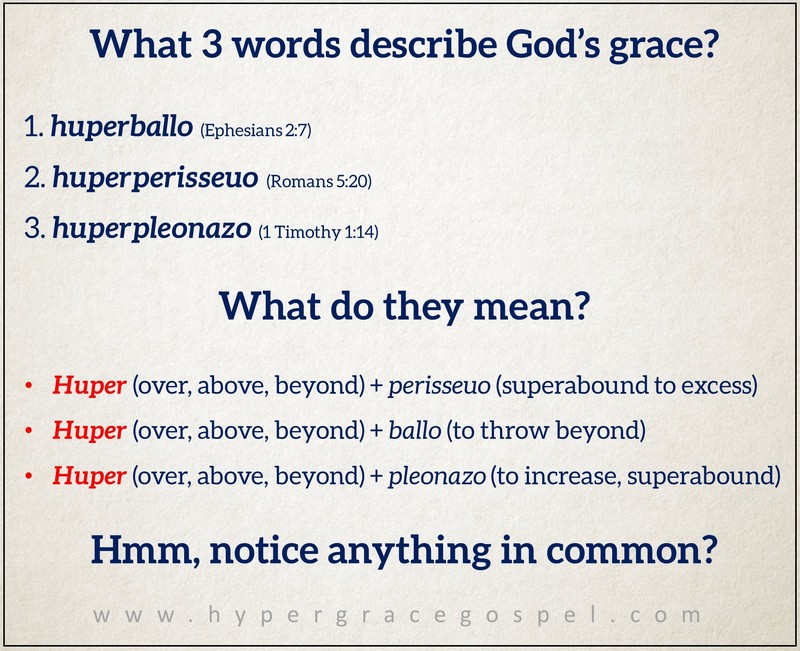
Paul uses the same word as before – the one that means super-abundant – and adds the prefix huper or hyper, which means over, above, and beyond (huperperisseuō). So if you think God’s grace is super-abundant to the point of superfluous excess, you are halfway there. And if you think it’s hyper-, you’re getting warmer but you’re still not quite there, for Paul literally preaches a hyper-super-grace!
The grace of our Lord was poured out on me abundantly (1 Timothy 1:14)
Yes, it’s the same old word in English but English is a woefully poor language for describing the extraordinary riches of God’s grace. Here we have another compound word, huper (over, above, and beyond) plus pleonazō, which means to increase or super-abound. As with his letter to the Romans, Paul literally describes God’s grace as hyper-super-abounding.
If we are to agree with the Bible, we should speak about grace the way the Bible does. We should use big, hyperbolic words and flowery phrases like this:
The grace (unmerited favor and blessing) of our Lord [actually] flowed out superabundantly and beyond measure for me… (1 Timothy 1:14, AMP)
Biblical grace is hyper
The apostle of grace demolishes the notion that hypergrace is an unbiblical or modern message, and we’ve only looked at six scriptures.
We have not examined the extreme grace of a God who loved us while we were sinners (Rom 5:8), who took the legal charges against us and nailed them to the cross (Col 2:14).
We have not considered the hypergrace significance of the cross and the empty tomb. On account of grace and at great personal cost, God tore up the books recording our sins (2 Cor 5:19).
Nor have we considered the testimony of a universe that is inexplicably expanding at an ever-increasing rate because it isn’t yet big enough to contain all the good things a hypergrace God has planned for us.
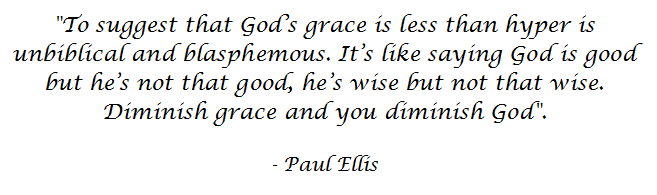
To suggest that God’s grace is less than hyper is unbiblical and blasphemous. It’s like saying God is good but he’s not that good, he’s wise but not that wise. Diminish grace and you diminish God.
Get your understanding of grace from Christian magazines, and you can be forgiven for thinking that hypergrace is bad, modern, and unbiblical. But read the Bible and you will see that hypergrace is a small word for describing an extraordinary reality: The One who sits upon the throne of grace is exceedingly rich in grace and he has poured out his measureless grace upon you!
Hypergrace preachers have not taken grace too far. On the contrary, we have not taken it far enough. We have not begun to scratch the surface of God’s goodness towards us.
To look at the original article, click the logo below:
*What is ‘hyper-grace’? It’s simply the way that St. Paul describes God’s Grace in his letters. The words we translate like ‘exceedingly’ and ‘abundantly’ are actually much more emphaticin the original Greek, and more and more believers today are catching sight of what God’s Grace really means. But of course it generates controversy – Grace always does – and many mainline Church leaders are afraid of it. I will let you judge for yourself why this is….and I also recommend Paul Ellis’s book, ‘The Hyper-Grace Gospel’. The link to it on Amazon is here or click the picture below:
Today’s Beautiful Destroyers post is just a little bit different, because not only do I showcase the legendary Boeing B-17 ‘Flying Fortress’, but I also present a little game you might like to try.
The B-17 ‘Fortress’ was the mainstay (along with the B-24 ‘Liberator’) of the United States 8th Air Force, flying from bases in the UK during World War II. This aeroplane has long been one of my favourite American aircraft from WWII.
Here’s the mighty B-17G Fortress ‘Sally-B’, one of the (happily) many airworthy examples flying today. She’s dressed up as the legendary B-17F* ‘Memphis Belle’, which was the first Fortress to complete the required 25 missions to enable her crew to return home to the United States.
The doctrine which inspired the design and construction of the B-17 was that ‘The Bomber Will Always Get Through’; an inter-war concept whereby bombers would be designed that were so fast and high-flying that fighters (which when the doctrine was formulated, had similar performance to the bombers) would not be able to intercept them. However, by the time the early B-17’s were designed, they knew that the fighters would most likely be able to catch the bombers. And so the Fortress was designed, basically with guns providing all-around firepower protection; defences covering every possible approach angle so that enemy fighters would have to run the gauntlet of heavy defensive fire no matter where they attacked from – hence the nickname ‘Flying Fortress’. And so, with the benefit of this all-round armament, the Fortress was supposed to have been able to make it all the way to the target (The bomber will always get through!), without fighter escort, and defend itself (and its squadron mates, with which it flew in a defensive ‘box’ formation to maximise mutual supporting firepower) all the way to the target and back.
B-17Gs flying in Combat Box formation
Of course, however, as with all such combat doctrines, the reality did not match up with the theory. Although at first, the B-17s could indeed get through to the target without serious losses, and deliver their bombs reasonably accurately, this did not last long. On the first daylight bombing mission, on 17th August, 1942, only two bombers suffered minor damage. However, the German fighter leaders of course developed tactics which they used successfully against the Fortress formations. This is what professional soldiers do well; if there is a tactic that works (in this case, massed formations of machine-gun toting bombers), you develop a counter-tactic, and so on. One of the primary such tactics was to attack the bomber formations head-on, where a) the bombers had weaker defensive weaponry (at some angles, just a single machine gun), and b) the closing speed was so high (of the order of 600mph) that accurate fire was difficult. But still the Fortresses had to go in in daylight – the whole idea was that they could actually see the target they were dropping their bombs on, unlike the RAF night raids where the bombers relied on a combination of good navigation and luck in order to hit their targets – if indeed they did hit their targets.
And so they found that the Fortress benefited from a fighter escort almost as well as did the Germans in the Battle of Britain. Both sides had learned that unescorted bombers iin daylight are vulnerable – but still the B-17 was far more capable of defending itself than were the much more lightly-armed German Heinkels and Dorniers they used in the Battle of Britain. In fact it wasn’t until early 1944 that the Fortress got a fighter escort all the way to the target; on the notorious raids on Schweinfurt and Regensburg in August 1943, the Fortresses lost nearly ten percent of their strike force, being escorted only about 25% of the way there and for the last 25% of the flight back. In October 1943, the second Schweinfurt mission resulted in such catastrophic losses (about 20%) that these missions in fact foretold the failure of the concept of deep-penetration unescorted daylight raids over Germany, in spite of the Fortress’s heavy defensive armament, and while raids continued unabated for the rest of the War, unescorted deep-penetration raids did not. Not until late 1943 were long-range escort fighters sufficiently long-legged to make it all the way to targets deep in Germany and back.
In fact, eventually, the US long-range escort fighters performed so well that some B-17 crews flew two 25-mission tours without ever seeing an enemy fighter.
The Fortress was held in high regard by its crews, because even though the bombers were regularly clobbered good and proper by both enemy fighters and flak (anti-aircraft fire), they had a reputation for being unbelievably tough.
“There were occasions where, any other airplane, took hits the way it took….wouldn’t’a brought us back…”
“God love ’em. They’d bring you home when you didn’t think you had a prayer, and, … they’d never let you down….”
“When you see what the B-17 went through, in combat, and still make it back home … it was a miracle to me”
Some Forts were indeed able to make it back home with some of the most incredible battle damage; damage that would easily have felled any other combat aircraft in the War. Some examples are given here. This Fortress, for example, was damaged in a collision with a German fighter which tracked its wingtip down across the rear fuselage and took off the left tailplane (horizontal stabiliser) too.
Or this Fort, where a Flak shell had exploded directly in front of the nose of the aircraft:
…and they incredibly managed to fly that aeroplane home! This, while extreme, is typical of the kinds of damage these aeroplanes used to absorb and still survive.
In this picture, you can see the contrails (the white vapour trails) of escorting Allied fighters above the B-17 formation:
Here’s a lovely picture of a B-17G on its bomb run. Note the spiral contrails induced by the spiral propeller wash.
And another incredibly atmospheric shot, this time a backlit picture of the propeller tips forming their own slipstream vortices:
And another beautiful picture of a B-17 formation and its contrails – beautiful but deadly. These contrails made it impossible for the defending German fighters to not see the American formations approaching.
So, the B-17 Fortress – another Beautiful Destroyer. Loved by its crews, but suffering heavy losses until the advent of 100% fighter escort.
And now for the little game, which I appreciate will only be of interest to WWII geeks 😉 I call this little exercise the ‘8th Air Force Legacy’.
During World War II, several tens of airbases were constructed during 1942-1943, in East Anglia – roughly the area east of Cambridge/Peterborough – in the United Kingdom. These bases were to be home to the tens of thousands of American servicemen whose mission it was to launch daylight air raids into Occupied Europe in order to cripple Nazi Germany’s war machine industry.
Whereas the RAF conducted its bombing campaign at night – largely a fairly indiscriminate ‘terror campaign’ waged against Germany’s civilian population (although many raids were also sent against German industrial targets in areas like the Ruhr Valley) – the US Army Air Force doctrine called for daylight precision bombing – attacks so accurate that the targets would be hit and hit hard.
The bases were placed in East Anglia so that they would be at the nearest practical ‘jumping-off point’ for raids into Europe. Raids began in August 1942 when twelve B-17s of the 97th Bombardment Group attacked the railway marshalling yards at Rouen. Within months, it became common for the skies above East Anglia to be filled with the reverberating snarl of aircraft engines as hundreds of bombers assembled their formations before commencing their long, freezing flights out over Nazi Germany and back again. Visions of the ground crews waiting anxiously for the first sound of approaching B-17s, returning from storms of flak and rivers of bullets. The culmination of the campaign against the Nazi war machine was in August 1943, where two raids were conducted against the ball-bearing plants at Schweinfurt, and the Messerschmitt factory at Regensburg, both deep in Germany, as already mentioned.
These air bases were absolute hives of activity. Thousands of personnel, hundreds of aircraft, thousands of vehicles, tons of ammunition, bombs, fuel, spare parts; busy hangars and repair shops, briefing and canteen facilities, chapels, stores, barracks – each airfield was a small town and was more-or-less self contained.
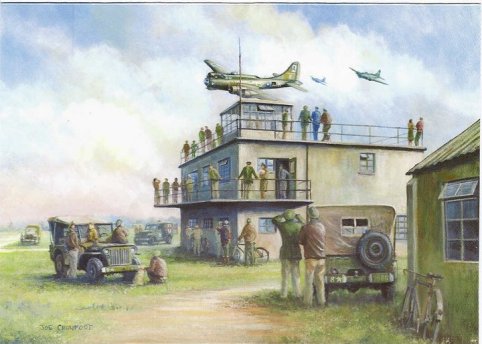
Many of these bases were closed at the end of the War, some were kept going, but now, over seventy years after the end of the War, there is in some cases little left of these once bustling places. Like navvy shanty-towns, they served their purpose, and were then left to fall into decay. Places full of memory, full of history, are now once again reverted to being farmers’ fields or other uses. Polebrook, Kimbolton, Snetterton Heath, Bassingbourn, Thorpe Abbots. Names that evoke visions of B-17s running up their engines, long grass waving behind in the prop wash, the thunder of engines as the heavily-laden B-17s rumble down the runways and lurch into the air, men playing baseball until the returning bombers could be heard, red flares on final approach to signify that the bomber had wounded aboard, wheels-up landings on one engine….
Now, here’s the game. Use Google Maps/Google Earth (satellite view) to search for the place names given below, and see if you can see the bases, or what’s left of them, nearby**. Or even just if you can see where they were. As an aid, you can type in the names of the bases into Wikipedia, and get an idea of what the shapes of the airfields were like. In Wikipedia, add RAF in front – RAF Polebrook, for example. Clue: Most of the airfields had three intersecting runways arranged in a rough overlapping triangle pattern. And take a look at what some of them are used for now – Snetterton Heath is a good example. Also, where possible, try the Google Street View on them – at Rattlesden you can even look along one of the runways that used to be used for B-17s (it’s now a gliding airfield). Would you believe that a very few of these are still active airfields in one form or another!
Here are the names you’re looking for:
Alconbury (an easy one to begin with)
Snetterton Heath
Bury St. Edmunds
Rattlesden
Knettishall
Bassingbourn
Deopham Green
Great Ashfield
Polebrook
Thorpe Abbotts
Framlingham
Grafton Underwood
Little Walden
Molesworth
Deenethorpe
Glatton
Podington (I think this is a drag-racing track!)
Chelveston (a very hard one!)
Thurleigh
Kimbolton
Ridgewell
Horham
Nuthampstead
Each of these bases was near(ish) to the village from which it took its name. Thorpe Abbotts is a bit further away, but that’s part of the fun. Look at the Google Maps from different heights and try to to spot the patterns in the ground. Polebrook is a particularly difficult one, as are Knettishall and Kimbolton. Give it a go and see how you get on. And, as always, comments are welcome 🙂
Good luck!
And finally, I found on the Internet a very moving picture of an unidentified young lady (whose face I have pixellated) walking on a disused runway at one of these old airfields***.
Look carefully above her head….
*The B-17F didn’t have the chin turret that the ‘G’ had (the twin-gun turret under the nose). The ‘Sally-B’ is a B-17G model.
**Because this article is about the B-17 ‘Fortress’, the bases included here are the ones that B-17s used for most of the war. There were also other bases, used by B-24 ‘Liberator’ heavy bombers, that were just as much a part of the 8th Air Force as the B-17s were.
If you would like to try the game with B-24 bases, here is a list of them:
Mendlesham
Shipdham
Hardwick
Hethel
Wendling
Tibenham
Bungay
Seething
Old Buckenham
Horsham St. Faith
Attlebridge
Rackheath
Sudbury
Lavenham
Halesworth
Eye
Metfield
North Pickenham
Debach
Again, good luck!
***The airfield in the ‘ghost B-17’ picture is one of those listed on this page. The challenge, of course, is to find out which one. Answers on a postcard please 😉
Sometimes there’s nothing like simply taking the time out to just go and sit in God’s Presence. Maybe in your spare bedroom; maybe just in your head while travelling to work on the bus. But however you do it, know that He delights in your being there and He delights to spend time with you.
Here’s a lovely song by Don Francisco, expressing the tenderness and love that is found in God’s Presence: Father Hear Me Calling
Deep within the silence, Father hear me calling
Open to your son and lift me to Your Throne above
Lord I need to hear You, feel Your Spirit near me Feel Your arms around me, rest inside your Love
There’s nothing on this earth can fill this thirst and longing
No-one else can satisfy the need within my soul
Come and fill my heart again with all the love that’s in You
Let me see Your Glory; let it cleanse and make me whole
There beside the river let my spirit wander
With my Friend and Saviour, to hear the Voice I love
Drinking sweet still waters
Lying in green pastures
While Your gentle Spirit rests upon me like a dove
There’s nothing on this earth can fill this thirst and longing
No-one else can satisfy the need within my soul
Come and fill my heart again with all the love that’s in You
Let me see Your Glory; let it cleanse and make me whole
(Instrumental)
There beside the river let my spirit wander
With my Friend and Saviour, to hear the Voice I love
Drinking sweet still waters
Lying in green pastures
While Your gentle Spirit rests upon me like a dove
Deep within the silence, Father hear me calling
Open to your child and lift me to Your Throne above Lord I need to hear You, feel Your Spirit near me Feel Your arms around me, rest inside your Love
Let me feel Your arms around me, rest inside your Love
– (Music and lyrics by Don Francisco, used here with his permission)