Here’s the brilliant Brian Zahnd with an interesting thought experiment:
“Let’s play a little game. I’ll ask a few questions and you answer them. Okay?
First question: Did God tell Abraham to kill his son?
You say yes? But hastily add that God didn’t actually require Abraham to go through with it—it was just a test of faith. All right.
Next question: Did God command Joshua, King Saul, and the Israelites to kill children as part of the ethnic cleansing of Canaan?
Is that a hesitant yes I hear, like walking in untied shoes?
My next question is simple and straightforward: Does God change?
I sense your confident answer of no to this question. And you are quite correct. A cornerstone of Christian theology has always been that God is immutable—that is, God doesn’t mutate from one kind of being into another kind of being. The immutability of God is the solid ground upon which our faith stands.
Next question (brace yourself): Since God doesn’t change, and since you’ve already acknowledged that in times past God has sanctioned the killing of children as part of a genocidal program of conquest, is it then possible that God would require *you* to kill children?
You say you don’t like this game? I understand. I don’t really like it either. But bear with me a little more; we’re almost done.
Last question: If God told you to kill children, would you do so?
I know, I know! Calm down. Of course, you answer without hesitation that under no circumstances would you participate in the genocidal slaughter of children. (At least I hope that’s how you answer!)
Yet in answering with an unequivocal no to the question of whether you would kill children, are you claiming a moral superiority to the God depicted in parts of the Old Testament? After all, the Bible says God commanded the Israelites to exterminate the inhabitants of the land during their conquest of Canaan, including children… right? Yet (hopefully) you find the very suggestion of participating in genocide morally repugnant. So what’s going on here? Is genocide something God used to command but now God has reformed his ways? We already agreed that God doesn’t change, God doesn’t mutate. So if God used to sanction genocide, and God doesn’t change… well, you see the problem.
You’ve been painted into a corner.
So where do we go from here? Our options are limited. We really only have three possible courses.
1. We can question the morality of God. Perhaps God is, at times, monstrous.
2. We can question the immutability of God. Maybe God does change over time.
3. We can question how we read Scripture. Could it be that we need to learn to read the Bible in a different way?”
— Brian Zahnd, Sinners in the Hands of a Loving God
Every so often – actually, no; it’s really quite rare, but let’s say occasionally – a really superb and thought-provoking TV or movie series comes along that really makes its watchers think about just Who Jesus was, and what He taught. The better programmes also examine the effect that Jesus had on those who met Him; those whom He healed, and why His enemies hated Him so much.
A great example of this was the series Messiah, which was first aired a few years ago. While not explicitly about Jesus, it was still brilliant and was highly instructive in so many ways. A multifaceted feast of fascinating stories, if you will[1].
Well, only last week, I discovered quite by accident[2] a superb, well I might say ‘new’ series, but actually it had its humble beginnings in 2017 and became more popular in 2020, during the Covid-19 pandemic.
It’s called The Chosen and it stars Jonathan Roumie as Jesus. And it’s absolutely brilliant.
Rather than do a 633 Squadron on you, where you have to wait until the end for the best bit[3], I will let you know, here and now, how you can get hold of this superb content for yourself and for anyone else you think might be blessed by it.
The first and main place to look is on the main website. The link is here, and the episodes can be streamed directly from that site free of charge. There’s really little else I need to do to help you on this, except maybe to let you know that there is a phone app too (search for it on your phone’s app store under The Chosen; the correct app has an icon showing a turquoise fish and two grey fishes) in which you can stream all the episodes, there’s a physical DVD set you can buy (I got mine on eBay) and there’s also a gift shop for both the UK and the USA.
And the entire series; the episodes themselves – they are all free of charge. Yowser.
So then, to whet your appetite for this brilliant project, here is my review, such as it is.
One of the things I noticed quite early on when reading about Jesus in the Bible, and reading other stories in the Bible too, is that they are not really written like ‘proper’ stories[4] Mainly, the texts are written as wisdom, stories, histories, personal letters and prophecy – which in terms of Hebrew prophecy, it’s written as poetry. The thing that is missing in most of not all of the Bible texts – and that makes them very different from ‘stories’ as we know them today – is that of description. There are no passages that say anything like, ‘Jesus came out of His tent and stretched with a huge smile on His face’, or ‘The group sat on the shores of Lake Galilee; the tops of distant mountains were glowing in the late evening light’. There’s very little descriptive text at all, some few exceptions being things like where someone ‘went away rejoicing’ (Acts 8:39); or the rich young ruler who ‘went away sad’ (Matt 19:22). Or even for Jesus, where you’re given a tiny glimpse into His heart when He was ‘full of joy in the Holy Spirit’ (Luke 10:21).
In some ways, that’s understandable, because most of the Biblical texts are not written to be read and ‘enjoyed’ in such a way as the reader is actually placed mentally into the situations depicted, as they are in modern novels. How many times have you read a really good book and, when you ‘come up’ from being ‘in’ the book, you might have experienced a momentary disorientation as you come back in the ‘real world’? Well there’s none of that in the Bible. It’s not a compendium that is intended for ‘escapism'[5] Even Jesus Himself is not properly-described; not really, anyway[6]. Although He was described as wearing brilliantly-shining garments during the Transfiguration (Matt 17:1-8, Mark 9:2-13, Luke 9:28-36), even then, this was only in the company of His best friends, and only on the one recorded occasion at any rate – and you can guarantee that He ‘masked’ the glowing stuff before they came down off the mountain! Certainly, if Jesus really had routinely worn brilliantly white shining garments as a matter of course, He definitely wouldn’t have gone around those sporting high-vis threads in public. Nor would He have got away with having a ‘sharp, double-edged sword coming out of His mouth’ (Rev 1:16); the Romans would have arrested Him immediately for sure 🤣. So, we don’t even know what Jesus actually looked like; not from the Bible, anyway. But the real lack of it is that, although Christianity says that Jesus was both God and Human, in some ways the human side of His character is not really all that well-portrayed in the Bible. It never says that He laughs, apart from (you would imagine, anyway) that bit where He was ‘full of joy in the Holy Spirit’. He never hugs anyone; He eats and drinks but the ‘partying’ side of His character, which was so frowned-upon by the Religious elite of His day, can only be inferred from their reaction to it, for example in Luke 7:13, where Jesus’s reply to them is, “The Son of Man has come eating and drinking; and you say, “Behold, a gluttonous man, and a drunkard, a friend of tax-gatherers and sinners!” He wouldn’t have had to say that to them unless they were complaining about His behaviour, either openly or secretly in their hearts[7].
For this reason, depictions in audio and visual media, such as plays, movies, screenplays, podcasts and radio programs are really useful because they can bring the stories to life like mere reading – of a categorically non-descriptive text like the Bible – can never do. These media are of course a feature of modern society; they didn’t have things like that in the past, at least not before the invention of moving pictures and then cinema.
And so, when a really good Jesus series comes out, it’s time to – once again – see how different scriptwriters and such interpret His life, His teachings and His actions.
The Chosen is such a series. I do not make this comparison lightly – for this next thing changed my life – but a quarter of a century ago, the New Zealand filmmaker Peter Jackson created the stunning, authentic and beyond-epic movie rendition of J. R. R. Tolkien’s ‘The Lord of the Rings‘. Never before, in my experience, had anyone created such a masterpiece in terms of bringing to life a book that I love so much. Granted, for a Tolkien nerd like me, I was just a little bit nonplussed by some of the plot differences, but the visualisations of the places, characters and story that I knew and loved so well were depicted so much better than I ever imagined anyone could ever do, and yet they were exactly as I imagined them – over the fifty years since I first read the books. Words can’t describe.
In the same way, The Chosen depicts the places, the characters, the miracles, the background – in short, everything in the Gospels – in just the way I’d imagined it all, and then some. There are at present five or six seasons[8], each consisting of eight episodes. In The Chosen, Jesus indeed parties with people; He joins in celebrations like at the wedding in Cana (John 2:1-11); He doesn’t just sit in a corner looking miserable and disapproving, like the Religious would like to think He would have done. No, He’d have joined in. He’d have laughed, danced, drunk wine, hugged people, and even smiled. And He does so – a lot! – in The Chosen. This series is absolutely brilliant. I was going to say that I can’t describe it, but I feel I owe it to you, my dear reader, to attempt to do so!
One of the most striking things is the age of Jesus’s disciples. Jesus looks to be in His early-to-mid 30s or so, and, similarly, His disciples look to be in their late twenties or early thirties. If you do a Google Images search on Jesus’s disciples, you’ll get loads of pictures of hoary old men with long grey beards and turbans. But they wouldn’t have been like that at all. They’d have been young lads, and they are depicted as such in The Chosen. The series also ‘reads between the lines’ a little, in that there’s lots of dialogue between the characters that reflects the wonder of what they are witnessing. Like where Simon Peter says to Mary of Magdala, “Can you believe we are here to see this?”. The freshness and wonder of what Jesus was doing is really brilliantly expressed.
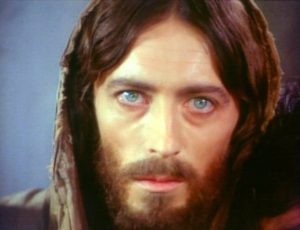
The characters are not fair-skinned, blue-eyed people, as portrayed in much Western artwork and movies depicting Bible stories. Think of the blue-eyed and very white British actor Robert Powell, who played Jesus in the 1978 movie, Jesus of Nazareth, and you’ll understand what I mean:
Robert Powell as Jesus
No, the Israeli characters are played by darker-skinned actors, and they also speak with a rather ersatz[9] ‘Middle Eastern’ accent. Except for the Roman characters, who speak with either an English or mildly American accent. Also really well done is the cosmopolitan nature of first-century Israel. Being at the ‘crossroads’ of many trade routes and central to the land-bridge between Africa, Europe and Asia, ancient Israel was a hotbed of differing cultures, peoples and races. This is why the story of the people who witnessed the coming of the Holy Spirit at Pentecost tells this:
“Now there were dwelling in Jerusalem God-fearing Jews from every nation under heaven. And when this sound [The disciples speaking ‘in tongues’] rang out, a crowd came together in bewilderment, because each one heard them speaking his own language. Astounded and amazed, they asked, ‘Are not all these who are speaking Galileans? How is it then that each of us hears them in his own native language? Parthians, Medes, and Elamites; residents of Mesopotamia, Judea and Cappadocia, Pontus and Asia, Phrygia and Pamphylia, Egypt and the parts of Libya near Cyrene; visitors from Rome, both Jews and converts to Judaism; Cretans and Arabs—we hear them declaring the wonders of God in our own tongues!’ Astounded and perplexed, they asked one another, ‘What does this mean?’ “
(Acts 2:5-12)
And The Chosen reflects this eclectic mix of peoples really very well; the story-immersion resulting from the authenticity really is remarkable.
There’s lots of really great characterisations, such as the earnest and honest seeking of Nicodemus (brilliantly played by veteran actor Erick Avari), the impulsive, fiery and indeed ‘laddish’ Simon Peter, played by the Israeli actor Shahar Isaac, and Paras Patel‘s superb rendition of the fussy, pernickety, and quite probably Autistic, Matthew the tax collector.
Many nice touches are included too. Simon’s wife[10] ‘Eden’ is a lovely, down-to-earth and honest lady who absolutely adores him, and their on-screen chemistry is a delight to see. The excellent portrayal of decent, sincere-but-misguided yet conscientious and honest Pharisees like Shmuel, as opposed to the High Priest, Caiaphas, who seems to be in it (in the episodes I have seen so far, anyway) just for the prestige and power. Then there’s the Roman Praetor, Quintus, who is ambitious, scheming and cunning, but who has the redeeming quality of recognising Matthew’s ability to think unconventionally (which is why I think he’s supposed to be Autistic)[11] – even if that recognition is only to be used to further his own ambitions[12]. Compare Quintus with the gritty, practical and down-to-Earth Roman Centurion Gaius who nevertheless recognises Jesus for Who He is. He’s the guy whose servant is ‘remotely’ healed by Jesus as per Matthew 8:5-13 and Luke 7:1-10. And Elizabeth Tabish‘s Mary of Magdala is simply superb.
There are also some great theological lessons in there too, which are presented in excellent ‘backstory’ scenes – in that they are not of themselves in the Bible, but are placed in the episodes to flesh out the story. A great example is this little excerpt where the Pharisee Nicodemus is tutoring his student Shmuel on God not being a static idea:
I could go on. But it’s far better for me to simply shut up and let you go and look at this, yes, phenomenon, for yourself. There are many clips from The Chosen on YouTube. And I would say that, without exception, every single one has, in its comments section, many testimonies of how The Chosen has brought to life the Gospel stories like nothing that people have ever seen. Granted, there’s a lot of clickbait out there too. But the overwhelming message of those testimonies is that God has touched people’s lives through this series like few recent things have. Jesus has become more real to people who just want more of Him in their lives. People’s faith; people’s personal walk with Jesus, has been transformed by this series.
Of course, there’s also been naysayers who complain that it is not exactly faithful to the Scriptures. People whose hearts are hardened to the amazing thing that this content really is. These people, like the legalists in Matthew 12:22-32, miss out on what Jesus is doing because they are so convinced that they are more right than He is. They miss the things that God is doing because they have their heads so far into their own preconceptions, and what they think the Messianic prophecies will look like when they actually happen. They therefore have neither the eyes to see, nor the ears to hear. Well, it’s their loss, and I have no sympathy for them – except that their precinceptions have likely come partly from others’ influence. God will hopefully give those people too the ears to hear, someday.
But, for myself, even though I already know Jesus personally, and have experienced Him in ways that maybe others haven’t, this series has strengthened even my faith. It’s lit up the Gospels like nothing else. It’s also taught me things about my own thinking that I won’t mention here – the Secret of the Lord and all that.
But I am absolutely sure that, if you watch these series, your faith will be strengthened too.
Peace and Grace to you!
Header Picture depicts actor Jonathan Roumie as Jesus of Nazareth
Yes, the 633 Squadron syndrome is my cynical term for making people wait until the end for the best bit. It comes from the epic 1964 movie, 633 Squadron, in which the film builds up, through a series of stories, subplots and other adventures, to the climactic battle at the end. The ‘original’ Star Wars movie – later called Star Wars Episode IV – A New Hope – was also structured like this, and was in fact inspired by 633 Squadron, as openly acknowledged by George Lucas, the creator of the Star Wars universe. Both films are excellent, of course, and I only use the term fondly!
The reason the term is cynical is because I see it as a very common tactic used by sports organisers, where they have a lot of build-up before the event itself; by rock concert organisers where they have supporting acts before the main act (which is of course actually good for the supporting act) and especially at churches. This might be for a communion service, where they make you wait until the end before you get your bread and wine. Or, especially, at a baptismal service where you have to sit through all the other stuff and people talking at you before you get to the fun bit at the end. It also happens on clickbait websites where they make you click through pages and pages of preamble before letting you read the news article or whatever that you really came for – if indeed you do actually get to it at all. I very quickly escape from those sites once I realise what’s happening. In short, it’s where they make you sit and wait – rather like being in a school detention – rather than getting around to the bit that everyone has really come to see. And that’s why I have put this as a footnote, so that it gives you the option of not reading it should you so wish!
Specifically in the context of this essay, the Gospels, which are really the parts we’re concerned with here as The Chosen is a rendition of the Gospels. The Gospels are written more as a collection of anecdotes and are written as history; Jesus said this, Jesus did that. They are presented more as factual than entertainment.
Which probably lends more credence to its authenticity, in fact, because there’s no mechanism in there for suspension of disbelief or immersive description, which in a fiction or propaganda document would be plentiful. There’d be lots of narrative content such as adverbs and adjectives – descriptive words – to draw the reader in. But there’s none of that; not really.
Except, notably, at the beginning of the book of Revelation (Rev 1:13-16). The description there, of course, is in an apocalyptic vision and as such the writer is trying to describe the indescribable, and all that while in the apocalyptic mode – which means that it is written in a sort of code. Much of Revelation was – and is – never intended to be taken literally, and it would be a mistake to do so.
Knowing the terminally self-righteous mindset, though, they would doubtless have been openly criticising His ‘sinfulness’ because that’s what self-righteous people did back then, and still do nowadays too.
As far as we know, from church tradition, Simon Peter was the only one of Jesus’s disciples who was married. We know that he was married, or at least possibly widowed, from the Gospel story told in all three of the Synoptic Gospels, in Mt 8:14-15, Mk 1:29-31 and Lk 4:38-39. In addition, 1Cor 9:5 mentions that other Apostles were also married, but it doesn’t say which ones. The reference in 1Cor9:5 refers to ‘Cephas’; this is Simon Peter.
[Edit]: Turns out I was right. The chartacter of Matthew, as portrayed in The Chosen, is indeed supposed to he Autistic. Here’s what The Chosen’s Director, Dallas Jenkins, writes about him:
“Dallas Jenkins, the creator and director of the show that has captivated millions, decided to depict the Biblical character of Matthew as a person on the autism spectrum.
“When we were first choosing Matthew to be a featured character, we noticed, ‘Okay, he is a numbers guy because he’s a tax man. He’s a facts guy because the first chapter of his book is a genealogy divided into three sections of 14 names apiece, so he’s very precise,” Jenkins explains to WW.
Jenkins continues, “He chose a profession that made him an outcast. I’m very familiar with the autism community. It’s in my family. I’ve done a lot of volunteer work there, so looking at that I go, ‘Boy, these are traits of Asperger’s or someone the autism spectrum. Wouldn’t that be interesting, very human and relatable to have a character who is like that? Is it factual? I don’t know. It’s plausible, and I think one of the top things that we’ve seen people relate to most with the show is the character of Matthew.”
And Matthew is played to perfection by non-Autistic actor Paras Patel; this role really showcases the guy’s acting ability and has in fact led him into becoming an advocate for the Autism community.
I love that quality in Quintus; how he recognises the special ability – call it a ‘superpower’ if you like – that Matthew has of being able to think like that. I too have that superpower and my boss in my last job knew about it, and invited me to participate in certain work meetings specifically because he knew I would bring a unique perspective to things because of that superpower. What a guy.
Some years ago, I published an essay on the Book of Revelation, the last book in the Bible. At that time, I referred to the ideas of the early Church Fathers, where I said that,
“The early Church fathers, in considering whether to include the book of Revelation into the Canon, took the decision to include it only under the following strict conditions: 1) It was not to be used for any major doctrine or in any liturgy of the church; 2) It did not have the canonical authority of the other New Testament writings; and 3) It was never to be taken literally in any way, but only metaphorically, as an encouragement for Christians about to undergo major persecution and bloodshed”.
Since that time, I have read and discussed this concept with other believers, and have also discovered a source for the concept from Canadian teacher and scholar Dr. Brad Jersak, where he kindly gave me his rationale for those ideas. I reproduce the rationale in a footnote below[1], and I have also modified the essay slightly to allow for that sourcing.
But still, the essay is worth looking at again. It is good to re-publish such good and informative essays so that my readership can see once again the useful things that God gives us. So, here is the essay once again, tidied up a little and also with a bit of new text in there too.
Enjoy!
The book of Revelation, sometimes also called ‘Apocalypse’, ‘The Revelation of John’, or even (incorrectly) ‘Revelations’ (like ‘Trivial Pursuits’, ‘Cliff Richards’, or ‘Tescos’; all pluralised words that definitely shouldn’t be 😉 ) is probably the most confusing book in the entire Bible, and it is certainly the most confusing in the New Testament.
Its weird imagery often reads more like a nightmare than anything else. And, in fact, so uncertain were the early Church as to its origins or relevance, that it was almost left out of the Canon of Scripture that we know today. Indeed, many early canons did not include the book at all.[2]. The early Church fathers, in considering whether to include the book of Revelation into the Canon, took the decision to include it only under the following strict conditions: 1) It was not to be used for any major doctrine or in any liturgy of the church; 2) It did not have the canonical authority of the other New Testament writings; and 3) It was never to be taken literally in any way, but only metaphorically, as an encouragement for Christians about to undergo major persecution and bloodshed. Naturally, these conditions have been conveniently forgotten, or more likely never even heard of, by those in the church today who love to misuse this book to the detriment of others.
Of course, because of what I call ‘Chalke’s Law’, which states:
“There are some people who will always find the angry verses in the Bible to confirm their obsession with anger and exclusion” (Steve Chalke)
…the book, with its weird and (on the surface) violent imagery is just perfect for those certain Christians who rejoice in – and indeed savour with eager and gleeful anticipation – the idea of the horrific mutilation, deaths, slaughter, and then endless torment of those who don’t agree with them, to the tune of rivers of the blood of the ‘unrighteous’ to the depth of a horse’s stirrups[3]. Yes, that imagery is there in Revelation, but of course it doesn’t mean what it says on the surface.
This is because we need to remember that much of Revelation is written in the ‘apocalyptic’style (which is why in some quarters it’s referred to as the ‘Apocalypse'[4]), and as such it is written in a sort of code, some of which has been lost to antiquity, but some of which can be inferred by its historical context, and from whom the book was written to. In fact I think this is why, in some apocalyptic writings, the author is instructed to ‘seal up what is written'[5], because it concerns things that need to be worked out properly. A good example of this would be in Daniel 12:4; the second half of the book of Daniel is written in the apocalyptic style, as are parts of Ezekiel. For more on this subject, I would far rather defer to more learned scholars than myself, who know far more about it than I do. For example, N. T. Wright’s ‘Revelation for Everyone’ would be a reasonable starter; it is a very informative book and is written in a style that is very easy to understand.[6]
However, the worst thing that can be done with apocalyptic literature like Revelation is to read it literally, because it was never intended to be read as such, and indeed the misuse of this book by ignorant people (ignorant in both or either senses of a) not knowing, and b) being unimaginably unintelligent) has caused untold harm to millions of people all down through history. Indeed, I would say that no book has been misinterpreted and misapplied to others’ detriment as has Revelation. And all because people haven’t a clue what they are doing with this most lethal, and yet potentially most blessing, of all the books in the Bible. The very last thing we should do with most of this book is to take it literally.
And yet, so much of modern theology, in terms of both ecclesiastical theology and common theology, is based on passages in Revelation. Without discussing these ideas specifically here, the concept of Heaven as an afterlife idea and the concept of ‘hell’ being a lake of burning sulfur, are both concepts which are strongly based on passages from Revelation. Even the ‘Pearly Gates’, where St. Peter is traditionally employed as a receptionist; even they are entirely from Revelation. Reference for the Pearly Gates? Revelation 21:21 is where that comes from. Go and take a look 😉
So, read in the light of the idea of an angry, retributive ‘nasty god’ like that found in much of the Old Testament, Revelation will of course be seen as incredibly bad news for most people, most of whom are going to be sorry they were born, according to the gleeful claims of those ‘certain Christians’ I mentioned above.
However, read in the light of Jesus, the Prince of Peace and the King of Love, the book can in fact instead be seen as excellent news for everyone. Again, I have here neither the time, the knowledge, nor indeed the inclination to expound on why this is the case; instead I would again refer you to people who really know what they are talking about. However, I would like to share with you today a brilliant piece by my friend Mo Thomas, where he presents an opposite view to the Evangelically-accepted ‘violent’ view of Revelation. No-one should read Revelation without having to hand several huge pinches of salt, and the definite guidance of the Holy Spirit to glean what it means for us today, and, more relevantly, what it means for you personally today[7]. Formation of major doctrine from Scriptures in Revelation is a serious error, as we have already seen. Personally, I happen to think that formation of any major doctrine, or at least dogma – a doctrine which is considered to be essential and non-negotiable – is also an error, but that’s just me 😉 I’d far rather live a life in the Spirit, completely unbound by others’ doctrines, rules and strictures. I’ll listen to others’ ideas, of course, but let’s just say there’s a lot of bones I spit out while I eat the meat 😉
Anyway, less of the masticatory[8] digressions; I will hand you over to Mo:
The term for “Revelation” is the Greek “Apocalypse”, or the “unveiling”. John’s revelation then in the scripture is primarily about the “unveiling” of the Person and Work of Jesus, not primarily the symbols, timelines, and events. But once seen through this lens…the symbols, timelines and events start coming into focus.
The subversive nature of the apocalypse can trip up many who are looking for a violent overthrow when Christ returns, much like the Messianic expectation of those in the 1st century. This type of overthrow requires a calamity-filled blood-soaked eschatology, which unwittingly fosters a perspective of escapism – with no authentic desire to engage and participate in God’s Kingdom here, now.
Here’s the thing. The book of Revelation may just be the most non-violent war scroll ever recorded in the history of apocalyptic literature. But we can’t ever see this unless we read as it would have been interpreted by those 1st century folks. It would have filled them with hope in the midst of evil Empire, Roman oppression. Victory is achieved – not by the methods of war and violence, but by the blood of the Lamb and the word of their testimony.
What better way to motivate hope for our role in the Story than to paint an optimistic view of the Shalom and Care of God for all that He reconciled to Himself, for His Cosmos.
The subversive way of the Slain Lamb continues to make its way forward.
________________
“Jesus is not coming back to renounce the Sermon on the Mount and kill 200 million people.
If that’s your reading of Revelation, what can I say? Lord, have mercy.”
– Brian Zahnd
_________________
The brilliant, subversive narrative we find at the end of our Bibles hinges on the throne room scene in Revelation chapter 5, where John hears an announcement for the Lion of the tribe of Judah. He turns, expecting to see a ferocious beast that tears His enemies apart, limb from limb, as Israel had long hoped and expected.
Instead, John turns and sees a tiny Lamb, looking as if it had just been slain. Ahhhh… the crucified Christ! From that point on, we no longer see ANY mention of a lion. But 29 more times, we see the Lamb of God, the prevailing theme of the Story.
This is masterful apocalyptic literature.
Yes, this King is victorious, and He reigns in power. Yet, this power is most clearly and succinctly displayed on the Cross, where we see that He would rather die for His enemies than kill them.
The book of Revelation is the Apocalypse, the “unveiling”, of Jesus the Christ, who displays His Power as the Crucified and Risen and Victorious Lamb. Don’t distort the brilliant subversion by making it a literal book about “end times” and Anti-Christ figures and the necessity of bloody violence.
Make it about our Beautiful King, the Crucified One who overcomes.
Rev 5:13. And I heard every created thing in heaven and on earth and under the earth [in Hades, the place of departed spirits] and on the sea and all that is in it, crying out together, To Him Who is seated on the throne and to the Lamb be ascribed the blessing and the honor and the majesty (glory, splendor) and the power (might and dominion) forever and ever (through the eternities of the eternities)!
Come, let us worship.
Shalom
– Mo Thomas
Regarding the return of the ‘Warrior Jesus’, and regarding a couple of other Revelation points, I once put it like this:
“If it is true that Jesus is the same yesterday, today and forever (Hebrews 13:8), then it follows that He will be the same Jesus when He returns. The angels at the Ascension said that ‘this same Jesus…’ will return (Acts 1:11); they never said He’d return as someone different. He won’t be, indeed He can’t be, a different Jesus than the gentle, healing and loving Jesus depicted in the Gospels. In addition, the passage (in Revelation 5:6) about the Lamb on the throne describes Him as a Lamb, not as a Lion. He will return as a Lamb, because He left as a Lamb. That whole scene is about the literary bait-and-switch of the throne of a mighty King, the King of the Universe, in fact, being the Lamb looking as if it had been slain in the centre of the throne. The power and right to rule comes from the power of God, which is the power of the Cross – as in, the submission of the Lamb to the point of death, thus showing where true power actually lies, in the self-giving nature of God and NOT the desire to lord it over others.
“Furthermore, Revelation is very much a book of metaphysical imagery and weird Apocalyptic, coded writing. To interpret it literally would be a mistake, for most of the book at any rate. I personally think that Revelation is something where John was seeing things that were very hard to describe from a human point of view, and so they need to be taken with a very large pinch of salt. Or a dose of magic mushrooms”.
As one final comment, and as a general tip for reading Revelation, I would say that if you come across a passage in that book that the Spirit does not make come alive for you[9], then by all means feel free to set that passage aside until such time as She does make it come alive for you. Some of it you may never understand, and this is not surprising as the book was in fact not written to you anyway (Rev 1:4). But that’s all right. We don’t have to ‘get’ it all; not by a long chalk.
Yes, the way I wrote that (probably in an appendix to a book by Hardin?) makes it sound very deliberate and collaborative, but I’m really distilling something quite messy, so in citing that, I would recommend saying that this is Bradley Jersak’s interpretation of a series of important factors that are not proof-texted directly.
Where I draw them from is from logical inference (some completely airtight) and from what we are warranted to say from what we know of various Fathers.
For example, we KNOW that the Nicene Creed (the dogma of the church) was finalized in 381. And we also know that while various significant theologians (like Origen and Athanasius) include it in their personal lists of NT Scripture, others (like Gregory of Nazianzus and Cyril of Alexandria) did not. This latter point is very important because Gregory also presided at the second council where the Nicene Creed was finalized. Here’s a bit of the messiness:
‘Chrysostom never quotes from Revelation, leaving the modern world no clue to his thoughts on the book of Revelation. Gregory of Nanzianus and Cyril leave it out of their listings of the canon. Moreover, the Nestorian churches still leave Revelation out of their canon. Revelation has never held a very secure place in the Eastern Orthodox canon. The Syriac Peshitta omits it, and the Council of Laodicea did not recognize it. As late as 850, the Eastern Church listed the book as disputed. They still do not read from Revelation regularly. [It is not at the altar with the Gospel or the reader’s stand with the Epistles].
Thus, the church did not collectively recognize it as canonical (complicated: Canonicity and Acceptance of Revelation (in Revelation) – Anabaptistwiki) until AFTER the Creed, meaning that the dogmas of the faith were settled BEFORE the book was received as authoritative, and therefore, the Book of Revelation CANNOT have been used to establish the dogmas that came before its reception.
The rest of the story are the sort of details one can read between lines or by reading the sermons and liturgies of the church.
BUT my point is NOT that we reject Revelation as canonical. It is now recognized as part of our canon. My point was that the church did not use it to generate the essentials of Christian doctrine and therefore, must not be used that way today. Any doctrinal statement drawn from Revelation would be derivative of and in alignment with the Gospels or Epistles that were used to establish that doctrine in the first place.
I think I’m right in saying that there are some of today’s denominations that still regard Revelation as not being canonical, although I could be wrong.
The modern word ‘apocalypse’ and its derivatives such as ‘apocalyptic’ means things that are of world-ending, or at least world-shaking, importance or magnitude. This is because Revelation is seen by most literalistic interpreters as describing the end of the world, or at least ‘end-times’ stuff, and indeed to the general reader it really does read like that!
Yes, that’s why there’s a sealed scroll for the header image. Much of Revelation is still sealed for many people, including myself, and the ‘Secret of the Lord‘ notwithstanding 😉
Even then, you should always ask the Spirit to explain, interpret (for your upbuilding!) and apply anything that you read in that book, or indeed any other source – including this blog! Always remember that God speaks to everyone in different ways, and it is perfectly ok to ‘eat the meat and spit out the bones’. If something doesn’t sit right with your spirit, then feel free to set that thing aside.
Technically, really, all Bible reading where you actually want God to speak to you through the Scriptures; all of that should be done under the tutelage of the Spirit anyway. Why risk missing out on His riches?!
Some Christians, including most Evangelicals, move the goalposts in regards to what they claim the Bible says about, well, anything really, when evidence is presented that refutes one of their tenets they hold fast to[1]. That is, at least, if they actually believe the evidence – many people simply ignore it because they don’t like it. A common human failing, in fact.
It’s not that they don’t believe something; it’s more that they say ‘Well, that’s not what we meant!’ or ‘We’ve never believed that!’, rather than just admitting they were wrong. Again, a common human failing.
A great example is this.
Many Christian preachers used to say (and indeed some still do) that ‘Jesus spoke more about Hell than He did about Heaven’.
When people found that a simple concordance search reveals this to be a lie[2], they changed their tune, and claimed that ‘Jesus spoke more about Hell than He did about any other subject’.
When this too was shown to be false[3] – and also incompatible with the previous assertion since if He spoke more about Hell than any other subject, then that would include Heaven, and we have already shown that to be false – they changed it yet again, to ‘Jesus spoke more about Hell than anyone else in the Bible’.
That too is almost right, except that in the passages where they think of Jesus as speaking about Hell, He wasn’t speaking of Hell in the way we understand it today. In the one instance where it was actually there, it was being used as an illustration – the Rich Man and Lazarus story – and even that does not fit with modern Evangelical doctrine on just about any level.
But the point is that they change their tune. They move the goalposts. And the really irritating thing about all this is that those who listened to, believed and proclaimed the earlier claims have now completely forgotten about them. They went on to the next claim without a second’s thought. And so on down the line. For more on the ‘Jesus spoke more about Heaven than He did about Hell’ thing, check out my earlier blog post here.
Another funny one is where they say the Bible is inerrant, infallible, perfect and yada yada yada[4]. Then, when they are challenged about the many different translations and how they say different things in some places[5], they’ll say that the Bible is perfect in its original manuscripts.
Which means that:
1) Since no surviving original manuscripts have yet been discovered, we have no way of knowing what was actually in them; and
2) Since any translation of the Bible is neither the original manuscript, nor of course translated directly from an original manuscript (because none exist), then it follows that no Bible – modern or older – is completely perfect, inspired, infallible or any of the rest of it; therefore
3) The authority of the Bible cannot be held to be complete in its absolute sense, because such a concept is based on a premise that does not exist (there are no original manuscripts) and also because by them claiming that only the original manuscripts are perfect, then it follows that other manuscripts are not perfect;
4) Many believers also don’t know that in the passage in 2Pet3:16, Peter refers to St. Paul’s writings as ‘scriptures’, even though they hadn’t been widely published yet, and were certainly not part of any recognised canon. The Greek word translated as ‘Scriptures’ in that verse is the word γραφας (graphas) or ‘writings’, as it is in 2Tim3:16, and the word ‘writings’ is translated usually as ‘Scriptures’ – which is an inferred translation influenced by the translator’s personal leanings. So in that way, we can surmise that even back in Peter’s time, the ‘writings’ were seen as inspired and sacred, but not necessarily Scripture as such. The only Scriptures they really had back then were the Hebrew Scriptures, roughly what we would nowadays call the Old Testament;
5) Another logical flaw in this is one that I have stated in other places, which is that if it takes someone to tell us that the Bible is the absolute authority, then this is self-contradictory because we are relying on the authority of the person/organisation telling us that the Bible is the ultimate authority. In this way, their vouching for the Bible simply means that they themselves become the higher authority. Ultimate, supreme authority does not need anyone to vouch for it; we should not have to be told[6]
6) Saying that the Bible is perfect and holds ultimate, supreme and absolute authority means that it is placed above God, Who alone is really the One with supreme, sovereign power and authority. This is in direct violation of the first of the Ten Commandments: You will have no other Gods before Me (Ex 20:3 and Deut 5:6), because the Bible is placed before God in order of authority.
So, in those ways, the Bible is not perfect. And it’s the reason why a) Jesus Himself contradicted Scripture (e.g. Mt 5:43) and b) Jesus sent the Holy Spirit in order to lead us into all truth (Jn 16:13). Only when He explains a given Scripture passage does it become ‘infallible’, which is fine because then it’s God Who is doing the teaching, yes using the Bible as a ‘tool’ or ‘channel’ for that teaching, but it’s Him Who does it.
Anyway I just thought I’d point out that ‘moving the goalposts’; thing.
Can’t let them get away with it, even if only because it needs to be reiterated that it’s about time Christians started using their brains!
Modifying what one believes, in response to evidence or experience, is actually a virtue. But in the way I’m describing and explaining it here, it’s not a virtue by any means!
I was going to soften that and simply say it’s ‘untrue’ or ‘incorrect’, but the fact is that many preachers still deliberately claim that it’s fact despite knowing it’s not true. And so it’s a lie.
I actually found a church website the other day where the Bible was the first thing they mentioned in their Statement of Faith. Not God, Jesus or any of the, you know, like really God things that should be mentioned first, but the Bible. Yawn 🤣 .
Some might argue that we need to be told, by others, about authority. For example, the police, or the Government, are authority, and we have to tell each other that, but that does not make us a higher authority than the Government. But that’s fine; they can speak for themselves, plus it is stated in national law that they are the authority, and in essence they have placed themselves – or in a democracy, we have placed them there – and so it’s self-evident. This is not the same as an inanimate book. It cannot speak for itself, even in 2Tim3:16, where the Biblical claim of authority (misinterpreted verse in my view!) is set up by believers as claiming authority using a circular argument.