Category Archives: Others’ stuff

Understanding the Parable of The Sheep and the Goats

This entry is part 4 of 4 in the series Lee O'Hare's mini-series on Hell

Here is the fourth and final part of the mini-series of video talks by Lee O’Hare, where he addresses the foundational issues underpinning the standard Evangelical doctrine of Hell.

In this talk, Lee addresses the other main pillar/weapon in the arsenal of the Fundagelical proof-texter: the Parable of the Sheep and the Goats.

With this Scripture, unsurprisingly, the Fundies have no problem accepting that this is a parable (unlike in the Parable of the Rich Man and Lazarus) because it suits their purposes and they can instead twist the parable. No-one really believes that sheep will go to Heaven whereas goats will go to Hell šŸ˜‰ . But because parables are stories with an indirect meaning that must be inferred by the reader, naturally this provides Fundagelicals with the opportunity to twist it how they want, which they do freely and shamelessly. In mitigation, many of them are just parroting what they have been taught…I know this because I used to do it too, just like that. But I never used the phrase ‘Pieces of Eight!’.

But in this talk, Lee explains the background to this parable and explores several avenues as to its interpretation.

As I have mentioned in previous blog posts giving you videos to watch, these talks do represent a fair amount of investment in terms of time; each talk is about an hour long. But if you can at all make the time to listen to these excellent videos, it will be time well spent, I assure you.

Lazarus and Rich Man

This entry is part 3 of 4 in the series Lee O'Hare's mini-series on Hell

This is the third part of the mini-series of video talks by Lee O’Hare, where he addresses the foundational issues underpinning the standard Evangelical doctrine of Hell.

The Parable of the Rich Man and Lazarus (Luke 16:19-31) is one of the main two pillars holding up the structure of the Hell doctrine. Although it’s a parable, and as such should not of course be taken literally, so keen are the Fundagelical apologists to keep this story in their arsenal of proof-texts about Hell that they even deny that it is a parable. And this despite it beginning with Jesus’s standard parable introduction; kind of like His ‘Once upon a time’, and despite it being a story told to the Pharisees; ‘The Bible clearly says…’ (lol) that Jesus only spoke clearly to His Disciples (Matt 13:10ff); to everyone else He spoke only in parables (Matt 13:34-35). In other words, so strongly do they want to believe in the Hell doctrine that they will even go to these, almost dishonest, lengths to protect what they choose to want to believe. It’s sad and it’s desperate.

But this talk is a real eye-opener, and Lee finishes his tale with a flourish that will gladden any heart with the ears to hear. But probably not those who have hardened their hearts in wanting to believe this nasty doctrine come-what-may.

As I have mentioned in previous blog posts giving you videos to watch, these talks do represent a fair amount of investment in terms of time; each talk is about an hour long. But if you can at all make the time to listen to these excellent videos, it will be time well spent, I assure you.

Over to Lee:

Jesus and Gehenna

This entry is part 2 of 4 in the series Lee O'Hare's mini-series on Hell

This is the second part of the mini-series of video talks by Lee O’Hare, where he addresses the foundational issues underpinning the standard Evangelical doctrine of Hell.

In this instalment, Lee looks at the use of the word ‘Gehenna’ in Bible translations (especially the King James Bible; you know, the one that Jesus used šŸ˜‰ ) where the word Gehenna has been incorrectly translated as ‘Hell’. This is a fascinating talk which will bring much clarity on this subject:

On the subject of Gehenna, as Lee says, it’s a real place that you can go and visit today if you’d like to. Here’s a picture of it. I don’t know about you but I think it looks pretty hellish. Not.

Why Young People are Leaving the Church

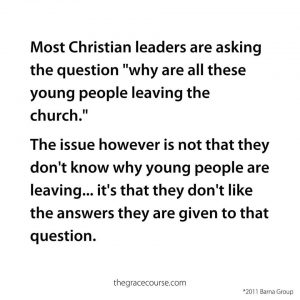
Young people are leaving the organised Church at an alarming rate. Well, it’s alarming to those who want to keep them ‘in’, anyway.

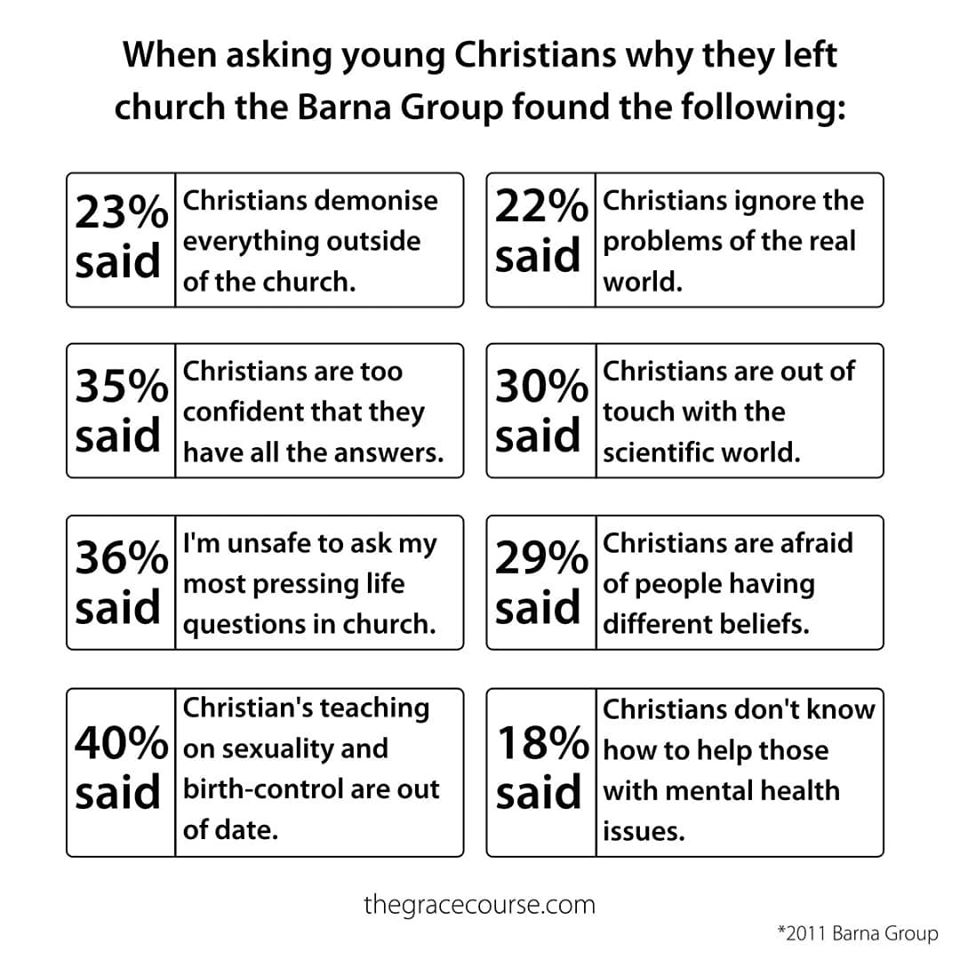
Here’s what my friend Phil Drysdale has to say on the issue:


The issue isn’t that Christian leaders don’t know why young people are leaving the church. No, young people are telling us very clearly why.

It’s that these types of answers require too much of a change for the average leader to be able to deal with.

My three big takeaways from this are:

1) Many young people today aren’t looking for certainty half as much as they are looking for a place to explore their doubts safely.

2) Many young people don’t see getting people out of the world and into the church as a primary goal. They care about loving the world and want to see Christians go out into it and make it a better place, without an agenda.

3) Many young people aren’t scared of the world or facts, they are happy to reinterpret their faith and its texts in light of newly discovered truth. A church that is unable to do so will lose them quickly.


I fully agree with all this. I have some comments too, as you might imagine.

You see, this sort of thing always attracts the inevitable responses from hardline, rigid and unbending* leaders who hold the ‘word of god’ ** above everything else, insisting that it’s not the ‘word’ that needs to change, but the ‘world’.

‘Oh well, it’s not us that say it, but it’s the Bible’.

‘This is what god says, not us. We can’t change what god says just because we don’t like it’

‘Don’t blame me, it’s the Bible wot sez it. I can’t change what the Bible says. ‘

‘The Bible has a timeless message; it’s not our fault that the times are changing away from its message. It’s the world that is going the wrong way’.

‘I’m not going to sugarcoat what the Bible says just because that would make me/it more popular’

‘It’s not about making the Bible more acceptable; it’s about telling people the hard truth’

And so on ad nauseam.

Maybe they should do a little thinking as to just why people no longer think the Bible is relevant…it’s not the Bible that’s at fault; it’s the attitudes of the people who brandish it. Who wants to be like one of these dull, grey, boring, joyless people?*** Evangelical Christianity is the worst advert for God there is, particularly when combined with the (mainly Old Testament-based) doctrines they espouse. And let’s face it, many of them are nasty about it; they are judgemental and condemning and almost gleeful about the idea of seeing those with whom they don’t agree burning in ‘hell’. And that comes out in their lives and in their interpersonal attitudes. Again, who wants to be like that? Jesus maybe should have said, “They shall know you are My disciples in that you judge one another”. Not.

Of course, I appreciate that not all Christians are like that. But the ones that get the publicity are indeed like that, and they are a terrible advert for Jesus. Again, “You shall be My bad witnesses throughut Judea and Samaria and into the whole world”. Not.

Instead, God continues His work in the hearts and lives of ordinary people all around the world, while Evangelicalism continues to pray for a future ‘great awakening’ which is already happening all around them and they can’t see it. It’s like Moses not being allowed into the Promised Land. Served him right, though, he was a prat.

Sadly, I have no pity for these people. Their own insecurities, and their unbending attitudes in response to those insecurities, render them unable to merge effectively into the very society they are trying to influence. ‘Hard truth’ can never be called ‘Good News’. But I am grateful for what their prayer has brought to birth – the new revival of Grace that is quietly and unobtrusively sweeping the world.

Shame they can’t see it.


*Rigid and unbending; hence, the header picture of a rigid steel joist (RSJ) šŸ˜‰

**Lower-case use of initial letters intentional.

***Obviously I know that not all Christians are like this. But my rant, as always, is against those who are like this šŸ˜€

Pretzels

Another compilation of ‘bite-sized’, interesting ideas and thoughts for your delectation:


“[This idea] is … the sort of idiocy that only the religious could come up with”
– Chris Daniels

“Was Jesus’ mission 100% successful? It’s either yes or no. There’s no “Yes, but…” answer. Think it through”
– Cindy DeGroot

“You cannot convince someone to return to where they’ve been when where they are is better”.
– Derrick Day

ā€œYour belongingness to God is simply not determined by family of origin or economic status or friend groups. It is not determined by religiosity, moral purity or political category. Your belongingness is determined by the still, small voice that calls you by name. And I’ve said it before but it bears repeating: nothing else gets to tell you who you are. ”
– Nadia Bolz-Weber

“If sin is defined as missing the bullseye on a target (Greek word hamartia) then grace is the guy who comes along and throws the whole target in the dumpster”.
– Don Keathley

“When people tell me that I’m ā€œwalking on thin ice with Godā€. I have to remind them that the ice underneath my feet is miles upon miles thick with Grace. Religion will have you believe that the ice (grace) is only a few millimetres thick, when in reality it’s infinite. Because even in the presence of sin, grace abounds even more. The ice is at it’s thickest when you are at your very worst”.
– Ben David

“From a Mother’s heart, I invite you to be you—I hereby give you permission! You get to move into who you are with no regrets. You get to enjoy life as the person you know yourself to be because who you are is fabulous! Who you are is amazing! And you get to embrace the you you keep changing into, because isn’t that cool that we get to keep growing more into our best us?!”
– Susan Cottrell

ā€œ[A] sufficiently thorough conditioning can make an otherwise sound mind perceive even the most ostentatiously absurd proposition to be the very epitome of rational good sense.ā€
— David Bentley Hart, ‘That All Shall Be Saved’ p.18

“The full acceptance of Grace means an end to struggling to please God, an end to worrying about your sinfulness, an end to having to explain yourself to others; it means total freedom to live life in all its fulness and in all the riches that God purposed for you in Christ. Everything that is in Christ is yours because you are in Him, and Grace enables you to avail yourself of Christ’s riches fully and freely like no legalism can ever accomplish”.
– Me

“If your Pastor told you today in church that your identity is sinner, separated from God, headed to hell, unclean, unrighteous, and you left church feeling worse than when you went, then you need to find a new place where you can learn your authentic and true identity is image and likeness of God, totally loved and fully included in the family of the Father”.
– Don Keathley

“Some people prefer the bad news over the good, and will do all they can to negate whatever good news you try to give them, This is my definition of ‘hell’ ”
– Me

“God loves us unconditionally. When we actually start to realise that, we begin to realise that God loves the person that just pissed me off unconditionally as well. And when we start to see that, we either let go of our anger, or our egos burn with unrepentance. Some might misidentify that as wrath because they would rather scapegoat God than let go of their selfishness and pride. Some biblical authors also had this problem, compounding our own blame shifting”
– Russell Croft

“Emmanuel…

God With Us

not

God Only At Church”
– Dave Griffiths

“At the moment, I see doctrine as only being essential for those who do not feel secure in the love of God. Doctrine is a way of setting up a feeling of security; it is setting up (at best) a belief framework, or (at worst) our own mental limitations on what God can/can’t do; either way I think it’s restrictive and even potentially stunting of our growth. Far better to do as you say, Wendy*, and just swim in the ocean. Ironically, that’s what the Fundie song ‘Oceans’ is about, but they are blind to the profundity of it”.
– Me


*’Wendy’ being Wendy Francisco; my quote here was in response to one of her posts.

Autumn

As I said in a previous post, my supremely talented daughter Ellie had prereleased her first EP, the four-track album ‘Autumn’.

Recently, the album became available for download on Amazon for the very reasonable price of £2.36, so as her dutiful and very proud Dad I really had to post a link.

If you’re interested in getting hold of a copy of ‘Autumn’, just click the image below to go to its Amazon UK sales page. It will also be available on your own country’s Amazon page. All proceeds go to our local Hospice, Rowcroft Hospice, where Ellie’s Mum was looked after for her last few days on this earth.


Apocalypse

The book of Revelation, sometimes also called ‘Apocalypse’, ‘The Revelation of John’, or even (incorrectly) ‘Revelations’ (like ‘Trivial Pursuits’, ‘Cliff Richards’, or ‘Tescos’; all pluralised words that definitely shouldn’t be šŸ˜‰ ) is probably the most confusing book in the entire Bible, and it is certainly the most confusing in the New Testament.

Its weird imagery often reads more like a nightmare than anything else. And, in fact, so uncertain were the early Church as to its origins or relevance, that it was almost left out of the Canon of Scripture that we know today. The early Church fathers, in considering whether to include the book of Revelation into the Canon, took the decision to include it only under the following strict conditions: 1) It was not to be used for any major doctrine or in any liturgy of the church; 2) It did not have the canonical authority of the other New Testament writings; and 3) It was never to be taken literally in any way, but only metaphorically, as an encouragement for Christians about to undergo major persecution and bloodshed. Naturally, these conditions have been conveniently forgotten, or more likely never even heard of, by those in the church today who love to misuse this book to the detriment of others.

Of course, because of what I am increasingly thinking of as ‘Chalke’s Law’, which states:

ā€œThere are some people who will always find the angry verses in the Bible to confirm their obsession with anger and exclusionā€ (Steve Chalke)

…the book, with its weird and (on the surface) violent imagery is just perfect for those certain Christians who rejoice in – and indeed savour with eager and gleeful anticipation – the idea of the horrific mutilation, deaths, slaughter, and then endless torment of those who don’t agree with them, to the tune of rivers of the blood of the ‘unrighteous’ to the depth of a horse’s stirrups. Yes, that imagery is there in Revelation, but of course it doesn’t mean what it says on the surface.

This is because we need to remember that Revelation was written in the ‘apocalyptic’ style (which is why in some quarters it’s referred to as the ‘Apocalypse’), and as such it is written in a sort of code, some of which has been lost to antiquity, but some of which can be inferred by its historical context, and from whom the book was written to. In fact I think this is why, in some apocalyptic writings, the author is instructed to ‘seal up what is written’ *, because it concerns things that need to be worked out properly. A good example of this would be in Daniel 12:4; the second half of the book of Daniel is written in the apocalyptic style, as are parts of Ezekiel. For more on this subject, I would far rather defer to more learned scholars than myself, who know far more about it than I do. For example, N. T. Wright’s ‘Revelation for Everyone’ would be a good starter; it is a very informative book and is written in a style that is very easy to understand.

The worst thing that can be done with apocalyptic literature like Revelation is to read it literally, because it was never intended to be read as such, and indeed the misuse of this book by ignorant people (ignorant in both or either senses of a) not knowing, and b) being unimaginably unintelligent) has caused untold harm to millions of people all down through history. Indeed, I would say that no book has been misinterpreted and misapplied to others’ detriment as has Revelation. And all because people haven’t a clue what they are doing with this most lethal, and yet most blessing, of all the books in the Bible. The very last thing we should do with most of this book is to take it literally.

And yet, so much of modern theology, in terms of both ecclesiastical theology and common theology, is based on passages in Revelation. Without discussing these ideas specifically here, the concept of Heaven as an afterlife idea and the concept of ‘hell’ being a lake of burning sulfur, are both concepts which are strongly based on passages from Revelation. Even the ‘Pearly Gates’, where St. Peter is reportedly employed as a receptionist; even they are entirely from Revelation. Reference for the Pearly Gates? Revelation 21:21 is where that comes from. Go and take a look šŸ˜‰

So, read in the light of the idea of an angry, retributive ‘nasty god’ like that found in much of the Old Testament, Revelation will of course be seen as incredibly bad news for most people, most of whom are going to be sorry they were born, according to the gleeful claims of those ‘certain Christians’ I mentioned above.

However, read in the light of Jesus, the Prince of Peace and the King of Love, the book can in fact instead be seen as excellent news for everyone. Again, I have here neither the time, the knowledge, nor indeed the inclination to expound on why this is the case; instead I would again refer you to people who really know what they are talking about. However, I would like to share with you today a brilliant piece by my friend Mo Thomas, where he presents an opposite view to the Evangelically-accepted ‘violent’ view of Revelation. No-one should read Revelation without having to hand several huge pinches of salt, and the definite guidance of the Holy Spirit to glean what it means for us today, and, more relevantly, what it means for you personally today. Formation of major doctrine from Scriptures in Revelation is a serious error, as we have already seen. Personally, I happen to think that formation of any major doctrine is also an error, but that’s just me šŸ˜‰ I’d far rather live a life in the Spirit, completely unbound by others’ doctrines, rules and strictures. I’ll listen to others’ ideas, of course, but let’s just say there’s a lot of bones I spit out while I eat the meat šŸ˜‰

Anyway, less of the masticatory** digressions; I will hand you over to Mo:


The term for “Revelation” is the Greek “Apocalypse”, or the “unveiling”. John’s revelation then in the scripture is primarily about the “unveiling” of the Person and Work of Jesus, not primarily the symbols, timelines, and events. But once seen through this lens…the symbols, timelines and events start coming into focus.

The subversive nature of the apocalypse can trip up many who are looking for a violent overthrow when Christ returns, much like the Messianic expectation of those in the 1st century. This type of overthrow requires a calamity-filled blood-soaked eschatology, which unwittingly fosters a perspective of escapism – with no authentic desire to engage and participate in God’s Kingdom here, now.

Here’s the thing. The book of Revelation may just be the most non-violent war scroll ever recorded in the history of apocalyptic literature. But we can’t ever see this unless we read as it would have been interpreted by those 1st century folks. It would have filled them with hope in the midst of evil Empire, Roman oppression. Victory is achieved – not by the methods of war and violence, but by the blood of the Lamb and the word of their testimony.

What better way to motivate hope for our role in the Story than to paint an optimistic view of the Shalom and Care of God for all that He reconciled to Himself, for His Cosmos.

The subversive way of the Slain Lamb continues to make its way forward.
________________

“Jesus is not coming back to renounce the Sermon on the Mount and kill 200 million people.

If that’s your reading of Revelation, what can I say? Lord, have mercy.”

– Brian Zahnd
_________________

The brilliant, subversive narrative we find at the end of our Bibles hinges on the throne room scene in Revelation chapter 5, where John hears an announcement for the Lion of the tribe of Judah. He turns, expecting to see a ferocious beast that tears His enemies apart, limb from limb, as Israel had long hoped and expected.

Instead, John turns and sees a tiny Lamb, looking as if it had just been slain. Ahhhh… the crucified Christ! From that point on, we no longer see ANY mention of a lion. But 29 more times, we see the Lamb of God, the prevailing theme of the Story.

This is masterful apocalyptic literature.

Yes, this King is victorious, and He reigns in power. Yet, this power is most clearly and succinctly displayed on the Cross, where we see that He would rather die for His enemies than kill them.

The book of Revelation is the Apocalypse, the “unveiling”, of Jesus the Christ, who displays His Power as the Crucified and Risen and Victorious Lamb. Don’t distort the brilliant subversion by making it a literal book about “end times” and Anti-Christ figures and the necessity of bloody violence.

Make it about our Beautiful King, the Crucified One who overcomes.

Rev 5:13. And I heard every created thing in heaven and on earth and under the earth [in Hades, the place of departed spirits] and on the sea and all that is in it, crying out together, To Him Who is seated on the throne and to the Lamb be ascribed the blessing and the honor and the majesty (glory, splendor) and the power (might and dominion) forever and ever (through the eternities of the eternities)!

Come, let us worship.

Shalom

– Mo Thomas


Regarding the return of the ‘Warrior Jesus’, and regarding a couple of other Revelation points, I once put it like this:

“If Jesus is the same yesterday, today and forever, it follows that He will be the same Jesus when He returns. The angels at the Ascension said that ‘this same Jesus…’ will return (Acts 1:11); they never said He’d return as someone different. In addition, the passage (in Revelation 5:6) about the Lamb on the throne describes Him as a Lamb, not as a Lion. He will return as a Lamb, because He left as a Lamb. That whole scene is about the literary bait-and-switch of the throne of a mighty King, the King of the Universe, in fact, being the Lamb looking as if it had been slain in the centre of the throne. The power and right to rule comes from the power of God, which is the power of the Cross – as in, the submission of the Lamb to the point of death, thus showing where true power actually lies, in the self-giving nature of God and NOT the desire to lord it over others.

“Furthermore, Revelation is very much a book of metaphysical imagery and weird Apocalyptic, coded writing. To interpret it literally would be a mistake, for most of the book at any rate. I personally think that Revelation is something where John was seeing things that were very hard to describe from a human point of view, and so they need to be taken with a very large pinch of salt. Or a dose of magic mushrooms”.

As one final comment, and as a general tip for reading Revelation, I would say that if you come across a passage in that book that the Spirit does not make come alive for you, then by all means feel free to set that passage aside until such time as She does make it come alive for you. Some of it you may never understand, and this is not surprising as the book was in fact not written to you anyway (Rev 1:4). But that’s all right. We don’t have to ‘get’ it all; not by a long chalk.


*Yes, that’s why there’s a sealed scroll for the header image. Much of Revelation is still sealed for many people, including myself, and the ‘Secret of the Lord‘ notwithstanding šŸ˜‰

**Related to chewing. Just so you know.

If I’m Wrong…

Here’s an excellent article by Ryan Harbidge, on the Evangelical misuse of the idea of ‘Pascal’s Wager’:


If I’m Wrong

Sometimes religious people post stuff on social media that just makes me roll my eyes.

This meme is one of them.

It originates from the thinking of Blaise Pascal and is thus called ā€œPascals Wagerā€.Ā  It is one of those which has been making the rounds online lately.Ā  This is a classic manipulative tactic designed to target your deepest existential fears. It’s an attempt to bypass your ability to reason with the intent of herding you into the corals of fear based religion.Ā  I would like to point out some problems with the thinking it represents:

There is an assumption going on in the background that the only reason we are brought into material existence is to see if we can pass a divine final exam. To hopefully come to find and believe in the only correct information about God. The purpose of acquiring this information is not for the good of this life either. It is only so you can escape this earth someday and more importantly….escape the default destiny of being tortured forever in hell for the crime of not finding the right information in time.Ā  The end goal is to end up in some blissful place called ā€œheavenā€ for eternity. Ā  Based on this thought process which is the foundation of evangelical Christianity, there are two logical ways of thinking about this meme.

1.Ā  There are thousands of religions around the world.Ā  Apparently there is only one belief system which will exempt you from eternal torture. Christians claim that theirs is the only one.Ā  However, most other religions make the same claim.Ā  I’m not much of a gambler. In fact, I once had to walk through the casino on a cruise ship to get to another part of the boat.Ā  I saw the slot machines and was about to put a quarter into one, when I realized I would likely never see that quarter again.Ā  I put it back in my pocket and kept on walking.Ā  The stakes are much higher and the odds are not in your favour in this supposed eternal gamble.Ā  Wouldn’t it be smarter to embrace and practice all religions?Ā  I would be much safer becoming a Jewish, Muslim, Hindu, Buddhist Christian just as a start!Ā  Exhausting, yes.Ā  But hey…who wants to be tortured forever?Ā  Might be worth it to diversify.

2.Ā  Most Christians believe that hell is a place where the presence of God is absent. They also believe that somehow, while loved ones who died without believing correctly are being tortured endlessly, they will be enjoying heavens bliss.Ā  I won’t presume to know your capacity for relationship with dodgy people, but for me, I would have a real hard time trusting someone who claims to be good and merciful, then finding out that he tortures people in his basement.Ā  I just couldn’t bring myself to have a close, vulnerable relationship with that person.Ā  Why?Ā  Anyone who tortures someone else—for any reason is a monster and cannot be trusted!Ā  If the religious people are right and God is truly like that, then God is indeed a monster. If heaven is a place where that god is, heaven is really hell.Ā  ā€œHellā€ is an excellent name to call a place where you are trapped for eternity with someone you can’t trust. Someone you cannot ever feel safe around.Ā  Knowing that people you love—people this god claimed to love while they were in physical form are being mercilessly tortured with no chance of reprieve. Also, if hell is a place where that god is absent, it must be heaven.Ā  It becomes a place of bliss.

What if Jesus was right?Ā  What if there isn’t and never has been some quid pro quo intellectually or morally for enjoying a nice afterlife?Ā  What if Jesus was simply introducing to us a way of living (the way of Christ) which shows us how to be fully human and live fully alive on this earth as we were meant to live?Ā  What if the ā€œheavenā€ we create on earth from living this way simply continues in the afterlife?Ā  What if we have always been unconditionally loved and accepted by a God who is incapable of doing anything else and all we need to do is to participate in the love and acceptance we have always had?

If I’m right, we live in a very safe universe where we truly can be at peace, where we can experience joy, where authentic relationship can flourish as we live in a reality which is saturated with love.

If I’m wrong, we’re all screwed.Ā  No matter what you believe.

As brilliant as Mr. Pascal was, his thought process is rooted in the wrong presuppositions. I choose to believe Jesus and His way of living!

– Ryan Harbidge, shared with his gracious permission.


Here is the link to the original article

Hell’s Escape Route

Here is a superb short piece by Jacob Wright, on the silliness of relying on others’ near-death experiences to ‘verify’ the existence of Hell:


“Many times when ā€œEternal hell cuz Bibleā€ starts unraveling as I explain the original language of scripture to people, they will then turn to ā€œnear death experiencesā€ (NDE’s).

“Besides the fact that the only NDE’s that Christians have heard are ones that line up with their beliefs, and NDE’s across the world by no means line up with evangelical Christian belief, I also pointed out one glaring problem with the ones that seem like they do. The people that supposedly went to hell and came back to tell about it are just proof that you can get out of hell and it’s not irreversible. They went to hell and got out. He said, ‘Well yea, because a defibrillator works, and it got them out.’

“So there it is. A person is sentenced to eternal damnation for not choosing Jesus and is in hell and a defibrillator gets them out. Once a person is in hell, a defibrillator can save them from eternal damnation, and yet God can’t. That’s hilarious.

“Excuse me while I go ponder the excruciating stupidity that can only pass under religion”.

– Jacob M. Wright

From the Menu…

More bite-sized quotations for your upbuilding:


“Religion hates Grace because Grace puts ALL people on the SAME level”
– Cindy DeGroot

“The quickest route to a mediocre life is that of constantly concerning yourself with the opinions of others”.
– Jeff Turner

…and related: ā€œwhat other people think of me is none of my business.ā€
– Anon

“Some are so busy desperately seeking their purpose, that their purpose is having a hard time catching them”.
– Jim Potts

“I don’t care how much you screw up. Where sin abounds (whatever your definition of sin) grace abounds all the more! God isn’t running out of patience, love, grace, faith etc. for you. God believes in you and loves you and there ain’t nothing you can do about that”.
– Phil Drysdale

[Said of a Pharisee troll who had got really annoyed with a group of us on Facebook and then disappeared like they always do] “It’s his pets I’m worried about. I do so hope he won’t kick his dog or his cat around the house because of his being in a radge with us…”
– Me

“You are the Crowley to my Aziraphale”
– Ellie

“There are some people who will always find the angry verses in the Bible to confirm their obsession with anger and exclusion”
– Steve Chalke

“To me, the very fact that we can trot out a verse that says one thing, then someone else can come along and counter that with a verse that says the exact opposite, shows me that, despite Evangelical claims to the contrary, the Bible does in fact contradict itself. So, for all those who believe that the Bible is infallible and does not contradict itself, you might want to think twice before contradicting one Scripture passage with another. Otherwise, Foot. Yourself. Shooting. You’re. The. In. Rearrange to find a well-known phrase or expression”.
– Me

“The Old Testament contains an awful lot of violent killing bracketed by “God told me to”. Then along comes Jesus and says, “Love your enemies; pray for those who persecute you”. How you deal with this apparent dichotomy goes to the heart of your theology of God”.
– Rob Grayson

“Christianity is an innocence trip, not a guilt trip”.
– Jeff Turner

“Always remain teachable. But let the Holy Spirit lead you as to who should be allowed to teach you”. – Derrick Day

“There seems to be a presumption amongst Fundamentalists that if someone else is happy or, worse, laughing, then there must be some kind of ‘sin’ involved somewhere along the line šŸ˜‰ ”
– Me

“People who come pre-loaded with an argument rather than interest aren’t ready”
– Dave Carringer

“A Community of believers that actually takes Jesus seriously will never force a person to choose between being honest and being accepted”.
– Jeff Turner

“The Religious of Jesus’ day complained that He was a glutton and a drunkard. Sounds like He was enjoying life pretty much to the full, while at the same time preaching how much God loved people. To me, what they found offensive was that someone could take life so lightly while at the same time taking God so seriously. Religion can’t cope with that”.
– Me

“I’m arriving at a peaceful place that allows another to believe [a doctrine], and graciously not allow them to tell me I must”.
– Matt Merry

“For God so loved the world that He gave His only Son, that whosoever believes in Hell shall not perish…

“Except that that’s not what it says.

“Belief in Jesus is the core of being a Christian, not belief in Hell”.
-Me

“Let’s be clear. When the Bible speaks for example of the word of God that is quick and powerful (Heb 4:12) or the word of God that builds faith (Rom 10:17) it’s not speaking of the book. It is telling us of the word that God speaks to you. What He says to you can change your life in an instant”.
– Don Keathley

“If we think the Love of God must be balanced out by the Holiness of God, then we understand neither one”
– Jeff Doles


Yes, I realise that ‘From the Menu’ means the same as ‘ƀ la carte’, the title I used for my last item of short and edible quotes šŸ˜‰