I’ve said before that I think that Hell was invented by the Church in order to keep people in line. Or, at least, the idea of ‘eternal conscious torment’, as espoused by most Evangelical Christians who maybe haven’t really thought about it all that deeply. To be fair, I think that latter statement is true; so many Evangelical Christians simply believe what they’re told – I was like that once upon a time, to my embarrassment 😉
While finding one instance of a supporting article on the Internet is not really ‘conclusive evidence’ as such, still I wanted to share this one as it looks as if I’m not the only person who thinks that about the control tactics. Here’s an excellent interview with a retired priest who thinks that too. Click the picture below to go to the article:
You could also visit my Hell Resource Page for more on why I don’t believe that Hell is what many Christians think it is.
So often, especially when we are distressed, we cry out to God, ‘Why is this happening?’ So often we ask the big questions: why does suffering happen; why is there pain if God is so good; why did my wife die so young?
And the silence is deafening. You listen for the Voice to explain things, like He does so often, and yet on these questions, when it seems so really important, He doesn’t say anything. You can almost feel Him looking at you with His huge compassion…
And I think that the reason is that the answer is so deep, so embedded in God’s purposes, so much unable to be put into words, that there’s no way He’d do it justice with a short answer. Such an answer wouldn’t, in fact, answer the question, because the answer is too immense. In some ways it’s almost as if the answer is ‘Wait and see!’ (although there’s a little more to it than that, as we shall see).
Because, only now, after my entire adult lifetime of following Him and learning to hear His voice; learning to hear His heartbeat; learning to feel the gentle breeze of His Spirit’s guidance; living through the very worst thing that could happen to me (Job 3:25); do I begin to get the slightest inkling of understanding, what it’s all about; the answer to ‘Why?’; the reason for the silence that denies me the quick, easy answer.
And I still can’t tell you ‘why’.
But I am beginning to discern the slightest shadow of an inkling of an answer – but I can’t put it into words. This kind of answer is only discerned, not learned, and even then only by actually living through the answer itself. I can’t teach this. But I do trust Him. And that in itself is part of the answer; learning to trust Him and hearing the answers are both part of the same plan.
The answer does not, cannot, come straight away, nor in one minute or ten. It doesn’t come in a week or even a year. No, these answers take a lifetime for us to even begin to understand, to do more than simply scratch the surface. When, eventually, we have trusted God so much, so often, and for so long, that trust does indeed form part of the answers. And each experience we have with God, the joy, the suffering, the standing with others in need, the worship; each of these events generates for us another tiny sliver of understanding; another tiny piece of the big picture of both our elusive answer and God’s purpose.
In a very real sense, God is honouring us by not simply fobbing us off with a short, trite answer to our questions, because there simply isn’t such an answer that would carry any meaning. Therefore, we have to be patient and learn through life itself; this is the only way in which the answers would carry any meaning, because we would have learned them through actual experience and lived the answers for ourselves.
Big questions deserve big answers, and these take a lifetime to hear and to learn. So when you ask the Big Questions, just imagine Jesus holding out His hand to you, silently saying. “Walk with me. I’ll show you as we go”. And He will.
“And we know that in all things God works for the good of those who love him, who have been called according to His purpose” – Rom 8:28
I have touched on the idea of seeing God’s plans worked out in their fulness in a previous post – Leaning and Laughing – about two years ago. The key passage in that post, which dovetails nicely with today’s ideas, is this:
Revelation 15:3 has this picture of Heaven where the people are singing:
“And they sing the song of Moses, the servant of God, and the song of the Lamb, saying, Great and marvellous are your works, Lord God Almighty; just and true are your ways, O King of the Saints”.
Although in some ways (because Heaven is not bound by time), this song is being sung right now; as far as we perceive it, it is being sung in the future when all the outworkings of God’s plans for our earthly lives will have come to their conclusion.
And those saints (that is, believers) have a Heavenly perspective. They can look at the whole sweep of time and history in its entirety, and when they see that, they sing that song. And notice how they *still* say that God’s ways are just – they are full of justice – and true – they are full of truth. Those people can see that actually despite what they thought during their earthly lives, God was actually in charge all along and was working His purpose out. Through good things and bad; through happiness and also through suffering. They can see the whole story; they have read the ending and it is a happy one, and they praise God for being the ultra-clever dude who has worked it all out for them.
I think that complements todays post nicely.
[Edit] – This post was also published on the Unfundamentalist Christians blog on the Patheos website. Click here to see it on that site.
If you have been a Christian for any length of time, and even if you’re not what you would call a Christian, you will have had doubts and questions about what you believe, what about God, Jesus, the Bible, suffering, why do wasps even exist, and so on.
In many churches, though, doubt is frowned upon and is seen as the enemy of faith, and so doubt is ‘not allowed’. “We don’t talk about that here, son”. And yet, the man who was most famous for his doubt – the apostle Thomas – had one of the most profound encounters with the risen Christ on record.
In this article, my friend Tim, in his blog ‘Jesus Without Baggage’, begins his series which goes into the subject of doubt and how to face into the honest questions you may have to do with the Bible and the faith, and how leaders and other authority figures fit into that matrix.
This really is a good piece and is well worth reading, as well as being the start of a bigger series that will also be well worth reading…
Dealing with the Fear of Doubt and of Questioning Religious Beliefs We have been Taught
Growing up a fundamentalist, and then 25 years as an evangelical, I witnessed a lot of fear and experienced significant fear myself. These very conservative environments are filled with fear and, to a large extent, are based on fear—fear of God, fear of hell, fear of making a mistake, fear of being wrong, and fear of being rejected by God (and the church).
One must constantly toe the line on God’s many requirements, believe all the right doctrines, and never waver. One of the greatest dangers is doubt; doubt is castigated as being from the devil, and we are warned of the dire consequences of being led astray—punishment in eternal hell fire. Security is found only in accepting tradition passed down as God’s own certain truth from one generation to another to another.
In these circles, having doubt is considered a loss of faith, so it is no surprise that when a believer begins to question their beliefs it often induces a lot of fear. Taking action on those doubts can be even more fearful. But there is NO REASON to fear!
Doubt, Faith, and Authority
Doubt is not the opposite of faith; doubt is the opposite of gullibility. Doubt is not the opposite of faith; doubt is an element of faith. Until we question beliefs we have received, those beliefs are not our own but someone else’s. Until we examine what we have been taught, we are actually putting our faith in some human authority or system. And, often, ‘Do not doubt!’ is a strong part of their message.
Don’t doubt = Don’t think
Appeals are made to the authority of the Bible, but in reality much of what people believe is based on an interpretation of the Bible and not a ‘clear teaching’ of the Bible itself; so our authority is not really the Bible but some particular understanding of the Bible, which is not at all the same thing.
For our beliefs to be our own we must question whether our underlying assumptions are correct and whether our beliefs make sense generally. As followers of Jesus, we must also consider whether they align with his teaching and example.
We must investigate aspects of our belief that just don’t seem right; we must pursue them diligently even if that means we can no longer accept them. This is called critical thinking—where we think for ourselves instead of depending on an outside authority.
‘Do not doubt’ means ‘Do not think’. It means accepting what someone else thinks (or what the group thinks) without questioning whether what they think is valid.
Warnings Against Questioning Our Beliefs
Of course, we are warned against such questioning. We are warned not to heed false prophets or to be tricked by the devil. But doubt means only that we examine our beliefs to see whether they are indeed valid. Do they reflect the most reasonable understanding of reality?
When I was young, a verse in Proverbs 14 guarded me against the danger of questioning my beliefs:
There is a way that appears to be right, but in the end it leads to death.
I didn’t want to be tricked into following the wrong path—one that led to death. This verse was very effective against my harboring doubt until one day I realized that it could apply to any ‘way’–even my current belief system. I was shaken. It was only then that I even considered there might be flaws in my beliefs.
But as I began to embrace critical thinking I was afraid, sometimes intensely afraid, because I had been warned to not fall into the dangerous error of questioning my beliefs. I was afraid God would punish me for my doubts even to the point of sending me to eternal burning hell. This is a tremendous deterrent to doubt—and independent thinking!
I feared I might be making a huge mistake, that the conclusions of my quest might be wrong, and that I would be rejected by God. But these fears were unfounded. No one should fear honest doubts and questions about beliefs they have been taught.
Discovering Errors in the Religious Baggage I Inherited from Others
As I began to question my inherited beliefs, it is interesting that I asked some of the same questions many other people from such conservative circles ask:
Is God angry, harsh, and vindictive or a loving Father as Jesus tells us?
Does God want us to follow long lists of religious rules (commandments) or to follow Jesus and his principles of the kingdom and of loving others?
Does a loving God really send people to eternal burning hell, and does the Bible even teach such a thing?
Should we assume the Bible is God’s very word throughout or read it as a record of how people understood God within their own eras, cultures, and limited grasp of God’s character?
Does a loving God exclude and reject some people such as gays, and does the Bible even suggest this?
These are not all the possible questions, of course, but are some of the most common ones. And I think there is a reason for this—these beliefs, passed down in some traditions, are seriously mistaken and lead to baggage, bondage, and erroneous understandings of God, Jesus, and the Bible; and at some point they just don’t feel right. I bet you have wondered about some of these questions—perhaps fearfully.
Faith in these and other mistaken beliefs, based on someone else’s word and understanding, is not true faith but a dependence on human authority. And once we realize this fear vanishes.
Click the graphic below to go to the original article:
I did say, when I began this series, that despite it being called ‘Beautiful Destroyers’, not all the aircraft featured would be military aircraft.
And today’s aircraft is the first civilian aircraft I am featuring in the series. The Cessna 152, first manufactured in 1977 and produced until 1985. The ‘152 is probably the most popular basic training aircraft in the world. Multitudes of pilots have learned to fly in this aircraft; it is steady and reliable, easy to fly, and a real delight. It’s a bit cramped with two people on board, but it does have a better load-carrying capacity than the Piper PA-38 Tomahawk, another popular training aeroplane (and the type I fly at present).
This is G-CEYH, ‘Yankee Hotel’, the aeroplane I flew a lot while at Cornwall Flying Club, Bodmin. In this shot, taken fron the observation point near the airfield approach road, someone’s on short finals for Runway 31. No idea who, though 🙂
The C152 has a maximum ‘never-exceed’ airspeed of 174kt (1kt = 1.14mph), a speed we’d never get near in practical flying, as at that speed the tail reportedly falls off. Maximum normal level speed 110kt; economical cruise speed 90kt or as near to 100mph as makes no difference. Ceiling (maximum altitude) is reportedly 14,500ft but all the Cessnas I have ever flown can make 10,000ft but will struggle to go any higher; there’s not a lot of oomph left by the time you get up there. Not that we can take them any higher than that anyway, as most Flying Clubs have rules routinely restricting pilots to 10,000ft due to lack of oxygen at altitudes any higher than that. Certainly at 10,000ft you can feel your heart beating faster, tingling in your fingers and toes, increased respiration rate and a slight dizziness; all signs of impending hypoxia (oxygen starvation).
Me with G-BNSM – ‘Sierra Mike’ – at Compton Abbas airfield, Dorset, after an epic 100-mile flight from Bodmin with my son David, July 2013. Note the stripe on the arm of my T-shirt; this can be clearly seen in my blog’s header image which was taken about ten minutes before this photo.
I learned to fly on the C152, at Plymouth Airport in Devon. During that time, I discovered that different aircraft of the same type can have very diferent handling characteristics, and so the Pilot develops a preference for certain specific aeroplanes over others of the same type, based on the ‘feel’ of the aeroplane. My favourite aircraft at Plymouth was C152 G-BSTO, ‘Tango-Oscar’. She had such lovely clean, sharp, responsive handling characteristics, along with an engine of decent power and decisive power response, I couldn’t help but favour her over the other two Cessnas at Plymouth Flying School. She always felt like an extension of my body – well, actually, all aeroplanes that I fly do, but especially Tango-Oscar. And she was the aeroplane in which I flew my first solo, which is described here. Tango-Oscar now lives at Newquay airport (just 20 miles from Bodmin), with the flying school there, and it was always strange, when flying out of Bodmin, occasionally to hear Newquay Radar talking to ‘Golf-Tango-Oscar’ and have to resist the temptation to reply to them. It took some getting used to to remember that someone else was flying Tango-Oscar at the time, and Newquay Radar weren’t actually talking to me. Here’s Tango-Oscar taxying at Cardiff Airport, with an unknown Pilot in command:
(The header image of this post shows me taking off from Bodmin in Tango-Oscar, in May 2009. The full story can be found at the bottom of this post).
Here’s another picture of Sierra-Mike at Compton Abbas in July 2013, this time on the ground and taxying for departure with David in command:
Note the elevator is fully raised – stick right back – and this has the effect (which can be clearly seen) of raising the nose away from the ground, to minimise the chances of a prop-strike (that’s where the propeller chews into the ground). It doesn’t do either the prop or the ground much good if that happens.
Finally for Sierra-Mike, here is the original photo, taken by an unknown photographer, that I use in my blog’s header image. It shows me flying Sierra-Mike down short finals for Runway 26 at Compton Abbas, 14th July 2013:
What is it that I love about the Cessna 152? Well, she has clean lines, a simple, uncomplicated design, docile and gentle handling characteristics, she’s easy yet still fun to fly, stable and reliable, and I am so familiar with the type that when I fly one she, more than any other aircraft type, feels like a part of me, like an extension of my body and senses.
Underside view of G-CEYH ‘Yankee Hotel’, photographed from the road just under the final approach for Rwy 31, Bodmin Airfield. This was on the day I joined the Flying Club there, and I had just done my Club Check flight in this aeroplane. By the time I left, it was someone else’s turn to fly her…
What’s it like to fly a Cessna 152? Well, for starters, here’s the instrument panel on Tango-Oscar, in flight over Teignmouth, Devon, en route to Exmouth at 2,250ft, looking from the passenger seat. It looks complicated at first, but believe me, you soon get used to all those switches and dials. It’s not so much, ‘What does that one do?’, but that you need some information, like ‘How fast are we going?’, and so you know to look at the airspeed indicator, which is the top left dial. Or you need to perform a task, like go into a climb, so it’s throttle to full power (the black knob next to the red Mixture control knob) and up you go. The picture is fully zoomable; click it once to download it to your browser, then click again to zoom, and scroll around as you like. many of the controls are actually labelled with a little caption saying what they do. You might find it interesting to take a closer look.
And another shot, this time a pilot’s eye view of the panel of Yankee-Hotel, again in flight, levelling out at 3,000ft and just finishing the turn on to heading:
And finally, here’s a little video shot by my friend Steve, where you get to see what it’s like to fly in one of these beauties (Yankee-Hotel) in short-field, grass-strip operations from Bodmin Airfield. Startup, taxying, takeoff, then rejoining the circuit (we’d probably been off to bomb Colliford Lake or something), final approach and landing. Points to look for: the building whine of the instrument gyros spinning up; the call of ‘Clear prop!’ before engine start; the bumpy ride on the takeoff roll (grass runway!) transitioning instantly to smoothness as she gets airborne; the final approach with the runway getting bigger; a little bit of sideslip at 5:50, where I dip the nose to lose a bit of excess height, and the extremely quick landing (not as rough as it looks) with hardly any hold-off at all. This was because it was a short-field landing: a landing flown with airspeeds ‘on the back of the drag curve’ at about 55kt or so. This means that as the nose is raised, the airspeed decays very rapidly and the aircraft comes down quite quickly. Which is what you need if you’re on a short runway. We were down, and slowed, and off the runway in 200 yards or less. That’s how it’s supposed to be done!
So, there she is. The Cessna 152, probably my all-time favourite aeroplane to fly, and for reasons that are probably obvious by now!
For more information on the Cessna 152, check out the Wikipedia entry on the type here.
Edit: You could in fact call the Cessna 152 a ‘Beautiful Destroyer’ in that we regularly used them to ‘attack’ the dams on local reservoirs. Tip in towards the target, a shallow dive to pick up airspeed, then race across the water at low level and high speed. Call ‘Bombs away!’ and then a sharp, high-g pull-up into the vertical and climb away. Most exhilarating, tremendous fun, and your grin is fixed for at least a week afterwards.
As I keep banging on about in my blog, I believe that the Christian is no longer subject to the Law – that is, the Law of God as described in the Old Testament. The Law brings death; the Spirit brings life. It couldn’t be clearer than that; St. Paul explains it clearly in Romans and in Galatians.
So what use, then, is the Law? Here’s a great article by Paul Ellis of Escape to Reality on the three main uses of the Law, and why they are ineffective in making a person righteous.
A well-known phrase, indeed. And, sadly, usually true.
But I have here a great piece by my friend John J. Withington, where the idea is challenged: Jesus invites us to the free lunch!
Here’s the piece in its entirety:
NO MERE RELIGION
Jesus Christ is NOT just another religious figure. He is not a cow-eyed weakling with a nice, but in the end unrealistic, idea about the power of human kindheartedness. Nor is he just another great moral teacher who stirred human hearts to rise to a higher level of social responsibility.
No, when we talk about Jesus Christ we are talking about the eternal source of ALL things (Hebrews 1:2-3), and more than that, he is also the redeemer, the purifier, the fixer of all things, who by dying and rising reconciled the whole out-of-kilter universe to God (Colossians 1:20). Jesus Christ is the one who made everything that is, who keeps it ALL in existence every moment, and who takes all its sin on himself to completely redeem it—INCLUDING you and me. He came to us as one of us to make us into what he created us to be.
Jesus is NOT just another religious figure, and the gospel is NOT just another religion. The gospel is NOT a new and improved set of rules, formulas and guidelines to get us in good with an otherwise bilious, ill-tempered Supreme Being; it is the end of religion.
Religion is bad news; it tells us that the gods (or God) are hopping mad and if we do this, that and the other thing just right, then they (or he) will change their minds and smile on us. But the gospel is not religion: it is God’s own good news to humanity.
It declares ALL sin forgiven and every man, woman and child God’s friend. It is a golden invitation on a silver platter to anybody and everybody who has sense enough to believe it and accept it (1 John 2:2).
“But there’s no such thing as a free lunch,” you say. Well, actually, there is, and this is it. It’s not only a free lunch, it’s a free banquet, and it lasts FOREVER . You don’t need anything to get in but trust in the One who is throwing the party.
In the cut-and-thrust of (what I call) ‘forum combat’, where all kinds of personal attacks come from other Christians (usually those who have ‘lost’ the argument) while trying to discuss matters of faith in a civil manner, sometimes one of the ‘accusations’ is that ‘you’re not a proper Christian’. So, what defines a Christian? Is there indeed a ‘definition’ as such, or does it depend on personal opinion?
For the hard-liners, it’s obvious. To them, at any rate…a Christian is whatever they define one as. But of course there are many more people who would define themselves as ‘Christian’, and, thankfully, the hard-liners are not the ‘gate-keepers’ of Heaven!
However, I discovered a really helpful little blog post the other day, where a good, broad and inclusive ‘definition’ of ‘Christian’ is given. Here it is.
Frequently, the media uses the word “Christian” in a funny way (not “funny – laughing” but “funny – weird”).
Traditionally, the word “Christian” referred to anyone who identified with any part of the Christian faith, regardless of their denomination, the details of their beliefs, or their levels of practice. Thus, anyone who identified him/herself broadly as part of the religion which followed the life and the teachings of Jesus was a Christian. Simple.
Lately, it’s become a bit different … and a bit more complicated.
Some Christians have started to say things like this about other Christians because of various details of their beliefs or practice: “This person isn’t a real Christian,” or “The people in that church aren’t real Christians”. It’s got to the point in the United States where the media uses the word “Christian” only to speak about the more narrow variety of “Protestants”. Increasingly, the media here in Australia is starting to do the same thing.
This situation isn’t helped by the fact that many of the groups that identify themselves most deliberately as “Christian” tend to represent a particularly narrow approach to Christianity.
For example, there’s a group called the Australian Christian Lobby. They represent the views of a particular group of Christians, but not of all Christians. The Christians whom they represent are those with particularly conservative religious beliefs (or, at least, conservative beliefs within a “Protestant” context), particularly conservative political opinions, and particularly conservative views on sex. (And they spend a lot of energy expressing their views on sex.). They have a perfectly legitimate right to hold and promote these views, but it is dishonest for them to act as if these are the only possible views that can be held by Christians.
As well, it is foolish for the media – and for politicians – to think that their views are the sum total of Christian opinion in Australia.
And it’s particularly foolish for anyone to think that Christians who hold contrasting opinions are somehow being other than Christian in their views.
Anyway, in the context of all of this, here’s my working definition of the word “Christian”:
The word “Christian” refers to any individual, faith community, or movement for whom Jesus of Nazareth is the central figure in their spirituality; without regard to whether or not other Christian individuals, communities, or movements regard their beliefs and practices as being adequate.
This definition has the advantage of regarding as a Christian any person who relates in a positive way to the Christian faith, without imposing a “Christian” identity on those who do not choose such an identity.
“The word “Christian” refers to any individual, faith community, or movement for whom Jesus of Nazareth is the central figure in their spirituality; without regard to whether or not other Christian individuals, communities, or movements regard their beliefs and practices as being adequate”.
This is one of my favourite songs from my early years as a Christian – Jesus, Name Above All Names.
I sometimes think that many people, even in the Church, underestimate the importance of Jesus. He’s not only the ‘Author and Finisher of our faith’ (Heb 12:2 (KJV)), but also that ‘From Him, and through Him, and to Him are all things’ (Rom 11:36); “For by him all things were created, that are in heaven, and that are in earth, visible and invisible…” (Col 1:16) and “Through him all things were made; without him nothing was made that has been made.” (Jn 1:3). Jesus is the Name before which every knee shall bow (Phil 2:10). His Name is the Name to which all authority has been given, in heaven and Earth (Mat 28:12) Jesus is absolutely central, in all of history, in the Church, in absloutely everything. “He is the beginning and the firstborn from among the dead, so that in everything he might have the supremacy”. (Col 1:18).
I could go on. I could go on declaring the majesty, the holiness, the power and the glory of Jesus…but I will instead pass you over to Terry MacAlmon, worship leader extraordinaire, to lead this lovely song declaring Jesus – Name Above All Names. Sing it in the light of what I have written here today about Jesus, the One Whose Name is indeed above every other name, and in the light of what you know in your heart to be true.
Let your praise be to Him as incense today. Lift up your hands and worship Him!
Jesus, Name above all names
Beautiful Saviour, glorious Lord
Emmanuel, God is with us
Blessed Redeemer, Living Word
If you’re wondering why Terry refers to God’s power moving all over the Netherlands, it’s because this video was taken at a worship conference in the Netherlands in 2010.
A version of this song which would be much more conteporary to my ‘early Christian years’ era can be found on the tape ‘Songs of Celebration‘ on my website ‘VintageWorshipTapes.com‘
I do get fed up of the way that dogmatic people in the Church twist the Scriptures to their own ends – and almost always swinging to the side of Legalism instead of Grace. And that’s even the case with arguably the most well-known verse in the Bible: John 3:16 – “For God so loved the world that He gave His only Son, that whoever believes in Him should not perish but have eternal life”. They have taken the most grace-filled sentence and twisted it into deceptive knots.
Well, my friend Tim, of ‘Jesus Without Baggage’ has untangled those knots for us, in an excellent article on this passage which I heartily recommend and share here. Just to make sure you have John 3:16 given to you in the best possible light!
How So Many Believers Completely Misunderstand God’s Love in John 3:16
I suppose most believers think John 3:16 is one of the most wonderful passages in the Bible—and I agree! This passage tells of God’s love for us in a very proactive way. This is why “John 3:16” is found everywhere: on T-shirts, bumper stickers, posters, mugs, at ball games, and in an endless number of other places. John 3:16 appears everywhere.
It is as though the mere reference to John 3:16, without comment or elaboration, is a strong message of God’s love. However, I am concerned that many believers who heavily promote John 3:16 have a fundamental misunderstanding of what it means, so that their use of the passage is really a misuse, and the message of God’s love is corrupted and severely garbled.
The Severely Garbled Message of John 3:16
When reading John 3:16, many believers infuse it with harmful doctrinal beliefs that really aren’t there, and the message of God’s love is lost and twisted from good news into what is essentially bad news. The meaning is transformed into something very different than what the passage says.
Here is the text of John 3:16 with typical misguided assumptions added in brackets:
God so loved the world [though he can’t bear to look at us because of our sin] that he gave his one and only Son [to suffer and die on the cross in our place and take the punishment for our sins], that whoever believes in him [and prays the sinner’s prayer] shall not perish [in the eternal fires of hell] but have eternal life [in heaven].
The message of God’s love has been seriously garbled! Instead of good news it has become bad news. The bracketed sections are not part of John 3:16 and do not represent its message. This understanding assumes:
God is angry and upset with us
God must satisfy his sense of strict justice by killing his own son (penal substitution)
God requires us to perform a salvation ritual in order to accept us
God will punish us forever if we do not comply
Eternal life is only in heaven
This is not at all like the loving Father Jesus tells us about; this is an angry, harsh, and vindictive God. And this is BAD NEWS. This terrible misunderstanding of God originates in harmful doctrinal baggage that developed and accumulated over centuries to produce an idea of God completely at odds with the God Jesus knew.
The truth is:
God loves us unconditionally
God accepts us as we are: broken, hurt, and alienated
God desires our healing and reconciliation and requires no ritual transaction of us
God does not punish any of us in some imagined hell
Eternal life begins now
God is like a loving Father/Mother who wants the best for each of us and sent Jesus to tell us of his/her wonderful, unconditional love for every person. This is GOOD NEWS—REALLY GOOD NEWS!
John 3:16 is Only Part of the Context
We need not stop with John 3:16 because the thought continues. Let us see what it says, and note that some believers insert misguided understandings into this passage too [in brackets].
John 3:17, 18:
For God did not send his Son into the world to condemn the world [to hell], but to save the world [from hell] through him. Whoever believes in him is not condemned [to hell], but whoever does not believe stands condemned [to hell] already because they have not believed in the name of God’s one and only Son.
Certain believers (and there are a LOT of them) understand that the goal in accepting Jesus is to go to heaven and avoid eternal hell, which is where angry god will send us if we don’t do the right things. This assumes God to be angry, harsh, and vindictive, but this is NOT the case. There is no reason to be afraid of God, and God is not going to punish anyone. Verses 17 and 18 do not refer to being condemned to, or being saved from, ‘hell’.
If this is true that hell is not in view, then what does it mean to not condemn the world but save it? Save it from what? Or that those who do not believe in him (Jesus) are condemned already? Condemned to what? These are good questions. If people are not being condemned to hell or saved from hell, then what is it they are condemned to or saved from?
I submit that we are being saved from a life of brokenness, pain, alienation, and death. Jesus came to bring good news such as:
God is not angry as many of us supposed but loves us deeply
God’s love for us takes away our fear, guilt, and condemnation
We are not asked to follow burdensome religious rules but to love people
As followers of Jesus we are agents for expanding God’s kingdom on Earth
Death is not the end because Jesus offers eternal life and happiness
But what of those who are condemned already because they do not believe in Jesus? I think this means they are still in a state of brokenness, pain, aloneness, alienation, and despair. But it does not mean this is a permanent condition. When one does hear the good news of Jesus and begins following him, this condition begins to change.
Reading John 3:16 should give us great joy, but misreading it (as many do) garbles the good news message entirely. So let us read the passage for what it says instead of what some people mistakenly think it says. For it is GOOD NEWS indeed!
Click the image below to go to the original article:
I get into all sorts of debates with believers, Pharisees and atheists on the faith forums. In one such debate, I had an atheist, using a somewhat condescending manner, insisting that Christianity is a fear-based faith and that it’s all made up. Although this gentleman was well-read, well-educated, well-travelled and very polite, he never once let up on his pressure and made no concessions whatsoever; conduct hardly conducive to a fruitful discussion! But some of his comments were really perceptive; this one in particular:
“Try to have a happier life and shrug off that evil influence of a death cult and fear of a “wrathful god”
Hmm. How odd, then, that CS Lewis’s character ‘Puddleglum the Marsh-Wiggle’, in his book ‘The Silver Chair’ (the penultimate book in the Chronicles of Narnia), should come to my rescue. I will relate the story of course – not to show off my lack of debating prowess, but to let you have the insight into the subject. 😉
My reply went like this
” – oh if only they would! […shrug off that evil influence of a death cult and fear of a “wrathful god”]
“I have to tell you that there is a current trend of change amongst Christians these days – including people like me – who actually fully reject the “evil influence of the death cult and fear of a ‘wrathful god’ “, as you put so well. There are those who don’t believe it at all, not the Hell stuff, not the Wrath stuff, not the inerrancy/infallibility of the Bible and all that. I sometimes wonder if the reason people think that most Christians believe in that sort of thing, is because those who do are the most vocal!
“No doubt you could point to the references in the Bible that refer to Hell, god being a wrathful monster and so on, and say, ‘What, it says it in your holy book and you don’t believe it?’ And the answer is no, I don’t believe it. I know and agree that it says all those abominable things, but I don’t believe it. As I have said to you elsewhere in this thread, my own faith is based on personal experience of God, not based on the writings of (sometimes) deluded people from an entirely different time and culture. Some of it is good, yes, but much of it isn’t.
“Can I prove God? No. And certainly not by quoting the Bible at you as some would.
“Does God make a difference to me, in my life? I have to say yes, I think He does. That’s how it feels to me, anyway.
“Am I deluded too? Maybe. You’d have to look at my life, my work, my writings, my lifestyle, my behaviour, my personality and all that sort of thing to be able to form an opinion on that. But I would say that I am a cynical, professional medical scientist; I am a Pilot; a musician; theologian; teacher; military historian; writer; computer programmer; I’m even a world-class Diplomacy player, or at least I was once upon a time.
“I mean I’m pretty switched-on. I’m not the sort of person who is easily duped. Most people I know and work with both at work and at home would not tell you that they get the impression that I am deluded.
“But still yes, I may indeed be wrong about absolutely everything I believe – but I’m enjoying believing it and for me that’s what matters. And it matters too to people who are positively affected by seeing my faith in action – my friends and family, strangers I meet, my colleagues, people who read my blog. The effects are real even if the cause is not. I’d rather have my belief structure in all its interest, dynamism, depth and comfort, than have nothing like that in my life. It reminds me of CS Lewis’s character ‘Puddleglum the Marsh-Wiggle’, in his book ‘The Silver Chair’, where he says this to the ‘Lady of the Green Kirtle’, who is actually the evil Witch of the Underworld:
“One word, Ma’am,” he said, coming back from the fire; limping, because of the pain. “One word. All you’ve been saying is quite right, I shouldn’t wonder. I’m a chap who always liked to know the worst and then put the best face I can on it. So I won’t deny any of what you said. But there’s one more thing to be said, even so. Suppose we have only dreamed, or made up, all those things – trees and grass and sun and moon and stars and Aslan himself. Suppose we have. Then all I can say is that, in that case, the made-up things seem a good deal more important than the real ones. Suppose this black pit of a kingdom of yours is the only world. Well, it strikes me as a pretty poor one. And that’s a funny thing, when you come to think of it.
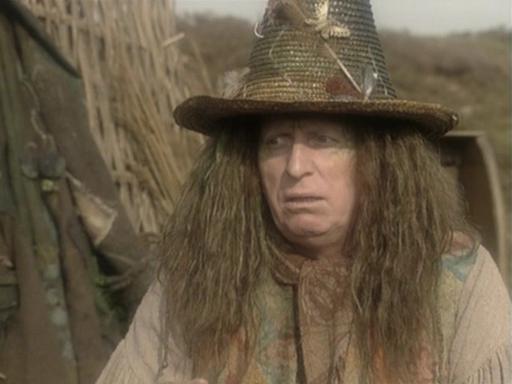
Legendary actor Tom Baker in his role as Puddleglum in the BBC version of ‘The Silver Chair’
We’re just babies making up a game, if you’re right. But four babies playing a game can make a play-world which licks your real world hollow. That’s why I’m going to stand by the play world. I’m on Aslan’s side even if there isn’t any Aslan to lead it. I’m going to live as like a Narnian as I can even if there isn’t any Narnia. So, thanking you kindly for our supper, if these two gentlemen and the young lady are ready, we’re leaving your court at once and setting out in the dark to spend our lives looking for Overland. Not that our lives will be very long, I should think; but that’s a small loss if the world’s as dull a place as you say.” ”
Nothing personal to my online critic, of course, but I’d rather have my ‘Narnia’ than his nowt. 🙂
For someone like my online friend, he’s so well-read that he’s actually in a position of unrealised danger of falling into believing: it could suddenly all come together for him as a blinding light of revelation – ‘Of course!! I see it all so clearly! How could I have been so blind!’ What many unbelievers, and especially atheists, forget or maybe don’t realise is that for many Christians, they have not always been believers. Once, they were just as my online friend – interested and well-read, maybe, but lacking belief. And that belief comes to each believer in a different way, but the point is that people who once did not believe, now do. Something happened to them, something that now makes them say, ‘I once was blind, but now I see’. Something happened to convince even the most cynical that God is real and that He cares for that person. Something happened that enables a religious person, steeped in rules and tradition, to suddenly have a ‘Eureka!’ moment and nothing is ever the same again. Something continues to happen in the spirit of even the most cynical people – people like me – that continueson a daily basis to convince us, usually irrationally, that there is a reality above and beyond this one we see, hear, touch, taste and feel.
So, I will live like a Narnian; like my friend Puddleglum. Because there are things I know, things I have seen, felt, touched and heard, that convinced me – and continue to convince me – of the reality of Jesus, Father God and Holy Spirit. This is real. I’m really not making this up!
For another interesting take on Puddleglum, here’s another article by another blogger. Click the graphic below to go to the article: