One gentleman I have had some great discussions with, both face-to-face and on the Internet, is my friend Martin Fell. Martin lives hundreds of miles away from me (I do sometimes go up to see him in Yorkshire where he lives) and yet we agree on so much that the Spirit is doing in these days. Martin is a passionate man, with a huge love for Jesus and a vast revelation of the Father’s Love for him and for others. It’s no surprise, then, that Martin writes passionately to defend the reputation of God the Father, in the light of how Jesus revealed Him to us. Not that God needs us to ‘stick up for Him’, of course, but most people have not heard the GREAT news of just how good He is. In fact, they have heard quite the opposite from those (the church) who really should know better. Here, Martin writes about how the idea of God being a nasty judge is actually a flawed concept, and in so doing, he reveals the loving nature of the God he knows so well. Over to Martin:
Jesus spent the whole of His ministry telling us and showing us that God was not a judge but a Father, why oh why are you trying to make Him a judge again! As soon as you put salvation and God in judicial terms you miss what Jesus taught and the heart of the gospel.We are children lost in our false beliefs about our Father and ourselves who need showing our true identity and worth. We are NOT criminals who need acquitting!
Jesus was clear ‘the Father judges no one’ that doesn’t mean that God judged in the Old Testament, is taking a break, and will judge again in the future. It’s a stand alone statement. It means God has never judged anyone in the past, doesn’t now, and never will in the future. Lovingly corrects, yes; judges, no; not even once has God judged a person.
That means God didn’t judge mankind with a flood, didn’t judge Israel by letting armies defeat them and exile them, didn’t use Israel to judge other nations, didn’t order genocide, didn’t rain fire down on cities, didn’t send a death angel to kill the firstborn, didn’t drown thousands in the Red Sea, didn’t open up a sink hole, didn’t send snakes to bite people , didn’t kill a guy for touching the Ark of the Covenant. He won’t judge anyone in the future either by sending them or ‘allowing’ them to go to Eternal Conscious Torment in ‘Hell’.
Judges false beliefs and identities yes; judges people never, not once in the whole of human history or in the future. ‘The Father judges no one’, period, full stop.
It really is about time you guys starting believing Jesus. ?
Hehe, I love how he opens his essay by hinting at the tendency of Christians to take the Good News (God actually likes you!) and turn it into bad (…ah but He’s also a stern Judge!) Sadly, that’s what Religion does…
I have deliberately placed this piece directly after the one with Don Francisco’s essay on the modification of belief, because here, once again, is another clear example of how our beliefs about God can be modified, yet without going ‘against’ the Scripture, or at least only going against certain people’s interpretation of Scripture.
Anyway, in closing, let me remind you that the ‘Judgement of God’ that the Bible speaks of is actually a Heavenly judgement of restoration and relationship, not one of wrath and punishment. God is into true Heavenly justice, not a justice that’s a poor reflection of our own, flawed, earthly justice. Martin and I have a good handle on that concept, and it is also deeply rooted in our own personal revelations of who God is to us, and who we are to Him. Can I encourage you to look again at ‘divine judgement’ in that light, and see what a marvellous and reassuring concept it really is 🙂
It’s quite funny, really. I know I said that the previous piece in this series on Spiritual Growth was to be the last one. But I’ve been wrong before 😉
And since examples are an excellent form of teaching aid, I figured, ‘What the heck’ and I have indeed added it to the series as sort of an epilogue.
Probably the most important underlying question I have been tackling repeatedly in my earlier articles is this: ‘What does spiritual growth look like?’ And so, today, I would like to give you an actual visual instance of this from real life. This is a great example of what the reappraisal of one’s personal beliefs actually looks like in practice. This is a very relevant piece, from the legendary Christian musician Don Francisco, and I just had to include it precisely because it is such a good illustration. Here we go:
I’ve had several supernatural revelations in my seventy-plus years. They first showed me, and then re-confirmed, the reality of Jesus/God and His love; they have become the foundations of my life.
Making an all-too-common error, however, I interpreted those undeniable experiences with God according to modern evangelical dogma, having no other context. It didn’t take long for those interpretations to mix with the revelations themselves, and together they hardened into intellectual barriers… I began to confuse defending those composite walls with defending the revelations themselves– which needed no defense. It took years for me to realize this had occurred…
Religious dogma would assert that such a realization is actually a spiritual attack that requires resistance – and the building of a higher, more extensive, and more impenetrable mental wall. Experience is deemed invalid (being identified with “the sinful flesh”), and doctrine is elevated to the place of prime importance.
Recently, I found myself surveying the damage after the wrecking ball of reason had swung full-force into those dogmatic walls. To continue the metaphor: All that I knew experientially of God was now buried under tons of intellectual rubble. (This is a place people find themselves after escaping from religious cults– doubting everything they’ve believed, not just the cults’ lies and half-truths.)
Removing the rubble and reclaiming my violated experiences was the task before me– all the more difficult because I still lacked a context: Evangelical doctrine was the only one I’d ever known for interpreting those revelations, and I needed a fresh perspective. I eventually found one that works for me; I realize it’s sort of cobbled together…
My interpretive wall had been built of the following common evangelical principles. (The list is not exhaustive, but nearly so…)
1) At the Fall in the Garden of Eden, the human race became evil at its core, and every child born since contains and is predisposed to express that evil. All of us were born separated from God by this misdeed of our ancestors.
2) God could not associate with humanity after the Fall because of His holiness and righteous anger toward our sins and sinful nature. His anger had to be satisfied, and our nature needed to be changed.
3) In the evangelical view, the Old Testament [OT] describes how God made a covenant with the nation of Israel via Moses; Israel continually failed to keep their part of the bargain, incurring God’s wrath and judgment. It’s presented as a model of God’s dealings with humanity outside of Jesus…
4) God sent His only, beloved, and perfect Son to become the human known as Jesus on earth so that He could die to pay the debt for our sins and to change our inner nature– if we ask him. When we do, we are included in the New Covenant, living forever in harmony with God.
5) Three days after His crucifixion and death, Jesus rose bodily from the dead, ascending back to God some time later. Pentecost occurred, followed by centuries of arguments about what it means…
6) Everyone who does not believe in Jesus’ deity and resurrection, repenting of their sins and asking Him to be their Lord and Savior, will be consigned by God to an eternal fiery torment.
7) All believers therefore have a duty to convince non-believers of the above, so that they, too, will receive natures acceptable to God and no longer be destined for hell-fire.
8) The Bible is the Word of God, a God-breathed, inerrant and infallible guide to understanding all these things. It is the sole authority in spiritual matters.
I can no longer believe that most of these things are true. Here are my beliefs today; you should work out your own, but feel free to cherry-pick from mine…
1) The Genesis story of the Fall was not intended by its writer(s) as a factual account of the first man and woman. It’s a metaphor meant to describe humanity when we decide that we know how to live without God. We are not born evil, but in the image of God– we’re like him. Some of us choose evil, but most just blunder through life on our own…
2) God never stopped associating with us– because of our ‘sins’ or for any other reason. Jesus, for one, proved it, preferring the company of practically anyone over that of religious leaders. (The Israelites’ idea of an angry god who needed appeasement by blood had been assimilated from neighboring cultures; to their credit, they usually used animal rather than human sacrifices.)
3) The Old Covenant scriptures are a human record of a nation groping after God but ultimately failing to understand Him. Some of the OT writers heard Him better than others, but it’s a mixed bag. Trying to build a theology from the OT won’t work.
4) Jesus did come because of God’s great love for us; he didn’t come to die as payment for our sins. He came to show us what God is really like because we had it all wrong: He’s not angry– He is Love, a love that understands and forgives, even when we murder Him; His love is also independent of our response to it. The Spirit of God is real, has always been present and has never turned from anyone. He would dearly love for you to welcome him into your life; he’s always felt that way… Jesus also came to show us what it looks like to be truly and fully human…
5) I believe Jesus rose bodily from the dead, proving his deity, his love for us, and God’s eternal identification with the human race. When He said, “It is finished” on the cross, He meant it: There is nothing left for us to do but live in the reality of His accomplishment. (The Spirit of God helps us to do that, but the assertion in Acts that he had not yet been “given” makes little sense to me; he is, and always has been omnipresent. Perhaps humanity’s previous lack of comprehension kept him out…) My own initial experience of being filled with him occurred without any “laying on of hands”. What is described as Jesus’ “ascension” was simply a dimensional relocation…
6) For various reasons, the idea of eternal conscious torment for unbelievers has been inserted into Jesus’ teachings and other places in the New Testament [NT]. Assigning anyone to such a place is completely incompatible with Jesus’/God’s character– even the OT writers didn’t threaten people with it… and there really is no such thing as “hell” in the NT.
7) Most of humanity’s hurtful, destructive, and evil actions are motivated by fear. By telling others of God’s love in Jesus– and demonstrating it by how we live– we can introduce them to Him and to reality– a universe governed by love. We can show them that God has always loved them, never condemned them, and not to fear death: It’s not the end, and there is no hell to be avoided by kissing up to an angry god.
8) Idolizing the Bible is foundational to the cult of evangelicalism; human interpretations of a book are thereby elevated to a place of authority above even the audible voice of God Himself. For me, what God says to me in my heart is always held above everything written or spoken by another human.
The Bible exists to lead us to Jesus: He is the Word of God. Hear Him.
This last point (#8), of necessity, affects all the others. If all you know of God is from
books, you are walking in deep darkness…
Here is the link to Don’s original piece on his Facebook page. It might well be worth your looking at some of the comments on there too; there are many people testifying to how the Spirit has been prompting them in the same way. As I’ve said before, I find this fascinating!
There are quite a few pieces planned for my blog in the near future, in which I will be featuring Don’s writings. Keep a good lookout for them! 😀
I know that it can be very hard at Christmas time for people who have suffered bereavement. At this highly traditional, cosy family time which is always known for its joy and ‘good cheer’ (has anyone ever explained what that actually means? 😉 ), the absence of our loved ones is always more poignant.
It’s similar for me, as the 25th of each and every month is always harder for me because my wonderful wife Fiona died on a 25th; the 25th October. That’s why I do a ‘Fiona post’ every 25th or thereabouts.
But what I want to write about today touches not so much on matters of faith, but rather on those of heartlessness and what amounts to spiritual terrorism, especially when directed towards those who do not share a ‘faith’.
Whatever your beliefs, you will have heard religious people – usually Christians, and to a lesser extent Muslims (these are the only two faith groups, apparently, that believe in it) banging on about Hell. About a terrible place where bad people go when they die, to be tormented for ever. Or, indeed, you might even have heard someone say that everyonegoes there, apart, of course, from the people who adhere to the ideas of the group making that claim.
So, I’m going to be talking a little bit about God today, but only in the context of trying to help you past any of these fears you might have, either for you or for your departed loved ones (or both!). If God doesn’t exist, then you don’t need to fear any afterlife of eternal torment in Hell. If God does exist, I would say you also don’t need to fear such an afterlife either, because, I believe, God is good and loving. Bear with me as I explain.
To my dismay, I have even heard of religious preachers at funerals perpetrating their despicable claims about Hell, at grieving relatives, destroying them in the process. Well, I am here to tell you today that, no matter what your beliefs in God, afterlife, whatever, Hell, as depicted by these nasty Religious people, does not exist.
Think back to those preachers I mentioned, who destroy grieving relatives at a funeral by claiming that the person they are mourning has gone to Hell. I can’t even imagine how someone like that can claim to be a follower of Jesus, the one about whom the Bible says that he will not crush those who are grieving; instead, he will gently lift them up. How do I know I am right, and these preachers are wrong? Well, you can tell by the effects – Christians would call it the ‘fruit’ – of what they say. If their words bring grief, destruction and sadness, they are not speaking the words of God. If, on the other hand, their words bring comfort, reassurance, even joy, then this is from God and is therefore true.
There are those who seem to really want to believe everything bad about God that they can. If there’s two Bible verses that contradict each other (and despite the contrary claims of certain religious people, the Bible does indeed contradict itself, regularly, blatantly, and often [1]) then why do they always go with the verse that means the most grief for the greatest number of people? I really don’t know the answer to that. But what I do know is that we need to remember Jesus. If you are afraid that God might not forgive you (for whatever), look at what Jesus did. He forgave people who were actually in the process of driving huge iron spikes through his wrists and his feet. If you are afraid that God is a grumpy old radge just waiting for someone to throw thunderbolts at, then tell me, did you ever hear any stories of Jesus doing anything like that? (Hint: Luke 9:54 where Jesus actually refuses to do just that) If you are afraid of Hell, be aware that Jesus did not speak once about such a place. Jesus actually shows God as a nice guy.
No, Hell is what happens here on earth when people are horrible to each other. Hell is the tragedy of lives wasted; lives lost to alcoholism or other addiction, or to religious fundamentalism, or whatever: anything where people are prevented from living to their full potential. Hell is nasty religious preachers telling people at funerals that, even as they speak, their loved one is burning in some terrible fire and being prodded by devils with pitchforks. That’s hell.
And Jesus came to set us free from that; both from its effects here in this world, and from the fear of its happening in the next. The afterlife – including for your loved ones, dear heart reading this – will be glorious, joyful; full of amazing colours and light and scenery and full also of the presence and love of God. Tell you what, since it’s Christmas Day today, let’s remember what the angels said to the shepherds:
Glory to God in the highest, and on earth peace to men, on whom His favour rests! (Luke 2:14)
It doesn’t mention only certain ‘chosen’ people; it says that there is peace to men (meaning all mankind) on whom His favour rests. This means that actually God likes humans. He’s not mad with us; no, He loves us and in fact likes us! This is a million miles away from the story told by those who would call everyone miserable sinners. Jesus never once did that. He just loved people, and demonstrated practically the claim of the angels; that God’s favour rests on humanity. God likes us!
And so, please be assured. Your loved one is notin a Hell of any kind. They have gone on to be with the One Who loves them – present tense – both in this life and in the next.
Don’t listen to anyone who would have the gall to tell you otherwise!
Be encouraged, dear heart.
[1] For example, the adjacent Bible verses Proverbs 26:4, and Proverbs 26:5. They go like this:
v.4: Do not answer a fool according to his folly, or you yourself will be just like him
v.5: Answer a fool according to his folly, or he will be wise in his own eyes.
So, which is it? Do you answer the fool, or don’t you? That’s a contradiction, plain as day. Oh sure, people will try to explain it away, and as a Bible college graduate, I do understand what it means. But it contradicts, and there’s no getting away from it.
Here’s a really interesting and profound set of ideas from the brilliant Phil Drysdale.
Do you ever stop to ponder the fact that God became a man?
We all know that when Jesus became a man He was still “fully God.”
But that makes me think…
Was Jesus in all places at once?
(No, He had to travel around and was limited to one body.)
Was Jesus all knowing?
(No: “Who touched Me?” “Only My Father knows the day”)
Was Jesus able to do all things?
(No: “He could only do a few miracles because of their unbelief” “Not My will but Yours, Father”)
The simple fact is Jesus gave up some huge things in becoming a man.
Now I’m not saying that God is not everywhere or He’s not all knowing or that He can’t do all things.
What I am saying is that if Jesus was fully God while on Earth then these things are not what make Him God.
Does God know all things? Sure. But apparently it is not required for Him to be God.
In the same way being all powerful and present everywhere are things God is capable of. But they are apparently not required for Him to be God.
It’s a huge thought. (And you are free to disagree as I’m sure many will. )
If Jesus was still fully God then you have to ask what attributes does God truly care about? What are the non-negotiable God-like qualities that He considers makes Him God?
I think we see them in the fruit of the Spirit.
Jesus doesn’t compromise on any of these attributes when He becomes man.
God is love. God is joyful. God is peaceful. God is patient. God is kind. God is good. God is faithful. God is gentle and God is self-control.
Why do we worship God?
Is it because He knows all things? Or because He is good?
Is it because He is all powerful? Or because He is love?
Is it because He everywhere? Or because He is faithful?
Again I’m not saying God doesn’t have these incredible “omni-” qualities. I’m merely saying they are apparently things that He does not consider essential like He does love, joy, goodness, faithfulness etc.
Can you imagine being Jesus and giving up certain God-like qualities so that you could be in human flesh and do all that He did for us. Talk about humility. Talk about love! (This makes us think of Philippians 2 doesn’t it!)
So today when we consider the God who resides in us… sure we will think about him being everywhere and all powerful. But hopefully we will remember that He values something much more than those things.
They are things that we too are fully able to walk in. Love, peace, joy, patience etc.
Perhaps we are made in His image more than we know.
Now that really is excellent. Ponder it; soak in it; build it in to your ways of thinking if it jives with you.
I was always told, as a youngster, that it is wrong (or, at least, bad form) to boast. And of course, as a Christian, it was hammered into me that you MUST be humble, the reason given was purportedly because God gives grace to the humble, but resists the proud (Prov 3:34, Jas 4:6, 1Pet 5:5). But in my view, those who didn’t like people boasting were usually those who didn’t feel like they had anything to boast about themselves and were therefore threatened by it.
Anyhow, I no longer agree. If something is worth telling, boast away!
Don’t get me wrong; no-one likes a braggart; a proud and arrogant person who is so conceited that all he can talk about is himself. That’s not what I’m talking about here.
In fact I would go as far as to say that humility and boasting are actually unrelated. You can have a conceited person (someone who is really full of themselves) who doesn’t boast, and a humble person who does boast.
Here’s a post from an online friend of mine:
“I’m seeing a lot of posts about humility. And to be honest I’m feeling kinda pissed off about them. What is so awful about owning your strengths and talents? What is so unforgivable about going bold or being loud? The worst thing I could be is unteachable. So I’m going to laugh too loud and be too much! I’m going to think I’m pretty ******* amazing because I’ve paid a hell of a price to be here! No more apologizing for who I am or what I can do or what I know. This is me! If that’s conceited I don’t give a ****.”
I replied thus:
“I don’t really think humility is about not being open about our strengths and our gifts. I’m humble, yes, but I’m also brilliant at loads of things, and yes I do mean loads. But I am fully cognizant that it is God has gifted me with all this, and I think that to deny our gifts is to deny how brilliant God is at making us the way we are. Boasting in the Lord (as the Scripture apparently allows!) includes boasting about how God has made us, like David does in Psalm 139. The only people who have any right to feel bad about those who are gifted, are those people who haven’t yet discovered their own gifts. A proper perspective on God being the Giver of all that is Good takes away all jealousy, covetousness and envy of another’s gifts, and instead allows us to rejoice with those who rejoice (Rom 12:15) and also enjoy our own gifts at the same time. That’s why covetousness is so painful: because it blocks us from rejoicing in our own blessings including our gifts.”
As for what humility actually looks like, consider what C. S. Lewis had to say about it in ‘Mere Chistianity’:
“Do not imagine that if you meet a really humble man he will be what most people call ‘humble’ nowadays: he will not be a sort of greasy, smarmy person, who is always telling you that, of course, he is nobody.
“Probably all you will think about him is that he seemed a cheerful, intelligent chap who took a real interest in what you said to him.
“If you do dislike him it will be because you feel a little envious of anyone who seems to enjoy life so easily. He will not be thinking about humility: he will not be thinking about himself at all.”
So, don’t be afraid to tell of the things God has done. Just remember to be sensitive to those who haven’t yet found their own giftings and, if you can at all do so, maybe help them to find such giftings!
Finally, here’s another thought. So many people these days, ‘believers’ and ‘unbelievers’ alike, believe either consciously or subconsciously that God is somehow a mixture of good and evil. He’s not. In God, there is no balance. His mercy is not balanced by His judgement, and His love is not balanced by His ‘holiness’ (as some Christians understand it, as meaning stand-offishness). No, He’s all good, and in Him there is no darkness.
Jeremiah 9:23-24 says this:
“Let not the wise boast of their wisdom or the strong boast of their strength or the rich boast of their riches,
but let the one who boasts boast about this: that they have the understanding to know me, that I am the Lord, who practises steadfast love, justice and righteousness in the earth, for in these I delight,” declares the Lord.
Now that’s something else worth boasting about!
Peace and Grace to you 🙂
Note: Some swear-words have been redacted in this piece for the sole reason that some people (not including myself) find them offensive, and I don’t want to distract such sensitive people from the message I am trying to communicate. Some people have the incredible capacity to become more focused on the swear-words than they do on the point of the article, and that’s why I am leaving the words out. I do not believe in censorship, because I know that most sensible people are perfectly capable of making their own decisions without being told what to think or what not to look at! For more information on this kind of consideration, take a look at this article.
“Are you tired? Worn out? Burned out on religion? Come to me. Get away with me and you’ll recover your life. I’ll show you how to take a real rest. Walk with me and work with me—watch how I do it. Learn the unforced rhythms of grace. I won’t lay anything heavy or ill-fitting on you. Keep company with me and you’ll learn to live freely and lightly.”
The way some Christians live their lives is a far cry from the peace and rest that Jesus talks about. Of course, if they really believe in Hell, then this should really be the consequence of that belief: a frantic, endless struggle to get those people ‘saved’ who would otherwise be candidates for the furnace of Hell.
Here’s a great piece by Jeff Turner, whose work I quote a lot on my blog. In it, he talks about how his struggles in this arena eventually led him to a place of peace and rest like Jesus describes:
I’m halfway to 72 (36).
I was a Pastor for 12 of those 36 years, and have been seriously attempting Christianity for about 23 of those 36 years.
For right around three years, I prayed 8-12 hours a day, and began and failed more forty day fasts than probably anyone else on the planet. I preached hellfire, brimstone, and, due to the strictness of God and extreme lostness of man, a mostly empty heaven. I “prophesied” until my face was covered in perspiration and my neck veins resembled tree roots. For more than a few years, I would toss and turn at night if I had not “preached” to at least one “unbeliever” that day, and would finally succumb to sleep only after being thoroughly exhausted by my guilty conscience. I’ve passed out enough tracts to paper the Great Wall of China, and spent a child’s lifetime awake, “petitioning heaven” at all night prayer vigils.
What I mean to say is, I gave extreme Christianity my best go. Not to sound arrogant, but I would be so bold as to say that I’ve only ever met a handful of people who were as intense as I was, and who actually backed up their intensity with actions.
I failed.
I hit a wall.
I realized that what I was attempting was impossible.
Christianity, that is. None of us can or will ever do it.
And so, more than ten years ago now, I learned that I could not become “like God.” But it was then that it dawned on me that I didn’t need to. God, in Jesus, has become what I am. He has exalted it (what I am) to the highest place, changed the rules of the game, and called the humanity which I was attempting to escape “like Him.” Therefore, when I simply am what I am, I am what he is. Since what I am has been glorified through the incarnation and ascension, to be me is to be like God.
Interestingly enough, once I understood this, all those virtues I tried so hard to attain seemed to appear in my life naturally. The more I knew I did not need to be anyone but myself, the more I naturally rose above some of the not-so-good aspects of my personality.
That’s just the way it works.
Call it Grace, or call it Frank for all I care. It works. When you realize you suck at Christianity, and stop trying to be a Christian, the more the nature of the Christ you adore will be diffused through your life.
In short:
We suck at this. So stop trying, and you’ll succeed.
A few weeks ago I went up to a sort of seminar thingy at a friend’s church in Wakefield, West Yorkshire. At the seminar, we were privileged to have Phil Drysdale as the guest speaker/facilitator for a whole day of discussion about the new things God is doing in these days.
Something I heard repeatedly in that session was this: “Once you have seen this, you can’t unsee it”. And that has been true for me these last few years.
The life-changing revelation that actually God is not mega-pissed with you as some people would like you to believe, but, in fact, that He loves you – and indeed likes you! – more than you know, and just as you are. He’s not looking for you to change before He will come and walk by your side.
He doesn’t stand far away from you because of how bad you might feel about yourself, maybe because of what others have told you. He’s not a right radgy miserable old grump up in the clouds clutching a handful of thunderbolts; no, in fact He is just like Jesus. For in Jesus Christ, everything about God lives in a human body, and in Him we too have been given everything we ever needed (Col 2:9-10). This is the completely one-sided, unfair, unearned, shocking, life-changing truth of the Gospel – which really is Good News. All of it.
Here’s the truth: if the god that people have told you about does not look just like Jesus, then it’s not the true God they have told you about. Period.
Today I am going to let you into the Church’s big secret on tithing.
I’m going to share with you a Scripture that you will never hear preached on from any pulpit you can think of.
But first, a bit of background.
Like quite a few other doctrines*, the doctrine of ‘Tithing’ is a contentious one. It refers to the practice of giving to the Church, or whatever religious organisation a person is part of, a certain proportion of (or sometimes a set amount of) one’s income. Usually, this proportion is one tenth of one’s income.
It’s not only contentious within a group; it’s usually contentious outside the group as well, in that one of the big turn-offs for non-churchgoers is the idea that giving money to some random (and usually non-accountable) organisation is not something that sane people would do. They just can’t believe that anyone would want to do that, and they want no part of it. And I don’t blame them. I can still remember one time before I became a Christian, hearing that the Jehovah’s Witnesses** give a tenth of their income to their Organisation. My response was something like, “They do what??!!” And that sentiment is shared by many, both inside and outside the church.
Of course, there are many varied practices involved in this giving model, in fact probably about as many as there are churches. I have shared before on this subject, and it is probably worth reading at least this article before you read this present article, for a bit of background, and my lead-in for this other article for more. However the later part of that last article does go into some pretty heavy Biblical study and is probably best left alone for the time being.
Suffice it to say that many Christian denominations and organisations have of course abused the ideas around tithing and made it a legalistic practice instead of a Grace-filled one. Drawing on predictable bullying, carrot-and-stick, and straightforward prosperity-doctrine tactics, they have set up a whole mythology around tithing, usually promising good returns on one’s tithe by emphasising certain Scriptures and, of course, ripping them brutally out of their proper context to serve their own ends, and ignoring completely Jesus’s teaching on giving being a secret practice between God and Man, and not done for the approval of humans (Mt 6:1-3). I won’t even begin to go in to the convoluted arguments and justifications that money-grabbing religious organisations use to extort money and other things from their people. It’s sickening, though.
You have probably gathered by now what I think about this 😉
But let’s look at the two main Scriptures abused used by some Christian groups to ‘encourage’ (a euphemism, folks!) people to give the whole tithe (meaning the whole ten per cent, although I have never once heard a church moan about anyone giving more).
The first is, naturally, an Old Testament (OT) text; the OT of course being the number-one destination for preachers wanting to find a choice verse to introduce yet another Rule to weigh down their people with. You want Rules? Begin with the OT. This is simply because few people know much about the OT, its background, and the cultural references in there, and in any case it all sounds (and reads) very stern and forbidding, and the god of the OT is a right misery who is pretty pissed at most people for most of the time anyway.
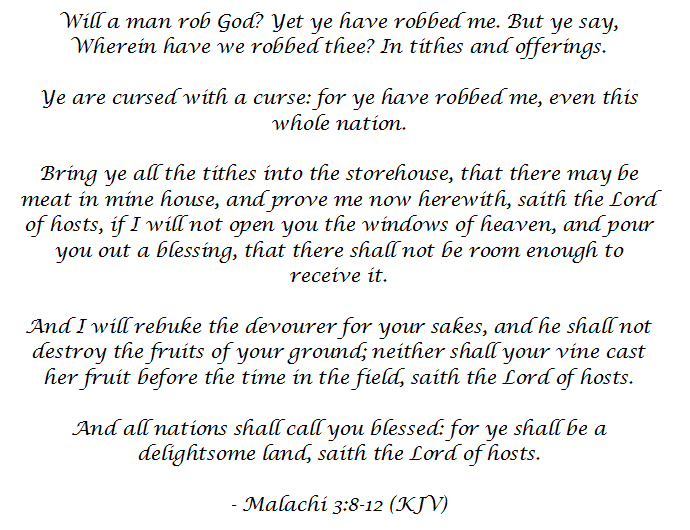
Here’s the main verse used in this way. I’ll leave it in the KJV language to make it sound more authoritative and threatening. Ladies and gentlemen, I present to you the number one tithing text: Malachi 3 verses 8-12!
(Mal 3:8-12 (KJV))
There is so much wrong with using this Scripture in the typical combination manner it is usually used: the carrot-and-stick approach to tithing – the carrot being the ‘promise’ of blessings, and the stick being the promise of a ‘curse’. I’m afraid I’m not going to give an exegesis of this passage right now, because I’m trying to get to my point!
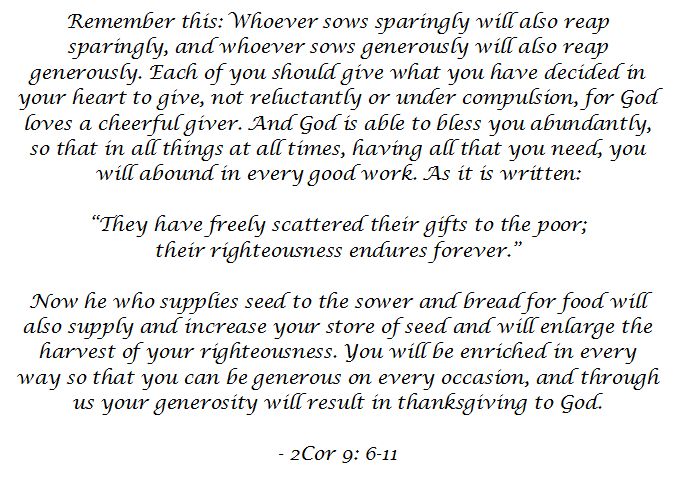
The second Scripture normally thrown at believers about tithing is in 2Cor 9:6-15, of which I will present just verses 6-11.
Note how the latter part of the preceding verse, verse 5, (2Cor 9:5) is always missed out (so they begin the reading at verse 6), verse 5 being the bit about not giving grudgingly (and this omission is excused because in the most popular translation, the NIV (New International Version) it comes before the ‘heading’ (inserted by the translators) of ‘Generosity Encouraged’).
When hearing this Scripture read out in public, you will also hear verse 7 (about ‘reluctantly or under compulsion’) being skipped over without emphasis, maybe even read in a quieter voice, or maybe faster so you don’t hear it. Or a combination of these tricks. (Yes, these deceptive practices do indeed go on! And it makes outsiders sick and repelled by the whole business). And this is how the context of this verse is destroyed. But again it’s the carrot approach – although this time no stick – but even then some people would in fact take the ‘grudgingly/reluctantly/compulsion’ bit and make it condemnatory: that it is the giver’s fault that they feel like that. But I have ranted enough. And you can believe that you will never, ever, hear or read me preaching on the subject of giving in this manner.
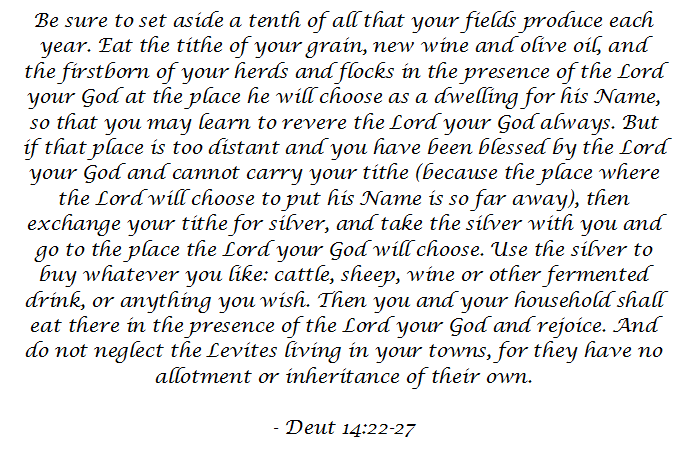
Now at last I want to share with you the Scripture you will never hear read publicly, at least not from someone who is after your money. Nor will you hear anyone preaching a sermon from it.
This is why I have called this post ‘The Sermon You Will Never Hear’.
I’m not going to do any exposition on the passage; I will let you and Holy Spirit together form your own conclusions and applications for it. My purpose here is just to blow the secret wide open! 😀
It’s Deuteronomy 14, verses 22-27:
(Deut 14:22-27)
What do you make of that, then? 😉
Unsurprisingly, I have never ONCE heard anyone preach on that passage (not even the final sentence, because that would mean revealing the existence of the entire passage!), which I discovered more than two decades ago – when I was still a legalistic Christian! And a wise elder a couple of years later told me, somewhat tongue-in-cheek, that he was sure I never would hear such preaching, either! And remember that many, many Christians do not read their Bibles (especially the Old Testament, of which this passage is a part); they only read the parts that their leaders tell them to, so how would they ever discover this for themselves?
But I had indeed discovered it, the cat was out of the bag, so to speak, and I decided to apply the Deut 14 teaching in my own life. This was my first step towards freedom from the onerous doctrine of tithing, and also my first step out from under legalism itself. That it also coincided with a complete loss of confidence in church leadership was simply the icing on the cake. Nobody ever told us that, despite our being a young couple living on the breadline, maybe we didn’t have to give as much as everyone else.
This kind of thing can only go on for so long. Twenty-five years ago, our ‘stewardship’ shifted from trusting others with God’s money, to deciding for ourselves where we wanted to place the money. We stopped ‘tithing’, and started setting aside money ‘for God’s Work’. Bottom line: I didn’t trust my church leadership to manage my giving for me. And I have never looked back. Good stewardship, then, means cutting out the middle man. And it also means being generous!
That’s not to say we didn’t continue to give; of course we did. It’s also not to say that I don’t give nowadays; I do. Naturally I’m not going to go into details except to say that my giving nowadays is done in the way it was always supposed to be done, as described in that 2Cor9 passage. It’s done liberally (that is, with total freedom); cheerfully; it’s done to bless others; it’s honouring to God; it’s done secretly (which I have always done; the idea of having to declare to the church how much we were giving ‘for budgeting purposes’ has always rankled with me!) and it’s done with great joy and motivated by the desire to bless people with the abundance God has given me, and continues to give me. And it’s not just in terms of money either. Work it out for yourself; I don’t want to be a model for anyone else’s giving, except in my attitudes.
And so I am sharing this secret with you today! The cat really is out of the bag, so to speak; ask your leadership about it and don’t let them wriggle off the hook until they have given you a satisfactory response!
Who knows; you may be the first person ever to preach on that Scripture!
Don’t get me wrong: it is far from my intention to use the Bible to set up any Rules for or against tithing or giving. I am neither a Biblical literalist nor a Biblical lawyer; I do not tell people what to do based on a document composed of books some of which are 4,000 years old. I don’t tell people what to do at all, in fact! Especially using Deuteronomy. As always in my blog, though, I am using the Bible as a tool to show that even where there are people who take the Bible literally and consider it inerrant, still there are passages that they use inconsistently and legalistically, and in some cases (like this one) they ignore them altogether.
Giving from a position of freedom is simply so liberating, I cannot imagine it ever being intended to be done in any other way.
Rejoice and be blessed, for the freedom of God’s children (Rom 8:21) is yours to use as you will. Never let anyone take it away from you!
*A ‘doctrine’ is a particular position or idea held to be true (and usually ‘essential belief’) by a religious – or in fact any, not just religious – group. And it’s usually restrictive rather than liberating!
**Not that I am singling out the JWs for special ‘naming and shaming’; just that they were the first organisation I had heard of that practised tithing 🙂
‘Deconstruction’ is quite simply the shedding or ‘deconstruction’ of old belief systems and modifying or replacing them with something new. In many ways, the process of spiritual growth could be seen as a continuous deconstruction and reconstruction process as our beliefs change over the years.
But here’s an interesting thought. The people we refer to as the ‘early Church’ – the people in the book of Acts in the Bible, for example – were also essentially deconstructionists. They looked at their old ‘religion’ (if indeed they had one; just like people today, some probably didn’t) and they reinterpreted their beliefs, their viewpoints, and their Scriptures, in the light of the Risen Christ that they knew personally.
Today’s deconstructionsists are not all that different. We are reinterpreting the Scriptures and our beliefs in the light of what that same Risen Christ is telling us now, and not just to us individually, but to other believers like us, all across the world, and we are being told the same things.
This is nothing short of remarkable. And yet, given that we serve the same Jesus, it is also unsurprising.
Over the last few months, I have been writing my series of posts on the Stages of Spiritual Growth, and we have come a long way on our journey of discovery in this fascinating subject. We’ve read about what it can be like in all the different stages, their characteristics, their advantages and disadvantages, the transitions and the hurdles on the path. We’ve heard about the frustrations, the joys and the challenges, while all the while acknowledging that these are but stages in a journey; a path and indeed a lifetime of discovery of the wonders of God.
It’s been quite a ride.
So here, then, I present a final essay in which I will make some concluding comments about how we can apply our new knowledge.
And I’m sorry it has taken so long to get this piece to publication – but I have had to put a lot of thought into it. Some of it’s recap; some of it is comment and application.
Perspective
When talking about the Stages of Faith/Stages of Spiritual Growth, I think it’s very important to remember two related points.
Firstly, the ‘Stages’ concept is only a model (shh!) [1] and it does not necessarily apply to everyone. Not everyone goes through the Stages in the same way, and some do not go through them at all, in the strictest sense.
Secondly, we must be careful not to try to place others on some sort of ‘progress scale’ that in fact they may not even be on. For example, ‘She’s going through Stage 4’, or ‘That’s typical Stage 3 behaviour’. Having said that, we may well recognise for ourselves our own place in the growth Stages, but that’s fine because that’s about ourselves, not others. Anyway, the take-home message is that the Stages are not intended to be used for labelling people; this is something I am quite averse to anyway, because to my mind, labels introduce limitations and increase preconceptions and judgmentalism. The Stages of Faith are not intended to be yet another set of criteria for Christians to use to judge others. So let’s not go there, ok?
Equally, though, there needs to be a consciousness, especially in Church leadership, that some people do indeed go through these Stages, and virtually all Christians must and will grow in their faith as part of their Christian walk, even if it is not via recognisable Stages. As we have already seen, what this will look like is going to be different for each individual, but the main manifestation of such growth is going to be change. You can’t have growth without change, because growth is by definition a change from one state to another.
A Safe Place
Having studied this subject in considerable depth, I have come to the place where I believe that not everyone is called to change in the way that movement through the Stages would suggest. For most people, just getting on with their normal Church life is all that God requires. Here’s an excerpt from a blog by my friend Peter, whose article I will link to in my references at the end of this piece:
“I am very conscious of the need to recognise that only some committed Christians are being called outside the walls of traditional Christianity at this time. The journey is often referred to as a time of detox or a wilderness experience […] Many people have attempted to describe how faith changes, matures and develops through life. Fowler uses ‘Stages of Faith’ (that tends to suggest a logical hierarchical approach), others have referred to styles or zones of faith (less rigid and allowing for overlap).
“For many people their experience of faith changes with adulthood – sometimes radically and unalterably transformed as they move into new ‘phases’ of faith.
“The great majority who attend church regularly could probably be described as in a ‘conformist stage’ where they are acutely tuned to the expectations and judgments of significant others and where there is the security of being part of a like-minded community. I see this as a valid position for many church-going Christians that should not be disturbed.
“Many are committed workers with strong loyalty to their church community, often with deep but unexamined convictions. They often focus on relationships with God and the important people in their lives – a strong sense of the church as an extended family – there to support each other.
Because of this, they tend to find conflict and controversy threatening to them. They tend to see opposites such as good and bad; sacred and secular; Christian and non-Christian; saved and unsaved. They don’t have an independent perspective.
“(This seems to be a reasonable starting point although it is certainly open to discussion – perhaps it is particularly true of some Evangelical, Pentecostal and Charismatic churches).
“Problems are thought to arise when some (possibly prompted by the Holy Spirit) become dissatisfied or disillusioned. Because of the ‘walled in’ secure feeling, it often takes a major upset for any transition beyond this stage to take place.
[…]
“The nature of pastoral care needs change over time – the need to understand the differing perspectives – we can all be vulnerable at times – the need for patience! There seems to be a need for Safe Havens – especially for older people?. A need for ministry at many levels – beware of the risk of concentrating only on those in the earlier stages.” [2]
And this is fine. It really does take all sorts, you know.
Stifling Growth
Problems, however, can arise – with both self, others and ‘leadership’ – when the person moving through the Stages is part of a congregation where they have what I might call ‘over-accountability’, or overbearing leadership structures similar to that found in what was formerly called the ‘heavy shepherding’ movement.
People in congregations which practise such accountability are usually highly ‘conformist’ and, as such, they seem to think that what they have is the ‘ultimate’ faith beyond which there is nothing better, and they would find it extremely hard to move out of that Stage and would possibly stagnate, barring a move of the Holy Spirit in their lives. I know this because I was once like that. For such congregations, the problem seems to be that they think there’s nothing else beyond what they have and so it’s harder for them to accept the growth of others – especially members of their group, but also including outsiders too – into faith regions beyond what they have themselves experienced. They feel secure in their knowledge and they usually feel threatened (either consciously or unconsciously) by people being ‘different’, even (and especially) if it’s one of their own number that has changed/is changing. Invariably, this results in people, who are moving onwards in their faith walk, in a way that the group ‘don’t like’, being labelled as ‘backsliders’, ‘heretics’ or other derogatory terms including the questioning of their salvation. This is so common it gets boring to see. And yet it’s understandable; there is a very real, though usually unacknowledged, fear in some congregants’ minds where they fear departing from the ‘norm’ in case they ‘get their theology wrong’ or ‘get their doctrines wrong’, which is tantamount to ‘getting God wrong’ and then (oh guess what) hi-ho, hi-ho, it’s off to Hell you go 😉 Needless to say, this kind of background stifles growth almost completely. [3]
In fact, the idea of spiritual growth means that we have to assume that we haven’t got it all right, something that Fundamentalists find difficult. Paradoxically, then, those who firmly believe that their doctrines are set in stone, and believe that with all their heart, are in fact those who will find it more difficult to grow spiritually. In fact, hard-set and firmly held beliefs actually make spiritual growth virtually impossible. We need honesty and repentance to grow out of that mindset.
Maybe that’s what Jesus meant when He spoke to the ‘Rich Young Ruler’ (Mt 19:16-22; Mk 10:17-27; Lk 18:18-23), or that the sick need the doctor, not the healthy (Mt 9:12; Mk 2:17; Lk 5:31). Those who believe they do not need Jesus’s help to change – because they don’t see the need to change – also end up missing out on His company; the Bible is full of examples of God saying that He draws near to those who are less than perfect. God humbles the proud, but lifts up the humble (James 4:6). Maybe that’s what that means.
But, at the same time, I do not believe it is possible to ‘decide’ to move on in our spiritual growth. Everyone grows differently in their faith, and much of the impetus for growth actually springs naturally from our simple everyday walk with Jesus. He leads us where He wants us to go. Maybe the best we can ‘do’, for want of a better term, is to decide in advance that we will co-operate with what the Spirit says to us, even if that appears to contradict our current belief systems – which is in fact what we should expect to some extent, since growth and change mean that things will be different, and that invariably involves belief changes. That, and the confidence in God that allows us to function without fear in the growth environment. There is a lot of depth to Jesus’s words in John 16:12, where He said, “I have so much more to tell you, but you are unable to bear it right now”. Meditate on that for a while…
The Old ‘Me’
One of the problems I have found with looking back on my former Stages is that I do feel some animosity towards (a) the person I was back then, and (b) the fact that there are other, equally obstinate, people still in those Stages who are just as dogmatic and unbending as I was then. It’s not so bad when they keep to themselves, but sometimes it seems they just can’t. But equally, I do not now consider myself to have reached any kind of stage of perfection or anything like that; I have simply grown. And so the temptation to judge my old self, or those like my old self, must be avoided because there is no ‘supremacy’ involved, nor should there be. In a way, we need to keep the good stuff from previous stages while discarding, or at least holding at a distance, the rest. And you can’t fully understand the next stage until you are actually in it, and even then it’s a learning curve.
Remember Love
To summarise this latter set of ideas, remember Love. Under the umbrella of God’s Love for us, and our love for each other as believers, let’s just love one another, and not criticise or judge. Sometimes we need to recognise where our temptation to criticism is coming from; usually it’s a fear of something ‘different’ that threatens our comfortable, secure mindset. I understand that, believe me. As an Autistic person, it’s actually worse for me to cope with than it can be for others. But, as part of loving one another, and as part of encouraging one another’s growth, it’s necessary for us to move outside of that self-protection instinct, and at the very least to not criticise others just because of our own insecurities. If we are threatened by someone else’s growth, maybe we should look at what the root of our own security is, and how that is being threatened by what someone else is doing or even thinking.
The Surprise of the Supernatural
Another point is that the person who interprets the Bible in the Literalist, Inerrantist manner (that is, they take the Bible word-for-word literally, and affirm that it is without error [4]) often has no room for imagination, no belief that the stories they read in their infallible and inerrant Bible could ever be true, or happen for real, for them in their existence here and now. This, possibly unconscious, position of seeing the supernatural as irrelevant is held despite a dogged insistence that the stories of supernatural occurrences, that the Bible is so full of, are in fact true, and actually did happen. In a lot of ways, this is the ironic tragedy of absolute Biblical dependency, in that anything that is not ‘in the Book’ is not valid, or worse, is ‘evil’ or ‘of the devil’. Because of this attitude, it’s as if these people are locked in a dark box which takes (usually) a supernatural breakthrough by the Holy Spirit to enlighten their hearts. That will probably come as quite a surprise!
Despite this, keeping – and in some cases treasuring – the ‘good stuff’ from previous stages is important. For example, the unlearned and automatic and complete trust of the small infant in Stage 0 is exactly the kind of trust exhibited by those in Stage 5/6; in fact, the earlier trust is in many ways more pure, and could therefore be learned from and emulated as being ‘better’ than that in later Stages. Another such example could be that the person learned very many Scriptures before their ‘wilderness experience’ (Fowler’s Stage 4) and they find that those Scriptures are still present, in their mental library, even after decades or more of deconstruction. That was certainly my experience, and I am so glad that it is the case. In this way, the ‘good parts’ of the ‘legacy’ of the previous Stages can be preserved and used by the believer in later Stages.
Learning and Growing
And it’s broader than that. Our whole lives of learning – about life itself, not just about faith issues – are always founded on lessons learned, habits picked up, attitudes assumed, and just life experience in general. We do not see our past experiences as being useless despite their sometimes being obsolete; instead, we see them as necessary stones on the path towards maturity, that can be re-used or discarded later in life as required, or not. And the walk of faith is no different. We should expect that some of our ideas, doctrines, dogmas and concepts will become less important over time, and eventually we outgrow them as we learn new things. And there are also things that will always stay with us and be useful.
My personal view is that the Stage to be at is the one you are in at the moment. I think that ‘movement’ from one Stage to another is something that we don’t decide for ourselves, it just kind of happens – maybe being led by God as He reveals new things to the believer.
I also think it’s easier to look back on ‘earlier’ Stages and accept what we thought back then as foundational to who we are now, even though we may have been ‘mistaken’ in some of our beliefs in those earlier Stages, or at least we have moved on from those positions.
The converse, sadly, is not normally true: people at ‘later’ Stages are often seen by those in ‘earlier’ Stages as being ‘backsliders’ because they appear to have ‘drifted’ outside the cultural norm of their faith community. It is also sad that this means they are often seen as ‘heretics’ and are ostracised, where in fact they are actually more mature and have so much to give to their faith communities in terms of edification and growth. The mistrustful attitudes exhibited by those ‘stuck’ in, say Stage 3 (the most common one where its incumbents accuse others of ‘backsliding’) are only depriving them of their own ability to move ‘forward’. In a very real way, they are being ‘left behind’ (oh the irony!). Key to all this is to think what personal spiritual growth could look like; what does it look like if we are ‘changed from one degree of glory to another’? True growth never involves remaining exactly as we are.
The Wisdom Bit
Let’s finish the present discussion on this concept with some wise words on this subject from a couple of friends of mine. Firstly, Jeff Turner:
“One does not despise or loathe their childhood, unless of course it was one of abuse. Rather we look upon it with great fondness and nostalgia. In the case of abuse, it is more than understandable to look upon it with loathing and hatred, but for the one whose childhood was relatively happy, it would be disrespectful, to both the biological process of growth, as well as to our caregivers, to look back and complain how binding it was, and how liberating it is now that we’ve woken up to the wonders of adulthood. If one were to become an evangelistic adult, and went about trying to convert children to adulthood, we would say they’ve lost touch with reality, and were guilty of robbing children of something extremely important and vital.
“In the same way, looking back at your spiritual life and loathing a certain stage of development, is a foolish and unproductive exercise. Blasting one’s past self for not being as enlightened, awakened or rational as one’s present self is, as Alan Watts put it, akin to a bird hating the egg from which it hatched. It’s irrational. Were it not for the egg, you wouldn’t be where you are. Certainly don’t glue it back together and crawl back inside of it, but don’t, at the same time, think of it in terms of disgust. And certainly don’t start an anti-egg campaign, lest you rob the world of birds altogether!
“You aren’t better now, you’re just older and more experienced.
“Some people grow up in secular environments and become religious. Some grow up in religious environments and become secular. Both think that the other is the unenlightened one, and that they are freer and more liberated than them. Both see the reflection of their past self in the other’s present position, and think of it as infantile and constricting. But the one whose position they view this way views the other’s position as something childish that they’ve moved past.
“We are all on a journey, and I’ve a belief about where this journey ultimately ends for all of us. However, in the meanwhile, don’t think of your spiritual and philosophical “childhood” as something worthy of mockery and derision, but rather as that which brought you to where you are. Without them, you wouldn’t be you. And future you ought to remember this when looking back at the very confident, present you as well. You may feel more liberated now that you’ve left behind a certain belief, but someone else feels just as liberated for having left behind the beliefs you presently are revelling in. People are not slaves simply because they think in ways you no longer think, and vice versa. We are all going somewhere, and since none of us begin at the same place, we will not progress at the same pace.
“May we all learn to love the former versions of ourselves, and the reflections of them that we see in both our neighbor and ‘enemy’ .”
And more from Chris Martin:
“None of us have it all figured out. We can learn so much from each other. But only if we understand we are all at different stops along our journey. Doctrines, theology, beliefs…we’re all brought up believing certain things about God and who He is. We have a number of different influences, whether it’s parents, culture, environment, pastors, teachers, etc.
“Something I’ve learned over the last couple years, and some days still learning, is to be patient with others. Not to assume. To walk in grace and understand we don’t have to agree on everything in order to press on together.
“Fighting and arguing isn’t doing anyone any good at all. Let’s be peacemakers”.
“Everyone is at a different point on their spiritual walk, and it is folly to reject that upon which our current faith structure is built. I think for me personally, the problems come when non-understanding people, who are where I was twenty years ago, talk to me as if I know bugger-all about my faith, like I have just woken up one morning and decided to become an heretic after like 38 years of faith. That’s what grates on me. My problem is to not despise the person I was back then, and, by extension, the reflection of that person I see in others who are still in that place.” – Me
“We must be extremely careful not to come off as arrogant when we discover truth others may not yet see. We are all on a journey of discovering who we are, who Papa is, and how we can all walk together in unity. Let’s not preach grace and condemn those who haven’t reached the place where we now stand. Let’s not speak of love while bashing others for their lack of love.
“Most importantly, let’s not act as if we are the only ones who have learned truth. Let’s not act as if we are the only ones receiving revelations from the Father.
“Let’s walk in grace, mercy, compassion and love.” – Chris Martin
Recognise and Remember:
Recognise that your past was important and do not despise those who are still at those stages. Bear with those people in love (Eph 4:2, Col 3:13)
Recognise that spiritual growth involves change, and you might not like what some people’s change looks like.
Remember to respect others’ individual journeys and keep each other safe (note: this does not involve criticising ‘in love’ what their beliefs are becoming like)
Remember that God is still in control and it is Jesus Who will build His Church (Mt 16:18)
Concluding Wisdom
“Once you say ‘higher level’ (regarding one’s level of spirituality), you appeal to the ego, and all the wrong instincts in people.” -Fr. Richard Rohr
“When you begin to refer to where you’re at on your journey as a “deeper place,” “higher level,” “another dimension,” or some other such thing, you create a space where pride, arrogance, and superiority can thrive in the name or spirituality. No, we’re journeying, and on this journey, mountains are laid low, and valleys exalted. Every place is an equal place for the sincere, it’s just that we are never all in the same place at the same time, and tend to assume wherever we’re at is the place to be.
“The place to be is wherever you are”.
– Jeff Turner
I hope this essay rounds off the series satisfactorily. If you have any comments or points to add, please feel free to comment on this or any other post in this series, as you need.
Thanks for following this subject, and I trust you have grown from reading about it 🙂
Peace and Grace to you.
References and Notes:
[1] From ‘Monty Python and the Holy Grail’ – ‘Camelot!’ ‘Camelot!’ ‘Camelot!’ ‘It’s only a model!’ ‘Sssh!’
[2] Stages of Faith – an article on the blog Outside the Goldfish Bowl – https://outsidethegoldfishbowl.wordpress.com/stages-of-faith/
[3] If you personally feel that you are growing beyond such a Church structure, the decision as to whether to follow your own conscience, or instead follow someone else’s conscience, is yours, and yours alone, to make.
[4] Literalism and Inerrancy are all very well until one realises that different translations of the Bible very often contain different wording of the same passages (so, how can one take it literally?) and sometimes portray different meanings in one translation, from the meanings in other translations, of the same passage. So how can it be inerrant? Some people take the simple step of assuming that ‘their’ translation is the only‘correct’ one; usually that would be the King James Version (KJV), which, ironically, is actually one of the more inaccurate translations 😉

 One gentleman I have had some great discussions with, both face-to-face and on the Internet, is my friend Martin Fell. Martin lives hundreds of miles away from me (I do sometimes go up to see him in Yorkshire where he lives) and yet we agree on so much that the Spirit is doing in these days. Martin is a passionate man, with a huge love for Jesus and a vast revelation of the Father’s Love for him and for others. It’s no surprise, then, that Martin writes passionately to defend the reputation of God the Father, in the light of how Jesus revealed Him to us. Not that God needs us to ‘stick up for Him’, of course, but most people have not heard the GREAT news of just how good He is. In fact, they have heard quite the opposite from those (the church) who really should know better. Here, Martin writes about how the idea of God being a nasty judge is actually a flawed concept, and in so doing, he reveals the loving nature of the God he knows so well. Over to Martin: