Here’s a superlative piece by Michael McElyea. I need add nothing:
Romans 6:23 begins by saying that “the wages of sin is death”…..and finishes by countering that with “but the free gift of God is eternal life in Christ Jesus”
I’ve heard that first part of the verse thrown AT people so many times as a threat; COMPLETELY void of its context, which is saying something incredibly liberating and empowering and truly good news.
As a matter of fact, if you read Romans chapter 5 and 6…FULLY and paying attention to what Paul is saying; you’ll find there’s ZERO mention of our choice or decision. Why?…because the context is the complete works of Christ which affect and will affect every person who’s ever lived.
We hear thrown at us….the wages of sin is death but Gods free gift is eternal life in Jesus, so invite Jesus into your heart (he’s actually already there) and make him the Lord of your life….or you will go to hell, to eternal conscious torment and torture in flames
IT DOES NOT SAY THAT AT ALL IN CONTEXT….CONTEXT IS KEY
What if “the wages of sin is death” is announcing the inherent consequences to our actions and what they will produce in this life as opposed to saying if we sin we deserve to die? (Remember it says death; not everlasting life being tortured in fire, it says DEATH)
I challenge you all to read Romans 5 and 6. Read what Paul is actually saying. See how he contrasts universal humanity “in Adam” with universal humanity “in Christ” as a result of the complete work of Jesus on behalf of allof humanity
What if there isn’t a judicial system in family?….Let me ask that again
What if….there isn’t a judicial system….in FAMILY
What if his name really is Abba…and He is a Father and Physician…. and not a Judge and we not his subjects and servants…but we (humanity) are his children….sons and daughters of the living God. Sons and daughters of heaven and eternity and glory.
What if the atonement (what happened at the cross) was totally void of violence from the Father altogether? What if it really was a victory over the Satan, sin and death, and an unveiling of His heart; as well as Him healing us of the delusions we’ve created and have also been deceived by….all of which manifested death in our lives and in the earth. Which was NOT on earth as it is in heaven….. and Jesus came to reverse the trajectory in order to bring on earth as it is in heaven.
What if we’ve been looking at this completely through the wrong lens.
The wages of sin is death but the free gift of God (for all of humanity) is eternal life in Christ….that is a conclusive statement.
– a buffet meal of various hot and cold hors d’oeuvres, salads, casserole dishes, meats, cheeses, etc.
– an extensive array or variety
“[When exhorted to] “read scripture as though my life depends on it”, [let me say that] my life does not depend on scripture … Scripture didn’t create me, die for me, redeem or restore me, Scripture doesn’t love me, or work all things for my good. Jesus, on a cross, reconciling and restoring all creation, not counting our sins against us, is my salvation, my friend, my redemption and lover of my soul.
– Jason Clark
“I got to the point of realizing that the divine plan is for us to eventually want goodness as if NO supreme being/force exists simultaneously knowing that they do. Otherwise, we are coerced and insincere as a result”
– Mike Liao
“…because purpose became more holistic than adding people to the total number of Christians…”
– Tom Boulton
It’s okay to ask questions. The only dumb question is the one you don’t ask.
– Diana
A fool will continue to validate why they are thought a fool to begin with, yet never understand themselves why they are thought of thus.
– Anon
Don’t search Scriptures to find life in Jesus.
Instead, search Jesus to find life in Scriptures.
– Anon
But yes, she is entitled to her opinion, just as I am entitled to reject it, using the same rights she has to assert it, and round and round we go 😉 The minute I take away someone else’s right to hold an opinion, I take away my own right to hold a different opinion.
– Me
ALL Religions come from a presupposition that God doesn’t like you
– Rex Gaskey
Sin doesn’t really exist; The only way sin exists is when you look at the world through the lens of good and evil
– Jamal Jivanjee
Prayer is simply a way to bring one’s being into an awareness of the presence of a God it is never separated from. Pray or don’t pray. Your proximity to God will not change one iota, but your perception of said proximity will.
– Jeff Turner
If Grace means that God is for me, regardless of my faults, then it also means that He is for the other guy too, regardless of his faults. It can be no other way
– Me
The God in Exodus was a reflection of Moses. Nothing more and nothing less.
– Richard Maggio
Revenge is a confession of fear
– Jedi proverb
Next time you’re inclined to label someone a certain way and sum up their substance or lack of it based on a tiny snapshot of their life, stop yourself and remember you haven’t a clue where that person has been before you and they came into contact
– Anon
My last two articles have been about ideas on keeping our good deeds between ourselves and God; not having to be accountable to others about our good deeds or our motivations; about the judgmentalism of others; and about the depth of the true motivations behind our actions.
Rarely, though, in these times of online presence and social media, do we really have to pay the penalty for our silence and our refusal to be judged by others. Usually, we can simply hit the ‘Block’ button, and that’s the end of it. But in times past, in fact even up until very recent times, it wasn’t like that, because most interactions were face-to-face and so there was often no escape.
Today, I would like to give what is for me a deeply moving real-life example of a person who modestly chose to conceal his true self, his personal convictions and his motivations from his critics. He did this at the expense of being unjustly labelled as a coward in what was, at the time, the most humiliating way possible. And this despite his being one of the bravest men I have ever read about.
His name was Arnold Ridley.
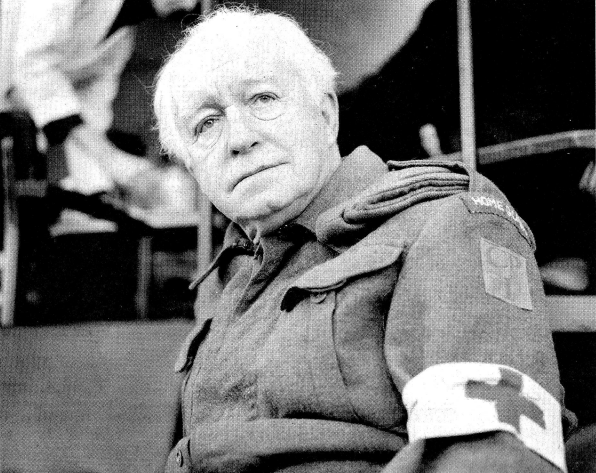
Many of my readers (especially ones of my age or older!) will remember the legendary 1960s/70s wartime sitcom ‘Dad’s Army’. And so you’ll also remember Arnold as the actor who played the lovable old duffer ‘Private Godfrey’. Yep, that’s the same Arnold Ridley.
Arnold Ridley as Pvt. Charles Godfrey
In one episode of Dad’s Army, ‘Branded‘, Godfrey declares that he wishes to resign from the Home Guard platoon because he realises that he could never bring himself to kill another person. He also reveals that he had been a Conscientious Objector (that is, someone who refused to fight for reasons of conscience) during the First World War, and because of this he is ostracised by some of the other members of the platoon. This is because Conscientious Objectors were thought to be ‘cowards’ by the rest of society, and so the platoon treat him as one; he is therefore effectively given the ‘white feather’ – the symbol of cowardice – by his platoon mates. Of course, some Conscientious Objectors may well have been ‘cowards’, but many if not most were simply people of high principles who stood firm on their personal beliefs, despite incredible outward pressure to conform. That takes courage at a level not often found in your average ‘coward’ 😉
Later in the episode, and at the risk of his own life, Godfrey bravely rescues his Commanding Officer, Captain Mainwaring, from being suffocated in a smoke-filled hut, and so the platoon visit Godfrey as he is recuperating in his bed at home.
Above the bed is a photo of Godfrey in uniform, and Capt. Mainwaring notices that, in the photo, Godfrey is wearing the Military Medal, a decoration for bravery in battle on land. Godfrey’s sister reveals that, during the First World War, he had volunteered to join the Medical Corps, and that he’d served as an unarmed stretcher bearer at the Battle of the Somme, and had recovered wounded men from no-man’s land under heavy fire. He tries to downplay the story and make light of his heroism, but his sister insists on telling his platoon mates the story as it was. He felt that wearing the medal would have ‘seemed rather ostentatious’ and so no-one ever knew about his courage[1]. ‘It does show, sir, that you can’t always go by appearances…’ are his words that close the episode.
That was Pvt Godfrey’s story.
What many don’t know is the very similar story of the man who played Godfrey, our aforementioned Arnold Ridley himself.
Arnold volunteered for the British Army on the outbreak of World War I in 1914, at the age of sixteen. Although, for medical reasons, he was not at first accepted, the following year he volunteered again and this time he was accepted.
He joined the Somerset Light Infantry, and fought at the Battle of the Somme in 1916. During the battle, he was severely wounded in the legs, head, back, groin and hand; he also suffered from severe shell-shock, and it is unsurprising that he was invalided home with a medical discharge.
Back in England, while out and about one day, Arnold was given a white feather – actually given a real, physical white feather – by a woman in the street who was obviously judging him for not being on the Western Front (or any other front for that matter) and participating in the fighting. He took the feather without comment, later explaining that, “I wasn’t wearing my soldier’s discharge badge. I didn’t want to advertise the fact I was a wounded soldier and I used to carry it in my pocket”. Not once did he try to justify himself, explain himself, or counter that woman’s action in any way.
My goodness. Words can’t describe that kind of courage.
And later, as if that wasn’t enough, when the Second World War began, Arnold selflessly volunteered again, and went to France in 1939 as part of the British Expeditionary Force (BEF). I understand that Arnold almost immediately began to suffer a relapse of his shell-shock, and that if anything his experiences in France in 1939-40 were worse than those at the Somme. He was evacuated on the last ship out of Boulogne in May, 1940, having seen the catastrophic collapse of the BEF as the Nazis’ Blitzkrieg swept across France. He was demobilised from the Army on his return; however, he joined the (real!) Home Guard and also ENSA,[2] in which he helped to entertain the troops.
Do I really need to comment? People often ask if our modern soldiers would have the same sense of duty, modesty, honour and all those other things so characteristic of that generation; I would assume that they would, of course, but that’s not what I’m writing about today.
I’d say my main point is that it takes huge courage to not try to defend oneself against unjustified criticism. Courage that, in Arnold’s case, he’d already shown he had, and then some. Here is a very brave man who was thought to be a coward, but was actually a courageous war hero who just happened to be so modest that he didn’t let anyone know about his heroism.
It demonstrates very strongly to me that no-one has any right what. so. ever. to judge someone else. Especially to judge them for what actions the person judges them as having, or not having, carried out to the judger’s satisfaction. Arnold is a case in point; he was willing to suffer others’ negative judgments because he didn’t want to ‘blow his own trumpet; that sort of thing just wasn’t done back then. But at the same time he also had his own inner security of knowing what he really was. He preferred for his heroism to remain anonymous even at the price of being given the white feather. Now that’s real heroism.
What is is with humans judging each other all. the. time? It seems, as I said in my previous essay, that some people exist only to judge others. Well, no-one has the right to judge anyone, under any guise whatsoever. In my previous posts, I’ve been through the theology; this time it’s all about reasonable, decent standards of behaviour and common sense 😀
So, I’m going to adopt the practice of not doing my judges the honour of responding to their judgmentalism and criticism. I have only a set number of heartbeats to spend on this earth; buggered if I’m going to waste them on people who really have neither a clue, nor the right, to impose on the ‘real me’ their own impressions of what they think I am. And you too can choose to adopt that point of view, should you so wish.
No, I’m going to follow the example of the amazing Arnold Ridley, and not even answer my critics. Not out of pride, you understand, but just that nothing of my life is any of their business, and I am secure in who I am, because I know myself 😀
But what a brave guy Arnold Ridley was. You’d never have guessed it, would you? And you know what, I am absolutely sure that that is exactly the way he would have wanted it.
Article about Arnold Ridley in the Daily Mail, featuring an interview with his son, Nicholas. Some of the things I have written in this piece as facts were researched from that article, which is why I have written above that ‘I understand that…’ because the only thing I really trust about the Daily Mail is the date on the front 😉
Some of the material in this piece was gleaned from an article published in the Herald Express, February 12th 2020, written by Guy Henderson, and used here with his kind permission.
Following on from my previous post, in which I explain why it is no-one else’s business what we are doing for others, for God, or for the world in general, here’s another piece looking at the concepts from a different angle. Maybe you could see this as a companion essay, and use the ideas from both to help build your personal understanding.
First, a bit of background: as with my former post, this piece was written at the time of the Covid-19 pandemic, and at a time of rioting in the USA over black people’s rights. And all over the Internet, the buzz-words and phrases are things like ‘Black lives matter’, ‘White male privilege’ and ‘Systemic racism’. Since I don’t talk politics, these concepts are not going to be the subject of my essay today.
As usual, people from all sides of the arguments – and like it or not, there is always more than one side to an argument, else there wouldn’t be an argument, would there? 😉 – all seem to expect everyone else to support their point of view. This is nothing new, of course, and is simply human nature. What I have noticed, though, is that there have been so many folks on the various social media ‘platforms’, from armchair warriors right up to actual activists, judging and shaming others whom they do not know and, of course, of whom they have no knowledge of their motivation and heart. This was reflected in my previous essay, where I expounded the freedom of the believer to follow the voice of God and so exercise their God-given freedom.
I have seen people judged for posting stuff, judged for not posting stuff, judged for posting the wrong stuff, judged for all kinds of things. I’m sure I’m not alone in noticing this. I have also seen people making false dichotomies; people twisting my beloved English language, which I personally wield as a precision instrument in my blog posts and other writings. To be honest, it makes me sick. One such example is some oik who proclaims that the idea of ‘not racist’ is not allowed; if you say you’re ‘not racist’, then you are in fact racist, however that’s supposed to work[1]. Great. So, now you’re not allowed to be ‘not racist’ without it being interpreted as something completely different from what it really means – the exact opposite, in fact. It’s getting to the point where there’s no need to have defined meanings for words anymore.
I understand, though, that most of these people are well-meaning folks who are trying to elicit change in society; change for the better. And for the believer who walks closely with Jesus, their refusal to go with the flow, to jump to others’ orders, or to have all their puppet strings pulled by people who are not, and never will be, their rightful Lord; this is always going to result in others’ disapproval and/or persecution. This is precisely what Jesus meant when He warned His followers about persecution, because it’s almost always the case that following Jesus means not following what others expect of you. My friend Joel put it like this, “…it’s like they’ve secretly given people jobs to do, and they’re disappointed when people don’t do the jobs (that they know nothing about)”. Someone else’s expectation of you is always going to be different a) from your own expectations of yourself, and b) from the expectations of the very next person you talk to. If you like, your ‘Action Station’, the place where you are supposed to be when there is any kind of battle going on, is the place where God tells you, not other humans. This is why it is vitally important for the believer to sit in the midst of the storm, maybe even ‘asleep on a cushion’ (Mk 4:38-40), in a state of rest from which all the actions that God Himself wants us to perform will flow. And the world, the unspiritual, will not understand this, nor can we expect them to. 1Cor 2:14-16 says this:
“The person without the Spirit does not accept the things that come from the Spirit of God but considers them foolishness, and cannot understand them because they are discerned only through the Spirit.The person with the Spirit makes judgments about all things, but such a person is not subject to merely human judgments,for,
“Who has known the mind of the Lord so as to instruct him?”
But we have the mind of Christ.”
-1Cor 2:14-16
We therefore cannot expect those who do not sit at Jesus’s feet, listening and learning by His Spirit, to understand our point of view on this, because it is completely alien to them. For the same reason, they are also not in a place where they are entitled to judge you, either, for your actions as guided by the Spirit. In fact, many if not most of your bog-standard ‘average’ Christians cannot understand this either – not because they are not ‘spiritual’, but simply because they haven’t learned how to do it yet. All in God’s good timing.
Let me give you an example. In 1981, I went to the Isle of Iona, a remote island in the Inner Hebrides just the other side of the Isle of Mull. The purpose of the visit was to spend a week there on a retreat at a Christian Youth Camp in one of the most holy places in the British Isles.
Sunrise over Iona Abbey, looking towards the Isle of Mull
I went there with my then-girlfriend (let’s call her Janet for the purposes of the story), who is of Scottish descent, and whose parents – both Christians – had suggested the retreat as a place for us to go to. At the age of nineteen (me) and nearly seventeen (Janet), it was quite an adventure for such a young couple to go to such a remote place, having been dropped off in Glasgow by Janet’s dad and essentially being left to fend for ourselves. But it was an incredible week; the atmosphere and the scenery on Iona and Mull are amazing, breathtaking, and spiritual all at the same time. This is one of those places where the spiritual world is very close to the surface; one of those places of the Deep Silence where you can enter your secret place very easily. I personally left a part of myself on Iona that summer; it will always hold a special place in my heart.
As usual, I digress. Sorry. The youth camp that year was run by a few people who were actually CND activists. CND is the ‘Campaign for Nuclear Disarmament’, which needs no explanation, and don’t forget this was at the height of the Cold War. Their brief seemed to be to recruit a set of impressionable young people to their activism cause. I felt at the time, and, looking back on it from 39 years later, I still feel, that I didn’t think those people were Christians at all – although of course that’s not for me to judge. But, certainly, other than using a thin veil of ‘christianity’ (note the small ‘c’) to make it look acceptable to vulnerable and malleable Christian youngsters, they were after recruits. I’m not saying it was a high-pressure sales thing; it wasn’t, or at least I don’t remember it being. But it was intended to get us youngsters to go back to our homes fired up to effect change. Jesus was not mentioned in any of the discussions, except for when they used cherry-picked Bible verses to show that Jesus was a peaceful man or other stuff like that. You’d have thought a Christian youth camp would have had more ‘Jesus content’!
Iona Abbey with the Sound of Iona and Isle of Mull in the background
Anyway, at the end of the week, there was a plenary session where we all got together and had to state what we were going to do about what we’d ‘learned’ when we went back home. Now, Janet and I, even at that age, were very spiritual people. We’d each had a very real, and very personal, experience of God. We knew the Voice of the Spirit. And so, when it came to our turn to ‘declare’ to this intrusive bunch what we were going to ‘do’, we said “We’ll pray about it”.
This didn’t go down too well. We were told we were lazy, good-for-nothing; that we needed to ‘do more’, that ‘praying about it won’t actually do anything’. In their incredibly limited, blinkered, narrow and completely unspiritual ‘understanding’, they thought that we meant we would go and ‘say prayers about it’, such was the one-dimensional concept of prayer that these supposedly Christian youth leaders had. They had even less understanding than I did, a newbie Christian of just over a year’s standing. They thought we meant that we were not going to get up off our fat asses and actually do anything active. Their reaction was what would be the modern-day equivalent of the contempt that is shown for the idea of ‘thoughts and prayers’. (If you have a problem with ‘thoughts and prayers’, I understand that, and I recommend you read this article to be informed with regard to my attitude to it).
This was, in fact, a perfect example of the unspiritual mind having not even the remotest concept of the things of the Spirit. What we were going to do, in actual fact, was to determine exactly what God wanted us to do. That’s what we meant by, “We’ll pray about it”. Back then, I didn’t have the personal life-verse of John 5:19, of ‘doing what I see the Father doing’, but this was the precursor to that concept. (I actually picked that up later, in 1986, when my wife Fiona and I trained in Signs and Wonders with the Vineyard team). But that was what we meant.
And what this actually becomes in practice is incredibly powerful. You see, make no mistake, when you get a called believer, acting in the Father’s will and moving in the power of the Spirit, someone who really gets hold of God’s calling on their life; when they grab what God has given them to do and run with it with the commission, anointing and power of God behind them, then no power in this world can stop them, and the results are going to be powerful, life-changing and even sometimes world-changing. Your ‘Action Station’, if you like; the place you are called to be, is the best place to be in, in order for your life to be the most fruitful, the most fulfilling, and the place with the most joy.
In the case of the CND’s ‘call’, God made it very, very clear to Janet and I that this was not our task for that time. And so we did not do any of the things that the CND ‘christians’ told us we ‘should’ be doing, because in God there is no ‘should’. There is just running with His call in the power of the Spirit, which was what we did.
Later, I found that my calling – my ‘Action station’ – was, and is, as an encourager and as a worship leader. They kind-of go hand-in-hand 😉 . When I lived in Leeds, I was well-known, and indeed renowned, in the local area, as a man who led great worship. People came from all over the region to worship at our church because it was so good. And this is what happens when people get hold of their calling and go with it: it bears huge amounts of fruit and blessing for all who come into contact with them. So, you see, to follow the CND ‘demands’ would, for me, have been hopelessly wrong, and would have denied so many people so much blessing, particulary once Fiona joined me in my calling.
And so to come back to today’s problems, and the application of these lessons in today’s environment.
Basically, it’s this: Whatever He says, do (Jn 2:5). It’s as simple, and as liberating, as that 🙂
While it is the standard technique for all ’causes’, whether religious, sociological or political (and probably still including CND!) to try to gather large numbers of people to their ’cause’, this is not God’s way. The Spirit does work in society at large, but Her main way of working is through the hearts of individuals. That’s not to say that you ‘shouldn’t’ join a group of some sort, if that’s what God is calling you to do. But just do what He calls you to do. Jesus is your One and only Lord, not some jumped-up oik with an agenda to recruit as many people as possible. Doing ‘works of faith’ in the Kingdom of God is not about numbers; it’s about calling. Whereas the world’s emphasis is to be ‘seen to be doing’, the Kingdom’s emphasis is actually to not be seen doing anything. Note: I don’t mean to be seen not doing anything at all. I just mean that doing things in order to be seen doing them could be a misplaced motivation. This ‘secrecy of action’ is described in detail in my previous post.
If you are not ‘doing what [you] see the Father doing’, then you are likely not going to be walking in the peace of Christ, because it will feel as though something is missing. Which in fact it is: you’re missing your calling and your fulfillment of that calling. Believe me, there is no place it’s sweeter to be in than right slap-bang in the centre of God’s will, walking in His Spirit and doing His works, whatever those works are that He’s called you to do. This is the path to true freedom. But you can’t make it up; you can’t pretend with this. You and you alone are the one who is capable of hearing God’s call on your life. God calls you by name, to a unique set of purposes and fruitfulness that are tailor-made just for you, incorporating your talents, your passions and your personality. There is no ‘one-size-fits-all’ with God and His ways.
For these reasons, your actions – or lack of actions – in any particular situation will be determined by your calling. You have God’s permission to listen to Him and to follow His promptings. You don’t need to feel guilty for not doing what everyone else wants you to do. That’s always going to be a different set of demands from person to person anyway, and so you’ll never be able to please everyone at the same time, and nor should you try to do so. You also don’t need to feel guilty for not doing what God wants you to do, either – all you need to do is just get on with it. It’ll feel right. If you feel you need to ‘do’ something, but you don’t know what that thing is that He wants you to do, then you have a couple of choices. The best option is to go with what you feel you want to do. That’s usually a pretty good indicator because, as we have already seen in the Scripture above, ‘…we have the mind of Christ’. Don’t let others understate the importance of that verse, or to deny its reality. If I’m honest, most Christians don’t actually believe that verse about themselves, much less for others. The other thing is to do something – anything – that will help someone else in some way. If you have been moved by someone’s plight, again, that is one of the ways in which God motivates us to ‘be Jesus’ to others, and you would be acting from compassion.
And so this is why it is so vitally important to follow God’s call on your life, and do what you see Father doing. You do not need to feel condemned or guilty because of what others say or think about you. All you need to do is to motivate any actions from the place of your rest in the Presence of God, and your knowledge of His love for you, which is the reason why you have that place of rest in the first place 😀
I’ll finish this on a flippant note.
Sadly, over the last week or so, the thing that has come most into focus for me is that it seems that the entire reason for some people’s existence is solely to judge others, and that usually from the safe side of a computer or phone keyboard.
Next time someone asks me ‘what’s the meaning of life?’ (and no-one ever has!) then, I will put that forward as a possible answer: The whole reason for your existence is simply to judge others. Get on and do it, then 😉
No way that’s right!
Header picture shows the US battleship USS Iowa firing her 16″ main battery in a full broadside to starboard. Note the way in which the wake shows that the recoil of the guns has pushed her sideways in the water, such is the colossal power generated in launching nine 2,700-lb shells (that’s over a ton each) with a muzzle velocity of at least 2,500 feet per second (depending on the type of shell being used). At the point when that photo was taken, her crew will have been at ‘Action Stations’ – everyone knowing what their job is, and in the right place to be in order to do it effectively. So, the Navigation Officer would have been in the chart room, the Captain on the Bridge (or, more likely, in the CIC or ‘Combat Information Centre’, the nerve centre of the ship while in combat), the damage control parties would be dispersed throughout the ship, and the seaman who is the gun-layer for Number 2 antiaircraft gun will have been in his seat on the Number 2 antiaircraft gun, and so on. Hence, my using this picture for the idea of ‘Action Stations’ 🙂
I’d have liked to have posed this question to the person who unilaterally decided that to say you’re ‘not racist’ means that you actually are racist: I’d have liked to ask him, ‘Are you racist?’
He answers yes, he’s dog-meat. He answers no, he’s racist (by his own definition) and therefore he’s dog-meat. It’s a question to which all possible answers are wrong.
You may have noticed that I don’t comment on political matters; usually there is enough of that going on on social media and news sites already. And today is no different; I’m still not going to comment!
What I have noticed in many people’s interpretations of the times we are living through at the moment, though, is that as usual everyone has an opinion and expects everyone else to have the same opinion. Worse, people’s hearts are being judged by complete strangers on the sole basis of what they write on social media. Some folks are confronting others and asking them what they, personally, are doing with regard to ‘getting involved’.
It concerns me that, once again, people’s innate judgmentalism is coming to the fore; it seems that yet another set of criteria have appeared by which people gleefully and angrily (both at the same time!) judge others. Instead of concentrating on what they themselves should be doing, they look to see if others are doing that same thing, and judge them if they’re not. The hypocrisy is immense.
As a note for posterity, this piece was written at the time of the Covid-19 pandemic, and at a time of rioting in the USA over black people’s rights. But whatever the situations are; this principle of hypocrisy is timeless, and people who are moved by the prevailing situations will vary on the actions they perform to address those situations, if indeed they do perform any such actions. Different people react in different ways – and not all people choose to place their actions on show – or even ‘in view’ – for others to judge. Of course, our actions are not performed for others’ judgment anyway, nor are they performed for others’ approval. In essence, approval is simply the end-result of someone’s judgment anyway, in that others judge an action and decide if they approve.
Jesus said that showing off our ‘acts of righteousness’ before other humans was not a good idea (Mt 6:2). This was more in the context of not showing off how ‘spiritual’ we are for others’ approval, but you see that word there again – ‘approval’? It’s almost as if they were setting themselves up for others’ approval – and therefore favourable judgment – by being ‘spiritual’ and praying on street corners and such-like. But the meaning can also be extended to putting any‘act of righteousness’ on display. It could be feeding the poor; standing up for black rights; giving money to good causes; all of which are good in themselves but can also be used as a ‘spiritual showing-off’ trick. “Look what I’m doing for [my choice of good cause]!”. In other words, it is inviting the ‘favourable judgment’ of others, in order to improve at least how one feels about oneself, and maybe also how others feel. And that was what He meant by “you have your reward already”.
So, personally, I have never cared what others think, nor have I ever placed myself on a pedestal for approval. And I have to say that the freedom from others’ opinions is simply incredible, although I haven’t really known it any other way. I suppose I am helped in that, having Asperger’s Syndrome, I have always considered others unable to understand my way of thinking anyway (it’s not ‘better’, it’s just ‘different’) and so I gave up trying to make others understand a long time ago.
For these reasons, then, any actions I perform will of necessity normally be secret. I will not tell anyone that I gave some money to a beggar; I would not trumpet it out that I am standing up for this person or that person’s rights. It just wouldn’t occur to me. And I am absolutely sure that this is also the case for many millions of others too, who just silently and unobtrusively get on with their ‘works of righteousness’ without flags, drums or trumpets, and without in any way calling attention to themselves doing those things.
Note, though, that just because no-one else knows does not mean they are not ‘doing things’. Equally, it does not mean that they are ‘doing things’. What it does mean is that whatever they ‘do’ or ‘don’t do’ in the cause of righteousness is no-one else’s business, and is known only by themselves, by God, and (sometimes) by the people whom they may choose to bless by performing those actions.
Another thing is that not everyone is capable of doing things that others can do easily. For example, someone may have a disability that prevents them from being able to do things. I’m sure there are other things those people can do should they feel the inclination. But you see that principle can also be extended in that everyonedoes things in their own way. There is no prescribed way to help; sometimes it may look like someone is doing nothing, but the truth may well be very far from that. Or it may not. Part of a believer’s freedom is to notgo along with the crowds and their expectations; as a believer, this freedom includes you too. I mean, I’m sure Jesus had many demands on His time too. But He did what He saw His Father doing (John 5:19). And that is the path to being free to make a difference: to doing what Father requires of you at the time. If you follow everyone else’s requirements, you’ll not get done what Father wants you to do. Remember there is no ‘should’ as far as a believer is concerned, because he lives in freedom.
Complete freedom as a believer becomes possible when one has shaken off the need to please humans, and this includes no longer feeling you have to justify your actions to others. As a free believer, you are above others’ judgment, and you are also above the politics and compulsions that drive them; they don’t have to drive you in the same way. Instead, if you need a ‘driving factor’, you can be free simply to let yourself be driven by doing what you see the Father doing, just as Jesus was. And if Father isn’t asking you to do something, you don’t do it.
Your life is not there to fulfil someone else’s wish list. And your life is not subject to others’ judgment or, following on from that, their condemnation. Don’t get bogged down in attempting to explain your actions to others, which can only lead to your being judged by them as they decide whether or not your actions (or lack of them) are ‘acceptable’ in their own eyes.
Because, at the end of the day, the only Person you need to please is God.
And you do that, in any case, just by being you. That’s what Grace does.
Recently, there has been tremendous upheaval in the way we live our lives, what with the Coronavirus pandemic and all that it has entailed. Also, there has been much social change going on with ‘Black Lives Matter’, and its consequences and ramifications, being very much in the forefront of the news.
Now, I don’t comment on political things, nor do I comment on news things in general. But I am aware that these huge social changes have a significant impact on everyone’s lives. How, as a believer, does one navigate not just these changes in the world, but indeed any major crisis or change?
But God’s calling is still God’s calling; it is unique to each of us (Jn 21:22), and He knows what He would like each of us to do in these circumstances, for the gifts and calling of God are without repentance (Rom 11:29 (KJV) ). He doesn’t change His mind for the sake of human whims, so you have that security.
So how, then, does the believer determine the call of God on their lives, and how do we apply that calling in the face of intense pressure from other people to conform, to not conform, to act, to do, to not do? It’s a combination of a whirlwind of ideas and thoughts; truth and lies, with a minefield of pitfalls. Often, it seems like we just can’t put a foot right!
In order to encourage my readers, I wrote this series of blog posts outlining what I consider the believer’s position is, with regard to these monumental events, and how to cope with those who clamour and vie for your attention, your affirmation, and your vote. I believe there will be something in these posts to encourage everyone, although of course there may be some things you will not agree with.
And so I invite you to dine at my table with these articles: eat the meat, and spit out the bones. No-one will tell you that you are bad-mannered for doing so 😉 Please dig in to this series which touches on aspects of your faith, your calling, your actions, and the judgments of others. You will find ideas on how to conduct yourself in these difficult times, you will read inspiring examples, and you will find encouragement in your position in Christ and as a citizen of the Kingdom of God.
And, all being well, you will find peace in the midst of the storm.
My readers are probably fed up by now with the way in which I keep reiterating that there are Christians who seem to determined to wring every bit of Bad News that they can out of the Good News. Examples of such articles are here and here. I didn’t mean to rant, honest! 😀
Anyway, my dear friend Mo Thomas looks at this phenomenon in some detail in this post, where he explains some of it with refererence to identifying how he himself used to believe. And he’s right in his thinking.
Responding to Mo’s piece, I wrote a short prose filling out a few other points, which he liked. Together, I believe these two pieces make for some instructive reading, which I think goes to the heart of the pessimistic outlook of those Christians, from two different angles. That’s why I thought I’d share it here with you. It has certainly helped me to see things from their perspective!
Mo first:
Over-Exaggerating God’s Goodness
Why is there such massive pushback in our churches, perhaps even outrage, against an unconditionally loving and merciful God, whom we hope will eventually rescue and save all people? Do people just not want a successful Savior?!?
Well… it’s more complicated than that.
Many that fall into this category are simply trying to honor God by taking the scriptures seriously and literally. They aren’t purposely painting God as a genocidal murderer and cruel torturer and giver of death and disease… instead, they sincerely believe these are unfair and grossly inaccurate labels that atheists tend to hurl as accusations and caricatures. They categorically believe the Bible says what the Bible plainly says, which means that God can and does do whatever He pleases – even if this includes behavior that we would, without hesitation, know is evil.
This was me for most of my life.
Here were a few points of my previous, seriously literal, Biblical logic:
1. God is filled with both love AND wrath, and without the darkness of “violent OT” [Old Testament – Ed] God and “overseer of hell” God, Jesus’ radical love in the Gospels is diminished and perhaps even meaningless without the contrast.
2. The Gospel by definition is centered on a CHOICE that REQUIRES some are in, and some MUST BE out, or else why did Jesus die at all?? In this case, “out” means you will be banished to a place of endless horrifying torture, the just requirement of an infinitely holy God.
3. There was a certain security and even (unspoken) pride in knowing I was heading to heaven’s bliss because of something I had done or believed. It also provides a sense of belonging to be in the “in” group with all the “in” benefits, in STARK contrast with those currently excluded.
4. The parable of the vineyard highlights how furious the “early arrival” workers became when learning the Master paid the “late arrival” workers the exact same amount. It seems so very unfair to say that EVERYTHING depended on the character of the Master, REGARDLESS of how long or how hard or how sincerely anyone worked. I guess I really wanted, in some sense, for God to place a great deal of weight on my life-long diligence, knowledge, choices, and hard work when it came to receiving His benefits.
My unraveling began as the nameless, faceless people, in the stories I read and the sermons I heard, started to become humanized in my heart. These were real flesh and blood image-bearers who, according to the narrative, suffer at the hands of God, in gratuitously violent and soul-sickening ways that I simply could NOT reconcile with the character of Abba as revealed by Jesus.
I also saw that my theology had been mainly propped up on MY beliefs and MY works, rather than on Christ – Their beliefs and Their works and Their loving acceptance of me into Their heart long before my birth.
So I started asking questions, and I encountered the Holy Fire of Their Love that unveiled the terrifying and utterly beautiful nature of raw, unfiltered Grace.
(By the By… it’s IMPOSSIBLE to over-
exaggerate the Goodness of God…
you will be forgiven for trying)
– Mo Thomas, used here with his kind and indeed enthusiastic permission
Of course, that post got me thinking. And, as so often happens when I read others’ posts, it helped me to crystallise my own thinking from over the last few months or so.
Here’s what I put:
I agree that they are trying to honour the ‘whole counsel of Scripture’, but of course even that depends on interpretation and on being able to see the whole arc of the story. For example, treating the OT Scriptures as if Jesus never came is a mistake that is all too common. We cannot give the same weight to OT Scriptures where they are superseded by the revelation of God in Christ.
Something else is that in our lives we are conditioned to believe that if something seems too good to be true, then it probably is. Maybe that hesitancy to believe that the incredible, [insert superlatives of choice] Good News really is as good as we claim, is based on that reluctance to believe that things can really be that good. Especially when we combine it with being told that God is Good, and holding that up against the crap that happens in the world. Evidence from civilisation suggests that God is not good, or at least if He is, then He’s not doing much about the bad stuff that happens.
For those who have experienced first-hand the goodness of God, there is no other way of seeing things except that God is indeed Good – and yes, that’s ‘all the time’ 🙂 But a combination of our fear of being let down (again), nature being red in tooth and claw, and shit being allowed to happen unchecked, and things being too good to be true, I suppose it’s no wonder that we fall short of allowing ourselves to bask in the fulness of the knowledge of just how Good the Good News really is.
So, there we are. Lots to think about there, and hopefully some understanding has been gained too.
Too Good to be True? Well, I think it was Kurt and Katy Adkins that said, “…if it is not too good to be true, then it is not the Gospel”
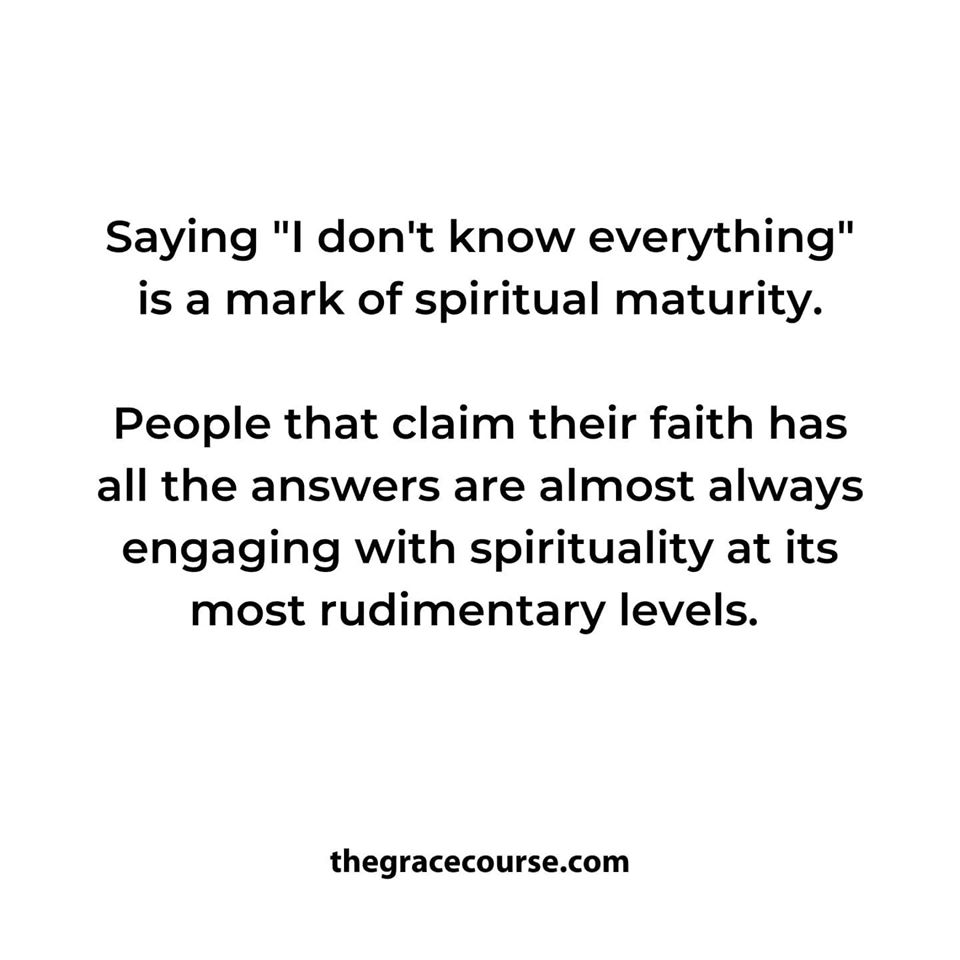
Here’s a great thought from my friend Phil Drysdale:There is nothing wrong with engaging with spirituality at that level. For many that is all they need and want.
But know that for those of us that have moved forward we are unlikely to start moving backwards again. That’s not the trajectory of our path. Your plea for us to return to your absolutes is not likely to do much more than cause you more frustration and pain. And I can say with all honesty that is the last thing we want for you.
If certainty is what you seek, enjoy your certainty. There are even many out there seeking certainty and they may be all ears to your answers. But we are not those people.
And do not fear those who kill the body but cannot kill the soul. But rather fear Him who is able to destroy both soul and body in hell. -Matt 10:28, NKJV
How often I’ve heard the above passage used to prop up the idea that it is healthy to transmit to others, and have in ourselves, a terror and fear of God based upon His ability to torment us in hell forever. However, it’s crystal clear, without even deconstructing the idea that Gehenna equals the modern version of hell, that this is not what is being said.
Remember, the context in which Jesus said this is that He is commissioning His disciples to go and preach the kingdom to hostile individuals who will seek to imprison and kill them. Jesus’ solution? Don’t be afraid of them, because what they can do to you is quite limited compared to what God could do.
So, it seems simple enough, right? Be more afraid of God than people, right?
Wrong.
Read what follows:
Are not two sparrows sold for a copper coin? And not one of them falls to the ground apart from your Father’s will. But the very hairs of your head are all numbered. Do not fear therefore; you are of more value than many sparrows. -Matt 10:29-31, NKJV
The point Jesus is making is that if you’re going to be afraid of someone, it should be the one who could do you far greater harm than any human could. However, this one is moved even by the death of a sparrow, which men imbue with little value, and yet He loves us far more deeply than He does the sparrow, as He’s has taken the time to number the hairs of your head. So if the death of a sparrow moves Him, how much more would harm coming to His children move Him! Therefore, though God is the only one capable of doing us true harm, He would never dream of it, and the conclusion of this passage used to encourage fear is actually “do NOT fear”!
So I say again what I’ve said ten thousand times before: any doctrine that encourages us to fear a God of wrath and retribution, violence and vengeance, is anti-Christ and the opposite of Gospel.
I have titled this piece as I have because I see a common theme of freedom all around the world: ordinary believers from all faiths, denominations and cultures are realising that God is simply available to all who call on Him, and He releases them into the freedom to serve Him as He calls them, and not according to the whims, doctrines and dogmas of other humans.
I wrote, in an article I published a few weeks ago, about how I am ministering in a group for ex-Jehovah’s Witnesses. On the back of that article, then, I present here an extract from the book Crisis of Conscience, by Raymond Franz, a man who for sixty years was one of Jehovah’s Witnesses, and who for the final nine years of that time was one of the Governing Body (the ‘GB’), the supreme council of that religion.
In his book, Ray Franz describes in detail much of the way in which the GB works, and he also describes the ‘witch-hunt’ and inquisition that led to his dismissal from the GB, and eventually his ‘disfellowshipping’ from the Jehovah’s Witnesses entirely. I mention this in order to give context, because what Mr. Franz speaks of here describes perfectly the freedom one feels when one emerges from under the domination of man-made religion and the need to please men in accordance with their doctrines. In my previous article, I talked about people I had met in the ex-Jehovah’s Witness community who are now living free in the Spirit. I would say that in fact complete freedom in the Spirit is not really possible until one has shaken off that need to please men; this shedding of the need to follow the ‘doctrines of men’ (Mt 15:9) is what my friends in that group have progressed to, and this is what this extract speaks of. Note also the parallels with dealing with Religious antagonists of any persuasion – especially the ‘judging adversely one’s standing with God’. Heaven’s gatekeepers at work again!
Over to Ray Franz:
The mind which renounces, once and forever, a futile hope, has its compensation in ever growing calm. I have found that saying true in my own case. I know that it has proved true in the case of many others.
Whatever the initial distress— a distress that sometimes follows the demeaning experience of being interrogated by men who, in effect, strip one of human dignity, make the weight of their authority felt, and presume to judge adversely one’s standing with God— however torn one may feel inside, afterward there does come a distinct feeling of relief, of peace.
It is not just knowing that one is finally outside the reach of such men, no longer subject to their ecclesiastical scrutiny and pressure. Truth, and the refusal to compromise truth, brings freedom in other fine and wonderful ways. The more responsibly one makes use of that freedom, the finer the benefits. The greatest freedom enjoyed is that of being able to serve God and his Son— as well as serve for the good of all persons— untrammelled by the dictates of imperfect men. There is freedom to serve according to the dictates of one’s own conscience, according to the motivation of one’s own heart. The sense of having a great burden lifted off, the lightening of a heavy load, comes with that freedom.
If genuinely appreciated, this gives one the desire to do, not less, but more in service to the Ones giving that freedom.
– Franz, Raymond. Crisis of Conscience: The story of the struggle between loyalty to God and loyalty to one’s religion. (pp. 453-454). NuLife Press. Kindle Edition.
I think that’s absolutely brilliant and, like I said, people from all faith walks are finding this freedom today all over the world. It makes no difference whether they are Jehovah’s Witnesses, Muslims, Evangelicals, whatever; God is doing this.
What’s even more remarkable is that Ray Franz had this epiphany some decades ago. God was moving in the ranks of Jehovah’s Witnesses even back then.
Wow.
Ponder and digest, for there is great freedom in this.








 You may have noticed that I don’t comment on political matters; usually there is enough of that going on on social media and news sites already. And today is no different; I’m still not going to comment!


 There is nothing wrong with engaging with spirituality at that level. For many that is all they need and want.