“Any message that begins with an offended deity, and ends with its appeasement through sacrifice, stems from the same system and primitive thought process that moved the Aztecs to sacrifice their fellow humans, and Moloch worshippers to throw their children into the flames. No matter what you change the god’s name to, or how you reimagine the sacrificial process, it’s still just primitive, sacrificial religion.
“The Gospel is not this same story with different characters. It is, rather, the exposure of this story, and its god, as poison, and the revelation of an entirely new and revolutionary way of seeing oneself, humanity and God. The Gospel is not merely a retelling of the same old violent myth, but the revelation of God as a self-giving, others-centered Family, who so cherishes creation, that he will suffer within our mythology in order to rescue us from it.”
Here is the final episode of Dr. Don Keathley’s groundbreaking series aimed at debunking the Evangelical Church’s doctrine of Hell as a post-death place of conscious, fiery torment for ever and ever. (The first part of the series is here, in case you missed it; I heartily recommend listening to these talks in sequence, as each one builds on the knowledge we gain from the previous talks).
The freedom you will gain from watching this series – freedom from fear, from condemnation, from sadness and despair – is immeasurable. Feel the weight lift off you! Feel the despair simply drain away! These are words of freedom 😀
In this penultimate episode in his classic series teaching about the catastrophically erroneous doctrine of ‘Hell’ as taught by the Evangelical church, Dr. Don Keathley hammers another nail into the coffin of the Hell doctrine by discussing seven logical impossibilities that the doctrine has going for it. (The first part of the series is here, in case you missed it; I heartily recommend listening to these talks in sequence, as each one builds on the knowledge we gain from the previous talks).
Being a professional scientist, this logical approach argued from the Bible, which exposes the contradictions in the Bible that would have to be exploited were the Hell doctrine to be true, really appeals to me. This is my favourite episode so far in the series!
Continuing Don Keathley’s brilliant series debunking the myth of Hell as an everlasting conscious torture chamber overseen by God (why are we even having this conversation?!), here is Episode 4 in which Don explains the Church’s use of three further ‘pillars’ which prop up the doctrine: Hell-fire (Gehenna-fire), Destruction, and the concept of ‘free will’. The first part of the series is here, in case you missed it; I heartily recommend listening to these talks in sequence, as each one builds on the knowledge we gain from the previous talks.
I’m continuing today with the best series I have ever seen on the idea of debunking the long-standing, but completely wrong, doctrine of Hell – that is, eternal conscious torment after death.
In this talk, Dr. Don Keathley takes on the first ‘pillar’ of the Evangelical doctrine of Hell by explaining the misuse (probably deliberate) of the Greek word ‘Aion’, (translated into English in the Bible as ‘Eternal/everlasting’), by the historical Church. Probably in order to keep people under their control, of course!
Ok, it’s a 50 minute talk but it would be 50 minutes well spent 😀 . I certainly never regretted watching it…
Today, we continue with Dr. Don Keathley’s series on ‘Hell’s Illusion’. (The first part is here, in case you missed it; I heartily recommend listening to these talks in sequence, as each one builds on the knowledge we gain from the previous talks).
Personally, I have always wondered why, given two contradictory Bible verses, or indeed two contradictory doctrines that are both based on Bible verses, why so many mainline Evangelical Christians will default to the Bad News side of things, rather than the Good News. After all, the word ‘Gospel’ actually means‘good news’! I’ve expressed this concern before in my blog.
Of course, the main example that springs to mind is that of the doctrine of Hell. Rather than believe the Good News that so many are realising in these days, that there IS no eternal conscious torment after death, these people stillwould rather believe the Bad News, and hold on tight to that awful doctrine, rather than let go and float free of it.
And I think that the reason why they default to the bad news is because that’s all they have ever known. Think about it. They simply know of no other system. If you take away the bad news that they have believed all this time, then their worry will be this: what else in their secure, all-worked-out system have they got wrong too?
As we saw in the last talk in this series, just about all the denominations in Western Evangelical Christianity are essentially based on one or the other of the two belief streams known as Calvinism or Arminianism; most Evangelical belief systems are therefore based on one of these two streams (not both; they are mutually exclusive). Despite their major differences, however, both of these streams rely on the doctrine of Hell to work properly. Therefore, to disbelieve in Hell is to take away one of the central pillars of the belief systems of Evangelical Christianity, and in fact if this pillar is taken away, the whole lot collapses for want of a better doctrine to hold the whole thing up. It’s all they have ever known, and the entire edifice depends on it.
And actually that’s not a bad thing, because it helps us realise that if a doctrine depends for its survival on something other than Christ, then it needs to go.
So, here’s the second in the series of talks by Dr. Don Keathley, in which he examines the four words from the Hebrew and the Greek Scriptures which have been erroneously translated into the single ‘English’ word ‘Hell’ (although actually the word is Norse in origin):
My regular readers will know that I do not believe in the idea of Hell; the place where the wicked/unbelievers/anyone that you don’t like will burn for ever in eternal fire. I just don’t believe in it at all, for many reasons: a non-exhaustive list being: personal; theological; Biblical; experiential; and also at a deeper level that is between me and Jesus (sorry!) I do believe that bad people can create a hell on earth for others, and for themselves too, and that that’s what Jesus was talking about in the Bible passages where He supposedly is talking about Hell. But that’s nowhere near the same thing; not even close.
I would love to be able to collect all my thoughts and ideas on the subject. I have done so to some degree in the past, with some blog articles and with my ‘Hell Resource Page’ (accessible via the ‘Resources’ tab in the menu on each page of my blog). But when there are teachers around of the calibre of American pastor and excellent Bible teacher Dr. Don Keathley, then the teaching and resource is right there and so why not share it?
Many of my friends, both online and in real life, agree with me that this is some of the best teaching debunking Hell that there is. And I will therefore be sharing one video every three days, to give you time to digest each message before the next one. Alternatively, if you just can’t wait, the talks are freely available on YouTube 😀 But I do recommend that you listen to them in order!
So, here is the first episode in Don’s series of six talks, shared here with his enthusiastic permission. In this talk, Don begins by explaining how the doctrine of Hell has historically become the lynch-pin of modern Evangelical doctrine.
The talks do represent a fair amount of investment in terms of time; each talk is about 40-50 minutes long. But if you can at all make the time to listen to these excellent videos, they will transform your life. They have certainly helped me, because they have confirmed that I am not the only person in the faith that is thinking along these exact same lines!
Today, it is three years since my love and soul-mate Fiona passed into the Presence of her Lord.
I so miss the feisty, spirited, funny, gentle, talented, generous, gorgeous, wise and above all deeply loving lady that she was.
We have kept her memory very much alive, in so many ways, the chief of which is that we recall the things that she did that were kind, funny and generous, when we are reminded of her by doing those things ourselves. And that’s significant because it means that in a lot of ways we are continuing to be Fiona to ourselves and to others.
We will say things like, ‘Mum would have found that hilarious’, or ‘I think Mum would have done it like this’. And then we laugh about it. And we are sure that ‘that was what Mum would have wanted’ 😀 Because she was that kind of person.
I still dream about her often. I still see little signs of her around the house: pictures, of course, but also little things that she made or set up that had her figurative ‘fingerprints’ all over them. Processes she set in place that we still use. I still see myself doing things that I learned from her, either directly or by ‘absorption’. I still see her attitudes in things I do.
What a privilege! What an intimate, close-up way of remembering a life so precious! So much of what she was to us is still with us…but the house still lacks the light of her presence. The gap she has left is still immense. And yet, I know beyond a shadow of doubt that I will see her again. Even though I may have to wait some decades, and of course I am not ‘wishing my life away’, still I know that she is there ready to welcome me, alongside Jesus, into that glorious Place where she now is. What a day that will be! 😀
On the first anniversary of Fe’s loss, I posted on here a track of my talented daughter Ellie singing the lovely song ‘Fly to Jesus‘. Fe would have been so proud of her. Well this year she would have been even more proud of her, because just a couple of weeks ago, Ellie put on prerelease her first ever EP, Autumn. Ellie has created this EP in the face of a debilitating illness, putting in work on it whenever she has been able, and now the finished product is out there and soon to become available. I am so proud of her and, like I said, I know her Mum would have been too!
The album is due to be released on 9th November, and all profits from sales will be going to Rowcroft Hospice, the place where Fiona was looked after in her final days on this earth. Rowcroft do such incredible work with cancer patients during their illnesses, with their families, and with end-of-life care.
Here is the link, then, to Ellie’s EP album – Autumn, on Amazon (and it’s also available on places like Spotify and iTunes too). And there are preview clips too.
Four songs written and performed by one of the most talented young musicians I have ever known – and that’s not just parental bias, you know! 😉 But yes, again, Fiona would have been so proud of her! Click the album cover graphic below to go to the Amazon UK prerelease page (on 9th November, it will become the sales page):
She has also released one of the songs, 365, later today as a single. If you listen to this, you will need a big box of tissues…
Here’s the YouTube video:
…and it too can be purchased on Amazon, as a single:
Fiona, you would have been sooooo proud of our Ellie! 😀
Edit: I have just looked at the previous post in the series, ‘In So Many Ways…‘. It’s almost identical in content to this one (apart from the plug for Ellie’s EP!). I find that interesting because to me it suggests that what we have left, after losing Fiona, is reasonably constant in its occurrence and its quality. In other words, these little habits I describe in this piece, I also noted in the previous one. So to me that means that our lasting legacy from Fiona is already in place and established. And that’s good news.
Here is an awesome tale shared recently by my online friend Mo. I need add no further commentary:
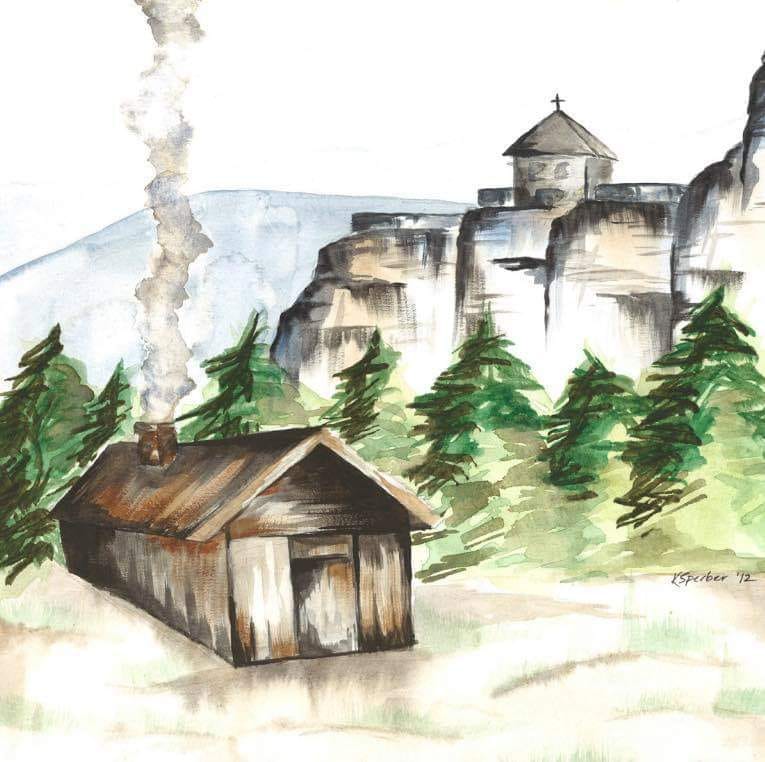
Once a great order, a decaying monastery had only five monks left. The order was dying. In the surrounding deep woods, there was a little hut that a Rabbi from a nearby town used from time to time. The monks always knew the Rabbi was home when they saw the smoke from his fire rise above the tree tops. As the Abbot agonized over the imminent death of his order, it occurred to him to ask the Rabbi if he could offer any advice that might save the monastery.
The Rabbi welcomed the Abbot at his hut. When the Abbot explained the reason for his visit, the Rabbi could only commiserate with him. “I know how it is,” he exclaimed. “The spirit has gone out of the people. It is the same in my town. Almost no one comes to the synagogue anymore.” So the Abbot and the Rabbi sat together discussing the Bible and their faiths. The time came when the Abbot had to leave. “It has been a wonderful visit,” said the Abbot, “but I have failed in my purpose. Is there nothing you can tell me to help save my dying order?”
“The only thing I can tell you,” said the Rabbi, “is that the Messiah is among you.”
When the Abbot returned to the monastery, his fellow monks gathered around him and asked, “What did the Rabbi say?” “He couldn’t help,” the Abbot answered. “The only thing he did say, as I was leaving was that the Messiah is among us. Though I do not know what these words mean.”
In the months that followed, the monks pondered this and wondered whether there was any possible significance to the Rabbi’s words: The Messiah is among us? Could he possibly have meant that the Messiah is one of us monks here at the monastery? If that’s the case, which one of us is the Messiah? Do you suppose he meant the Abbot? Yes, if he meant anyone, he probably meant Father Abbot. Certainly he could not have meant Brother Elred! Elred gets crotchety at times. But come to think of it, even so, Elred is virtually always right. Maybe the rabbi did mean Brother Elred. Of course the Rabbi didn’t mean me. He couldn’t possibly have meant me. I’m just an ordinary person. Yet supposing he did? Suppose I am the Messiah?
As they contemplated in this manner, the monks began to treat each other with extraordinary respect on the off chance that one among them might be the Messiah and in turn, each monk began to treat himself with extraordinary respect.
It so happened that people still occasionally came to visit the beautiful forest and monastery. Without even being conscious of it, visitors began to sense a powerful spiritual aura. They were sensing the extraordinary respect that now filled the monastery. Hardly knowing why, people began to come to the monastery frequently to picnic, to play, and to pray. They began to bring their friends, and their friends brought their friends. Then it happened that some of the younger men who came to visit the monastery started to talk more and more with the older monks. After a while, one asked if he could join them. Then, another and another asked if they too could join the abbot and older monks. Within a few years, the monastery once again became a thriving order, a vibrant center of light and spirituality in the realm.
– Author Unknown: Adapted from the Different Drum: Community Making and Peace by Dr. M. Scott Peck*
Have you ever heard of the ‘Chainsaw School’ concept? Probably not, as it’s a cynical idea that my family and I have held for quite some time, and haven’t made all that public.
But I share it here today. It goes something like this:
There must be a school where they teach people how to use chainsaws. Not the safety and basic operation sort of stuff, like how to use the thing without chopping their own heads off, or even someone else’s.
But instead it’s the little tricks of the trade.
Like, for example, making sure that you operate your chainsaw on the only fine-weather Saturday, at the most idyllic National Trust property you can find.
The main part of the course, though, is the bit where you learn how to time it just right so that you can stop one bit of chainsawing, lull your listeners into a false sense of relief thinking that you have, finally, stopped making your racket, and then you start it up again just as they were beginning to relax a bit.
There’s also the bit about blipping the throttle like a 2-stroke motorcyclist at a traffic light, so that even when you are not chainsawing ‘proper’ you can still annoy people while they wait for you to stop.
We understand that the course is also offered as a subsidiary on other courses involving noisy power tools (like leaf blowers or angle grinders), along with the ‘builders’ language’.
As a Builder, you have to be able to shout ‘Oip?’ back and forth all the time to your mates and you all have to understand what each other means by it. The same word ‘Oip?’ can mean anything and everything pertaining to the construction industry, from ‘Pass me the pneumatic drill, please, mate’, to ‘Can’t be the end of tea break already, chaps; we’ve only just sat down!’
Enrolments on these courses are welcome every September at your local college, so you’ve missed the boat this year, I’m afraid.
However, using this description, I am glad to be able to inform my readers that now they will easily be able to recognise graduates of the Chainsaw School. You won’t be able to miss ’em.