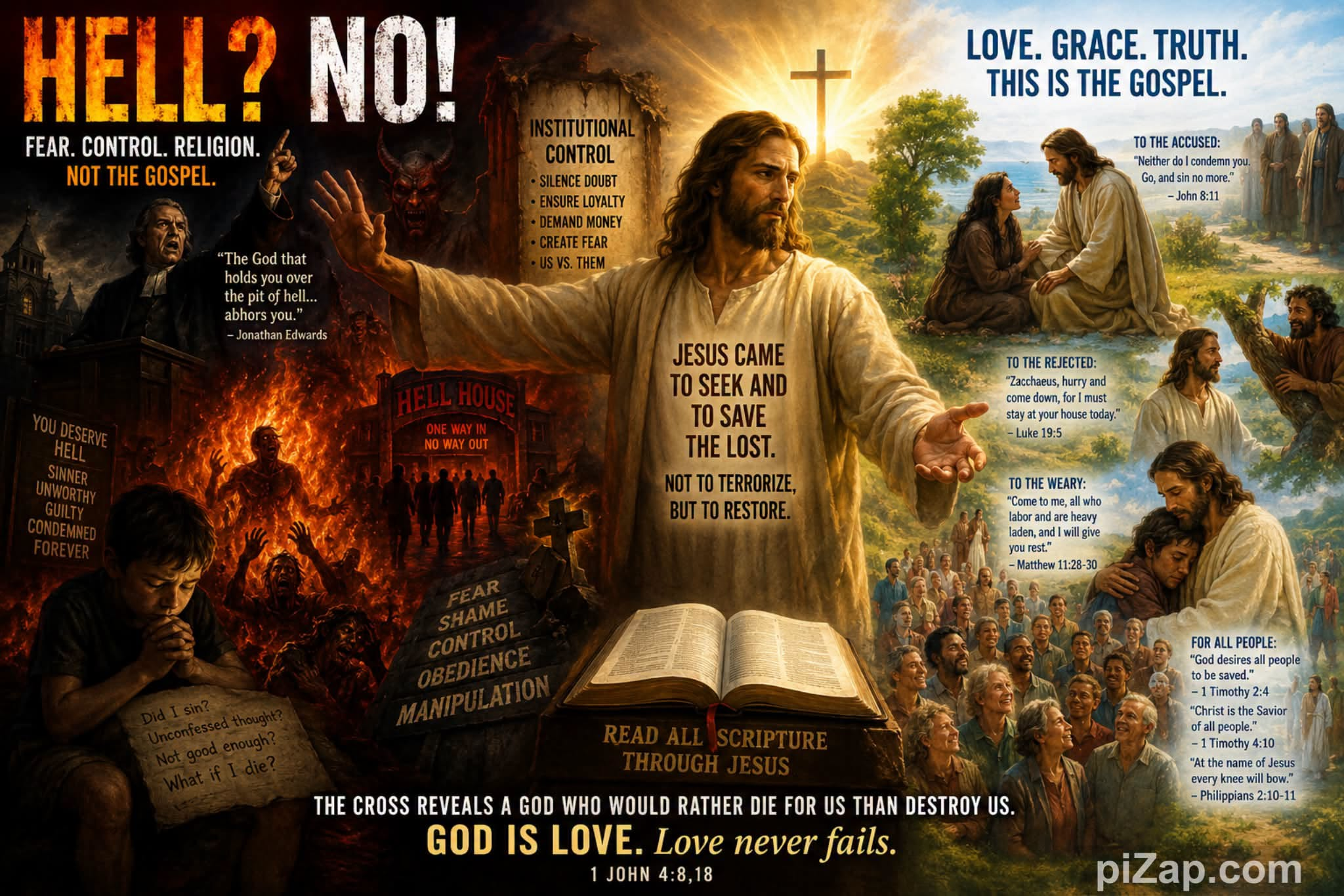
(The above picture is clickable so that you can zoom in to read the smaller parts of the writing!)
As my readers will know, I consider the belief in the post-mortem eternal conscious torment of people in Hell to be the most repulsive doctrine in all of Christendom.
In this magnificent piece, my friend Glenn Regular examines some of the history of the modern use of the Hell doctrine, and also explains, using a real-life story, how damaging it can be to people who believe it.
I was going to call it another Dark Testimony, like all the other Dark Testimonies in this series, but it’s a third-hand story so I can’t really call it a ‘testimony’ as such! Also, I could have added a lot of commentary, but I think I will refrain. Glenn’s writing packs enough of a punch as it is and I would only detract – and distract – from his powerful writing if I did.
Anyway, the piece is long but it is well worth the read and Glenn does indeed keep the reader’s attention. I hope you find the piece to be a blessing!
Peace and Grace to you, and now over to Glenn:
Hell? No!
A Guest Post by Glenn Regular
A false assumption governs modern conservative Christianity: if you do not believe that God will consciously torment billions of human beings in hell-fire for all eternity, you have abandoned the gospel. Preachers declare this from pulpits every Sunday. Theological institutions write it into their doctrinal statements. Well-meaning believers repeat it to children in Sunday School. We are told that eternal conscious torment is the clear, non-negotiable teaching of the Bible, and that to question it is to compromise the absolute authority of the Bible itself.
I defended this view because I was told it was right, but simply saying something is right does not necessarily make it fight. If the doctrine of endless torment were as unmistakable as Christianity claims, faithful followers of Jesus would not have been debating it since the earliest centuries of the church. The historic record shows that the early church held diverse views on judgment, restoration, and the afterlife. The idea of eternal conscious agony was neither universal nor unchallenged in the formative centuries of Christian thought.
What we call orthodoxy today is often nothing more than the loud survival of religious traditions. Over centuries, the Western church turned a complex body of biblical metaphors into a rigid system of post-mortem vengeance. In doing so, it created an engine of spiritual anxiety that has haunted millions of faithful men, women, and children. To understand how we arrived at this moment, we must examine the human toll of this dogma, the historical moments that hardened it into dogma, and the stark contrast between this devilish construct and the person of Jesus Christ.
Consider the story of Jonathan Parrish. Jonathan grew up in a devout, Bible-believing home in suburban Georgia. His family attended an evangelical church three times a week. From his earliest memories, Jonathan loved Jesus. He memorized Bible verses for Sunday school badges, sang hymns with enthusiasm, and listened attentively to his pastor. Yet by the age of seven, Jonathan lived in a state of quiet terror.
Every night followed the same routine. Jonathan lay in bed, staring at the ceiling, gripped by a paralyzing fear that he might die in his sleep. His Sunday school teachers had taught him that a single unconfessed sin could sever his connection to God. If an unrepentant thought slipped through before his heart stopped beating, he would wake up in an ocean of liquid fire where he would burn forever without relief. To protect himself, Jonathan developed an obsessive ritual. He prayed the Sinner’s Prayer dozens of times each evening. He cataloged every thought from his day, asking forgiveness for minor irritations, fleeting moments of selfishness, or forgotten chores. If his mind wandered during the prayer, he started over from the beginning to ensure the transaction was valid.
This was not genuine worship. It was survival. Jonathan was not seeking communion with a loving Father; he was managing a cosmic threat. He viewed God as an omnipotent tyrant who watched for the slightest technical error to justify an eternity of torture.
As Jonathan reached adolescence, the anxiety deepened. Every summer, his church sent youth to week-long camps. The schedule always followed a calculated pattern. The first four days built emotional vulnerability through intense social activities, sleep deprivation, and emotionally charged worship music. On Thursday night, the camp held its signature service. The preacher spoke in vivid detail about the horrors of hell. He described the smell of burning flesh, the sound of weeping and gnashing of teeth, and the absolute finality of the judgment.
The youth leaders lowered the lights, played minor chords on acoustic guitars, and called students forward to accept Christ. Jonathan watched his friends weep in the aisles, overwhelmed by sheer panic. He walked forward every single summer, rededicating his life because he was never entirely sure his previous conversion had taken root. The system demanded absolute certainty while teaching a theology that made certainty psychologically impossible.
Jonathan’s experience is not an isolated oddity. It is the predictable outcome of a theological framework that equates God’s justice with endless violence. When an authority tells a child that the creator of the universe is going to torture most of humanity forever in hellfire the developing mind cannot process that information through the lens of love. It processes it through the lens of trauma.
Psychologists recognize this pattern as religious trauma syndrome. When fear is used as the primary motivator for moral behavior, it damages the human nervous system. It creates chronic hypervigilance, emotional dependency, and deep-seated guilt. Believers trained in this mindset find themselves unable to trust their own moral intuitions. When their natural conscience revolts against the idea of God torturing people forever, they are told that their conscience is fallen and corrupt. They learn to call cruelty justice and terror love.
How did the Western church come to embrace such evil rhetoric of terror? While roots of this theology stretch back through medieval Catholicism and the Latin church fathers, its modern American expression was forged in the fires of the First Great Awakening during the eighteenth century.
On July 8, 1741, a Congregationalist minister named Jonathan Edwards stood before a congregation in Enfield, Connecticut. Edwards was an intellectual powerhouse, a philosopher, and a central figure in the colonial revivalist movement. His sermon that day, titled Sinners in the Hands of an Angry God, became one of the most famous pieces of religious rhetoric in Christian history.
Edwards did not deliver this sermon with shouting or theatrical gestures. Historical accounts indicate that he read his manuscript in a calm, level voice, leaning heavily on the pulpit. Yet the words he spoke were engineered to induce acute psychological panic. Edwards wanted his listeners to feel the physical precarity[1]. of their existence over the pit of eternal damnation: “The God that holds you over the pit of hell, much as one holds a spider, or some loathsome insect over the fire, abhors you, and is dreadfully provoked: his wrath towards you burns like fire; he looks upon you as worthy of nothing else, but to be cast into the fire; he is of purer eyes than to bear to have you in his sight; you are ten thousand times more abominable in his eyes, than the most hateful venomous serpent is in ours.”
Notice the language Edwards chose. God does not merely judge sin; He abhors the human being. The sinner is not a lost child to be sought and rescued, but a loathsome insect suspended over an open furnace. Edwards continued, detailing how God holds humanity by a slender thread while the flames of divine wrath singe and burn that thread, ready at any moment to drop the soul into perpetual agony.
The effect on the Enfield congregation was immediate and devastating. Eyewitnesses recorded that men and women shrieked, groaned, and wept aloud. People clung to the wooden pillars and the backs of pews, feeling as though the floor beneath their feet was physically opening to swallow them into the abyss. Edwards had to stop his sermon multiple times to ask for silence so that his voice could be heard over the cries of his terrified audience.
This sermon set a precedent for American evangelicalism. It shifted the primary focus of Christian preaching away from the early church’s proclamation of the resurrection and the inauguration of God’s kingdom on earth. Instead, it centered the message of Christianity on individual escape from post-mortem torment. The gospel was no longer the declaration that Christ has conquered sin and death; it became a rescue plan from God Himself.
Edwards’s approach established an emotional template that persists to this day:
First, convince the listener that their natural state is an object of divine hatred and disgust.
Second, describe the horrors of eternal torment in vivid, graphic detail to induce acute existential dread.
Third, present Jesus as the only narrow fire escape from the Father’s imminent violence.
Fourth, demand an immediate, emotional conversion experience to secure safety.
This revivalist method spread rapidly across the Western World. It was efficient, it produced immediate measurable conversions, and it filled church rosters. Yet it did so by trading the beauty of the self-giving God of the cross for an angry deity whose wrath could only be appeased by blood.
Modern descendants of this rhetoric appear in various forms. In the late twentieth and early twenty-first centuries, fundamentalist churches developed “hell houses” as alternatives to Halloween haunted attractions. These events walk teenagers through graphic theatrical scenes of suicide, fatal car accidents, botched abortions, and drug overdoses, followed immediately by a depiction of demons dragging the victims into a simulated pit of screaming agony. The goal remains unchanged from Edwards’s day: terrorize the human imagination until the individual surrenders out of self-preservation.
When we turn from the rhetoric of revivalist preachers to the pages of the New Testament, we encounter a fundamentally different reality. We see Jesus of Nazareth walking the dusty roads of Galilee and Judea. His demeanor toward fearful, broken, and morally compromised people stands in direct opposition to the methods of religious terror.
Consider the encounter between Jesus and the woman caught in adultery, recorded in the eighth chapter of John. The religious leaders brought the woman before Him, quoting the law of Moses and demanding her death by stoning. They stood with rocks in their hands, ready to execute divine retribution. If the character of God were accurately reflected by Jonathan Edwards’s sermon, Jesus should have intensified her terror, reminding her of the eternal furnace awaiting her unrepentant soul.
Instead, Jesus knelt down and wrote in the dust. When her accusers slunk away under the weight of their own conscience, Jesus looked up at the woman and spoke words of absolute peace. “Neither do I condemn you,” He said. “Go, and from now on sin no more” (John 8:11). Jesus did not manipulate her emotions through threats of torture. He did not describe her as a loathsome spider. He treated her with dignity, extended unmerited grace, and invited her into a transformed life.
Look at Zacchaeus, the chief tax collector in Jericho. Zacchaeus was an extortionist who grew wealthy by collaborating with the Roman military occupation to exploit his own countrymen. The religious establishment viewed him as an unclean traitor worthy of condemnation. Yet when Jesus saw him sitting in the sycamore tree, He did not threaten him with eternal flames. Jesus said, “Zacchaeus, hurry and come down, for I must stay at your house today” (Luke 19:5).
The hospitality and unconditional acceptance of Jesus broke Zacchaeus’s heart open. Without a single threat of hellfire, Zacchaeus declared that he would give half his goods to the poor and restore fourfold anything he had stolen. Love accomplished in an afternoon what centuries of religious threats could never produce: genuine, lasting repentance from the inside out.
Throughout the Gospels, Jesus reserves His harshest words not for vulnerable sinners, outcasts, or moral failures, but for the religious elite who used fear to maintain their authority. In Matthew 23, Jesus delivers a scathing critique of the scribes and Pharisees, accusing them of shutting the kingdom of heaven in people’s faces and tying up heavy burdens that they themselves refuse to lift. The religious leaders used fear to keep the population subservient. Jesus arrived to break their monopoly on God’s grace.
When Jesus invited the crowds to follow Him, He did not say, “Flee the fires of My Father’s wrath.” He said: “Come to me, all who labor and are heavy laden, and I will give you rest. Take my yoke upon you, and learn from me, for I am gentle and lowly in heart, and you will find rest for your souls. For my yoke is easy, and my burden is light.” (Matthew 11:28–30)
The New Testament consistently describes the Christian message as euangelion, a Greek word meaning “good news.” An announcement that God plans to torture the vast majority of His beloved creation for all eternity while rescuing a tiny few “born-again” through hell-fire fear-mongering is not good news. It is the most terrifying news imaginable. The real good news of the gospel is that the Creator has stepped into human history in the person of Jesus Christ to reconcile the world to Himself, forgiving sins and destroying the power of death.
If the doctrine of eternal conscious torment contradicts the gentle, inclusive, self-giving nature of Jesus, why has it remained so central to Christian institutional life for centuries? The answer is simple: fear is the most effective tool for human control ever devised.
From an organizational perspective, a religious system built on unconditional love is difficult to manage. Unconditional love produces free, autonomous individuals who think critically, follow their consciences, and relate to God directly without the need for priestly intermediaries. Free people do not blindly obey institutional mandates. They do not easily submit to authoritarian leadership. They do not give money out of guilt or dread.
A system built on existential fear, however, operates with remarkable efficiency. Fear functions as a psychological lock on the human mind. Consider how the mechanics of religious terror protect an institution:
- It prevents critical questioning. When an institution teaches that incorrect doctrine leads straight to hell, congregants become terrified of their own doubts. Asking honest questions about church history, translation errors, or theological contradictions feels like dancing on the edge of the pit. Believers suppress their critical faculties, choosing intellectual blinders over the risk of damnation.
- It enforces absolute loyalty to leadership. If the pastor or the church hierarchy holds the keys to eternal safety, their authority becomes unquestionable. Challenging the leadership feels equivalent to challenging God Himself. Spiritual abuse thrives in this environment, as victims fear leaving an abusive church because they have been taught that salvation exists only within their specific theological camp.
- It guarantees financial support. History demonstrates that terrified people are generous people. During the Middle Ages, the Western church turned the afterlife into an economic powerhouse through the sale of indulgences, promising that donations would reduce a loved one’s time in purgatory. While Protestantism rejected indulgences, it retained the same psychological lever: support our ministry, spread our message, and help us save souls from hell.
- It creates narrow-minded Christians. Fear of the outside world keeps believers safely inside the institutional walls. Non-believers are viewed not merely as neighbors to be loved, but as dangerous, corrupting influences destined for destruction. This us-versus-them mentality creates a high-control environment where leaving the group means losing your entire social, emotional, and spiritual support network.
In this dynamic, the doctrine of eternal torment stops being a purely theological concept. It becomes a social and administrative technology. It maintains the hierarchy, stabilizes institutional budgets, and silences dissent. When a theologian suggests that God might actually succeed in saving all people, the institution reacts with fury not because the biblical text is clear, but because the institution’s primary lever of control has been threatened.
A church that relies on hell to keep its pews full has forgotten how to rely on the beauty of Christ. When fear is the foundation, love becomes impossible, because genuine love requires freedom. You cannot truly love a God whom you are terrified of cross-examining.
To dismantle this architecture of fear, we must recover the ancient, biblical way of reading Scripture through the lens of Jesus Christ. For centuries, theologians have made the mistake of reading Jesus through the Old Testament’s most violent imagery, or through the dark lenses of medieval philosophy. We must invert this approach. We must Jesus be the interpretive factor in of the Bible, He is the image of God and the only one who has seen Him.
The author of Hebrews opens with a radical theological claim: “Long ago, at many times and in many ways, God spoke to our fathers by the prophets, but in these last days he has spoken to us by his Son, whom he appointed the heir of all things, through whom also he created the world. He is the radiance of the glory of God and the exact imprint of his nature.” (Hebrews 1:1–3)
The writer does not say Jesus is one of many representations of God. He declares that Jesus is the exact imprint of the Father’s nature. In John 14:9, Jesus looks at His disciple Philip and says plainly, “Whoever has seen me has seen the Father.”
This is the foundation of Christian theology. If you want to know what God looks like, you look at Jesus. If you want to know how God responds to His enemies, you look at Jesus on the cross, praying for the Roman soldiers driving nails through His flesh: “Father, forgive them, for they know not what they do” (Luke 23:34). If you want to know how God exercises justice, you look at the Shepherd who leaves the ninety-nine safe sheep to search the dark wilderness until He finds the one that was lost (Luke 15:4).
God does not have a dual personality. There is no dark, vengeful Father hiding behind a gentle, loving Son. The Son and the Father are one in purpose, character, and essence. Therefore, if a doctrine presents God acting in a way that contradicts the character of Jesus Christ, that doctrine must be rejected as an unfaithful human construct.
A God who commands His followers to love their enemies, bless those who curse them, and forgive seventy times seven, while He turns around and tortures His own enemies for trillions of years in unquenchable fire, is a moral contradiction. It creates a deity who fails to live up to His own moral standards. If human beings are called to be holy as God is holy, and God exercises eternal retaliation, then human vengeance would be holy. But Jesus taught the opposite. He commanded enemy-love precisely because that is how the Father acts: He makes His sun rise on the evil and on the good, and sends rain on the just and on the unjust (Matthew 5:45).
The Apostle John summarized the entire nature of the divine life in three simple words: “God is love” (1 John 4:8). He did not write that love is one of God’s many attributes, or that love must constantly compete with an opposing attribute called retributive justice. Love is who God is. His justice is not the opposite of His love; His justice is the restorative working of His love, healing what is broken and putting right what has gone wrong.
Furthermore, John directly addresses the psychological disease of religious terror: “There is no fear in love, but perfect love casts out fear. For fear has to do with punishment, and whoever fears has not been perfected in love.” (1 John 4:18)
A theology that cultivates fear of eternal punishment is fundamentally immature, incomplete, and contrary to the spirit of Christ. Fear belongs to systems of human punishment, not to the heart of the Father revealed in the Son.
The New Testament overflows with sweeping declarations of cosmic redemption that cannot be squeezed into the narrow framework of eternal conscious torment. Consider the scope of these apostolic claims: Paul writes that through the cross of Christ, God was pleased “to reconcile to himself all things, whether on earth or in heaven, making peace by the blood of his cross” (Colossians 1:20).
He declares that “as in Adam all die, so also in Christ shall all be made alive” (1 Corinthians 15:22). The scope of the life in Christ is just as universal as the scope of death in Adam.
He states that God “desires all people to be saved and to come to the knowledge of the truth” (1 Timothy 2:4), and that the living God is “the Savior of all people, especially of those who believe” (1 Timothy 4:10).
He announces that at the name of Jesus “every knee should bow, in heaven and on earth and under the earth, and every tongue confess that Jesus Christ is Lord, to the glory of God the Father” (Philippians 2:10–11). In the ancient world, to confess Christ as Lord was an act of genuine spiritual worship, not a coerced concession extracted under torture. I refuse to build a doctrine of God that nullifies these clear declarations. I refuse to worship a deity who lacks the power, the will, or the love to accomplish the cosmic restoration promised throughout the Scriptures.
Jonathan Parrish eventually walked away from the terrifying faith of his childhood. For years, he lived as an agnostic, unable to reconcile the cruelty of his church’s theology with any recognizable form of goodness. Yet in his thirties, Jonathan encountered the writings of early church leaders who saw the cross not as a shield against an angry God, but as the triumphant victory of divine love over death, darkness, and decay.
He discovered that he was not required to check his moral conscience at the door of the church. He realized that the terror keeping him awake as a seven-year-old boy was not the Holy Spirit; it was the voice of a man-made tradition that traded the gospel of peace for the mechanics of control.
The journey toward spiritual liberation begins by naming the terror for what it is. The doctrine of endless conscious torment is not the heart of people of the Jesus Way. It is an ancient religious distortion that has wounded millions of souls and slandered the character of God. The cross of Jesus Christ tells a different story. It reveals a God who would rather die at the hands of His enemies than destroy them; a God whose mercy triumphs over judgment; a God whose love never fails.
– Glenn Regular, shared with his enthusiastic permission.

Note: Glenn is an American man, so I have left his American spellings unaltered in this piece!
Footnotes
| ⇧1 | A condition of existence without predictability or security, affecting material or psychological welfare – Ed |
|---|