A story of deliberately dishonest leadership in the Church of England
My last church was a Church of England (CofE) church, and I never had any major problems there.
However, my friend’s experience in ‘their’ CofE church was very different. They have written up their story for inclusion in my blog as a ‘guest post’, and I thank them for both their efforts and their courage in doing so. And they want to remain anonymous – fine by me! – and I am honoured to present my friend’s story below.
I’m not going to comment on the story[1]. I don’t think I’ll need to.
Right, that’s all from me; over to my friend:
My experience at the hands of a charismatic evangelical Anglican church, and its leadership.
I should preface this by saying that I am autistic – and although I have only known this for a couple of years, that isn’t to say that I have only been autistic for a couple of years; autism is a life-long condition. In common with many (or probably most) autistics, I was horribly bullied at school – simply because I was ‘different’ (in ways I shan’t waste time explaining here and now – the differences are, at most, only peripherally relevant to this tale). Those who were, in effect, ‘in loco parentis’ during the school day signally failed (with a few notable exceptions) to discharge their duty of care towards me; indeed, a few colluded and even, on occasion, joined in. My own mother decided, with no evidence whatsoever, that the reason I was bullied was that I wasn’t tough enough. So she decided that she would toughen me up. YAY!! Great stuff, I was bullied at home as well as at school. It should come as no surprise that I finished my school career pretty badly damaged, and with a complete distrust of authority figures.
During my last year of school, I ‘gave my life to Christ’ and became an evangelical Christian, thanks to a person who became a dear, dear, friend. I absolutely don’t hold her responsible, in any way, for the things which I shall describe below – she has never been anything other than a true ‘Follower of the Way’ (of Jesus Christ), and always loved me unconditionally, as who I was, rather than as a ‘project’ or someone who needed to be ‘fixed’.
Even so, it took me more than thirty years to learn to trust anyone enough to share the secrets of my abused past. That I did, eventually, ‘get there’ was down to the patience and care of very good (church) friends, who were consistent and ever-faithful in their love.
So that’s a bit of background, which may serve to illustrate why what I describe below was so devastating – when it may seem quite trivial if read without the above caveat.
Several years ago, the Anglican church I belonged to at the time ran the ‘Living in Love and Faith’ course, alongside most of the rest of the Church of England. It was billed as a conversation around the topic of whether or not LGBTQIA+[2] people could fully belong to the church, and receive all the sacraments (including marriage). Cutting a long story short, our particular course started out as a conversation, but once the leadership discovered that most people on the course disagreed with their ‘conservative’ (reactionary?) stance on the topic, and were far more ‘liberal’ and ‘inclusive’ than the leadership wanted them to be, it began to be turned into some very heavy, uncompromising, and essentially ‘tone deaf’ teaching (I’m not sure teaching is the right word to use – hectoring might better suit what happened). Things were done, during the official sessions, to try to ‘colour’ the result – in direct contravention of the ‘rules’ under which the course was meant to be run.
The course culminated in an extra session which the vicar tacked on to the end of the course, ostensibly so that we could ‘discuss’ where ‘our’ church was going to land on this particular topic. When we all arrived, we were surprised to find that the doors (two sets of double doors) had been wedged open (which was definitely not how they’d been on any other evening). The first thing the vicar told us was that the doors were open because if any of us disagreed with anything he said it would make it easy for us to leave – ‘other churches are available’ being his exact words, reeling off a list of churches he thought might suit us better.
He then proceeded to harangue us with his interpretation of the situation – riding roughshod over the careful groundwork the course had laid, starting by expounding the Church of England’s definition of marriage, and carrying on to tell us exactly what the (English) Bible has to say about homosexuality (and telling us to ignore anyone who cast any doubt upon the correctness of the English version he’d chosen). Faces across the room became gradually stonier – from ordinary folk through to eminent theologians who work at the university. Eventually, he wound up.
The curate completely misread the room, and launched into a fulsome vote of thanks. There was a little desultory applause – from probably a fifth of the room; and a lot of upset and very angry faces. I had, over the course of several years, worked hard to learn Ancient Greek, so as to be able to understand the scriptures in one of their original languages; I’d also made a particular study of the verses of scripture which (so-called) theological conservatives used to deny membership of God’s kingdom to those who were LGBTQIA+. I had become convinced that actually, there was nothing in scripture which could possibly preclude their being full members of the church – indeed, if they couldn’t be members, then neither could anyone else! Being told I was wrong, so vociferously, by someone who I knew was only parroting what he’d been taught, hurt. It was easy to understand the naked anger of the academic theologians in the room, whose hard-won professional opinions had been dismissed over the course of a few minutes by sheer ignorance.
Afterwards, over the next days and weeks there was a steady queue of people making appointments to see him, to tell him why they thought he was wrong, and also to protest at the way he had treated us; that queue included me. When it came my turn, he flatly denied having wedged the doors open, or that he’d suggested any of us leave, or that he had harangued us with his interpretation. He suggested that I had misremembered not only the tone but that facts of what had happened and what he’d said. So passionate and definite was he that I began to doubt my memory of the event.
I met one of the theologians the next day for our regular fortnightly coffee date, and he asked how it had gone. I told him, and he assured me that my memory of the events was well-nigh perfect – and that what the vicar had tried to do to me was classic gaslighting.
Bear in mind here that the first ‘authority figure’ I ever really trusted was a clergyman (it took decades before I shared any details of the abuse I was subjected to as a child with anyone, let alone anyone in authority), and you might get an inkling of the sheer devastation caused by the revelation that I’d been gaslit by my vicar – a man I’d worked alongside closely (as one of his churchwardens) for six years and had learned to trust.
That vicar left, not long after – ‘shuffled sideways’ by the bishop into a role which kept him away from public ministry – the volume of complaints about him had proved too much for even the ‘tone deaf’ functionaries at the diocese.
His replacement was said to be a very ‘pastoral-minded’ man (which was what we all felt the church needed after the earlier debacle). All seemed well, for a few months, and once I felt I might be able to trust him, I made an appointment and told him about my previous experiences. He listened, expressed sympathy, and assured me that he was open-minded and that he wouldn’t hold any of my ‘less conventional’ views against me – in fact he was rethinking a lot of stuff himself, having a sister who had recently ‘come out’. So that all seemed fine.
We run a group for a bunch of students – they come round every Wednesday during term times (and those who’re here year round come every week whether it’s term-time or not); we feed them, listen to their woes, and hold open-ended, open-minded, theological discussions in which ‘anything goes’; it’s all run on ‘Las Vegas Rules’ – i.e. what happens in Vegas, stays in Vegas; to our pretty certain knowledge, everyone has always respected those rules.
The vicar sent a message to tell us that he needed to see us urgently. When we met, he revealed that ‘one of the students’ had complained that we were teaching them heresy during the discussions. He wouldn’t tell us who’d complained nor exactly what they’d actually complained about, but that we had to stop doing it, or he’d stop us running the group (how the heck were we meant to stop doing something when he wouldn’t tell us what the something was?). We would meet again to review it in a couple of weeks when we’d had time to repent and rethink what we’d been doing – oh, and from then on we’d have to follow strictly a programme of discipleship he would set…
Because, after all, he was responsible for what was taught in his church and he would have to stand before God on Judgement Day and explain why he’d allowed heresy to be taught in his church. (And this is one reason amongst many why I don’t agree with the idea of an ordained priesthood. Maybe I’ll talk more about that another time!)
We were hurt and confused. We tried really hard, over the following weeks, to work out what the complaint might have been, and who might have made it – so as to at least try to meet his demands. Our conclusion was that, in the absence of any evidence, and knowing ‘our’ students as well as we do, actually, he was making it up, for reasons best known to himself!!
When the time came for the second meeting with him, we insisted on there being an independent witness present; we’ve known one of the current churchwardens for four decades or so, and trust her; happily she agreed to be present. In the face of this ‘witness’, his tune changed and he ‘backed down’ almost entirely from his previous stance – he didn’t go as far as admitting that there hadn’t been a complaint, but he might as well have done.
But I can’t trust him any more… Despite his best efforts to be friendly and ‘open’, I’m not playing his game… I’m keeping my distance, and not falling for his ‘niceness’ – I know it’s an act – all he’s interested in is having power over others, and in building his pathetic little empire of sycophants. I remain unsure of where I stand, and not a little hurt. I’ve more or less stopped attending – unless someone we know is being baptised, or something like that. We’re still running a group for students – but almost entirely independent of the church’s scrutiny; recruitment isn’t a problem – ‘our’ students bring more students, who become ‘our’ students in turn.
A short time later, that same clergyman also ‘received’ (or so he said) an allegation of ‘inappropriate sexual behaviour’ against someone who, as a student, had been part of our group, and had stayed in the area and become a close friend. He was henceforth banned from all ‘ministry’ (even from serving on the tech team, presumably in case he ‘corrupted’ anyone by the way he changed the words on the projection screens or something). We know our friend; we knew, right from the very first moment, that this accusation had to be false. The situation got really messy, until, eventually, in the face of opposition from our friend and his fiancée, and with us acting as ‘chaperones’ at a meeting, the vicar again backed down.
The very next day, he revealed that ‘the diocese’ had now determined that the allegation was false and there was no case to answer (and no, none of us were allowed to know who’d made the allegation, what it was, what evidence there was, and nor were we ever party to the supposed ‘report’ from the diocese). Nevertheless, our friend would not be allowed to rejoin any church ministries until he had receiving counselling (from the vicar), to educate him on what constitutes ‘appropriate behaviour’. Our friend has since left the church, and wants nothing whatsoever to do with it – and I absolutely support him in that.
Personally, I think it all points to yet another ‘fantasy’ on the part of the vicar, and I don’t suppose he ever reported it to the diocese… He just wanted to exercise control over someone… And who cares whether he hurt them, destroyed their trust, or anything – so long as he had his pathetic little power trip. And I wonder – was the second incident a further attempt to ‘get at’ us, via our friend?
At this point, personally, I have decided to adopt an old saying as my ‘motto’ for dealing with clergy: ‘fool me once, shame on you; fool me twice, shame on me’. It’s not happening again – I’ve lost all trust in them.
Fuck the lot of them.
I hurt because the trust in authority which I’d ‘learnt’ over so many decades in the church has gone; I’m angry that clergymen of all people have been the ones to betray my trust; I’m grieving because I’ve effectively lost the family I’ve been part of for over forty years; I’m lost – I don’t know where I belong any more, if I belong anywhere. And all because of the ‘power trips’ of two ‘little Hitlers’.
I’m still passionate about Jesus Christ, and I still count myself as a (rather flawed) ‘Follower of the Way’ (to use the ancient phrase), but I think I would consider being called a Christian insulting, if that’s really what christians are like.
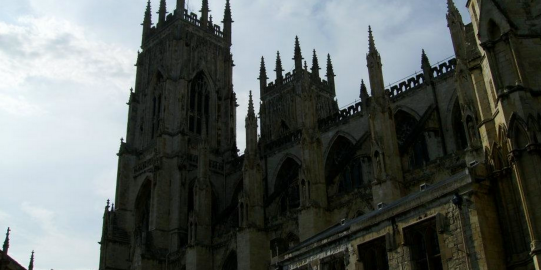
Header image shows a suitably dark picture of York Minster, one of the Church of England’s cathedrals.
Footnotes
| ⇧1 | Except just a single, general, observation regarding my main and ongoing reason for including this essay in my blog series: This kind of disgusting behaviour in churches is exactly why I began this series, and exactly why I will continue to share stories of people doing dreadful things to innocent people, in the very place where, more than anywhere else, individuals should be cared for, honoured, nurtured and above all loved. There is no excuse. These stories need to be put out there! |
|---|---|
| ⇧2 | The ‘LGBTQIA+’ acronym means ‘Lesbian, Gay, Bisexual, Transgender, Queer (or questioning), Intersex, Asexual’, and the plus sign refers to other sexualities that are not specifically mentioned in the acronym. |