
I am an avid BBC Radio 4 listener.
While I do listen to the BBC news on there, it’s always with a hefty pinch of salt… however, there are also quite a few intellectual-type programmes on Radio 4; things that engage my mind and my thinking. There’s some very good humour too, and there’s also some terrible humour, of the kind where you need to be told it’s humour or you’d never have noticed[1]. In particular, I actually find ‘Woman’s Hour‘ to be really interesting and useful, for reasons which are probably too complex to go into here.
But there’s also some more personal-style programmes on there, and one of these is ‘Desert Island Discs‘, which I usually listen to on a Friday as I am cleaning out our rats’ cage.
The format is simple. Each episode features a ‘celebrity’ – referred to as ‘the castaway’ – who is about to be stranded on a desert island, and has to choose a list of eight musical tracks[2] which they consider to be important to them for one reason or another. The show is centred around an informal ‘interview’ with the castaway, where they introduce each track and give the reasons why they have selected it to accompany them to the desert island. A short excerpt from each track is then played, or maybe the entire piece if it is very short[3].
The interview with the castaway usually elicits anecdotes, attitudes and wisdom, in a highly-varied mix from castaway to castaway, which are usually fascinating to hear. In addition, at the end of the show, they are told that, in addition to the complete works of Shakespeare, and the Bible[4], they are also allowed to choose one other book and a ‘luxury item’ that they would take with them to their desert island. And then to choose which one song from their list they would simply have to have with them on the island.
As I listened today (it’s a Friday as I write this, so it’s clean cage day once more for the ratties!), I thought to myself, “I wonder which tracks I’d choose?”, closely followed by, “This might make a good blog post!” and so here I am, about to be marooned on a desert island[5] and having to think of eight tracks, a book, and a luxury item.
My tracks are not necessarily my favourite music. But they do have meaning for me, and that’s what I’ll share.
So, here we are. My Desert Island Discs. I will present the full version of each track, and my readers will maintain full control as they can always stop each track as they get bored!
Find somewhere comfy to sit; this is a long one!
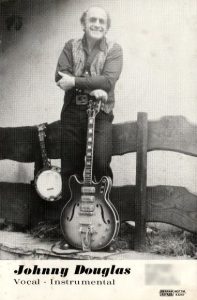
All my life, I have been surrounded by music. My maternal Grandad, whom I never met (he died of cancer shortly before I was born), was an amateur operatic performer and musician. My Mum and Dad were part of a concert party that used to do performances in local theatres. And then my Dad was a professional musician for many years working hard doing the club circuits in the North of England. Back then, in the heyday of the Working Men’s Clubs, many well-known names in British entertainment cut their teeth on the stages of smoke-filled halls filled with ordinary, everyday working-class people who were simply leaving behind the grind of everyday life for a few hours and just having a good time. This scene was what was known as ‘Clubland’. Entertainment in Clubland was provided by snooker tables; darts; bingo; slot machines; the raffle; well-priced, top quality beer; and the ‘turn'[6] the Artiste, aka a ‘club act’. The artiste would be a musician, a singer, a comedian, a drag queen, or maybe a magician, maybe a ‘muscleman’; a man with a bodybuilder’s physique who would pose and show off his muscles as his ‘act’. Sometimes, several acts would be on each evening, so as to provide a range of different entertainments for the club membership. There was a very wide variety of such artistes, and my Dad’s thing was to sing and play guitar and the ukulele-banjo (banjolele). His stage name was ‘Johnny Douglas’ and, in my opinion, he was one of the best turns in Clubland, retiring from performing in 1986 when he opened his bodybuilding gym in Yeadon.
This is my Dad in 1978 on one of his publicity cards:
My Dad met and worked with many such artistes, including such well-known names as Frankie Vaughan, Des O’Connor, Joe Belcher, comedian Pete ‘Machine-Gun’ Wallis[7] (so named because of his rapid-fire delivery of his jokes; he was so fast that you only got chance to laugh at about one in every three because you’d be so busy laughing that you’d miss the next couple of gags…), Freddie Starr, Bernard Manning, Tessie O’Shea, Alan Randall, Les Dawson, and many others, all of whom started their careers on the Clubland circuit. For a flavour of the sort of thing that the working-mens’ clubs used to have going, check out this episode of ‘Wheeltappers and Shunters Social Club’, which was a long-running TV series in the 70’s which gently lampooned – ‘gently’, because it was so realistic – the sort of thing I’m talking about. Anyway, I used to go with him often and watch him perform; although I was only young (and therefore couldn’t drink alcohol in the clubs, not that I wanted to anyway!) I was still allowed in because I was part of my Dad’s ‘road crew’. I used to assist him in plugging in his gear, sound checks and setting things up. And later, while I was learning to drive, I used to drive him to and from his shows. Much of my pre-test driving practice was carried out at night!
My Dad performed numbers[8] from two main genres: Wartime; and Country and Western (C&W). He sang songs from both the World Wars; veterans of both conflicts were still alive in those days, and his singing of nostalgic songs which used to remind them not only of their youth, but also of lost friends, and these songs were always welcome.Songs like ‘When the Poppies Bloom Again’, ‘We’ll Meet Again’ and similar. I particularly remember that October used to bring ‘El Alamein Reunions’, where soldiers from both sides of the Battle of El Alamein used to sing together, especially the song ‘Lili Marlene‘, which was the song that men on both sides of the lines used to sing at night. At these reunions, the Royal British Legion clubs, which were part of Clubland, used to host their former enemies with great enthusiasm; a marvellous thing to see.
The C&W stuff was a mix of Hank Snow, Johnny Cash, George Hamilton IV, Jim Reeves, and others. I particularly remember him doing a song with his singing partner, Kay, where they sang the classic (although not strictly C&W) ‘Something Stupid'[9]. ‘Kay Stevens and Johnny Douglas’ was the title for their double act when they were working together[10]. In addition, as part of his Second World War repertoire, he used to play a lot of songs by George Formby, including some really rather masterful ukulele playing. My Dad was really talented, but as far as I could tell, he didn’t want to become really famous because the Clubland scene already took him away from us as a family a lot. When he was fully professional, he used to have entire fortnights staying away from home, back for a couple of weeks, then away again staying in digs in remote parts of England. One of those places is the Webbington near Weston-Super-Mare, a place not too far from where I live now; back then it was called Webbington Country Club and he played there for a couple of fortnights a year over the course of several years. And this was before we had things like motorways, especially the M5 which actually runs past the Webbington. Anyway, back to George Formby. Formby songs were pivotal in bringing me into being a musician in my own right. I learned to play the ukulele at the age of seven, and Formby’s music ingrained, into my musical ear, a huge amount of practical and experiential knowledge of how music works, what sounds good and what doesn’t, and the structure and proper use of chords[11]. My stage debut – at the same age – was playing the theme tune for ‘Skippy the Bush Kangaroo‘, for which my proud Dad gave me the princely reward of half a crown – two shillings and sixpence – as extra pocket-money, which for a seven-year-old was an absolute fortune! I still have that uke in my cupboard and I trot it out now and then…
Which brings me rather nicely to my first track, George Formby’s ‘Bell-Bottom George’. I am using this song here to showcase Formby’s extraordinary talent on the instrument. While neither I nor my Dad had Formby’s talent, he was an inspiration to us both, and he’s one of the main reasons why I am a musician. This is the version from the Formby movie that it featured in, the eponymous ‘Bell Bottom George’, first screened in 1943. The ukulele solo at the end of the song is one of his best:
At around the same time, I was brought up on a diet of Gerry Anderson’s science fiction (SF) TV series ‘Thunderbirds‘, ‘Captain Scarlet‘ and ‘Stingray‘, and, later on, Anderson’s ‘Space: 1999‘, along with Irwin Allen’s ‘Land of the Giants‘, ‘Lost in Space‘, ‘The Time Tunnel‘, and ‘Voyage to the Bottom of the Sea‘. There were others too, along with movies such as Arthur C. Clarke and Stanley Kubrick’s ‘2001: A Space Odyssey‘ – and above all, the Apollo moon landings[12]. And SF writers such as E. E. ‘Doc’ Smith, Clifford D. Simak and of course the inimitable Arthur C. Clarke. Also, the astronomer Patrick Moore and, again, Arthur C. Clarke, were decisive in instilling in me a love for astronomy in particular, and science in general. And not forgetting, of course, cosmologist Carl Sagan’s beautiful series ‘Cosmos’ – which came along later in my teens – and all the possibilities that it opened out for my eager and hungry mind.
The effect of these shows and authors was to give me a huge inspiration into technology, science and engineering. To have the confidence to believe in stretching the limits of the possible. To allow my mind and imagination to wander unfettered in the unknown lands of clever inventions of the future, and facts yet to be discovered. Is it any wonder that I became a professional scientist, working in both medical research and then pharmaceuticals?
As an aside, before his career as a musician, my Dad had been an engine fitter in the Royal Air Force, and was on active service in Kenya during the Mau Mau uprising in Kenya in the mid-1950’s. During his RAF career, he worked on the engines of such varied aircraft as the Avro Anson, Avro Lincoln, Vickers Varsity, Hawker Hunter, Gloster Javelin, DeHavilland Chipmunk, English Electric Canberra, Gloster Meteor and DeHavilland Vampire, and others too. He therefore taught me all I know about DIY, car mechanics, machinery, problem solving in those fields – all of this knowledge and experience culminating in me being able to help my friend Nigel build his Van’s RV-9A aeroplane in a hangar at Exeter International Airport, which is the aeroplane that we now fly and maintain as part of a small team of skilled engineers (there’s four of us). This gives us some of the cheapest flying it is possible to participate in, as we do all the servicing and maintenance ourselves.

And, of course, it was only right and proper that my passion for all things aviation should stem from my Dad’s similar passion, including his RAF service. But I describe that passion enough in the rest of my blog, without having to expand upon it here!
Anyway, I digress again! These experiences during my formative years, of being exposed to the possibilities afforded by engineering, technology, and science, gave me my scientific and problem-solving mindset right from the get-go. In addition to being a man of faith, I am also a dyed-in-the-wool scientist. I am a competent engineer and mechanic, and a problem-solver. There are very few problems I can’t solve with the judicious application of my huge skill-set[13]. And it’s all down to the training from my Dad and the inspiration of those early SF TV series[14] and the aforementioned science authors.
But in addition to all of that, it is certain that no SF series was more influential in my life than Star Trek.
Following closely, in my timeline, after Lost in Space, Star Trek took me, and millions of others, to places that we could only dream of. And showcasing technologies that, yes, we could only imagine back then, but which have become real and even, in some cases, already obsolete[15] in my lifetime. Now, granted, we don’t yet have the Transporter Beam (Beam me up, Scotty!) nor the Warp Drive, to give us the ability to travel faster than light. But so many things that Star Trek first thought of are now commonplace in our everyday lives. Things like the ‘communicators’, which are what we now call a ‘smartphone’. Things like the ‘medical beds’, which we now call CT and MRI scanners. Even the fast-opening automatic doors from Star Trek now exist in everyday society. Star Trek was truly visionary in its scope; indeed only in the last decade has humanity discovered the awe-inspiring truth that most of the stars in the Galaxy have planets around them, something which Star Trek took for granted. My lifelong career in science is due to these powerful formative influences in my life; I love these things and they are part of me, part of my character. Star Trek and the Apollo space program especially instilled in me a near-fanatical interest in space exploration, space science, and astronomy. I am a member of The Planetary Society, and also my local astronomical society, because of this interest.
And so, that all brings me to my second track. Here are the opening credits from the original series of Star Trek. A beautiful melody with beautiful chords, and would you believe that there are even lyrics for it. Google it if you don’t believe me (“Beyond the rim of the star-light”)!
Earlier, I mentioned the author E. E. ‘Doc’ Smith. ‘Doc’ Smith wrote within a genre of SF called ‘Space Opera‘; this is essentially the classic, action-packed and rambunctious space adventure fiction involving loads of space battles and aliens, empires and villains. Star Trek, while indeed having ‘bad guys’ and things, and the occasional space battle, wasn’t really space opera as such; although it is listed as such in the link above, I’ve never really considered it to be so, it being more of a thinking-person’s adventure series telling stories which may, or may not, be linked as part of a wider, overreaching story arc. But ‘Doc’ Smith wrote excellent space opera, especially the ‘Lensman’ series, which tells the story of a vast, eons-spanning struggle of good versus evil. There’s everything in that series that a space opera fan could ever want: Galaxy-wide travel and civilizations; battles; super-powers; huge ships bristling with weapons; good heroes and evil villains – indeed, superheroes and supervillains! – evolving propulsion and weapons technology; faster-than-light travel and all sorts of other stuff. Smith also wrote the ‘Skylark‘ and the ‘Family D’Alembert‘ series; again, epic space opera novels that capture the imagination like nothing else.
And all that was simply excellent reading for a young man with a feverish imagination and no real cap on his concept of the limits of the possible.
But then came Star Wars. Here at last was the visual representation of the space opera. Sure, there’d been things like the comic strip ‘Flash Gordon’, from the 1930s, ‘Buck Rogers‘, and other similar stuff.
Star Wars, though, was different. Although it was at first just the one movie, first screened in 1977, there were also spin-off books, magazines and even some toys. I remember I bought my first lightsaber in about 1978! But in Star Wars, space opera was brought to life like nothing had ever done it before. And it has stood the test of time, too; like Star Trek, Star Wars has a worldwide cult following and, also like with Trek, words, phrases and concepts from the franchise have passed into common parlance. I would imagine that when I referred to a ‘lightsaber’ earlier in this paragraph, all of my readers would have known what I was talking about! Sometimes, in common ‘personality quizzes’, where you are asked things like ‘what’s your favourite colour?’ and similar, one of the questions is Star Trek or Star Wars?, like it’s one or the other that you have to like. Similar to Indian vs. Chinese food. But in both cases, these are false dichotomies; there is a third option. Both Star Wars and Star Trek. Both Indian and Chinese. And, indeed, both science and faith. There is no need for any of these to be in conflict, as each part of a pair covers areas that the other doesn’t. And so it is for these things. So, Star Wars and Star Trek have both been massive influences on me both in terms of the possibilities of technological progress, and the related suspension of disbelief that is so important in faith matters as well as in imagining the limits of the possible. Both are inspirational in their own way.
I need to mention, as a (still relevant) aside here, that I have a special love for classical music. Being both a musician and an Autistic person, I find that I try to over-analyse music that isn’t classical. My mind tries to work it out, to figure out what that chord is, how to play it, what piano fingering to use, and that sort of thing. But because classical music is so a) outside my playing style, and b) beyond my abilities, I have the ability to just let classical music ‘be’, without having to dissect it in my mind. And this is a real relief; it’s really relaxing. Because of this love for classical music, I wanted to bring to my desert island a track that is classical in style. I thought of tracks like ‘Jupiter’, ‘Mars’ or ‘Uranus’, from Holst’s The Planets suite. Or maybe Elgar’s Pomp and Circumstance March Number 1, which always used to make my Mum cry. Or some Mozart, Grieg, Bach or Boelmann. All these are worthy, but I had to pick something. And so, I chose this piece, Imperial March, by the incomparable John Williams, because, like all the best movie scores, it is classical (in that it’s orchestral), and it represents the Space Opera which, together with the more cerebral Star Trek stuff, completes my love for science fiction and its consequent effects on my scientific mindset. A mindset which has carried me through a long career as a professional scientist and on into my retirement, in which I am still given opportunities to use my mind in a similar way. I really can’t complain!
Here we are, then. John Williams’s Imperial March, from Star Wars Episode V, The Empire Strikes Back:
Although I grew up, as I said, surrounded by music, I didn’t listen to music on the radio very often. I think it was because I had no control over the music that was played; I didn’t like a lot of the music in the ‘hit parade'[16] at the time. However, I did have some songs that I liked, and, if I liked a song enough, I would just go out and buy the single. A single, of course, being a 7″ vinyl disc which you played on your record player (a ‘turntable’ as they are known nowadays). I’d only be able to afford about one a month as there were other things I wanted to spend my pocket money on; things like Airfix model kits and paints in order to build up my huge collection of plastic model aircraft. But I did manage to buy the odd record every so often. Bands like ABBA were especially important to me back then, and I did indeed buy their albums… I used to go down into Bradford where I knew I could get the albums I wanted, at WH Smith in the city centre.
And I had other musical tastes too. On one occasion, when my Dad worked in Clubland, he was in ‘digs’ (temporary lodgings) in Spennymoor in northern England. My mother, my brother and I went up to visit him in his digs and, while there, we got playing table tennis with some guys from another band that were staying in the same digs. I learned many years later that the band were in fact the Electric Light Orchestra (ELO), a band that had many hits in the British charts during the 70s and 80s, but who never had a Number One hit despite all that. This encounter was before they became famous! Anyway, entirely independent of those table tennis games!, I grew to really appreciate ELO’s music. Because they were semi-classical, I could just enjoy their music without analysing it. Their music was often played on jukeboxes in the indoor skateboard parks I skated at in 1978, during the ‘skateboard craze’ that was on at the time. And when I worked in my cousin’s car mechanic workshop in 1979, their music was on the radio a lot then, too. And so, my late teens were lived to a backdrop of ELO music, amongst other excellent music including ABBA and, of course, a lot of C&W music too – especially that of George Hamilton IV. On my parents’ record player, I used to flog[17] ELO, ABBA and George Hamilton IV numbers all day long. Of course, this meant that I was steeped in really good quality music. What with my Dad and his wartime and C&W stuff, and the bands mentioned above, how could I not then develop – on top of my already-existing gifting – a really good ear for what constitutes good music. And I must say that ABBA’s Benny Andersson was a huge influence on my piano style too, although it would take a very discerning ear to detect that as I actually don’t play anything like him.
So for my third track, then, I have chosen ELO’s Mr. Blue Sky, one of their most well-known, popular and indeed catchy creations. This song epitomises the musical backdrop, as I’ve said, to my teens, and reminds me of my youth spent trying to seriously injure myself doing crazy things on my skateboard – which I still have!
On the 12th of July, 1980 – the day I left school, in actual fact – my life was changed irrevocably by my encounter with my best Friend, Jesus. I cannot even begin to describe what my life became after I met Him, save to say that everything – everything – I am today is because of that encounter. When asked by those two rogue evangelists on my doorstep back in May what difference Jesus had made in my life[18], all I could do was laugh deeply from the wellspring of joy – ‘Jesus joy’! – in my heart. Words are simply not enough to describe it. I suppose that by reading some of my blog posts from over the nearly eleven years this blog has been in existence, you might be able to see some of what He’s done, but to try to express it in words, and especially in only a few words – is simply impossible. The Apostle John wrote in John 21:25 that “Jesus did many other things as well. If every one of them were written down, I suppose that even the whole world would not have room for the books that would be written”. And that really is how it feels, to try to describe what He’s done with me, in me and, yes, through me over the decades. Next July, it will be 46 years since I met Him. Words cannot express enough….
And, neither can music. Yes, I was a worship leader and I led people into God’s tangible Presence on a regular basis. But even in that arena, the individual believer has to have their own, unique and individual, encounter with Him. I can’t do that for them; all I can do is to help to set them up so that they can do it more easily, if they choose. And it doesn’t need me to do it for them anyway; somehow, though, God seems to like corporate worship: “How good and pleasant it is when God’s people live together in unity! … For there the Lord bestows his blessing, even life forevermore.” (Psalm 133:1, 3b) and so, it ‘works’. But still, my life has been shot through – like the letters in a stick of seaside rock – with the Songs of Heaven. They run through me like lifeblood. And while I know, and can play, literally hundreds of these songs, for me I have two favourites: When I look into Your Holiness and Great is the Lord. The stories of what those songs mean to me is related in this article, but of all the songs I know, When I look into Your Holiness is my absolute favourite. More than any other, that song sums up and epitomises the heart of worship for me. And so, unsurprisingly, I’ve chosen it as my fifth track:
One of the things that Jesus set up for me was for me to meet my precious wife, Fiona. Fiona was the perfect wife for me. I can’t even begin to describe why that was the case, save to say that we were soul-mates. Losing her to cancer just over nine years ago was the worst thing that has ever happened to me; much of this blog since then has been about her influence on me and how I have survived her loss.
Our life together had its ups and downs, yes, but over all that time we had eyes only for each other. We were absolutely besotted, I suppose the word is, and we were like teenagers all the time, so smitten were we! Alongside that, our love for Jesus guided our lives, and the reason why I now live in the south-west of England is solely because we followed His lead and moved here on what we believed was His guidance. And I would even be so bold as to say that the fruits of that, I suppose you could call it ‘obedience’, have remained with me to this day. This is where we were supposed to be; indeed this is where I am supposed to be, right here and right now. I have lived my life under the guidance of the Holy Spirit, and no-one can ever take that away from me, nor convince me otherwise. This is the effect of living the life of faith; the life in the Spirit (Gal 5:16). I say this as a declaration of fact, not as a boast of any kind. This is the only way I know how to live, and it works.
Probably the song that helped me the most, when I lost Fiona, is the gorgeous My God and King (Eyes for Only You) by Shauna Chanda. I showcased it before in my series on Fiona, but here it is once more, as my sixth song. Soak in it; feel it. You will not be disappointed.
This next track has a bit of a different slope to it. In addition to listening to Radio 4, I also listen occasionally[19] to the station Classic FM. For reasons already explained, I love classical music and, while Classic FM do tend to play only the more popular, well-known, pieces, I do occasionally discover a real gem via that station. One such piece, for example, would be the duet from the Bizet opera The Pearl Fishers; look it up on YouTube if you’d like to hear it.
But the piece I am introducing now is one of the few classical pieces I can play; it was always a firm favourite with the audiences when I used to play it on the Blüthner grand at Coleton Fishacre when I used to volunteer there for the National Trust, some years ago.
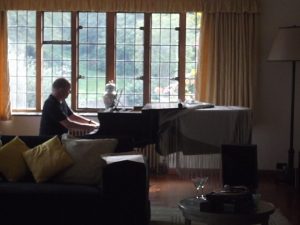
It’s called The Ashokan Farewell, composed by Jay Ungar, and it was used as part of the soundtrack for the Ken Burns historical documentary ‘The Civil War‘ (1990). And I first heard it on Classic FM, although the version I heard was not this one I present today[20]. And when I heard it, I was so entranced by it that I had to write down the title (so I would remember it!), and then go and find it and buy it as soon as I got home. The Ashokan Farewell is, without a doubt, one of the most beautiful pieces of music ever written, and its haunting melody has permeated my life since the first time I heard it. No Desert Island Discs collection compiled by me could ever be complete without it. This piece is so evocative and deep, yet so simple that I can play it; it is absolutely priceless.
This version is the definitive track from the Civil War soundtrack, performed by Jay Ungar and his wife, Molly Mason. Here we go:
For my final track, a shorter explanation will suffice. I mentioned earlier that ABBA were a huge influence on my musical style and tastes. Well, of all their songs, none means more to me than their beautiful Thank You for the Music. I have always loved this song, from the very first moment I heard it, and once I began using music in my Christian ministry, it became almost a personal worship song for me.
I mean it full well when I sing this song (apart from the line where Agnetha sings, “I am the girl with golden hair”; I’m a bloke and I have close-cropped dark hair 🤣🤣) because I really am thanking God for the music.
So, I say Thank You, [Lord], for the music, the songs I’m singing. Thanks for all the joy they’re bringing!
There is really no other song to finish with, that encapsulates it all so well: a lifetime of music and worship for which I am so deeply grateful. With this song, just as much as with any ‘proper’ worship song, hymn or chorus, I can express from the depths of my heart the gratitude for the gifting and for the lifelong lifeblood of music that flows through me. I am so thankful!
Well, that’s the songs. And so now to the other items I am ‘allowed’ to take on to my desert island with me. The Complete Works of Shakespeare, the Bible, a book of my choice, and a luxury item. And to select the one song that would mean the most.
Well, I have to say that The Complete Works of Shakespeare holds absolutely no attraction for me whatsoever. I really don’t understand what all the fuss is about Shakespeare; I don’t know, maybe this makes me some sort of infidel or something? But I think he’s vastly overrated and is indeed only held in such reverence because nobody wants to go against the general flow and say out loud how rubbish it all is. Emperor’s Clothes, and all that. I also think that most modern people, even those like me who have a classical education, feel the same – but they daren’t say it out loud. But I have no such inhibitions! No, if we’re going to have a ‘complete works of [some classical author]’, I’d much rather it was Jane Austen. She’s just brilliant. One of my favourite books ever is her classic Pride and Prejudice; I’ve read it at least eight times!
The Bible? Yeah, I can cope with that 😀
My book would have to be The Lord of the Rings, by J. R. R. Tolkien. I have read it at least fourteen times, but I am sure I could cope with reading it a few more times if I was pressed 😉
And as for my luxury item, well that would simply have to be a piano. Preferably with something to stand it on so its feet don’t sink into the sand on the island 😉 And I would prefer it if it were my own piano, which I love and which was made in 1907 and used to belong to my maternal grandfather. Failing that, a nice Steinway grand would do…. 😉
And which would be the one song that I just couldn’t do without? Well, it’s a difficult choice, for sure. But probably the one I’d pick would be ‘When I Look into Your Holiness’. That, for me, encompasses nicely the main focus of my life, which is to be close to Jesus. ‘Nuff said.
So, there we have it. My Desert Island Discs. Thankfully, I am no kind of celebrity, so I am highly unlikely to be asked to present my track list on Radio 4, and I’d probably decline if I was so asked.
Because I really don’t like the limelight…. 🤣
Footnotes
| ⇧1 | The best humour on Radio 4 is to be found in the programmes ‘Just a Minute‘, hosted by the brilliant Sue Perkins, and ‘I’m sorry, I haven’t a clue!‘, presented by the wonderfully deadpan Jack Dee. |
|---|---|
| ⇧2 | Although it has to be said that some of the tracks might well be some sort of ‘rap music’, which phrase is, to me, an oxymoron. In addition, ‘rap’ is the only word in the English language that begins with a silent ‘C’. 🤣 |
| ⇧3 | This is probably to keep the show flowing properly and maintain the listener’s interest |
| ⇧4 | Or other appropriate religious or philosophical work |
| ⇧5 | Which, being Autistic and very happy with my own company most of the time, I would find quite a relief! |
| ⇧6 | They’d ‘do a turn’, which meant to get up on stage and perform. |
| ⇧7 | In that video, he talks just like I used to talk, with that broad Yorkshire accent! Unfortunately, my accent moderated somewhat once I moved south! But, regarding Pete, I saw him once, at Yeadon Constitutional Club, and I particularly remember his parting shot was “…and please do remember to take care on your way home, because ninety percent of people are caused by accidents…” – he was hilarious! |
| ⇧8 | That is, songs |
| ⇧9 | Which, while not really their own song, was made into a worldwide hit by Frank Sinatra and Nancy Sinatra |
| ⇧10 | Kay had a beautiful singing voice, and she sang in a local choir in Yorkshire until only a few months before she died at the age of over 100. |
| ⇧11 | Chords are where several related notes are all played at the same time, to create a fuller sound. This concept is easier if it’s demonstrated rather than explained in writing! |
| ⇧12 | Moon landing deniers: Don’t even bother commenting or communicating. Your comment will vanish without trace, into the nonexistence that both it, and you, deserve. |
| ⇧13 | Yes, this is similar to another ‘judicious application of…’ saying. IYKYK!🤣 |
| ⇧14 | The word ‘series’ is both the singular and the plural word for ‘series’, so I don’t call them ‘serieses’ or anything like that! |
| ⇧15 | Technology like the 3.5″ floppy disc drive, first seen as the ‘data card’ in Star Trek, but which has now of course passed into history in favour of the ‘thumb drive’. |
| ⇧16 | A probably British term for music that was popular at a given point in time. |
| ⇧17 | ‘Flog’ meaning to play a song repeatedly again and again ad nauseam. |
| ⇧18 | Why do some Christians always have to issue challenges to everything someone says?? It’s like they’re constantly in interrogation mode… |
| ⇧19 | Usually when Radio 4 has Gardeners’ Question Time or The Archers on 🤣😂 |
| ⇧20 | The version I heard on that day was one played by the band of HM Royal Marines, with the violin solo by Capt. J R Perkins. Here it is. |