Those who visit Christian and other faith forums will know that there are many – probably well-intentioned; let’s give them the benefit of the doubt – people who unctuously ‘correct’ those whom they deem to be ‘spreading a false gospel’. I won’t express my opinion of these people, which gives you a clue as to what it is 😉
Anyhow, in this brilliant piece, Jacob M. Wright lampoons these sermonisers with his idea of what their response might be to one of St. Paul’s sermons.
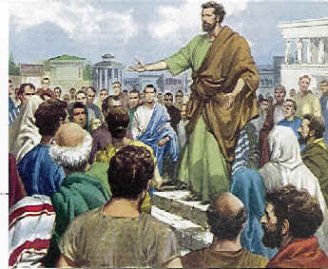
“APOSTLE PAUL EXPOSED!” A Fundamentalist response to Paul’s preaching to the Athenians in Acts 17:
In Acts 17, Paul is invited before the leading philosophical thinkers of the day to present the gospel to them. Keep in mind they are all idol worshipping pagans. Paul starts off with telling them that they worship God without even knowing it! Paul tells them God is not removed or distant from them, and in fact that they “live, move, and have their being in him” which is something he borrowed from their writings about Zeus. Paul tells them that all of humanity is one blood with one origin: God. And that God is at work in history to cause all to feel after him and find him. Paul quotes one of their pagan authors who said of Zeus “we are indeed his offspring”, and uses it to affirm that God is their Father. Paul tells them that God gives them life, breath, and everything, and satisfies their needs. Paul tells them that God is therefore not some inanimate object like their idols and therefore they should change their way of thinking to embrace the one universal Creator! Paul ends it with saying that God will bring the world to justice through a man that God raised from the dead.
Here is a fundamentalist response to Paul’s supposed “preaching of the gospel”:
“Paul there is so much heresy in this ear-tickling message you told the Athenians I don’t even know where to start. Why don’t you just stick with the simple gospel truth instead of this new agey existential stuff? Telling idol worshipping pagans that they are so close to God that they in fact live, move, and have their being in God? Paul, God is holy. He can’t look upon sin or be around it. You said ‘God is not far from you’ when in fact those idolaters could not be farther from God! Those pagans don’t live, move, and have their being in God, they are completely separated from him!
Also, quoting their own pagan author and saying they are God’s offspring? The fact that you agree with and are quoting a pagan author is evidence enough to me of how you have strayed from the pure truth of God’s Word. Preach the Word Paul, you don’t need to quote pagan authors to try to reach people for Christ. You’re mixing truth with error and coming up with a deadly mix. In fact there is barely any truth here at all! It’s 95% error! Paul repent! Quit watering down the gospel! The Word is clear, they aren’t God’s offspring, they are children of the devil. No one is a child of God until they are born again! You can’t just go and tell a bunch of pagans that they are children of God!
Last but not least, when you declared to them that they worshipped God without even knowing it, this was the last straw. You’re preaching a false gospel. Just because they have an altar to ‘the unknown God’ does not mean the altar is to God and that you can somehow tie this into some mystical idea that it points to God who is their origin, in whom they live, move, and have being, and of whom they are offspring. Your whole sermon did not even mention the name Jesus! How do you expect anyone to get saved! You are beyond anything resembling Gospel truth. Sure, you briefly mentioned that God will bring the world to justice, but didn’t specify that this justice was eternal conscious torment in hell for every unbeliever! There was nothing about wrath, hell, or torment.
Next time, Paul, tell them that the wrath of God burns against them because of their sin, that his justice demands being appeased by the shedding of innocent blood as well as eternal torment. Tell them that yes God loves them, but they need to accept the legal transaction of the atonement before God can forgive. Otherwise they cannot even approach Gods presence! Ask them if they’ve ever told a lie before, or if they’ve ever cursed, lusted, etc. Use the righteous Law of God to show them that they stand condemned to hell before a holy God. We have some gospel tracts for you to use that help with this. Make sure you ask them where their soul would go if they died tonight. Preach the true gospel, Paul.”
Yes, I love my Bible. No other book that I have read (and I have read many) speaks to me about God better than the Bible does. And yet, I am aware of its limitations. As we have seen in this series, the Bible is not God, and should not be revered to the point of being idolised – the line between these two states can often be quite blurry.
But the main thing for me is that this enigmatic, ancient, complex, terrifying, encouraging, feel-good, feel-bad, feel-terrible, uplifting, edifying. life-changing tome can be interpreted in so many ways. I personally use two main Bibles; here they are, a 1939-printing King James Version and a 2008 – printing NIV which uses the better 1979 translation.
I also use a copy of The Message. The idea behind all these different translations, for me, is that I can get a better handle on the meanings of many passages of Scripture without having to look at the original Greek; however, I can also do that if required, having had a classical education.
But that’s all about translation. It’s a different beast entirely from interpretation and application. What does this passage mean, and what does it mean in my life today? Sure, translation is an important part of interpretation, but to me the key is this:
We cannot read the Old Testament (or even the New) while ignoring the life, teaching and example of Jesus Christ of Nazareth.
In other words, we need to take into account what Jesus said, did and demonstrated about God’s nature, and interpret the Bible – and especially the Old Testament – in that light; through a ‘Jesus Lens’, if you like. You see, there are so many contradictory and conflicting ideas of the nature of God in the Bible that we often don’t know which way to turn. Which of these two apparantly contradictory passages is ‘correct’, if either? Jesus, then, is the standard by which we must weigh all of Scripture. (This, I feel is what 2Tim 2:15 speaks of when it says about ‘rightly dividing’ the word of truth – although I appreciate that this passage may not necessarily be referring to the Bible per se).
Here, then, is Jeff Turner on this very subject. This is a reprint of a recent Facebook post of his; he is well worth following on Facebook and his insights are always excellent. I don’t know how he does it. Well actually I do, but I’m not telling (it should be pretty obvious, really!)
Over to Jeff:
Would you like a feminist Bible? I could give you that, using only the Bible.
Would you like a misogynistic Bible? I could give you that, using only the Bible.
Would you like a gay-affirming Bible? I could give you that, using only the Bible.
Would you like a gay-bashing Bible? I could give you that, using only the Bible.
Would you like an anti-slavery Bible? I could give you that, using only the Bible.
Would you like a pro-slavery Bible? I could give you that, using only the Bible.
Would you like a pro-child sacrifice Bible? I could give you that, using only the Bible.
Would you like an anti-child sacrifice Bible? I could give you that, using only the Bible.
Would you like an angry, violent God? I could give you that, using only the Bible.
Would you like a loving, forgiving, non-violent God? I could give you that, using only the Bible.
The point? We can paint any portrait of God we desire, and only ever dip into the pallet the Bible provides us with to do so. The raw materials are there for us to craft any image of the divine we’d like to, and to therefore justify any action or attitude we’d like to. One will not have to necessarily go “against the Bible” in order to craft a certain image either. Yet one person’s image of choice contradicts another’s, and both were able to craft their respective images without ever having to go “against the Bible.” Both will have piles of proof texts to help prove their points, and neither will have to have taken them out of their contexts.
Humans, left to interpret the Bible on their own, will do so to their own hurt, as we have seen thousands of times throughout history. The Christian has the responsibility, not of simply reading what’s on the page and assuming its 100%, inherent truthfulness, but of reading every statement, prediction, prophesy, and exhortation in light of the God who is revealed in Jesus. I may be able to “prove” that God is pro-violence using only the Bible, but I will never be able to prove such a thing using Jesus. And so on and so forth, ad infinitum.
The Christian’s interpretive lens must ever be the person of Jesus, or we are just one more group using their sacred text to create the God that they wish was, regardless of what God actually is.
I thought I would present things slightly differently in this instalment of the series on the Stages of Spiritual Growth. Today, I’m going to present the ideas partly as personal testimony, and partly as a song: the beautiful ‘Where My Heart Will Take Me’, also known as ‘Faith of the Heart‘, from the TV series Star Trek – Enterprise. You’ll hopefully understand the reasoning behind this by the time we get there. And rather than disrupt the narrative flow of this article, I will place the more technical stuff at the end of the article, as an Appendix*.
First, let’s recap.
In the last episode of this series, I talked about ‘The Wall’, the ‘Dark Night of the Soul’, the ‘Individuative – Reflective’ Stage (Stage 4) of Fowler’s Stages of Faith. In this Stage, a person realises that they have been in a spiritual ‘box’ and they find that the box is too small. And so the distinguishing mark of Stage 4 is that the believer is breaking free of all (or most) of the previous strictures under which they lived their spiritual life. It may be that they are realising that the paths of Grace and the open plains of the believer’s walk are so much huger, broader, wider and free, than they had previously believed while in their ‘box’.
Because I have recently (well, four years ago) come out of a ‘Dark Night’, much of what I write below is stuff that I can personally testify to; things I have personally experienced. But please remember that your own personal spiritual walk will not look like mine; we all have our own walk to experience for ourselves. Think of it as an example of what things can look like.
People who pass through Stage 4 and into Stage 5 – what Fowler calls ‘Conjunctive Faith’ – I believe, are the people who discover the true freedom in Christ that is spoken about so much but so rarely practised. Or, alternatively, if they are in the right kind of environment, they can go straight into Stage 5, and this does happen. Let’s say, for example, that there was no problematic doctrine, no religious straitjacket in a person’s life, then that person has very little to be set free from in terms of toxic spirituality. This might occur if someone has been brought up in an atmosphere of Grace instead of Legalism, or someone who comes to know the Lord later in life and has a clean slate which the Lord can write on. Having said that, just about everyone has some sort of ‘toxic’ baggage about faith which needs to be dropped at some stage – but only when the Lord feels you are ready to do so. (You can’t rush this stuff). And that’s what is known as ‘repentance – changing your mind about things. In this way, the way of faith is a continual walk of repentance, because we are constantly being taught new things by the Spirit of God in our hearts, and changing our minds, our thought patterns, to conform to what She teaches us.
Anyway, in Stage 5, we are free to pick and choose; accept and disregard, ideas, doctrine, advice, comment or admonishment from others, or indeed from any source. That’s not to say that we don’t discuss things with others, or that we don’t let ourselves be influenced by others’ ideas or opinions; far from it! We accept and take in the good stuff from others, while gently leaving behind those things we find unhelpful. In short, we can make up our own minds, think for ourselves, stand on our own two feet…and we are free to follow Jesus where He leads and to listen to His teaching without the constraints of others’ opinions. This sounds very much as if the believer is approaching something that looks like like spiritual maturity, doesn’t it? 😀 And this is really what I am talking about today.
And there is also the freedom that comes with this responsibility of thinking for ourselves. We as adults are now free to make our own choices: what we will eat tonight; what we will wear; whom we will hang out with; what we spend our time doing. In a similar way, a person in Stage 5 has developed the ability to accept the responsibility for his or her own beliefs, and is not bound by others’ opinions – or, at least, they are learning not to be so bound – and they can increasingly make their own choices. Do you go to the cinema? Yes, if you want to, you go. Do I listen to rock music? Yes, if you like it anyway. (I do). The person is free not only to make their own choices, but also to choose to live life in the Spirit. There is no need to worry about ‘straying into sin’ if a person is led by the Spirit. Freedom is only freedom when a person has a choice; if there is no choice, then there is no freedom. In fact, I would say that it is a logical progression from this that unless a person is free from living under Law, it’s actually not possible to live in the Spirit. Only once a person is free from the shackles, restrictions and indeed decisions of following the Law, are they fully free to live life in the Spirit. So if in the past a believer was constrained by a set of ‘Rules of Expected Behaviour’, they have come through the (sometimes chaotic) Dark Night of Stage 4, and now they are in the process of learning how to live in that freedom that they have now they realise they have a choice.
And this is Stage 5. You can see that the person really has not ‘arrived’ at any kind of final stage of spiritual maturity despite me calling it the Stage of Spiritual Maturity – it’s more a stage of learning how to use that maturity and growing in it. Indeed, if someone thinks they have ‘arrived’, it’s a sure sign they have not!
Anyhow, have a listen to this song – ‘Where My Heart Will Take Me’, written by Diane Warren and performed here by Russell Watson:
Where My Heart Will Take Me
It’s been a long road Getting from there to here It’s been a long time But my time is finally near And I can feel the change in the wind right now Nothing’s in my way And they’re not gonna hold me down no more No, they’re not gonna hold me down
‘Cause I’ve got faith of the heart I’m going where my heart will take me I’ve got faith to believe I can do anything I’ve got strength of the soul And no one’s gonna bend or break me I can reach any star I’ve got faith I’ve got faith, faith of the heart
It’s been a long night Trying to find my way Been through the darkness Now I finally have my day And I will see my dream come alive at last I will touch the sky And they’re not gonna hold me down no more No, they’re not gonna change my mind
‘Cause I’ve got faith of the heart I’m going where my heart will take me I’ve got faith to believe I can do anything I’ve got strength of the soul And no one’s gonna bend or break me I can reach any star I’ve got faith, faith of the heart
I’ve known a wind so cold, and seen the darkest days But now the winds I feel, are only winds of change I’ve been through the fire and I’ve been through the rains But I’ve been fine
‘Cause I’ve got faith of the heart I’m going where my heart will take me I’ve got faith to believe I can do anything I’ve got strength of the soul And no one’s gonna bend or break me I can reach any star
‘Cause I’ve got faith of the heart I’m going where my heart will take me I’ve got strength of the soul No one’s gonna bend or break me I can reach any star I’ve got faith I’ve got faith, faith of the heart It’s been a long road
This is the Stage of Faith where your heart is allowed to find its true expression, unshackled by Law, dogma and doctrinal strictures and limitations. You are free to be what you want to be, but, and here’s the beautiful irony, only because of what you have been through ‘before’, what you have built on that, and you’ve then put in its proper place. This is a position of faith where your wisdom has been learned through experience, both bitter and sweet, at the feet of the Master; sometimes consciously, sometimes not. And it is a living, dynamic faith, not a staid and static faith.
Because this faith enables us to respect others’ faith viewpoints as being valid for their holders at their stage in their spiritual walk; without seeing their ‘different’ beliefs as a threat to our own, because we are secure in our own faith, we actually appear more tolerant – because we are – and because our faith is stronger than ever; and not at the expense of pulling down someone else’s belief system. Because we have found that the freedom to question our own beliefs, without feeling lost or ‘unsaved’, also enables us to recognise that others’ faith can be different from ours because we have already questioned our own beliefs and are secure in why we believe what we do, because we have worked them out for ourselves. Our faith is therefore not under threat by people with a different faith. If you like, “The power of your own salvation does not depend on someone else’s faith being ‘wrong’”. And this isn’t to say that our beliefs can’t change; they can and they will. But the core Relationship with Jesus is the solidity that keeps us standing in the faith – whatever stage of our walk we are at.
In this Stage, it’s almost as if you are looking in at the Church from the outside, while all the time still being a part of it. You can see where all the tenets and beliefs come from; you can see the sources of the fears and problems. And all this is because your thoughts have been set free to hear the voice of the Spirit. Some might consider this a state of ‘enlightenment’; maybe it is, but the thing is that having had the blinkers removed by the detoxifying effect of Stage 4 (the ‘Dark Night’), you feel as if you can see it all so clearly. Paradoxically, you develop a childlike innocence and lightness of spirit, not weighed down by the constraints of Religion and those of its adherents, but the freedom to go, live, and be who you were always meant to be.
What to do with that knowledge, though, does require wisdom. One needs especially to avoid all kinds of being ‘puffed up’ by one’s own ‘spirituality’. As hinted at above, the spiritual maturity of a believer in this Stage is, usually by necessity, built on the Stages that preceded it. You need to know where you came from in order to have a firm foundation to know where you are going. And, for this reason, it is not good to disrespect those Stages you have come through, nor those who are still in those Stages, but to recognise their value in teaching you both the good and the bad in the Christian walk. But also don’t ever feel that you have to go back to that state of being. Because once you have tasted of the freedom of the Children of God, there is no going back, because the former things will likely look like a cage. You will never want to have your freedom taken away again, even though people may well try to steal your peace, kill your joy, and destroy your freedom (Jn 10:10). This is your freedom; no-one else’s, and it will not look like someone else’s freedom either, because we are all different and we were made that way.
Because of this, don’t follow someone else’s plan for your life; follow God’s plan. He speaks to your heart, so follow your heart. The answer to the question ‘What does God want me to do with my life’ is not found in the pages of the Bible, nor, in my experience, is it found in well-meaning ‘prophecies’ from people supposedly giving ‘direction’. It’s found in your own desires, your own personal longings for the things that God also wants.
Let God take the lid off your spirituality. Decide to go where your heart will take you. If it means a ‘dark night’, so be it. Don’t let them hold you down any more. Maybe its been a long road for you; maybe you’ve known a spiritual wind so cold and seen the darkest of days. But the winds of change are not here to bend or break you, they are here to give you a heart-based faith that you can indeed do anything, through Christ, Who strengthens you (Phil 4:13).
How can I put this any more effectively than this? Listen to the song again; be inspired by it, take it in and make it yours. Remember how I once said that some of the finest worship songs are actually secular ones? This one is no different. This is a song of the Spirit, it’s for you, and it’s for today.
This is freedom!
*Appendix: Fowler and Peck
Here are the more formal descriptions of this Stage from our old friends Fowler and Peck, as promised. It’s quite ‘heavy’, but it may increase your understanding a little.
In this table, we can see that Peck combines Fowler’s Stages 5 and 6 into one Stage IV. We will come on to this in a later instalment. For now, let’s take both Fowler’s and Peck’s table entries here together, because they do complement each other nicely.
Fowler:
“It is rare for people to reach this stage before mid-life. This is the point when people begin to realize the limits of logic and start to accept the paradoxes in life. They begin to see life as a mystery and often return to sacred stories and symbols but this time without being stuck in a theological box.”
Here is Fowler’s ‘formal’ definition:
Restless with the self-images and outlook maintained by Stage 4, the person ready for transition finds him- or herself attending to what may feel like anarchic and disturbing inner voices. Elements from a childish past, images and energies from a deeper self, a gnawing sense of the sterility and flatness of the meanings one serves – any or all of these may signal readiness for something new.
Stories, symbols, myths and paradoxes from one’s own or other traditions may insist on breaking in upon the neatness of the previous faith. Disillusionment with one’s compromises and recognition that life is more complex than Stage 4’s logic of clear distinctions and abstract concepts can comprehend, press one toward a more dialectical and multileveled approach to life truth.
[…]
Stage 5 Conjunctive faith involves the integration into self and outlook of much that was suppressed or unrecognized in the interest of Stage 4’s self-certainty and conscious cognitive and affective adaptation to reality. This stage develops a “second naiveté” in which symbolic power is reunited with conceptual meanings. Here there must also be a new reclaiming and reworking of one’s past. There must be an opening to the voices of one’s “deeper self.” Importantly, this involves a critical recognition of one’s social unconscious-the myths, ideal images and prejudices built deeply into the self-system by virtue of one’s nurture within a particular social class, religious tradition, ethnic group or the like.
Unusual before mid-life, Stage 5 knows the sacrament of defeat and the reality of irrevocable commitments and acts. What the previous stage struggled to clarify, in terms of the boundaries of self and outlook, this stage now makes porous and permeable.
Alive to paradox and the truth in apparent contradictions, this stage strives to unify opposites in mind and experience. It generates and maintains vulnerability to the strange truths of those who are “other.” Ready for closeness to that which is different and threatening to self and outlook (including new depths of experience in spirituality and religious revelation), this stage’s commitment to justice is freed from the confines of tribe, class, religious community or nation. And with the seriousness that can arise when life is more than half over, this stage is ready to spend and be spent for the cause of conserving and cultivating the possibility of others’ generating identity and meaning.
The new strength of this stage comes in the rise of the ironic imagination-a capacity to see and be in one’s or one’s group’s most powerful meanings, while simultaneously recognizing that they are relative, partial and inevitably distorting apprehensions of transcendent reality. Its danger lies in the direction of a paralyzing passivity or inaction, giving rise to complacency or cynical withdrawal, due to its paradoxical understanding of truth.
Stage 5 can appreciate symbols, myths and rituals (its own and others’) because it has been grasped, in some measure, by the depth of reality to which they refer. It also sees the divisions of the human family vividly because it has been apprehended by the possibility (and imperative) of an inclusive community of being.
But this stage remains divided. It lives and acts between an untransformed world and a transforming vision and loyalties. In some few cases this division yields to the call of the radical actualization that we call Stage 6. [1]
Peck:
“People who reach this stage start to realize that there is truth to be found in both the previous two stages and that life can be paradoxical and full of mystery. Emphasis is placed more on community than on individual concerns.”
Peck’s ‘Stage IV: Mystic, communal’ is also fleshed out by Margaret Placentra Johnston thus:
“According to Peck, Stage IV of spiritual growth arises when the seeker in Stage III keeps seeking. They keep finding more pieces to the puzzle and the “larger and more magnificent the puzzle becomes.”
“Thus the person in Stage IV grows to value the beauty of the mystery of our existence over the definitive answers provided by the traditional church. They speak of unity and connectedness and are not into magnifying the differences that divide us. Peck’s StageIV of spiritual growth is roughly equivalent to the “Mystic” stage [as described on her website].” [2]
Peck is also paraphrased by Schwartz:
“Stage IV: Mystic, communal. Out of love and commitment to the whole, using their ability to transcend their backgrounds, culture and limitations with all others, reaching toward the notion of world community and the possibility of either transcending culture or — depending on which way you want to use the words — belonging to a planetary culture. They are religious, not looking for clear cut, proto type answers, but desiring to enter into the mystery of uncertainty, living in the unknown. The Christian mystic, as with all other mystics, Sufi and Zen alike, through contemplation, meditation, reflection and prayer, see the Christ, Gods indwelling Spirit or the Buddha nature, in all people, including all the Buddhists, Hindus, Muslims, Jews and so forth, recognizing the connectedness of all humanity with God, never separating oneself from others with doctrine and scripture, recognizing that all scripture acts as fallible pointers of inspiration, unable to capture the essence of truth outside of both human perception and the linguistic straight jacket of language and articulation, that is, the words of fallible men who experienced the nature of God, that of their inner true self, and attempted to record their experience in human words, words constrained by the era of time they were written in that became compromised the moment they were penned and are further removed from objectivity when interpreted by us, fallible men and women who read them.
“It is as if the words of each had two different translations. In the Christian example: “Jesus is my savior,” Stage II often translates this into a Jesus who is a kind of fairy godmother who will rescue us whenever we get in trouble as long as we remember to call upon his name. At Stage IV, “Jesus is my savior” is translated as “Jesus, through his life and death, taught the way, not through virgin births, cosmic ascensions, walking on water and blood sacrifice of reconciliation – man with an external daddy Warbucks that lives in the sky – mythological stories interpreted as literal accounts, but rather as one loving the whole, the outcasts, overcoming prejudices, incorporating inclusiveness and unconditional love, this, with the courage to be as oneself – that is what I must follow for my salvation.” Two totally different meanings.
“The Stage IV – the mystic – views the conception of “back sliding” as the movement away from the collective consciousness and true inner nature, returning to the separate self – the ego, as opposed to the Stage II – the fundamentalist, whose conception of “back sliding,” is the movement away from mapped out security to that of chaos. Two totally different views.” [3]
References quoted in this article:
James W. Fowler, “Stages of Faith – the Psychology of Human Development and the Quest for Meaning” – Harper San Francisco, a division of HarperCollins Publishers, 1995, p. 183, 197-8
This is a great piece by the brilliant Nathan Jennings, one of my ‘online friends’.
Enjoy!
“Forgiveness is prior to repentance.” -TF Torrance
This quote by the late renowned theologian and scholar often creates quite a stir among Christians. Many studied and non studied Christians agree with him. But many with just as many credentials do not. It’s a debate that has long been contested by many who insist “the Bible clearly says” that there is no forgiveness without repentance or belief or confession or first forgiving others. But others insist that forgiveness for all time happened at the cross. Still others believe God has always forgiven freely. I’m of the mind that the cross didn’t activate God’s forgiveness but displayed it. Why then would such a studied scholar come to this conclusion and others not? Why are there so many different views on when forgiveness happens and why it happens and who is forgiven?
Forgiveness in the New testament is more nuanced than a plain reading of the text suggest. There are 4 words in the Greek used for it. The verb “aphiemi” and the noun counterpart “aphesis”, “apoulo” and “charizomai”.
The “A” words
We will talk about the first 3 that just so happen to start with the letter “A”. Hence the quirky title of this section. Aphiemi, aphesis and apoulo.
So these words basically can be lumped to all mean the same basic thing. They are interchangeable really. Their meaning is a release from bondage or the removal of a debt or a pardon. To me, its best translated as “liberation” as it always seems to denote freedom from something holding a person or group captive. These “A” words always have a stipulation to achieve them. Such as repentance, confession and forgiving others. This is because to be liberated always requires an action.
But what we are liberated from is not an angry God that wants to punish us or an eternal conscious torment chamber when we die. It’s from the effects of sin. As Author Paul Young stated in his book “The Shack”, sin has its own punishment. In NT Wright’s book “The day the revolution began”, he describes sin as idolatry which causes one or a group of people to be “exiled” and so, he says, the ‘forgiveness of sins’ that is described in scripture is an escape from exile. Liberation!
So to repent of sin and be forgiven is to change our mind or turn from the sin causing us harm and we will be liberated from its consequences. Same thing with confession and forgiving others. We are freed from that which holds us captive.
Below are some verses reworded using this thought process.
“But if you refuse to release others of their offense, your Father will not be able to liberate you from yours.”
– Matthew 6:15
“And Peter said to them, “Change your minds and follow the way of Jesus so you will have liberation from your sins, and you will activate the gift of the Holy Spirit.” -Acts 2:38 If we admit we screwed up, he is faithful and just to liberate us from our sins and that will cleanse our consciousness. – 1 John 1:9
Charizomai
The other word found in the NT translated as forgiveness is Charizomai. Sounds like the name of a Pokémon to me. This word has a root word that we all know and is probably the most used word in the christian language. Charis. If that’s greek to you, and it is, it means grace.
It simply means to freely give someone what they do not deserve or at least didn’t earn. It’s unmerrited favor that cancels all debt. It is the removal of guilt so it’s liberation like aphesis but there is nothing one has to do to receive it. In this sense the natural consequences of sin might still be there but Charizomai of God is given regardless. I believe this is the forgiveness that God has been giving, no strings attached, since humans have walked this earth. God has always Charizomai (Forgiven) the sin of man since the beginning. There are no conditions to this kind of forgiveness and has already been given to everybody for all time.
“When you were dead in your trespasses and in the uncircumcision of your sinful nature, God made you alive with Christ. He Charizomai (forgave with no strings attached for all time) us all of all our trespasses” – Colossians 2:13
“Be kind to one another, tenderhearted, Charizomai (forgive with no strings attached) one another, as God in Christ Charizomai (forgave with no strings attached for all time) you.” – Ephesians 4:32
The wrap up
It’s true that in order to be liberated(aphesis) of and from sin, we must repent (change our minds, turn from sin), confess or forgive others. But even if we do not aphiemi, aphesis or apoulo, God still forgives (Charizomai) us of all our sin and all we have to do for that is nothing because that is just what God does. But without aphiemi, aphesis and apoulo, we may still suffer the consequences of sin and remain under it’s bondage.
So I believe TF Torrance was right in his assessment that forgiveness comes before repentance. We see throughout the life of Jesus, “the visible image of the invisible God”, that is just how God rolls. I would say that it is through grace and God’s Charizomai that we even have the ability to aphiemi, aphesis and apoulo in the first place. That’s where I’m at anyways.
If you haven’t seen the movie ‘Come Sunday‘ yet, I would like to recommend it. The movie is about an American pastor by the name of Carlton Pearson. You may already know the story, but Carlton was a Pentecostal bishop; he is also a preacher, vocalist and evangelist. In short, Carlton heard the voice of God telling him something that his demonination would not sit still for: He told him there is no Hell. And Carlton openly declared this visitation to his congregation. He paid the price for that honesty, in that he lost many of his congregation and was also declared a heretic by his peers. He felt he could not ignore the voice of God he believed he had heard, despite the reception his declarations received and despite the rejection he suffered. The movie is on Netflix, and I think this link leads to it (in that I don’t actually know if Netflix does links like that which work for non-Netflix customers). I have to say that it presents a beautifully balanced view of the whole story, from both ‘sides’ – that of Carlton himself, and that of the people who were grieved by what happened. An excellent film.
Having just seen the movie, I was interested to see that many people in my online groups had also seen it, enjoyed it and recommended it. I also noticed a very relevant post by Jeff Turner, whose work I share regularly here on Flying in the Spirit. Apparently – although personally I have never been subjected to this – some churches actually get their members to sign a declaration that they believe in the doctrines of the church; these may be specific ideas or they may be general ones applicable to the denomination as a whole. In any case, these doctrines will eventually become strictures, or possibly stumbling-blocks, to the more honest people in these congregations who may have genuine questions or doubts – in terms of the Stages of Spiritual Growth, people who are perhaps on the cusp of a transition from Fowler’s Stage 3 to Stage 4. In short, these documents will invariably be restrictive of people’s spiritual growth – whether this is intentional or not.
In this story, Jeff tells of The Envelope that arrives one morning, containing the Declaration that is to be duly signed and returned. His story is one of freedom, as you might have guessed, and what he has to say is very interesting. Over to you, Jeff:
Every year the envelope would arrive, and every year I would, through gritted teeth and a tear or two, dutifully sign and return its contents.
I was a part of a denomination that required its credential holders to annually affirm their continued agreement with two particular doctrinal positions, that were instrumental to this particular denomination’s founding. The problem was, I had long, long ago begun questioning the validity of these doctrines, and had started to feel increasingly guilty for claiming to believe what I was not convinced of, simply to avoid having my credentials revoked. It was not that I was angry at the denomination, or even hurt by these doctrines. I just simply could not defend either from scripture (and not for lack of trying), and had begun to see them as both historically and biblically unsound. I did not believe them to be dangerous, or even harmful, but was simply no longer convinced of their truthfulness.
Yet, year after year, I would sign on the dotted line, feigning compliance in order to avoid controversy. The problem was that every small integrity-lacking act such as that, though aiding in my survival and financial well-being, chipped away at what I can only refer to as my very soul.
And so, one year, not all that long ago, the papers arrived again on schedule. I sat there, staring at them for what felt like hours, pen in hand, contemplating whether or not I would finally push past the comfortable boundaries of casual and almost justifiable dishonesty. I could not sign that year. I just could not. I did not announce it with trumpets, banners and a parade. I did not contact the denomination, or even alert my superiors. I just hid the envelope somewhere in my disorganized desk, and awaited the consequences. Interestingly, none came immediately. What came instead was a sense of liberty, renewed confidence, and a respect for myself as a person. It was a very small risk, and it was certainly not revolutionary, but it was a first step in the right direction. I had not yet begun fearlessly proclaiming the truth as I saw it, but I had made a conscious decision to make a break with casual dishonesty.
From that day forward, I had a newfound appreciation for truth. I knew what it was to part ways with it for my own benefit, and I knew the sick feeling of my spirit rotting that accompanied it. Thankfully, that feeling stayed with me, and did not disappear beneath the covering of a thick soul-callous, and eventually led me to move in the right direction. Again, I was not yet an all out truth-speaker, but I had decided that, at least when it came to certain things, I would no longer feign belief. I began to trust myself again. My world became clearer. I was able to make clear distinctions between my own thoughts and those I confused as my own, but were actually being imposed on me from the outside. That first, small step really changed everything.
My preacher friends, what if, starting tomorrow, you simply stopped saying things that you were not convinced of? I know that mystery is key to faith, so I do not mean that you stop talking entirely. I am referring to those doctrines that disturb and unnerve you, that you do not even fully believe anymore, but feel you must continue to affirm in order to keep the lights on. What if you simply stopped saying those things? Now, mind you, you do not have to begin teaching the opposite. You do not even need to *say anything, really. What if you just *stopped saying the things you do not actually believe?
I cannot say for certain what would happen for you, but I can tell you for a fact what happened to me: I was liberated. I began a journey toward wholeness and clarity. I did not realize how much my speaking over my true thoughts had damaged me, but it had. So, I challenge you, starting tomorrow, simply begin to omit from your talks and sermons, ideas you are no longer convinced of.
The first step toward reformation is not necessarily bold speech, but a refusal to speak what you do not believe.
It’s been a while since I’ve shared a Terry MacAlmon worship song, so let’s put that right straight away, shall we?
Here’s a lovely number from Terry’s album ‘Visit Us‘. The song is called ‘Spirit Of The Lord’, and is very simple to sing. I’ll put the song up first and the lyrics, and then make a few observations on it.
Spirit of the Lord, fall on me And fill me with Your glory Spirit of the Lord, set me free And fill me with Your glory
Terry MacAlmon is not only a talented and anointed worship leader, but he’s probably the best worship pianist I have ever heard. His style is flexible and varied, resembling a cross between a classical concert pianist style and a lounge music style. But the technical aspect which many will not notice – because he does it so masterfully – is the accompaniment style, which Terry’s songs work particularly well with. What do I mean by this? Well, if you listen closely, you’ll hear that when people are singing, he keeps the piano simple, but in between each line of the lyrics, he carries the music along and leads the congregation into the next line with a musical (piano) flourish, bridge or interlude – even though it’s only a couple of seconds long. So, for example, ‘Spirit of the Lord, set me free’ – (di-da-dumm – di di) – ‘and fill me with Your glory’. I hope that makes sense; if not, listen to it again and pay particular attention to the music when people are not singing the lyrics; where the lines of the lyrics are linked together by music. That’s what I’m talking about, and that’s showcasing the real talent of accompanying people in their singing – it’s providing a strong rhythm and key lead so that the people feel confident to sing out and that they won’t be left ‘hanging’ or – the opposite – come in too early. Worship leading is not just about hearing the Spirit directing what She wants you to play, say or do next – or indeed not play, say or do – but it’s about making sure that the people in the congregation feel as confident and secure as possible in their singing. Believe it or not, many people find it hard to sing in public, and having a skilled accompanist on the lead instrument makes a huge positive difference to their worship experience.
What I particularly love about this track is Terry’s imaginative use of the piano during the accompaniment ‘links’. The musical phrases he uses – yes, they really are called ‘phrases’! – are varied and uplifting, and in fact I think this is one of his best tracks yet for showcasing this talent that he has.
“Truth does not compromise Love, and truth offered forcibly, out of harmony with Unconditional Love, is no longer truth.” – ‘Sarah’
“The same people who tell you that one sin is exactly as bad as any other sin, in God’s sight, also use Hitler as an example of a really evil person. Think about it. How is that a consistent standard??” – Me
“…we’ve decided that The Bible speaks everything that God ever has or ever will say, and that He’s said it exactly as we’ve determined, translated, and believe it to be. In other words, by elevating the Bible to the same level as God, and by leaning on our own understanding of its 66 books, we’ve crafted a God that seems to think a lot like we do, vote like we vote, hate who we hate and bless what we bless.
[…]
“The question we need to ask ourselves as modern believers, is whether we really trust God to speak clearly and directly to someone, independent of the Bible. Sometimes it seems we believe that the words of the Bible are, as it says, “living and active “, but believe that God is not. The inevitable outcome of thinking the Bible is the last and only word, is a God who is no longer living.” – Mike Douglas
“When we proclaim God is love but then proclaim that God will either destroy or eternally separate God’s self from those who didn’t make a certain decision in this life due to whatever reason (being born in the “wrong” culture, abuse, mental illness, etc), then maybe we should redefine what love really is. We certainly couldn’t use 1 Corinthians 13…” – Nathan Jennings
“The Us vs. Them mentality around [contentious issues] has grown exponentially recently, proving that even in the Church we are wanting to create more enemies, rather than loving those we already have.” – Russell Croft
“For Jesus didn’t die to save us from an angry God, but to save us from believing He is”. – Chris Kratzer
“I don’t do crashes. Just…exciting landings” – Gen. Hera Syndulla, Star Wars Rebels
“The gift God gives me is the peace of knowing I will be ok no matter what happens in this life. The peace that surpasses understanding is the miracle. We so often want the miracle to be circumstances changing. Sometimes they do. Sometimes they don’t… God is renewing our minds, not our circumstances” – ‘Kelly’
“We’re told that if you lose one sense, your other senses are enhanced. Maybe that’s why people with no sense of humour have an increased sense of self-importance.” – Anon
“No matter what interpretation of Scripture you arrive at, no matter how clear you think Scripture is being or how faithful you think you are being to the words on the page, if your interpretation (and therefore your way of life) does not adhere to the greatest commandment – love the Lord your God with all your heart, soul, and mind, and your neighbour as yourself – then your interpretation of scripture is wrong.” (Attributed to St. Augustine, probably paraphrased)
“My freedom to be me depends on me granting him [someone else with whom he disagrees] the same exact freedom to be him” – Joshua Lester
“Church these days reminds me of going to the dentist – you go there because you are in pain, they inflict more pain on you, then they lecture you that you shouldn’t have been in pain in the first place and then they empty you of your life savings and demand that you come back more often”. – ‘Barry’
“Remember that old saying: ‘Great minds think alike’? It’s correct, but not because we are great, but because we actually receive inspiration from the same Great Mind!” – Dennis Wade
“Knowledge is knowing that a tomato is a fruit. Wisdom is knowing not to put it in a fruit salad” – Anon
“I believe [Jesus] is the exact representation of what God is like, presented in a way that we as humans can understand Him. Genius, if you ask me.” – Me
“…if it is not too good to be true, then it is not the Gospel” – Kurt and Katy Adkins
Occasionally, when reading others’ blogs (in this case, a particular article on ‘Jesus without Baggage’), I come across some well-reasoned and presented discussions. The thing that impressed me in this particular discussion was that the participants were all respectful with each other; they discussed things in depth, yes, but they did it reasonably gently.
One of the participants, whose forum name is ‘wildswanderer’, also presented a link to an article on his blog, which I found to be really excellent. It’s interesting how, by following certain links, we can find unexpected treasures 🙂
I have copied and pasted the article in one go into my blog here, so it contains all the original links that the author included in his piece. It may look a little odd compared to my usual blog style, but this is not my article so that’s ok!
Here you go:
16 He went to Nazareth, where he had been brought up, and on the Sabbath day he went into the synagogue, as was his custom. He stood up to read, 17 and the scroll of the prophet Isaiah was handed to him. Unrolling it, he found the place where it is written:
18 “The Spirit of the Lord is on me,
because he has anointed me
to proclaim good news to the poor.
He has sent me to proclaim freedom for the prisoners
and recovery of sight for the blind,
to set the oppressed free, 19 to proclaim the year of the Lord’s favor.”[f]
20 Then he rolled up the scroll, gave it back to the attendant and sat down. The eyes of everyone in the synagogue were fastened on him.21 He began by saying to them, “Today this scripture is fulfilled in your hearing.”
Jesus arrives on the scene, after being tempted in the wilderness for 40 days, and here, at the start of his ministry, he proclaims exactly what he was sent to do. Freedom? Is that what you think of first when you think about religion, about church, about the God you learned about in Sunday School, or Catholic school or even, if you weren’t raised Christian, is this what you think of when you hear people talking about evangelism? A quick surf around the ‘net will tell you it’s the opposite of what most people think about in reference to religion. Most equate religion with the bringing of oppression, the enforcement of rules and a loss of freedom.
This is not the God I always heard about from the beginning of my life. Oh, he was there in brief and fleeting glimpses, in Mom’s smile and unselfish love, in a Sunday School teacher’s kindness and the comfort of early morning prayers. But, sometimes between the fiery sermons and the faded flannel graphs of Jesus holding baby lambs, He got confusing. Was he the angry man in the sky or the gentle shepherd? He sure did seem to have a lot of rules about how we dressed, yet Mom insisted God judges the heart, not the appearance, while others seemed to think you could tell who was in or out by how long their skirts or sleeves were. And Chapel at school was certainly confusing. All Rock music was bad, along with all movies and T.V. And most of the time, it did seem that God was all about rules. Maybe he only died for those who kept them all perfectly all the time? But weren’t snide comments and gossip by the Christian kids at school sins, also? I was the quiet one who observed and learned from people’s behavior, that things aren’t always what they seem.
Many years later, as an adult, I heard a radio preacher winding up to deliver his killer pitch, and at the height of the tale was Rebel Joe, of course. I knew Rebel Joe well, and when Radio preacher spun his tale of Joe roaring by the revival meeting on his motor bike, I couldn’t help but laugh, and say to myself:
“It’s either going to be a telephone pole or a tree.” I knew he would hit one or the other, and his young life would end, because I knew the story by heart from hearing it repeated in Chapel service. The preacher who had Rebel Joe get decapitated gets extra points for creativity and creating fear induced altar runs. Wait, didn’t some of these kids get saved last week, too? I sat still and wondered if I was Rebel Joe.
The stories that frightened the others only hardened me against the God I thought was real. The one who apparently said we all had to wear our hair the same and dress alike and listen to the same music. It wasn’t that I had a problem with hell and certainty not that I doubted Jesus was real. I had felt the Holy Spirit’s call many times, and not all the preachers were scary, some did emphasize a Savior of love. The roadblock in my mind was what I thought God was out to do. To take my fun away, then wait for me to mess up so he could disown me. Perfection wasn’t possible, and I think even then, I knew by observation that those who claimed perfection didn’t possess it. So, what chance did any of us really have to escape the pit?
Somewhere along the way, I got tired of myself. God didn’t beat me up, he just waited for me to get worn down. God, I found, was no respecter of persons or preachers. The Holy Spirit was sneaky and would arrive at the scene when I least expected him to. He didn’t need fiery altar calls, he only needed to show me how miserable I was left to my own selfish whims.
But, as a believer, I still struggled with the belief that one sin could damn me at any moment. How do you get through the week, or even through the day without thinking one wrong thought, and instantly falling from grace? Even if an angry thought didn’t qualify, maybe I was just a little disobedient to my parents, or maybe it was a lustful look. My sins didn’t seem all that big, I mean, no fornication, no murders or stealing, but they were certainly real, nonetheless.
I really think it did take quite a few years to understand that God wasn’t out to get me. I remember I was writing a news letter for the Wesleyan church we were going to many years later and the piece started “ I thought God was out to get me.” then went on the portray God’s grace as being far more forgiving then I’d thought at one time. Surprisingly, they published it.
From where I stand now, let me just put it this way: I have resonated a lot more with the “Ragamuffin Gospel” ( by Brennan Manning) then with Francis Chan’s “Crazy love” I didn’t understand why at the time, but, although “Crazy love” is a good book in a lot of ways, it comes from a perspective of : if you aren’t a super Christian, you’re not a Christian. In other words, it’s a very works based view, which always ends up with Christians judging who is worthy or not based on what they are seen to be doing for God. What is the entrance fee for salvation? “Believe on the Lord and you will be saved.” I know, it can’t be that simple, right? Don’t worry, if it’s real, you will do works for God. They might be stumbling and awkward and may look small, or they may be huge and world changing to others eyes. But, they will be done from love, not fear.
Listen, if you think you’ve reached perfection, you haven’t. How do I know? Because if you had, you wouldn’t even be thinking about yourself, for one thing. Sorry if this offends anyone, but yes, saints still do sin. Jesus spoke of the Pharisees putting heavy weights on people, trying to make them live by extreme laws, and many of us have felt that weight, under certain versions of Lordship salvation. If you could get to heaven by doing perfect works, heaven would be empty, because only Jesus ever lived up to that standard. And let me just acknowledge that Churches can be confusing, especially if you’ve spent any time at all as a church hopper. You find out very quickly that the emphasis between radical grace and radical service varies widely from one congregation to the next, and yet, they all read the same Book.
And you might even start asking how this is possible, that we get such different views from the same source. Is God really the God of the lifelong alcoholic who still holds onto his faith, or is he the God of only the radical Christian who gives all he has to the poor, and lives in rags? Is Mother Teresa more saved than the person who constantly falls back into sin and constantly confesses? Hopefully we all want our kids lives to look more like Franchis Chan’s picture of radical service then Manning’s pitiful alcoholism. At the same time, we have to acknowledge that entrance to the kingdom is not based on how much tithe you put in the offering plate or how often you evangelize. Perhaps it would be good to just admit right here, that the lives of most believers fall somewhere in the middle. When Manning says that God loves you as you are and not as you should be, we feel relieved, because we know that’s us. When Chan chastises us for not stepping out of our comfort zone and giving more to the cause, we know he’s right, and we at least dig deeper in our wallet next Sunday. Are we lukewarm at times? You bet. Do we really love Jesus? You bet. Because that love is based on his love for us, not our performance for him. We are all of us, bundles of paradoxes wrapped in contradictions, committed Christians one day and moody doubters the next. And I remember my Uncle Andy, a Methodist pastor saying something similar and then adding. “That’s ok, if we admit it.” I remember being rather stunned by that simple admission. That’s not an exact quote, it’s been a lot of years gone by. And perhaps things are different now. If there’s one thing we’ve gotten a bit better at in the Church community, it’s admitting we are not perfect people, and allowing broken people in without asking them to fix themselves first.
This might seem like a strange place to quote Paul Simon, instead of say, the Apostle Paul, but the metophor fits: “I have reason to believe we all may be received in graceland.” and the Apostle Paul confirms that we all may be received:
You can’t earn your way in, you can only accept the gift. You can’t clean yourself up enough to be worthy. The Prodigal son still smelled like pig manure when the Father embraced him and welcomed him home.
When writing these things, I usually know what they are about long before I know what they are for. In this case, I thought I was writing about my life, when really it was all for a different purpose. No, not to say you should be a lukewarm believer or that you shouldn’t do good works, but to say, ok, you’ve messed up a lot, you’ve been the sloth or the prodigal, but don’t think you are disqualified and kicked out because of all your past screw ups. And don’t think you can pull yourself up by your bootstraps and be better, either. Only God can make you better, so you do what the prodigal did and fall on his grace.
One of Satan’s favorite tricks is to tell people we aren’t good enough for God to love us . And it works, because it’s true that we aren’t good enough, and there is something in the natural man that tells him that he has to earn his way into God’s grace. Look at just about any other religion and you can see this clearly. It’s all about saying your prayers often enough, and doing enough good stuff that God might take notice and allow you to meet him. Grace turns all that upside down.
James is known as the a book about doing good deeds. In fact, some will say that Paul and James were at odds as to how salvation is earned, because James emphasized deeds and Paul emphasized faith. But, listen to what James says:
8If you really keep the royal law found in Scripture, “Love your neighbor as yourself,”a you are doing right. 9But if you show favoritism, you sin and are convicted by the law as lawbreakers. 10For whoever keeps the whole law and yet stumbles at just one point is guilty of breaking all of it. 11For he who said, “You shall not commit adultery,”b also said, “You shall not murder.”c If you do not commit adultery but do commit murder, you have become a lawbreaker. (James 2)
And James said if you break one, you’ve broken all. He wasn’t saying don’t even try to do good, just the opposite, but it’s quite obvious that no one has ever earned heaven by keeping all of the law.
Paul puts it this way in Galatians 2:
15“We who are Jews by birth and not sinful Gentiles 16know that a person is not justified by the works of the law, but by faith in Jesus Christ. So we, too, have put our faith in Christ Jesus that we may be justified by faith ind Christ and not by the works of the law, because by the works of the law no one will be justified.
19“For through the law I died to the law so that I might live for God. 20I have been crucified with Christ and I no longer live, but Christ lives in me. The life I now live in the body, I live by faith in the Son of God, who loved me and gave himself for me. 21I do not set aside the grace of God, for if righteousness could be gained through the law, Christ died for nothing!”e
That’s a pretty strong statement. But he gets even more emphatic about it in the next chapter:
10For all who rely on the works of the law are under a curse, as it is written: “Cursed is everyone who does not continue to do everything written in the Book of the Law.”e11Clearly no one who relies on the law is justified before God, because “the righteous will live by faith.”f12The law is not based on faith; on the contrary, it says, “The person who does these things will live by them.”g13Christ redeemed us from the curse of the law by becoming a curse for us, for it is written: “Cursed is everyone who is hung on a pole.”h14He redeemed us in order that the blessing given to Abraham might come to the Gentiles through Christ Jesus, so that by faith we might receive the promise of the Spirit.
If you rely on the law to save you, you’re under a curse? What’s he saying? Christ took the curse of the law on himself. Paul says elsewhere that if you rely on the law to save you, Christ will be of no use to you.
1It is for freedom that Christ has set us free. Stand firm, then, and do not let yourselves be burdened again by a yoke of slavery.
2Mark my words! I, Paul, tell you that if you let yourselves be circumcised, Christ will be of no value to you at all. 3Again I declare to every man who lets himself be circumcised that he is obligated to obey the whole law. 4You who are trying to be justified by the law have been alienated from Christ; you have fallen away from grace. 5For through the Spirit we eagerly await by faith the righteousness for which we hope. 6For in Christ Jesus neither circumcision nor uncircumcision has any value. The only thing that counts is faith expressing itself through love.
I’m not going to copy the whole book here, but you should read it for yourself, if you’re stuck on trying to earn your way into God’s grace. It can’t be done. And if you think it can, if you live like it will, you will move away from Christ, not towards him. It doesn’t matter if you wear all the right clothes and say all the right religious stuff and refrain from dancing and bacon. None of that earns you any points with God, because God is concerned about your heart. If you think you’ve sinned too much or strayed too far for God to want you, let me assure you, you haven’t. If you had, you wouldn’t care at all about God. There are people in that state, who have seared their conscience and feel no guilt for their sins. But as long as you are awake enough to feel remorse, you can and should also feel hope, because God’s grace is still there waiting for you to receive it.
7“Ask and it will be given to you; seek and you will find; knock and the door will be opened to you. 8For everyone who asks receives; the one who seeks finds; and to the one who knocks, the door will be opened.
9“Which of you, if your son asks for bread, will give him a stone? 10Or if he asks for a fish, will give him a snake? 11If you, then, though you are evil, know how to give good gifts to your children, how much more will your Father in heaven give good gifts to those who ask him! 12So in everything, do to others what you would have them do to you, for this sums up the Law and the Prophets.
The old law was a long list of rules. The new law is love.
1John 2:1My dear children, I write this to you so that you will not sin. But if anybody does sin, we have an advocate with the Father—Jesus Christ, the Righteous One. 2He is the atoning sacrifice for our sins, and not only for ours but also for the sins of the whole world.
When you fail even in that, and you will, you can rest assured that confession will result in forgiveness. Every time. So, live in the freedom of love, not the in the bondage of useless laws.
Shalom, peace to you.
– ‘Wildswanderer’, used by permission
To read the original article, click the graphic below:
I have lived in the South-West of England for over 20 years, and Fiona and I lived the greater part of our married life here. While we missed Yorkshire, we never regretted moving here and I would probably not move back, unless my Dad wins the Lottery and buys us a cottage in the Dales 😉
While I am progressing well along the grieving path having lost her eighteen months ago, I was taken completely by surprise by an unexpected emotional response I felt a few weeks ago.
Ellie and I were up in Yorkshire on holiday, at the holiday cottage near Skipton where our family have stayed for the last sixteen years – with the exception of last year as the anticipated memories would still have been very raw. And the cottage was no problem; we had a lovely week in our tranquil, idyllic refuge from the hustle of everyday life. Fiona’s memories were strong there, of course, but in a good way.
Where I came unstuck was when I went to my home town of Yeadon, passing through my original home town of Guiseley, to see my old friend with whom I’d arranged to meet up. Seeing all the places that Fiona and I used to frequent in our earlier years together, was what I found made me feel very odd, and indeed rather sad. While we love South Devon, our formative years as a young married couple were spent in Yeadon, and the memories evoked by the visit that evening – even though it was a dark evening and I couldn’t see much – were poignant and sad. I arrived back at the cottage that evening really quite shaken by the intensity of the emotional reaction I’d had. I have so many happy memories from our past life in Yorkshire, before the immense and life-changing adventure of moving more than 300 miles away to start a new life.
Memories of taking our boys out for walks, with the dogs, in their prams and pushchairs (the boys, not the dogs!). Seeing how hugely my home towns have changed over the past 23 years (since I left) – and not for the better, either*. Memories of surviving in poverty and hardship, where the last few pennies we needed to buy a loaf of bread had to be scraped out of the back of the cutlery drawer. Memories of the boys’ birthday parties; my Dad’s bodybuilding gym; our tiny first house; and our second house which was like a palace in comparison. The grubby black muck of melted snow and the bone-numbing cold so typical of Yorkshire in the winter. Memories of friends, music and worship; walks and stunning views from the hills; memories of seeing God work amazing things in our lives. The griefs, the challenges and the joys of two young lives shared and merged into one.
Somehow, all that came back to me in a rush, comparable to the combat fatigue I had experienced during the fight. And it shook me up good and proper.
I think of it as combat fatigue because it took only a small trigger to kick off all the painful feelings again; the feelings from the battle with cancer and the pain of losing her. Dr. John W. Appel, a U.S. Army combat physician, had this to say about the strain of constant battle: “…there [is] no such thing as ‘getting used to combat’. Each moment of it imposes a strain so great that men will break in direct relation to the intensity and duration of their exposure. Thus psychiatric casualties are as inevitable as gunshot wounds in warfare“. (1) And that’s what it was like, and still is even now, years after the constant, unrelenting battle (which began in late 2013 and ended in October 2016). I am bruised, broken, damaged, and in need of continuing healing from my best friend, Jesus, Who holds my hand on this road.
I suppose that what I have realised is that, while I have (largely successfully) dealt with – and come through – the pain of losing Fiona, and coming to terms with living here in my house that is now so obviously devoid of her light and presence, I had not appreciated how much it would cost me to revisit the good memories of the past, in the places where they happened. The places we went together. The place where I first saw her; the place where she used to live before we were married; the place where I first asked her out. All those familiar, physical places, which, again, no longer look like they used to do back then, so it’s almost as if the memories are all that is left. And that’s very painful; seeing the places where I grew up so changed, and being reminded of the good times we had there. Yes, it’s great to remember those times, but it also has the effect of reminding me of just what I have lost, for this life at least. It has highlighted the gaping space at my side which is where Fiona used to be. In the same way as the old landscapes up there in Guiseley and Yeadon have been lost forever under the blight of tarmac and concrete, so my lovely wife is no longer here with me – until we meet again on the other side of the veil.
So, how do I cope with that?
Well, I am processing it all in a similar manner to how I have processed everything else that’s happened. I confront the feelings, see where they come from and how they affect me, and then turn them around for good. I remember the good things fondly and with gladness and gratitude, and I remember the hard times with gratitude also because God always came through for us, and He never once let us down. And so, the happy memories I hold precious as examples of how good life was, and indeed still is. In essence, whether Fiona is here or not, those memories would only ever be all I have left of those times, because what is past is indeed only ever memories. But the lasting effects of all those experiences are what build up wisdom, gratitude and love – both for God and for others. They convince me even more that death is not the end – don’t ask me how; I actually don’t know, it’s just a deep-seated conviction I have about that.
St. Paul puts it like this: “Therefore, since we have been justified through faith, we have peace with God through our Lord Jesus Christ, through whom we have gained access by faith into this grace in which we now stand. And we boast in the hope of the glory of God. Not only so, but we also glory in our sufferings, because we know that suffering produces perseverance; perseverance, character; and character, hope. And hope does not put us to shame, because God’s love has been poured out into our hearts through the Holy Spirit, who has been given to us.” – (Romans 5:1-5, emphasis mine). And it’s that hope – something to look forward to, and to live in, in the here and now – that keeps me going. Hope for this life, and hope for the next.
As always, with any painful experience, it’s how we deal with it that determines how we will come through. If we can find the strength and determination to just press on and get on with it, that will carry us through, no matter how hopeless things seem. Even if it’s just one small step at a time. And even if you don’t feel it, even if you are not aware of it, still the Presence of God is right there with you as you struggle with your feelings. The Lord is close to the broken-hearted, and He saves those who are crushed in spirit (Ps 34:18). He really is, and He really does. In the meantime, keep your hope alight and press on. Determine that you are not going to let this time beat you. The human spirit is tougher, stronger and more resilient than you would ever believe possible, but it’s not until the hard times come, of course, that we actually see that in action. Wholeness is coming, and your salvation – that wholeness – is at hand.
Be encouraged!
Header picture shows my beautiful Fiona at the age of 29, with my son Richard on her shoulders, in May, 1993. Rich would have been nearly four years old there; he’s now the same age as Fiona is in that photo. She was so gorgeous, wasnt she? 😀 What a blessed man I am to have been married to such a beauty.
*My Dad always used to say, “When I were a lad, all this were just fields”. And now I know how he felt.
References
(1) Dr. John W. Appel, U.S. Army combat physician, quoted in ‘Eighth Air Force – The American Bomber Crews in Britain’ by Prof. Donald L. Miller, Aurum Press Ltd (2007), p.129
Here’s the brilliant Christian writer and pastor Lee O’Hare, writing about the emphasis of ‘the Bible over Jesus’, which is a prevalent point of view in mainstream Evangelical thought (although most would deny it!):
“The foundational and essential problem with the popular theological system of modern fundamentalist/evangelical Christianity which gives us so many doctrines and passionate beliefs that are so contrary to the message and Person of Jesus (such as penal substitutionary atonement, belief in a “hell” of eternal torture, a perverse emphasis upon the wrath and justice of God over His love and mercy, etc.) is that they have deified and actually worship the Bible as the ultimate standard of all Truth and they bow down before and submit their hearts and minds to a crass literal and flat interpretation believing every word and phrase therein to be the very “Word of God” regardless of how it may directly contradict what Jesus (who is the only true Word of God) taught and revealed about the true character and nature of God.
“In short, they have traded the worship and surrender of their lives to a book rather than to the Lord of Life Himself, Jesus Christ, the true and only Word of God– the very One who alone is the visible image of the invisible God and the “exact representation of His being” (Col. 1:14, Heb. 1:3), the One who said “He who has seen me has seen the Father” (John 1:14). This is nothing short of idolatry — the worship and deification of a thing, i.e., a book written by men, rather than the true and living God.
“Please do not take this to mean I do not greatly love, appreciate and value the Bible. I do, in fact, believe it to be inspired and it is the primary and essential way we learn about Jesus. But the point is to remember that it is the scriptures that testify of Jesus and not the other way around. HE is the focus and the purpose of all that is in the Bible. And unless we read and interpret it through the interpretive lens of who He is and what He has revealed about the Father we will take away images and portrayals of God that are completely unworthy of Him. As long as I am reading the Bible through the interpretive lens and filter of Jesus Himself it has an awful lot of truth to reveal to me.”




 would not sit still for: He told him there is no Hell. And Carlton openly declared this visitation to his congregation. He paid the price for that honesty, in that he lost many of his congregation and was also declared a heretic by his peers. He felt he could not ignore the voice of God he believed he had heard, despite the reception his declarations received and despite the rejection he suffered. The movie is on Netflix,